
Establishing biochemical reference intervals in dogs using the Respons920® analyser: effects of age and sex
B. Teixeira, A. C. Silvestre-Ferreira, A. Maia, G. Silva and F. L. Queiroga*
Bernardo TEIXEIRA1, bernardo.oteixeira@hotmail.com; Ana Cristina SILVESTRE-FERREIRA2, aferreir@utad.pt, orcid.org/0000-0002-
7114-6918; Amana MAIA2, amanamedvet@gmail.com, orcid.org/0009-0003-3452-7150; Grasiene SILVA2, grasivet@gmail.com, orcid.
org/0000-0003-3511-4772; Felisbina L. QUEIROGA2* (corresponding author), fqueirog@utad.pt, orcid.org/0000-0001-6130-8381
1 Department of Veterinary Sciences, University of Trás-os-Montes and Alto Douro, Quinta dos Prados, 5000-801, Vila Real, Portugal
2 CECAV- Animal and Veterinary Research Center, University of Trás-os-Montes and Alto Douro, Quinta dos Prados, 5000-801, Vila Real, Portugal
 https://doi.org/10.46419/cvj.57.2.7
Abstract
Dogs are among the world’s most cherished companion animals, reflecting their increasingly close relationship with humans. As pets become integral members of households, the demand for accurate and reliable veterinary diagnostic tools is growing, particularly to ensure optimal health and clinical care. This study aimed at establishing species-specific reference intervals for canine serum biochemical parameters using the Respons®920 (DiaSys) liquid biochemistry analyser, with applicability in routine clinical practice. Additionally, the influence of sex and age on these parameters was assessed. A total of 193 clinically healthy dogs were included. Reference intervals were established for commonly used serum biochemical parameters: total proteins (TP), albumin, alanine aminotransferase (ALT), aspartate aminotransferase (AST), alkaline phosphatase (ALP), phosphorus, calcium, creatinine, urea, cholesterol, triglycerides, sodium, potassium, and chloride. Reference intervals were calculated using the Reference Value Advisor software, strictly following the American Society of Veterinary Clinical Pathology guidelines. Statistical analysis revealed significant sex-related differences for ALT, AST, and urea, with higher values observed in males. Age-related differences were also identified for ALP, phosphorus, and TP, particularly between younger and older age groups. Although these differences were not sufficient to justify separate reference interval partitioning, they should be considered by clinicians during interpretation. This study provides species- and instrument-specific reference intervals for canine serum biochemistry using the Respons®920 analyser, and contributes valuable data on the influence of sex and age on routine biochemical parameters in dogs.
Key words: Dog; Clinical Pathology; Reference Intervals; Biochemistry; Respons920®
Introduction
In recent years, the relationship between humans and companion animals, particularly dogs, has deepened significantly. With over 470 million dogs kept as pets worldwide, their role as family members has intensified, increasing the demand for accurate diagnostic tools to safeguard their health and well-being (Blackwell and O’Reilly, 2023; World Population Review, 2023; Scoresby et al., 2024).
Biochemical reference intervals (RI) are essential tools in veterinary medicine, supporting clinical decision-making, early disease detection, and individualised patient care. Laboratory diagnostics are pivotal in veterinary medicine, playing a crucial role in the detection, diagnosis, and monitoring of diseases. Biochemical analyses, when combined with clinical history and physical examination, provide vital insights into an animal’s health status (Russell and Roussel, 2007; Marques et al., 2021). RIs are essential for interpreting these results, representing the expected range of analyte values in a healthy population, and serving as a critical tool for veterinary professionals in assessing patient health (Nielsen et al., 2010; Marques et al., 2021). However, using RIs from the international literature often presents limitations. These intervals may not reflect the unique characteristics of local populations or laboratory methodologies. The lack of detailed information about reference populations, analytical methods, and statistical approaches in published RIs complicates their applicability to specific instruments and settings (Friedrichs, 2010; Marques et al., 2021). Consequently, the development of tailored, laboratory-specific RIs is highly recommended to address these issues.
The Respons®920 analyser by DiaSys is capable of automating photometric, turbidimetric, and potentiometric tests with high precision and processing up to 360 tests per hour, representing an advanced option for clinical laboratories. To our knowledge, despite its widespread veterinary use, there are no established canine-specific serum biochemistry RIs for this instrument. This study, therefore, aims to establish specific de novo RIs for key serum biochemical parameters in dogs using this analyser. Additionally, we aimed to explore the influence of sex and age on these parameters, for the purpose of enhancing the specificity of diagnostic tools available for veterinary practice.
Material and Methods
This retrospective study used data and clinical information from the records of the Clinical Pathology Laboratory at the Veterinary Teaching Hospital, University of Trás-os-Montes and Alto Douro, Portugal. The analysis included records spanning from 1 March 2021 to 15 January 2023. Data were collected without consideration of patient characteristics such as age, sex, breed, or the reason for sample submission. Information regarding breed and neuter/castration status was not consistently recorded in the clinical files and was therefore not included in the analysis.
All biochemical analyses were performed using the Respons®920 analyser (DiaSys Diagnostic Systems GmbH, Holzheim, Germany). Rigorous daily control and calibration procedures were performed to ensure the accuracy and reliability of results. The following parameters were analysed: total proteins (TP), albumin, alanine aminotransferase (ALT), aspartate aminotransferase (AST), alkaline phosphatase (ALP), phosphorus, calcium, creatinine, urea, cholesterol, triglycerides, sodium, potassium, and chloride. The analytical methods used for each biochemical parameter on the Respons®920 analyser (DiaSys Diagnostic Systems GmbH, Holzheim, Germany) were: TP (biuret method); albumin (bromocresol green method); ALT and AST (UV kinetic method with pyridoxal phosphate activation); ALP (p-nitrophenylphosphate kinetic method); phosphorus (molybdate UV method); calcium (arsenazo III method); creatinine (Jaffé method); urea (urease-GLDH kinetic UV method); cholesterol (enzymatic CHOD-PAP method); triglycerides (enzymatic GPO-PAP method); sodium, potassium, and chloride (ion-selective electrode – ISE method). All enzymatic determinations were conducted at the standard temperature of 37°C, as per the Respons®920 analyser’s manufacturer protocol.
Inclusion criteria
Inclusion criteria were set in compliance with the Veterinary Clinical Pathology (ASVCP) (Arnold et al., 2019). Dogs eligible for inclusion were those presented for routine health assessments or minor surgical procedures, such as vaccinations, geriatric panels, or sterilisation. To qualify as healthy, dogs had to have a normal clinical history, which included a normal physical examination, haematology analyses, and no diagnosed diseases in the six months prior to sample collection. Records indicating the presence of lipemia or haemolysis were excluded. Additionally, lactating bitches and animals not adhering to correct vaccination and deworming protocols were also excluded from the study.
Sample collection and processing
Blood was collected from either the jugular or cephalic veins, and immediately transferred into 5 mL serum separator tubes (Gel tubes, FL Medical, Torreglia, Italy). To facilitate clot formation, samples were left at room temperature for approximately 30 minutes prior to centrifugation. Routine centrifugation was performed using a Centromix BLT centrifuge (JP SELECTA, Barcelona, Spain) at 2618 × g for 5 minutes. It is important to note that no additional analyses were performed specifically for this study. Consequently, the number of data points available for each biochemical parameter varied. This variation occurred because only the parameters deemed necessary by the attending veterinarian were analysed for each patient at the time of sample submission. As this was a retrospective study, detailed information regarding the preanalytical phase, such as whether dogs were fasted prior to sample collection, the exact time of day the blood was drawn, or whether owners received specific pre-sampling instructions, was not available in the clinical records.
All procedures complied with the Portuguese legislation for the protection of animals used for scientific purposes (i.e., Decree–Law no. 113/2013, of 7 August 2013), which transposes European legislation (i.e., Directive 2010/63/EU of the European Parliament and of the Council of 22 September 2010).
Data analysis
Reference intervals were estimated by strictly adhering to the ASVCP guidelines (Arnold et al., 2019), using the Reference Value Advisor software for calculations (Geffré et al., 2011). Outliers were identified using the Tukey method (interquartile range criterion), as recommended in the ASVCP guidelines (Friedrichs et al., 2012), and excluded prior to reference interval calculation. Other statistical analyses were conducted using IBM SPSS Statistics, version 29 (IBM Corp., Armonk, NY, USA). Differences between sexes were evaluated with the Student’s T-test for normally distributed variables, and the Mann-Whitney U test for nonparametric data. To evaluate the potential influence of age on reference intervals, dogs were further grouped by age based on the classification system proposed by Harvey (2021): young (0–1 year), young adult (>1–2 years), adult (2–6 years), and elderly (>6 years). Age-related differences in biochemical parameters were assessed using Analysis of Variance (ANOVA) for normally distributed data and the Kruskal-Wallis test for nonparametric variables. Subsequent to ANOVA, differences among age groups were further examined through Bonferroni post hoc adjustments to control for multiple comparisons. A significance level of 5% (P<0.05) was set.
Results
A total of 193 dogs met the predefined inclusion criteria and were included in the reference population for this study. The cohort comprised 77 females and 116 males, with ages ranging from 5 months to 16 years (median: 5.5 years). Table 1 presents the descriptive statistics for all biochemical parameters, including the minimum and maximum values, mean, median, and standard deviation, and the calculated reference intervals (RI) accompanied by the 90% confidence intervals (CI) for the lower (LRL) and upper (URL) reference limits. Identified outliers were excluded from the analysis in accordance with the ASVCP guidelines.

Abbreviations: ALP: alkaline phosphatase; Alb: albumin; ALT: alanine aminotransferase; AST: aspartate aminotransferase; Ca: calcium; Chol: cholesterol; Cl: chloride; Creat: creatinine; K: potassium; P: phosphorus; Na: sodium; TP: total proteins; Trig: triglycerides; SD: standard deviation; Min: minimum; Max: maximum; RI: reference interval; LRL: 90% lower reference limit; URL: 90% upper reference limit; CI: confidence interval; n: number of samples. An outlier was identified in the urea parameter and therefore it was excluded from the final analysis in accordance with the established guidelines.

Abbreviations: ALP: alkaline phosphatase; Alb: albumin; ALT: alanine aminotransferase; AST: aspartate aminotransferase; Ca: calcium; Chol: cholesterol; Cl: chloride; Creat: creatinine; K: potassium; P: phosphorus; Na: sodium; TP: total proteins; Trig: triglycerides; SD: standard deviation; *indicates statistical significance (P < 0.05)
Sex and Age effects
Sex
Table 2 summarises the effects of sex on the analysed biochemical parameters. Although numerical differences were observed between males and females across several parameters, these differences were statistically significant only for ALT, AST, and urea, with higher values recorded in males.
Table 3 presents the partitioned RIs for the three parameters that showed statistically significant differences between the sexes, with their respective values.
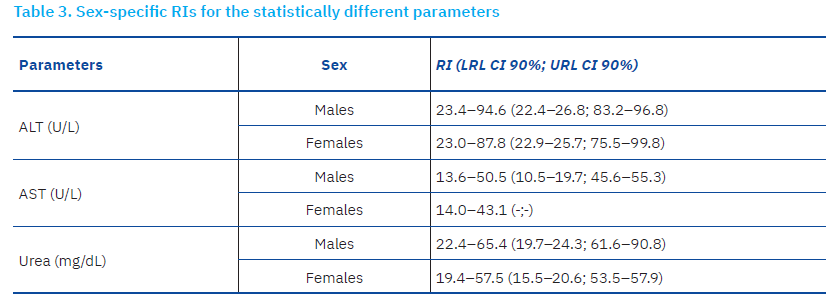
Abbreviations: ALT: alanine aminotransferase; AST: aspartate aminotransferase; RI: reference interval; LRL: lower reference limit; URL: upper reference limit; CI: confidence interval; (-): non-computable.
Age
To evaluate the potential influence of age on RIs, the animals included in the study were classified according to their respective age groups. The results are presented in Table 4.

Abbreviations: ALP: alkaline phosphatase; Alb: albumin; ALT: alanine aminotransferase; AST: aspartate aminotransferase; Ca: calcium; Chol: cholesterol; Cl: chloride; Creat: creatinine; K: potassium; P: phosphorus; Na: sodium; TP: total proteins; Trig: triglycerides; SD: standard deviation; * indicates statistical significance (P < 0.05). Values with different superscript letters (a, b or c) indicate statistically significant differences between groups (Duncan’s multiple range test, P < 0.05).
Statistically significant differences between age groups were observed for ALP, P, and TP, particularly between young dogs and those in the adult and elderly groups. It is important to note that, for some parameters, the mean and standard deviation could not be calculated within certain age groups due to an insufficient number of measurements. This limitation resulted from the fact that those parameters were not requested for animals in those age categories at the time of sample submission.
Discussion
Given the significant role of dogs as companion animals, their health and well-being have become a growing priority for pet owners. This trend highlights the critical importance of veterinary laboratories in providing accurate and reliable diagnostic results, supported by advanced equipment and standardised methodologies (Smith and Van Valkenburgh, 2020). However, establishing laboratory-specific RIs is a complex and resource-intensive process that requires access to a well-characterised population of healthy animals, and considerable logistical and financial investments. Consequently, many laboratories rely on RIs provided by manufacturers or published in the literature (Lavoué et al., 2013). Although this is common practice, population-specific factors and regional variability can result in significant discrepancies, potentially compromising diagnostic accuracy. For this reason, the development of de novo RIs tailored to local populations and based on specific analytical methods is strongly recommended (Chung et al., 2016).
It is also widely recognised that the type of analyser and methodology used can influence RI values, as different instruments and protocols may produce analytically distinct results. In this context, the present retrospective study aimed to establish RIs for multiple serum biochemical parameters in dogs using the Respons®920 (DiaSys) biochemistry analyser. According to ASVCP guidelines, RI establishment should be based on a carefully defined and clinically healthy population (Friedrichs et al., 2012). In the present study, data were obtained from the archives of the Clinical Pathology Laboratory, allowing for a rigorous selection of reference individuals, and ensuring that the studied population was representative of the patient population typically seen at the hospital. Importantly, animals were selected regardless of age, sex, or breed, to avoid introducing bias and to produce broadly applicable RIs. We successfully established RIs for 14 of the 16 parameters evaluated. It was not possible to generate RIs for GGT or total bilirubin, as these parameters were infrequently requested under the study’s inclusion criteria.
Beyond RI establishment, this study also aimed to evaluate the influence of sex and age on the biochemical parameters and assess the need for RI partitioning. Understanding the influence of biological factors, such as sex and age, can contribute to the refinement of RIs, allowing for the development of more specific intervals for defined subgroups to potentially reduce inter-individual variability (Walton, 2001). In the present study, statistically significant differences between the sexes were observed for AST, ALT, and urea, with higher values recorded in males. This observation is consistent with the findings of Connolly et al. (2020) and others, who attributed sex-related differences in AST and ALT to the generally greater muscle mass of male dogs. Given that these enzymes are closely associated with muscle metabolism, higher concentrations in males may reflect underlying physiological differences. Interestingly, no previous studies have consistently reported sex-based differences in urea levels, making this result particularly noteworthy, and warranting further investigation. Despite these findings, most biochemical parameters exhibited minimal or no variation by sex, in agreement with prior studies (Castillo et al., 1997; Altunok et al., 2001; Mundim et al., 2006; Chang et al., 2016).
The influence of age was also evaluated, with statistically significant differences observed for TP, ALP and phosphorus. The age-related increase in TP has been well documented and is commonly attributed to enhanced γ-globulin production resulting from heightened immune system activity, as well as improved albumin synthesis associated with the maturation of hepatic function (Lowseth et al., 1990; Strasser et al., 1993; Kley et al., 2003). Similar age-related trends in serum protein concentrations have been reported in other species, including horses, donkeys, guinea pigs, monkeys, and buffaloes (Sato et al., 2005; Gurgoze and Icen, 2010; Patel et al., 2016; Spittler et al., 2021; Silva et al., 2024). Regarding ALP, our study identified a biphasic pattern, with enzyme activity decreasing from young to adult dogs, followed by a secondary increase in elderly animals. This trend is consistent with the findings of Chang et al. (2016), although other studies have reported a more linear, age-associated decline in ALP activity (Harper et al., 2003; Kley et al., 2003; Mundim et al., 2006). Similar age-related patterns have been documented in various species, including humans, horses, and guinea pigs (Wilding et al., 1972; Kelly et al., 1979; Sato et al., 2005; Gurgoze and Icen, 2010). Elevated ALP levels in young animals are primarily attributed to the bone-specific isoenzyme released during periods of active skeletal growth, which progressively declines with skeletal maturity (González and Silva, 2008). This complex, age-dependent variation in ALP activity should be carefully considered when interpreting biochemical profiles in dogs of different age groups. Phosphorus concentrations were also significantly higher in younger animals, likely reflecting increased bone turnover and enhanced renal phosphate reabsorption during growth. This age-related decline in phosphorus has similarly been reported in other species (Harper et al., 2003; Gurgoze and Icen, 2010; Chang et al., 2016; Connolly et al., 2020). Although statistically significant differences were observed between age groups for certain analytes—particularly between younger and older dogs—the magnitude of these variations was not sufficient to justify partitioning by age. Nonetheless, these findings contribute to a more nuanced understanding of age-related biological variability in canine serum biochemistry, and support more informed clinical interpretation of laboratory results (Mundim et al., 2006; Gurgoze and Icen, 2010).
This study acknowledges several limitations. The RIs were determined retrospectively (a posteriori) by selecting reference individuals from an existing database. Although strict inclusion criteria were applied, they were not defined prior to sample collection, which would have been preferable for optimal methodological rigor. Additionally, while the laboratory adheres to standardised pre-analytical and analytical protocols, the influence of minor, uncontrolled variables cannot be entirely excluded. Although a posteriori RI determination is not the gold standard, it is considered acceptable by the ASVCP Quality Assurance and Laboratory Standards Committee (Friedrichs et al., 2012). The principal advantage of this approach is the ability to access a larger and more diverse reference population.
Conclusion
This study successfully established RIs for multiple routine serum biochemistry parameters in dogs using the Respons®920 (DiaSys) analyser. These RIs serve as valuable diagnostic benchmarks for veterinary practitioners in the clinical assessment of canine patients. Additionally, the findings demonstrated that sex and age can significantly influence certain analytes, specifically AST, ALT, and urea by sex, and TP, ALP, and P by age.
Further research involving larger and more balanced populations, along with prospective study designs, is recommended to determine whether sex- and age-specific RIs may enhance diagnostic accuracy. Overall, this study contributes to the expanding body of veterinary clinical pathology literature, supporting ongoing efforts to optimise diagnostic interpretation and improve the quality of care provided to companion animals.
Acknowledgements
This work was financed by National Funds (FCT/MCTES, Fundação para a Ciência e a Tecnologia and Ministério da Ciência, Tecnologia e Ensino Superior, Portugal) under the project UIDB/00772. The authors also want to acknowledge the support received by project LA/P/0059/2020, from FCT/MCTES.
References [… show]
Određivanje biokemijskih referentnih intervala kod pasa uporabom uređaja Respons920®: učinci dobi i spola
Bernardo Teixeira1, bernardo.oteixeira@hotmail.com; Ana Cristina Silvestre-Ferreira2, aferreir@utad.pt, orcid.org/0000-0002-7114-6918; Amana Maia2, amanamedvet@gmail.com, orcid.org/0009-0003-3452-7150; Grasiene Silva2, grasivet@gmail.com, orcid.org/0000-0003-3511-4772; Felisbina L. Queiroga2* (dopisni autor), fqueirog@utad.pt, orcid.org/0000-0001-6130-8381
1 Department of Veterinary Sciences, University of Trás-os-Montes and Alto Douro, Quinta dos Prados, 5000-801, Vila Real, Portugal
2 CECAV- Animal and Veterinary Research Center, University of Trás-os-Montes and Alto Douro, Quinta dos Prados, 5000-801, Vila Real, Portugal,
Psi su među najpopularnijim kućnim ljubimcima na svijetu, što odražava njihovu sve veću povezanost s ljudima. Kako kućni ljubimci postaju članovi obitelji, potražnja za točnim i pouzdanim veterinarskim dijagnostičkim alatima raste, posebice onima koji osiguravaju najbolju zdravstvenu i kliničku skrb. Cilja je ove studije utvrditi referentne intervale (RI) specifične za ovu vrstu, za biokemijske parametre psećeg seruma korištenjem uređaja Respons®920 (DiaSys) za analizu biokemijskih parametara te njegove primjene u rutinskoj kliničkoj praksi. Osim toga, procjenjivao se utjecaj spola i dobi na navedene parametre. Obuhvaćeno je ukupno 193 klinički zdravih pasa. Referentni intervali utvrđeni su za uobičajeno korištene biološke parametre seruma: ukupni proteini (total proteins – TP), albumin, alanin aminotransferaza (ALT), aspartat aminotransferaza (AST), alkalna fosfataza (ALP), fosfor, kalcij, kreatinin, urea, kolesterol, trigliceridi, natrij, kalij i klor. Referentni intervali računali su se uporabom softwarea Reference Value Advisor, strogo se pridržavajući smjernica Američkog društva za veterinarsku kliničku patologiju. Statistička analiza pokazala je značajne razlike vezane uz spol za ALT, AST i ureju, s višim vrijednostima uočenih u mužjaka. Razlike povezane s dobi su utvrđene i za ALP, fosfor i TP, posebice između mlađih i starijih dobnih skupina. Premda navedene razlike nisu dovoljne da opravdaju posebno izdvajanje referentnih intervala, kliničari ih trebaju uzeti u obzir kod tumačenja. Ova studija daje referentne intervale specifične za vrstu i instrumente za biokemiju psećeg seruma koristeći uređaj Respons®920 te doprinoseći vrijednim podatcima o utjecaju spola i dobi na rutinske biokemijske parametre kod pasa.
Ključne riječi: pas, klinička patologija, referentni intervali, biokemija, Respons920®
