
Faunal Composition and Seasonal Dynamics of Stable Flies (Diptera: Muscidae and Calliphoridae) in Pasture Ecosystems of the Samarkand Region, Uzbekistan
A.Shukhratovich Ismoilov, F. Sayfidinovich Pulotov, A. Ilalatdinovna Kamalova, S.Špičić, I. Reil* and U. Bozorboy O’gli Aktamov
Adkham Shukhratovich ISMOILOV1, adhamismoilov01@gmail.com, orcid.org/0009-0003-5090-5609; Faxridin Sayfidinovich PULOTOV1, polatovfaxriddin613@gmail.com, orcid.org/0009-0001-1160-8068; Aynura Ilalatdinovna KAMALOVA2, nurjayna.aynura@gmail.com, orcid.org/0009-0004-7061-7716; Silvio ŠPIČIĆ3, spicic@veinst.hr, ORCID: orcid.org/0000-0001-8317-5831; Irena REIL3* (corresponding author), reil@veinst.hr, orcid.org/0000-0002-2198-557X; Umidjon Bozorboy O’gli AKTAMOV1, mr.akhtamov077@gmail.com, orcid.org/0009-0006-5442-7255.
1 Veterinary Scientific Research Institute of Uzbekistan, 123140 Samarkand region, Samarkand, Uzbekistan
2 Nukus Branch of Samarkand State University of Veterinary Medicine, Animal Husbandry and Biotechnology, 123140 Samarkand region, Samarkand, Uzbekistan
3 Laboratory for Bacterial Zoonoses and Molecular Diagnosis of Bacterial Diseases, Depatrment of Bacteriology and Parasitology, Croatian Veterinary Institute, 10000 Zagreb, Croatia

https://doi.org/10.46419/cvj.57.4.10
Abstract
Stable flies (Diptera: Muscidae) and other zoophilic dipterans represent a major veterinary and economic challenge in livestock production due to their haematophagous feeding behaviour and their capacity to transmit pathogens. This study aimed to characterise the species composition and seasonal dynamics of synanthropic flies associated with cattle pastures in the Samarkand region of Uzbekistan. Systematic sampling was conducted from April 2022 to May 2023 in the Payariq and Nurobod districts using active net collection from cattle and their immediate surroundings. A total of 3,512 specimens were collected, representing 14 species across six genera and two families. Muscidae were overwhelmingly dominant (95.4%), whereas Calliphoridae accounted for 4.6% of the fauna. Musca domestica (13.1%) and M. autumnalis (12.6%) were the most abundant species, followed by Stomoxys calcitrans (8.1%), Musca simplex (8.5%), and Lyperosia spp. (7.7%). Pronounced seasonal patterns were observed, with peak fly abundance during summer months, when 62.8% of all specimens were collected, and a complete absence of adult flies from December to February. Blood-feeding species with piercing–sucking mouthparts (S. calcitrans, Lyperosia irritans, L. titillans, Haematobia dentipes) comprised nearly one quarter of all collected specimens and reached their highest densities in summer, indicating a critical period for pathogen transmission risk. In contrast, lapping-type flies were present from spring through autumn and, despite lacking direct haematophagy, may act as important mechanical vectors. These findings provide the first comprehensive overview of pasture-associated stable fly fauna in Uzbekistan, highlighting seasonal windows of increased veterinary risk, and underscoring the need for integrated, region-specific vector management strategies.
Keywords: stable flies, Muscidae, Calliphoridae, vector ecology, seasonal dynamics, pasture insects, cattle health, Uzbekistan
Introduction
Stable flies and other zoophilic dipterans (Diptera: Muscidae, Calliphoridae) remain a persistent challenge in cattle production systems due to their haematophagous feeding habits and their efficiency in transmitting a wide range of infectious and parasitic diseases. These insects negatively impact animal health, welfare, and productivity, causing significant economic losses worldwide (Pulatov et al., 2022; Kozhebaev, 2003; Ismoilov, 2024b). For example, stable fly infestations in the United States are estimated to cost the livestock industry over USD 700 million annually through reduced milk yield, weight gain, and feed efficiency (Taylor et al., 2007, 2012). In the United Kingdom, fly infestations cause annual losses exceeding GBP 400 million in dairy production (Rochon et al., 2021).
Globally, more than 3,000 species of blood-feeding flies are associated with livestock, contributing to reductions in productivity of 16–40% (Campbell et al., 2001; Mavlanov & Ismoilov, 2023). Their economic and veterinary importance lies not only in their direct effect on host animals but also in their role as mechanical or biological vectors of pathogens, including Bacillus anthracis, Francisella tularensis, Mycobacterium bovis, Brucella spp., Anaplasma marginale, foot-and-mouth disease virus, and filarial nematodes (Zumpt, 1973; Taylor et al., 2020; Ismoilov, 2024a). Stable flies (Stomoxys calcitrans) and Lyperosia spp., in particular, possess piercing-sucking mouthparts that facilitate efficient blood-feeding and pathogen transmission (Baldacchino et al., 2013; Ro’zimurodov et al., 2018).
Stable flies (Stomoxys spp.) also represent a growing veterinary concern across Asia, where their diversity and abundance are shaped by local agro-climatic factors (Duvallet et al., 2023). Studies from Iraq and other parts of Central Asia have demonstrated that S. calcitrans populations peak during hot and humid summer months and decline sharply in winter, closely mirroring seasonal cycles observed in Uzbekistan (Hatem et al., 2017). Similarly, research in Southeast Asia confirms that regional climate and pasture management strongly affect stable fly population dynamics, underlining the importance of localised monitoring and control strategies (Keawrayup et al., 2012). Beyond their direct impact, these flies are important mechanical vectors of pathogens in extensive grazing systems, particularly in regions where veterinary surveillance is limited (CABI, 2022).
Recent investigations in Uzbekistan have begun to document pasture symbionts and evaluate new bioinsecticidal approaches for livestock protection (Dzhalolov et al., 2024; Rahimov et al., 2024). Despite such progress, the ecology and fauna of stable flies under pasture conditions in Central Asia remain insufficiently studied. Field observations in Uzbekistan and Kazakhstan suggest that species diversity, abundance, and seasonality are strongly influenced by climatic cycles and agro-ecological factors, with peak densities during summer months (Pulatov et al., 2022; Ismoilov and Mavlanov, 2023). Moreover, Pulatov et al. (2023) demonstrated that ecto- and endoparasite populations in livestock exhibit distinct seasonal patterns and host preferences, emphasising the need for integrated parasite management strategies in the region. Recent studies have also highlighted the limitations of conventional chemical control and emphasised the need for integrated, region-specific management strategies, including pyrethroid-based interventions (Rochon et al., 2021; Ismoilov, 2022).
Given these concerns, systematic investigations into the fauna, population dynamics, and seasonal activity of stable flies in Uzbekistan are urgently needed. Such studies provide the foundation for evidence-based vector surveillance and the development of targeted control measures that can improve cattle health, welfare, and productivity under local conditions. Therefore, the aim of this study was to characterise the diversity and seasonal dynamics of parasitic stable flies infesting cattle in the pastures of Samarkand province, Uzbekistan.
Material and Methods
Study Area
The study was carried out over a period of more than one year (April 2022–May 2023) in two districts (Payariq and Nurobod) of Samarkand province, Uzbekistan. These areas are characterised by semi-arid continental climate with hot summers and cold winters, conditions that strongly influence fly population dynamics. Surveys were conducted at cattle farms, household yards, and adjoining pastures where livestock grazed under open-field conditions. The choice of study sites was based on the high density of cattle and their proximity to natural breeding habitats for synanthropic flies, such as manure heaps, moist soil, and animal resting areas.
Sampling Methods
Systematic entomological collections were performed using classical active capture methods. Flies were sampled with gauze insect nets (standard entomological sweep nets) from cattle herds in pastures and yards. During peak fly activity (spring to autumn), sampling was conducted once a week, while in the colder months (late autumn to winter) sampling frequency was reduced to once a month due to minimal insect activity. Each sampling session was carried out at similar times of day, typically in the morning and late afternoon when flies were most active, in order to minimise observational bias.
At each location, flies were collected by sweeping around and directly from the bodies of cattle, ensuring a representative capture from different animals and environmental microhabitats. All captured specimens were immediately transferred to containers containing 70% ethanol to preserve morphological features. Samples were labelled with site information, date, and environmental notes, and transported to the Arachnoentomology and Acarology Laboratory of the Veterinary Scientific Research Institute in Samarkand for processing and identification.
Identification
Specimens were examined using stereomicroscopes and identified to the species level based on external morphological features, including chaetotaxy (bristle patterns), wing venation, coloration, and mouthpart structure. Particular emphasis was placed on distinguishing species with piercing-sucking mouthparts, such as Stomoxys calcitrans and Lyperosia spp., from those with lapping mouthparts, given their differing potential in pathogen transmission. Species identification was primarily conducted using established entomological keys and manuals. Relevant morphological characteristics of Stomoxys calcitrans and other Diptera were consulted in Stackelberg (1956, pp. 120–145), while the determination of Muscidae and Calliphoridae species followed the keys provided by Bey-Bienko (1969, pp. 200–230). Additional taxonomic information for Diptera and Muscidae was incorporated from studies by Ismoilov (Ismoilov, 2016, 2018, 2023, 2024a, 2024b). Where species determination was uncertain, senior entomologists specialising in Diptera taxonomy were consulted.
Environmental Monitoring
During each sampling session, basic environmental parameters were measured to assess possible correlations with fly activity. Ambient air temperature and relative humidity were recorded using portable meteorological devices. The density of cattle at sampling sites was also noted, as animal crowding may influence fly abundance. Geographic coordinates of all sampling sites were documented with GPS units, enabling mapping of species distribution across the study area.
In addition to abiotic factors, observations were made of farm management practices (housing type, manure disposal, presence of water sources) as these may provide suitable breeding and resting habitats for synanthropic flies.
Data Analysis
Descriptive statistics were used to calculate prevalence and relative abundance of each fly species. Species dominance was evaluated using ecological indices, allowing comparison between taxa and across sampling periods. Seasonal activity trends were analysed by aggregating data into monthly intervals, enabling identification of peak population periods (typically late spring to early autumn) and periods of inactivity (winter months).
Comparisons were made between locations and environmental conditions to assess variability in species composition and density. Graphical representations of species abundance and seasonal fluctuations were generated to visualise the phenological patterns of the collected fly fauna.
Results
Species Composition
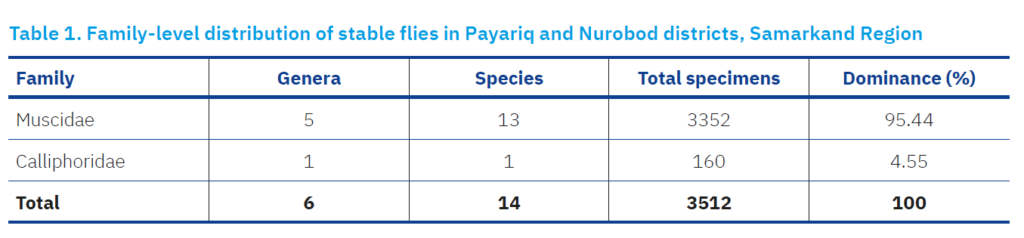
Over the course of the survey, a total of 3512 fly specimens were collected from cattle pastures in Payariq and Nurobod districts. These belonged to 14 species representing six genera and two families (Diptera: Muscidae, Calliphoridae). The Muscidae family was overwhelmingly dominant, accounting for 95.44% of all specimens, whereas Calliphoridae contributed only 4.56% (Table 1).
Among Muscidae, Musca domestica was the most abundant species (13.06% of the total catch), followed closely by M. autumnalis (12.64%). Other highly prevalent species included Stomoxys calcitrans (8.05%), M. simplex (8.50%), Lyperosia irritans (7.74%), L. titillans (7.72%), and Haematobia dentipes (7.06%). Several additional taxa such as M. tempestiva (6.40%) and M. vitripennis (5.75%) occurred at moderate levels. Less frequent species included M. osiris (4.59%), M. lucidula (3.69%), M. larvipara (3.15%), and representatives of Calliphoridae, namely Lucilia sericata (3.95%). An unidentified Muscidae sp. made up the remaining 1.20% of the collection (Table 2).
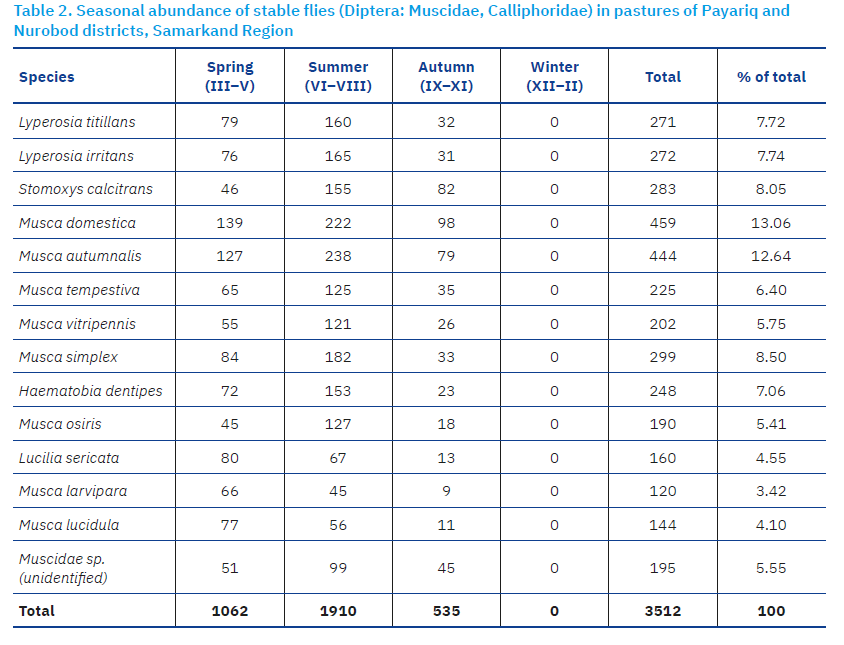
On the basis of dominance indices, five species (M. domestica, M. autumnalis, M. simplex, S. calcitrans, and Lyperosia spp.) were classified as dominant (≥7% relative abundance), four species were subdominant (M. tempestiva, M. vitripennis, H. dentipes, M. osiris), while the remainder were considered rare.
Seasonal Dynamics
Clear seasonal fluctuations in stable fly abundance were observed (Figure 1), with no adult flies recorded during the coldest months of December to February. The first individuals appeared in March, with activity steadily increasing throughout April. Abundance rose sharply from May, reaching maximum densities during June, July, and August.
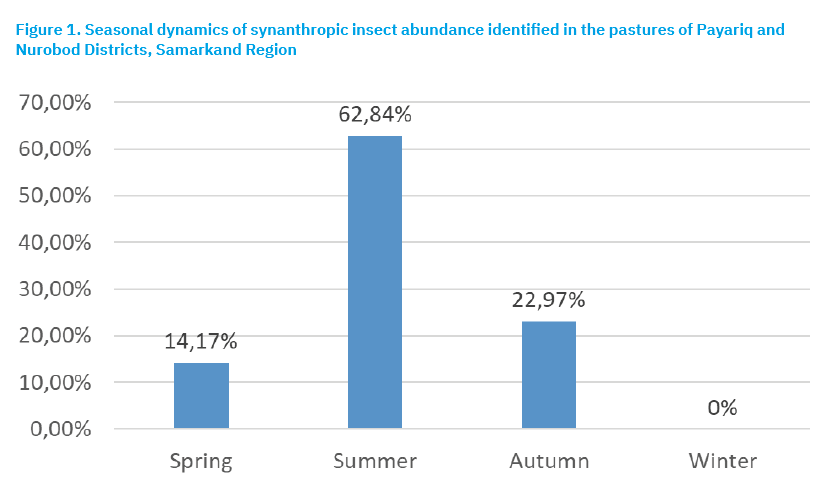
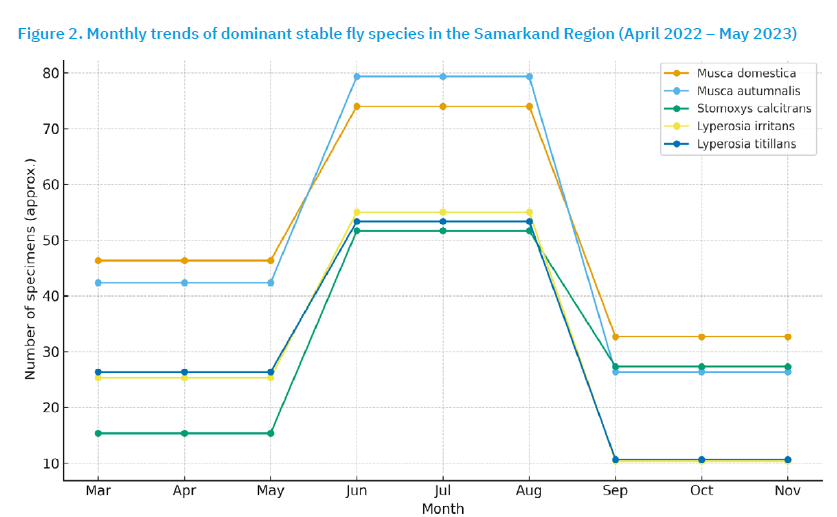
Summer accounted for the majority of individuals collected (62.8%), with autumn contributing 22.9% and spring 14.2%. Peak abundance varied among species. M. domestica reached its maximum in July (18.95% of all individuals collected that month), M. autumnalis also peaked in July (20.72%), while S. calcitrans showed its highest activity in July and August, together representing 22–23% of summer captures. Lyperosia irritans and L. titillans exhibited similar summer peaks, with slightly lower but consistent representation through early autumn. H. dentipes was relatively frequent during summer (peaking at 9.3% in June) but declined rapidly by late September. By October, the abundance of most species declined markedly. Only sporadic individuals of M. domestica and M. autumnalis were still detected in November, after which fly activity ceased completely until the following spring. To better visualise species-specific seasonal patterns, the monthly distribution of dominant stable fly species is shown in Figure 2.
Functional Feeding Groups
When grouped by mouthpart morphology, species with piercing-sucking mouthparts (S. calcitrans, Lyperosia irritans, L. titillans, and H. dentipes) collectively represented nearly one-quarter of all flies captured. Their highest densities coincided with the summer months, marking this period as the critical season for pathogen transmission risk to grazing cattle.
In contrast, lapping-type species (M. domestica, M. autumnalis, M. simplex, M. tempestiva, and others) were present across a broader temporal range, from spring through late autumn. Although individually less threatening in terms of direct blood-feeding, their high abundance during summer and autumn highlights their potential as mechanical vectors of pathogens.
Discussion
This study provides the first detailed account of the diversity, abundance, and seasonal dynamics of stable flies associated with cattle pastures in the Payariq and Nurobod districts of Samarkand province. A total of 14 species were identified, with members of the family Muscidae accounting for more than 95% of all collected specimens. This finding is consistent with previous reports indicating that Muscidae are the dominant synanthropic dipterans in livestock environments across Eurasia (Ismoilov, 2016; Ro’zimurodov et al., 2018). The predominance of Musca domestica and M. autumnalis reflects their cosmopolitan distribution and ecological plasticity, enabling them to exploit a wide range of breeding substrates in agricultural systems (Zumpt, 1973; Taylor et al., 2020).
Of particular veterinary relevance was the high prevalence of Stomoxys calcitrans and Lyperosia spp., which together comprised nearly one quarter of all specimens collected. These species possess piercing–sucking mouthparts and are highly efficient haematophagous feeders, making them important mechanical vectors of infectious agents such as Bacillus anthracis, Brucella spp., Anaplasma marginale, and filarial nematodes (Taylor et al., 2012; Baldacchino et al., 2013). Their peak abundance during the summer months coincides with the period of greatest exposure of cattle on open pastures, emphasising the increased risk of pathogen transmission during this season. Comparable summer peaks in S. calcitrans populations have been reported from other continental regions, including Central Asia, Iraq, and Kazakhstan (Kozhebaev, 2003; Hatem et al., 2017; Ismoilov and Mavlanov, 2023), highlighting the central role of climatic conditions in shaping vector seasonality.
The complete absence of adult flies from December to February underscores the strong influence of low winter temperatures on survival and reproductive activity. Similar seasonal interruptions have been documented in neighbouring regions such as Kazakhstan and Iran (Pulatov et al., 2022; Ismoilov and Mavlanov, 2023). These findings suggest that vector control measures should be strategically intensified in late spring, prior to the rapid population increase observed in early summer, with particular emphasis on the peak activity period from June to August.
In addition to blood-feeding species, lapping-type flies such as M. domestica, M. autumnalis, M. simplex, and M. tempestiva were present in high numbers from spring through autumn. Although these species do not feed directly on blood, their high abundance and frequent contact with animals, manure, and the surrounding environment facilitate the mechanical transmission of pathogens, contributing to animal stress and productivity losses (Duvallet et al., 2023). Their prolonged seasonal activity highlights their epidemiological importance in pasture-based livestock systems.
A limitation of the present study is that species identification was based exclusively on morphological characteristics using standard entomological keys. Although morphological identification remains a widely accepted and practical approach for faunistic and ecological field studies—particularly in regions with limited access to molecular facilities—the possibility of misidentification cannot be entirely excluded, especially among closely related taxa. Future studies should therefore incorporate molecular methods, such as DNA barcoding or other genetic markers, to confirm species identity and further refine the taxonomic resolution of stable fly fauna in Uzbekistan.
The species composition observed in this study is broadly consistent with reports from other parts of Asia and Europe, but also reveals ecological patterns specific to Samarkand province. The co-dominance of nuisance lapping flies (Musca spp.) and haematophagous species (Stomoxys and Lyperosia) reflects a mixed ecological community in which multiple functional groups contribute to veterinary risk. This emphasises the need for integrated, region-specific fly management strategies combining chemical control (e.g., pyrethroid-based insecticides), environmental measures such as manure and waste management, and biological control approaches (Baldacchino et al., 2013; Ismoilov, 2022). These findings are in line with recent regional studies evaluating insecticidal interventions and their effects on livestock parasites (Djalolov et al., 2024; Kamalova, 2024a, 2024b).
Overall, the results confirm that stable flies remain a significant veterinary and economic challenge in Samarkand province. Blood-feeding species pose a direct threat through pathogen transmission, while highly abundant lapping flies contribute to mechanical transmission and reduced livestock productivity. The pronounced summer peak in fly activity represents a critical window for targeted interventions. Beyond livestock health, these findings also carry important One Health implications, as fly-borne pathogens may affect humans in close contact with cattle, including farmers and veterinarians. Coordinated surveillance and integrated vector management strategies are therefore essential to mitigate the impact of stable flies in Uzbekistan and across Central Asia.
Conclusion
This study presents the first comprehensive assessment of the fauna, abundance, and seasonal dynamics of stable flies associated with cattle pastures in the Samarkand region of Uzbekistan. Fourteen species were identified, with members of the family Muscidae clearly dominating the assemblage. Among them, Stomoxys calcitrans and Lyperosia spp. posed the greatest veterinary risk due to their haematophagous behaviour and high abundance during the summer months. The pronounced seasonal peak in fly activity highlights a critical window for targeted control interventions, while the coexistence of blood-feeding and highly abundant lapping flies underscores their combined role in pathogen transmission and livestock productivity losses. These findings emphasise the importance of continuous entomological surveillance and the implementation of integrated, region-specific vector management strategies, including improved pasture hygiene, timely insecticide application, and environmental control measures. Overall, the results contribute valuable baseline data for understanding stable fly ecology in Central Asia and support evidence-based approaches to reducing the economic and health impacts of synanthropic flies on cattle production systems in Uzbekistan.
References [… show]
Sastav faune i sezonska dinamika obada (Diptera: Muscidae i Calliphoridae) u pašnjačkim ekosustavima Samarkandske regije, Uzbekistan
Adkham Shukhratovich ISMOILOV1, adhamismoilov01@gmail.com, orcid.org/0009-0003-5090-5609; Faxridin Sayfidinovich PULOTOV1, polatovfaxriddin613@gmail.com, orcid.org/0009-0001-1160-8068; Aynura Ilalatdinovna KAMALOVA2, nurjayna.aynura@gmail.com, orcid.org/0009-0004-7061-7716; Silvio ŠPIČIĆ3, spicic@veinst.hr, orcid: orcid.org/0000-0001-8317-5831; Irena REIL3* (dopisni autor), reil@veinst.hr, orcid.org/0000-0002-2198-557X; Umidjon Bozorboy O’gli AKTAMOV1, mr.akhtamov077@gmail.com, orcid.org/0009-0006-5442-7255.
1 Veterinarski znanstveno-istraživački institut Uzbekistana, 123140 Samarkandska regija, Samarkand, Uzbekistan
2 Podružnica Nukus Samarkandskog državnog sveučilišta veterinarske medicine, stočarstva i biotehnologije, 123140 Samarkandska regija, Samarkand, Uzbekistan
3 Laboratorij za bakterijske zoonoze i molekularnu dijagnostiku bakterijskih bolesti, Odjel za bakteriologiju i parazitologiju, Hrvatski veterinarski institut, 10000 Zagreb, CroatiaObadi (Diptera: Muscidae) i drugi zoofilni dvokrilci predstavljaju značajan veterinarski i gospodarski problem u stočarskoj proizvodnji zbog svog hematofagnog načina prehrane i sposobnosti prijenosa patogena. Cilj ovog istraživanja bio je utvrditi sastav vrsta i sezonsku dinamiku sinantropnih muha povezanih s govedarskim pašnjacima u Samarkandskoj regiji u Uzbekistanu. Sustavno uzorkovanje provedeno je od travnja 2022. do svibnja 2023. godine u okruzima Payariq i Nurobod, primjenom aktivnog lova entomološkim mrežama s goveda i njihove neposredne okoline. Ukupno je prikupljeno 3.512 jedinki, koje pripadaju 14 vrsta iz šest rodova i dviju porodica. Porodica Muscidae bila je izrazito dominantna (95,4 %), dok je Calliphoridae činila 4,6 % faune. Najzastupljenije vrste bile su Musca domestica (13,1 %) i M. autumnalis (12,6 %), slijede Stomoxys calcitrans (8,1 %), Musca simplex (8,5 %) i Lyperosia spp. (7,7 %). Uočeni su izraženi sezonski obrasci, s najvećom brojnošću muha tijekom ljetnih mjeseci, kada je prikupljeno 62,8 % svih jedinki, dok tijekom razdoblja od prosinca do veljače nije zabilježena prisutnost odraslih muha. Krvopijuće vrste s boduće-sisajućim usnim aparatom (S. calcitrans, Lyperosia irritans, L. titillans, Haematobia dentipes) činile su gotovo četvrtinu svih prikupljenih jedinki i dosezale su najveću gustoću tijekom ljeta, što ukazuje na kritično razdoblje povećanog rizika prijenosa patogena. Nasuprot tome, vrste s ližućim tipom usnog aparata bile su prisutne od proljeća do jeseni te, unatoč izostanku izravne hematofagije, mogu djelovati kao važni mehanički prijenosnici patogena. Ovi rezultati predstavljaju prvi sveobuhvatan pregled faune obada povezanih s pašnjacima u Uzbekistanu, ističu sezonska razdoblja povećanog veterinarskog rizika te naglašavaju potrebu za integriranim, regionalno prilagođenim strategijama upravljanja vektorima.
Ključne riječi: obadi, Muscidae, Calliphoridae, ekologija vektora, sezonska dinamika, pašnjanski kukci, zdravlje goveda, Uzbekistan
