
First Molecular Detection of Ehrlichia canis in Croatia Reveals its Presence in Rhipicephalus bursa Ticks from Ruminants
D.Jurković Žilić*, E. Gagović, T. Dumić, K. Pintur and R. Beck
Daria JURKOVIĆ ŽILIĆ1* (corresponding author), jurkovic@veinst.hr, orcid.org/0000-0002-3504-5271; Ema GAGOVIĆ1, gagovic@veinst.hr, orcid.org/0009-0007-6122-5958; Tomislav DUMIĆ2, tdumic@vuka.hr, orcid.org/0000-0001-5943-4346; Krunoslav PINTUR2, kpintur@vuka.hr, orcid.org/0000-0003-4724-4523; Relja BECK1, beck@veinst.hr, orcid.org/0000-0002-5304-2875.
1Laboratory for Parasitology, Department for Bacteriology and Parasitology, Croatian Veterinary Institute, 10000 Zagreb, Croatia
2Department of Wildlife Management and Nature Conservation, Karlovac University of Applied Sciences, 47000 Karlovac, Croatia

https://doi.org/10.46419/cvj.57.5.3
Abstract
Ehrlichia canis, the causative agent of canine monocytic ehrlichiosis, is considered endemic in Mediterranean Europe and is primarily associated with the brown dog tick, Rhipicephalus sanguineus sensu lato. In Croatia, previous molecular investigations in dogs failed to detect the pathogen, despite sporadic serological findings and the confirmed presence of competent tick vectors. The aim of this study was to investigate the presence of E. canis DNA in ticks collected in Croatia. A total of 583 ticks from five genera were collected from the environment, domestic animals, wildlife, and humans across approximately 130 locations. All ticks were screened by PCR targeting the 16S rRNA gene, and positive samples were further characterised by sequencing of the full-length 16S rRNA gene. Six ticks tested positive for Ehrlichia sp. DNA, and sequencing confirmed all isolates as E. canis. All positive ticks were identified as Rhipicephalus bursa and originated from coastal Mediterranean regions of Croatia. Positive specimens were collected from goats, sheep, and chamois (Rupicapra rupicapra). These findings represent the first molecular evidence of E. canis in Croatia and indicate its circulation in ruminant-associated tick populations within the Mediterranean part of the country. Further studies are needed to clarify transmission dynamics and the potential epidemiological relevance for domestic animals.
Key words: Ehrlichia canis; Croatia; Rhipicephalus bursa; ruminants; PCR
Introduction
Ehrlichia canis (genus Ehrlichia) is an obligate intracellular bacterium belonging to the family Anaplasmataceae. It is the causative agent of canine monocytic ehrlichiosis (CME), an important tick-borne disease of dogs worldwide (Sainz et al., 2015). Infection may occur in acute, subclinical, or chronic forms, which are often difficult to distinguish clinically. Reported manifestations include fever, weakness, lethargy, anorexia, lymphadenomegaly, splenomegaly, hepatomegaly, thrombocytopenia, anaemia, and haemorrhagic disorders (Sainz et al., 2015).
In Europe, E. canis is considered endemic in dogs from Mediterranean countries, including Spain (René-Martellet et al., 2015), Portugal (René-Martellet et al., 2015; Dordio et al., 2021), Italy (Solano-Gallego et al., 2006; René-Martellet et al., 2015), Greece (Diakou et al., 2019) and Turkey (Aktas and Özübek, 2019). Sporadic cases have also been reported in dogs from France (Bouzouraa et al., 2017), Albania (Shukullari et al., 2017), Cyprus (Attipa et al., 2017) and Serbia (Sukara et al., 2023). Although primarily associated with dogs, E. canis has occasionally been detected in other hosts. In Portugal, sequencing confirmed infection in one of 601 cats tested (Maia et al., 2014). Ehrlichia canis has also been identified in wild canids, including the red fox (Vulpes vulpes), grey wolf (Canis lupus), and golden jackal (Canis aureus), and other wildlife species such as the raccoon (Procyon lotor) and Eurasian otter (Lutra lutra) in Portugal (Cardoso et al., 2015), Italy (Santoro et al., 2016; Santoro et al., 2017), and Spain (Criado-Fornelio et al., 2018), indicating circulation in sylvatic transmission cycles. Moreover, E. canis DNA was detected in 21% (26/125) of aborted foetuses of small ruminants in Sardinia, suggesting a possible role as an abortion-associated pathogen (Chisu et al., 2021). Molecular detection in humans raises further concerns regarding its zoonotic potential (Perez et al., 2006; Bouza-Mora et al., 2017; Sgroi et al., 2024).
The principal vector of E. canis in Europe is the brown dog tick, Rhipicephalus sanguineus sensu lato (s.l.), a species complex closely associated with domestic dogs (Dantas-Torres et al., 2007, 2024). R. sanguineus s.l. is widely distributed in Mediterranean regions (ECDC, 2023; Dantas-Torres et al., 2024) and has increasingly been reported in central and northern European countries, including Germany (Fachet-Lehmann et al., 2025), Belgium (Claerebout et al., 2013), the Netherlands (Nijhof et al., 2007), Austria (Rubel and Brugger, 2022), Slovakia (Didyk et al., 2012), Poland (Nowak-Chmura and Siuda, 2012), Romania (Andersson et al., 2018), and Hungary (Ghodrati et al., 2025).
Molecular evidence of E. canis in R. sanguineus s.l. has been reported from several European countries, including Spain (Estrada-Peña et al., 2017), Italy (Satta et al., 2011; Chisu et al., 2018), Romania (Ionita et al., 2013), and Albania (Christova et al., 2003), generally with low prevalences ranging from 0.09% to 3.49%. Although R. sanguineus was experimentally confirmed as a competent vector (Groves et al., 1975), E. canis DNA has also been detected in other tick species across Europe. In Italy (Sardinia), the pathogen was identified in Rhipicephalus bursa, Haemaphysalis punctata, Haemaphysalis sulcata, and Dermacentor marginatus (Satta et al., 2011; Chisu et al., 2018; Masala et al., 2021). In Romania, E. canis DNA was detected in 10.9% of R. bursa ticks (Matei et al., 2021), while in France (Corsica) it was identified in 0.8% of R. bursa ticks collected from cattle (Dahmani et al., 2017). More recently, Ixodes ricinus was reported as positive in several Central European countries, including the Czech Republic, Hungary, Poland, Romania (Ghodrati et al., 2025), and Bulgaria (Stanilov et al., 2023).
In Croatia, serological surveys have shown a low prevalence of antibodies against E. canis in dogs, ranging from 0.4% (2/435) to 0.6% (9/1433) (Mrljak et al., 2017; Jurković et al., 2019). However, a molecular study by Huber et al. (2017) failed to detect E. canis DNA in blood samples from 1080 apparently healthy dogs or in the tissues from 63 deceased dogs. Despite the confirmed presence of R. sanguineus s.l. in Croatia (Hornok et al., 2017; Krčmar et al., 2022) and numerous investigations of tick-borne pathogens in companion animals, livestock, and wildlife (Duh et al., 2008; Beck et al., 2009, 2019; Deždek et al., 2010; Pintur, 2012; Huber et al., 2017; Jurković et al., 2020; Šarić et al., 2022), molecular evidence of E. canis in ticks from Croatia has not been reported to date.
The aim of this study was to investigate the presence of E. canis DNA in ticks collected in Croatia using molecular methods and to provide the first molecular evidence of this pathogen in ticks from this region. Given the confirmed presence and expanding distribution of competent tick vectors, establishing the molecular status of E. canis in Croatia is essential for understanding its regional epidemiology and potential emergence in previously non-endemic areas.
Materials and methods
A total of 583 ticks from the genera Ixodes (n = 176), Dermacentor (n = 65), Rhipicephalus (n = 291), Hyalomma (n = 35), and Haemaphysalis (n = 16) were collected from approximately 130 locations across Croatia. Ticks were obtained from the environment, domestic animals, wild animals, and humans. Wild animal hosts included the red fox (Vulpes vulpes), European hare (Lepus europaeus), golden jackal (Canis aureus), wild boar (Sus scrofa), fallow deer (Dama dama), red deer (Cervus elaphus), roe deer (Capreolus capreolus), chamois (Rupicapra rupicapra), European mouflon (Ovis aries musimon), and brown bear (Ursus arctos). Domestic hosts included cattle, sheep, goats, horses, dogs and cats. The approximate geographic origin of each tick was recorded.
Ticks were morphologically identified to species, sex, and developmental stage using standard taxonomic keys based on morphological characteristics (Estrada-Peña et al., 2017). Documentation was carried out using a SteREO Discovery.V20 microscope (Carl Zeiss AG, Oberkochen, Germany) equipped with AxioVision and ZEN2 Pro software. After identification, each tick was washed in 70% ethanol, rinsed with sterile distilled water, dried on sterile filter paper to remove external contaminants (such as soil particles, host-derived material, fur, and blood residues), and stored individually in sterile 2 mL tubes containing 96% ethanol until molecular analysis.
Genomic DNA was extracted using the NucleoSpin® DNA Insect kit (Macherey-Nagel, Düren, Germany) following mechanical homogenisation with a TissueLyser II® (Qiagen, Hilden, Germany) according to the manufacturer’s instructions, with a final elution volume of 100 μL. Species identity of ticks was confirmed molecularly by amplification and sequencing of fragments of the mitochondrial 16S rRNA gene (Black and Piesman, 1994). All ticks were screened for the presence of Anaplasma/Ehrlichia species by conventional PCR targeting a 345-bp fragment of the 16S rRNA gene (Parola et al., 2000). Samples yielding positive results were further subjected to amplification of a 1462-bp fragment of the 16S rRNA gene specific for members of the family Anaplasmataceae (Kawahara et al., 2006). Primer sequences used in this study are listed in Table 1.
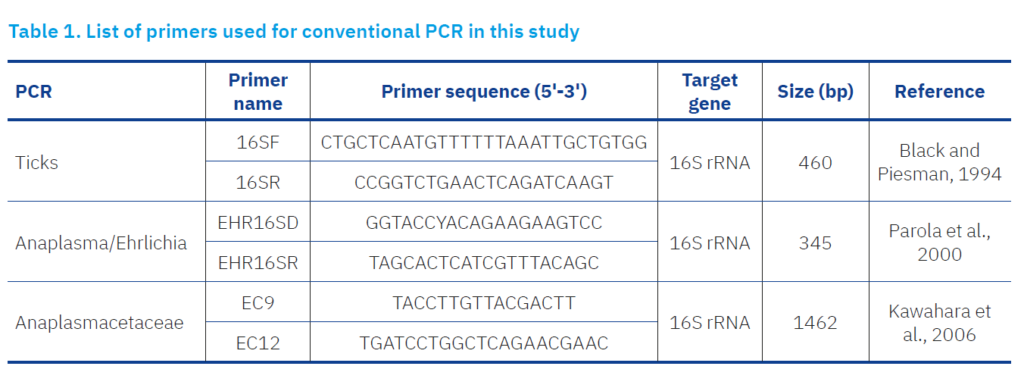
PCR reactions were performed in a final volume of 20 µL containing 10 µL GoTaq® G2 Master Mix (Promega, Madison, WI, USA), 7.2 µL DNase/RNase-free distilled water (Promega), 0.4 µL of each primer (10 pmol/µL), and 2 µL DNA template. Positive and negative extraction controls were included in all amplification rounds to monitor contamination.
Amplification products were evaluated by capillary electrophoresis using a QIAxcel system (Qiagen, Germany) with the QIAxcel DNA Fast Analysis kit, DNA QX Alignment Marker (15 bp – 3 kb), and QX DNA Size Markers (50 bp – 1.5 kb and 100 bp – 2.5 kb). PCR products were purified using ExoSAP-IT™ PCR Product Clean-up Reagent (Applied Biosystems, Waltham, MA, USA) according to the manufacturer’s instructions and sequenced bidirectionally at Macrogen Europe using the corresponding primer sets.
Raw sequence chromatograms were assembled and edited using SeqMan Pro 18 and SeqBuilder Pro 18 (DNASTAR, Madison, WI, USA). Consensus sequences were aligned and analysed using SeqMan and EditSeq (Lasergene, DNASTAR) and compared with reference sequences available in GenBank using the BLASTn algorithm (https://blast.ncbi.nlm.nih.gov) to confirm species identity.
For visualisation of spatial distribution, positive and negative ticks were mapped using QGIS software (version 3.34.0 RC).
Results
Of the 583 ticks collected and analysed using molecular methods, tested positive for Ehrlichia sp. DNA, corresponding to an overall prevalence of 1.03% (6/583; 95% CI: 0.38–2.23). In all positive samples, amplification and sequencing of the full-length 16S rRNA gene confirmed the species as Ehrlichia canis. The obtained 16S rRNA gene sequences were identical to several E. canis sequences available in GenBank, including isolates from Greece, Japan, and Brazil, demonstrating high genetic conservation at this locus. None of the ticks collected from humans (4/583) tested positive for E. canis.
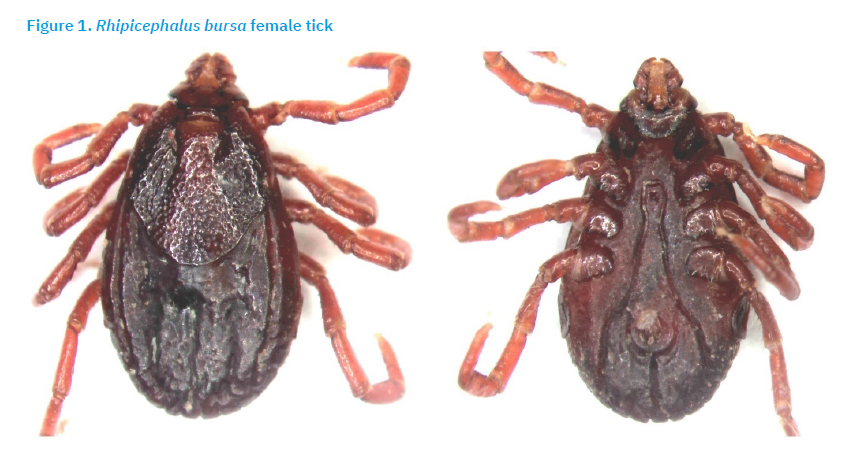
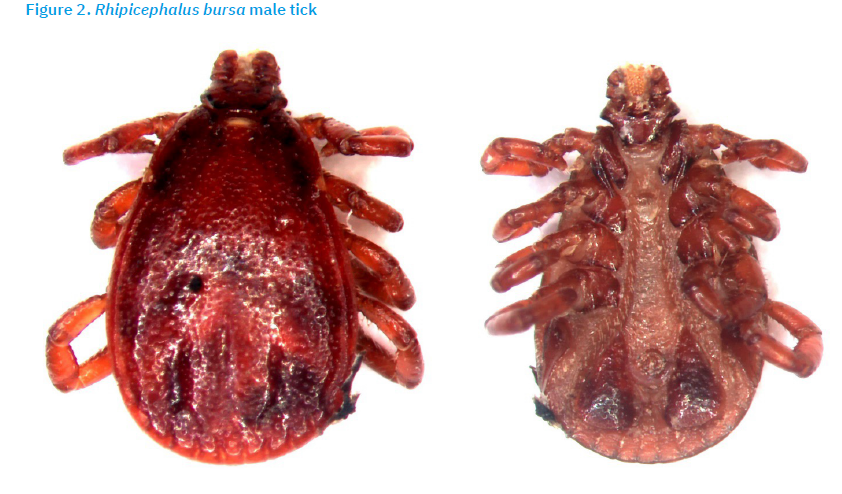
All positive ticks were morphologically identified as Rhipicephalus bursa (Figures 1 and 2) and species determination was molecularly confirmed by sequencing a fragment of the tick mitochondrial 16S rRNA gene. The obtained sequences showed 99–100% similarity to R. bursa isolates from Turkey (GenBank accession numbers MT302761, OL347854), Greece (GenBank accession number JS6644GR1), and Spain (GenBank accession number AJ002956), confirming accurate species assignment and demonstrating close phylogenetic relatedness to other Mediterranean populations.
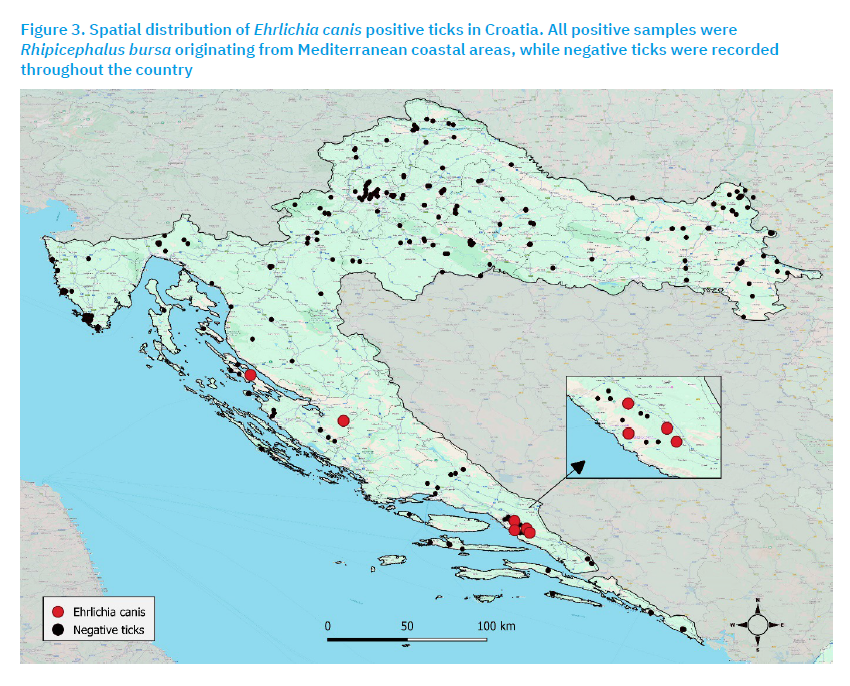
Positive ticks were collected from one goat in Medviđa, one sheep on the Island of Pag, and four chamois (Rupicapra rupicapra) from the Mt. Biokovo area. Notably, all positive samples originated from coastal regions of Croatia (Figure 3), suggesting geographic clustering within the Mediterranean bioclimatic zone. The detection of E. canis in ticks parasiting both domestic small ruminants and wild ungulates indicates circulation across different host categories within the same ecological region.
Although the overall prevalence was low, the exclusive detection of E. canis in R. bursa collected from coastal areas may reflect localised transmission foci or ecological conditions favourable for maintenance of the pathogen in southern Croatia.
Discussion
This study presents the first molecular evidence of Ehrlichia canis in ticks collected in Croatia. Although the overall prevalence was low (1.03%), the detection of E. canis DNA confirms the presence of this pathogen in the country and expands its documented geographic range within Europe.
Interestingly, all positive ticks were identified as Rhipicephalus bursa, a tick species primarily associated with domestic and wild ruminants. This finding is noteworthy, as E. canis is traditionally linked to dogs and the brown dog tick, Rhipicephalus sanguineus s.l. (Sainz et al., 2015; René-Martellet et al., 2015; Dordio et al., 2021; Dantas-Torres et al., 2007, 2024). The exclusive detection of E. canis in R. bursa collected from goats, sheep, and chamois (Rupicapra rupicapra) suggests that the pathogen may be circulating within ruminant-associated tick populations rather than in the typical dog–R. sanguineus transmission cycle in Croatia.
The absence of molecular detection in dogs in previous Croatian studies (Huber et al., 2017; Beck et al., 2019) and the low seroprevalence reported in canine populations (0.4–0.6%; Mrljak et al., 2017; Jurković et al., 2019) may therefore be partially explained by vector ecology. Rhipicephalus bursa is a well-recognised tick of small ruminants and wild ungulates, with limited association with dogs (Estrada-Peña et al., 2017). If E. canis circulation in Croatia is predominantly linked to R. bursa and ruminant hosts, exposure of dogs may be sporadic or minimal, which would account for both the previous molecular negativity in canine samples and the low serological reactivity detected in earlier surveys.
The detection of E. canis in R. bursa is consistent with previous reports from Mediterranean regions, particularly Italy (Sardinia) (Satta et al., 2011; Chisu et al., 2018; Masala et al., 2021), where the pathogen has been identified in R. bursa parasiting sheep and goats. Similar findings have been reported from Romania (Matei et al., 2021) and France (Corsica) (Dahmani et al., 2017) supporting the hypothesis that R. bursa may participate in alternative transmission cycles beyond the classical dog – R. sanguineus cycle. In this context, the Croatian findings align with a broader Mediterranean epidemiological pattern.
Geographically, all positive ticks originated from the coastal regions of Croatia, corresponding to the Mediterranean bioclimatic zone (Estrada-Peña et al., 2017). This spatial clustering is epidemiologically relevant, as E. canis has been considered endemic mainly in Mediterranean countries (Sainz et al., 2015; René-Martellet et al., 2015). The absence of positive ticks from continental regions in this study further supports the interpretation that E. canis distribution in Croatia remains restricted to southern coastal areas, consistent with the known ecological preferences of both the pathogen and its associated tick vectors.
The detection of E. canis in ticks collected from both domestic small ruminants and wild chamois suggests the possibility of parallel transmission cycles. A rural cycle may involve goats and sheep together with R. bursa, while a sylvatic cycle could be maintained in wild ungulates such as chamois. The coexistence of domestic and wild ruminants within Mediterranean mountainous habitats, such as the Mt. Biokovo area, creates ecological interfaces where tick exchange between host species may occur. Such interfaces may function as “bridge zones”, facilitating pathogen maintenance and occasional spillover between wildlife and livestock.
Although the pathogenic role of E. canis in ruminants remains unclear, previous detection of the pathogen in aborted small ruminant foetuses (Chisu et al., 2021) suggests that its epidemiological significance may extend beyond canine hosts. A Croatian study (Jurković et al., 2025) investigating hemotropic pathogens in aborted foetuses of domestic ruminants (cattle, sheep, and goats) failed to detect Ehrlichia canis, although other pathogens from the family Anaplasmataceae, including Anaplasma marginale, A. ovis, and A. phagocytophilum, were identified. Based on currently available evidence, E. canis does not appear to currently represent a significant health threat to ruminants in Croatia. Nevertheless, further investigations in Croatia should incorporate molecular screening of aborted materials from domestic ruminants in the Mediterranean belt to better evaluate the potential clinical and epidemiological significance of these findings. Whether ruminants act as incidental hosts, transient carriers, or potential reservoirs requires further investigation. The present findings do not permit conclusions regarding reservoir competence; however, they show that E. canis DNA is present within ruminant-associated tick populations in Croatia.
The relatively low prevalence detected in this study may reflect limited focal transmission rather than widespread distribution. Alternatively, infection rates in ticks may be underestimated due to typically low bacterial loads in field-collected specimens. Longitudinal and multi-seasonal studies are required to assess temporal dynamics and determine whether prevalence varies across years.
From an epidemiological perspective, the exclusive detection of E. canis in Rhipicephalus bursa collected from ruminants suggests that the pathogen may be maintained within a ruminant-associated transmission system in Mediterranean Croatia. Such a system may function independently of, or be only partially connected to, the classical dog–Rhipicephalus sanguineus cycle described in endemic Mediterranean countries. The apparent geographic restriction of positive ticks to coastal regions further supports the influence of climatic and ecological factors in shaping local transmission dynamics. The coexistence of domestic small ruminants and wild ungulates in mountainous Mediterranean habitats may facilitate pathogen persistence through overlapping rural and sylvatic cycles. Whether this represents a stable enzootic system or an emerging focal transmission pattern requires further longitudinal investigation.
Conclusion
This study presents the first molecular evidence of Ehrlichia canis in Croatia and confirms its presence in Rhipicephalus bursa ticks associated with domestic and wild ruminants in the Mediterranean region of the country. The findings challenge the traditional perception of E. canis as being exclusively linked to dogs and R. sanguineus in Europe, and suggest the existence of alternative transmission pathways involving ruminant-associated tick species. The spatial clustering of positive ticks in coastal areas corresponds with the established Mediterranean distribution of the pathogen and underscores the importance of ecological context in understanding vector-borne disease dynamics. These results highlight the need for integrated surveillance of tick populations across different host categories to clarify the epidemiological role of ruminants, the interaction between rural and sylvatic cycles, and the potential implications for canine exposure in southern Croatia.
Acknowledgements
This study was funded by a Croatian Science Foundation project (IP-2022-10-7842 “Apicomplexan and bacterial tick-borne pathogens in domestic ruminants, horses and haematophagous vectors”). The authors express their sincere gratitude to technicians Kristina Skrbin, Marija Cvetnić, Ada Vilić, Petra Cikoš, and Martina Pavić for their significant contributions to this study.
References [… show]
Prvi molekularni dokaz Ehrlichia canis u Hrvatskoj otkriva njezinu prisutnost u krpeljima Rhipicephalus bursa prikupljenih s preživača
Daria Jurković Žilić1*, (dopisni autor), jurkovic@veinst.hr, orcid.org/0000-0002-3504-5271; Ema Gagović1, gagovic@veinst.hr, orcid.org/0009-0007-6122-5958; Tomislav Dumić2, tdumic@vuka.hr, orcid.org/0000-0001-5943-4346; Krunoslav Pintur2, kpintur@vuka.hr , orcid.org/0000-0003-4724-4523; Relja Beck1, beck@veinst.hr, orcid.org/0000-0002-5304-2875.
1Laboratorij za parazitologiju, Odjel za bakteriologiju i parazitologiju, Hrvatski veterinarski institut, 10000 Zagreb, Hrvatska
2Odjel lovstva i zaštite prirode, Veleučilište u Karlovcu, 47000 Karlovac, HrvatskaSažetak
Ehrlichia canis, uzročnik monocitne erlihioze pasa, smatra se endemskom u mediteranskim područjima Europe te je primarno povezana s krpeljem Rhipicephalus sanguineus sensu lato. U Hrvatskoj dosadašnja molekularna istraživanja nisu dokazala prisutnost uzročnika u pasa, unatoč sporadičnim serološkim nalazima i potvrđenoj prisutnosti kompetentnih vektora. Cilj ovoga istraživanja bio je utvrditi prisutnost DNA vrste E. canis u krpeljima prikupljenima u Hrvatskoj. Ukupno je analizirano 583 krpelja iz pet rodova, prikupljenih iz okoliša, s domaćih i divljih životinja te od ljudi na približno 130 lokacija. Svi uzorci testirani su PCR metodom ciljajući gen 16S rRNA, a pozitivni uzorci dodatno su okarakterizirani sekvenciranjem cjelovitog gena 16S rRNA. Šest krpelja (1,03%; 95% CI: 0,38–2,23) bilo je pozitivno na DNA roda Ehrlichia, a sekvenciranjem je potvrđena vrsta E. canis. Svi pozitivni krpelji morfološki i molekularno su određeni kao Rhipicephalus bursa te su potjecali iz mediteranskog obalnog područja Hrvatske. Pozitivni uzorci prikupljeni su s koza, ovaca i divokoza (Rupicapra rupicapra). Ovim je istraživanjem po prvi put molekularno dokazana prisutnost vrste E. canis u Hrvatskoj te je ukazano na njezinu cirkulaciju u populacijama krpelja povezanih s preživačima u mediteranskom dijelu zemlje. Daljnja su istraživanja potrebna radi razjašnjenja dinamike prijenosa i epidemiološkog značaja za domaće životinje.
Ključne riječi: Ehrlichia canis, Hrvatska, Rhipicephalus bursa, preživači, PCR
