
Impact of Season on Fresh Semen Parameters and Post-Thawing Motility of Sperm of Arabian Stallions
M.A. Sultan, A. A. Kishta and A. E. Elweza*
Mahmoud A. SULTAN1 mahmoud.sultan@vet.usc.edu.eg, orcid.org/0009-0005-5226-7537; Afaf A. KISHTA2 afaf.kishta@vet.usc.edu.eg, orcid.org/0000-0002-9590-6440; Ahmed E. ELWEZA1* (corresponding author), ahmed.elweza@vet.usc.edu.eg, orcid.org/0000-0002-3108-2366.
1Department of Theriogenology, Faculty of Veterinary Medicine, University of Sadat City, Sadat City, Menofia 32897, Egypt
2Department of Physiology, Faculty of Veterinary Medicine, University of Sadat City, Sadat City, Menofia 32897, Egypt

https://doi.org/10.46419/cvj.57.5.8
Abstract
The study examined the influence of season on several parameters of fresh semen ejaculates and the post-thawing motility of the sperm of Arabian stallions. Three Arabian stallions were used for semen collection using a Missouri-type artificial vagina. Semen was evaluated macroscopically for volume, colour and consistency, and microscopically for motility, concentration of sperm, and total sperm count in ejaculates. The semen was frozen using di-methyl formamide egg yolk based freezing extender and evaluated for post-thawing motility. Results revealed that the volume of semen, total number of sperm per ejaculate and the post-thawing motility in the breeding season was significantly higher than in the non-breeding season, while the opposite was true for sperm cell concentration. There was no difference in colour, consistency or motility between stallions in either the breeding or non-breeding season. In conclusion, season had a direct influence on semen volume, sperm cell concentration, total number of sperm, and post-thawing motility of sperm of Arabian stallions.
Keywords: season; semen parameters; Arabian stallions.
Introduction
The efficiency of artificial insemination depends largely on semen quality, which is influenced by several factors, including semen storage conditions, individual characteristics, age of stallions, breed, and season (Greiser et al., 2020). Horses exhibit seasonal breeding behaviour that is advantageous for the survival and development of their offspring. Seasonal variations in daylight are considered the primary factor responsible for fluctuations in sexual activity in horses (Gamboa et al., 2010).
As long-day seasonal breeders, horses exhibit peak reproductive activity during the spring and summer months (Chemineau, 2008). Deichsel et al. (2016) proved that stallion semen quality was improved with 8 hours darkness and 16 hours light during the winter in the Northern Hemisphere. This offers a biological reason for the changes in semen characteristics, probably because more light affects the release of gonadotrophin-releasing hormones (GnRH) (Aurich, 2016). According to Wrench et al. (2010) and Suliman et al. (2020), there were no noticeable differences in ejaculate volume, concentration of sperm, total sperm count, or stallion ̓s sperm progressive motility during their breeding and non-breeding seasons.
Reproductive efficiency is a crucial component of successful equine breeding programmes, especially in breeds of high cultural and genetic value such as the Arabian horse (Aurich, 2011). Semen quality profoundly influences fertility outcomes, making it essential to understand the factors that regulate stallion reproductive performance. Among these factors, seasonal variation is recognised as a major determinant of semen characteristics due to the horse’s inherent pattern as a long-day, seasonally influenced breeder (Aurich, 2011). To maximise a stallion’s sexual performance, it is crucial to maintain normal reproductive behaviour and libido. This also involves producing high-quality ejaculate, which can be achieved by carefully managing the frequency of semen collection (Aurich, 2016).
Recently, our research group reported different sperm parameters during breeding and non-breeding seasons of native breed Egyptian stallions (Sultan et al., 2023). The aim of the current study was to study the influence of season on parameters of fresh semen ejaculates and the post-thawing motility of cryopreserved sperm of Arabian stallions.
Material and methods
This study was approved by the Animal Care and Use Committee Ethics of the University of Sadat City, Egypt (approval no. VUSC-013-1-25).
Freezing extender
An egg yolk-based extender containing di-methyl formamide (DMF) as a cryoprotectant was used. The egg yolk-based extender was freshly prepared and consisted of EDTA, trisodium citrate dehydrate, D-glucose, sodium bicarbonate, amikacin sulfate, potassium penicillin G, egg yolk, D-lactose solution (11% w/v) and DMF.
Animals
This study was done in a clinic in the Giza governorate, Egypt (from January 2025 to November 2025). Three adult healthy Arabian stallions aged 7–10 years old were included in the study. Stallions were kept in separate crates, fed concentrates and hay, and given unlimited access to water. These stallions were utilised for artificial insemination, according to their reproductive history. Every stallion was raised in compliance with the experimental design. These stallions underwent a normal andrological check using palpation and four semen ejaculates were collected from each stallion (two collections per season from each stallion) following Crespo et al. (2020).
Semen collection
Collection of the semen from three Arabian stallions was carried out using lubricated, pressurised and prewarmed (45-50℃) Missouri-type artificial vagina. The AV was provided with inline filter for removal of gel of ejaculates. Semen collection was performed in the presence of an oestrus mare as a teaser using a dummy mare (Esmail et al., 2023). Four semen collections were taken from each stallion (two collections per season).
Semen evaluation
The gel filter was removed as soon as the semen was collected, and the semen was assessed for various semen characteristics, such as: macroscopic evaluation of the ejaculate volume using a graduated collection apparatus (Sieme et al., 2004); visual examination of colour (Sieme et al., 2004); visual examination of consistency (Samper, 2009); and microscopic examination of individual sperm motility (Turner, 2005). The enhanced Neubauer haemocytometer was used to detect the concentration of sperm cells (x106/mL) in accordance with Bailey et al., 2007. The total sperm in the ejaculate was estimated by multiplying the concentration of sperm with its volume.
Cryopreservation of semen
Following evaluation, semen samples were diluted with a primary extender for centrifugation in a ratio 1:1. Cushion fluid (Minitube, Germany) was added to the bottom of each tube to protect spermatozoa during centrifugation, centrifugation at 1000 ×g for 10 minutes, then the sperm pellet was removed and diluted with a secondary extender for freezing. The diluted semen was packed in straws with 0.5 mL capacity using a semi-automated semen filling machine. The rack containing straws was cooled in the refrigerator for 25 minutes. The diluted cooled semen on the rack was placed in Styrofoam box containing liquid nitrogen at a height of 4 cm for 12 minutes. Finally, the straws were placed in the liquid nitrogen and evaluated for the post-thawing motility and plunged in a -196℃ tank of liquid nitrogen.
Evaluation of post-thawing motility
To assess post-thaw sperm motility, one straw from each ejaculate was removed from liquid nitrogen and thawed in a water bath at 37°C for 60 s. Immediately after thawing, sperm motility was evaluated under a phase-contrast microscope.
Statistical Analysis
The obtained data were analysed with the Student’s T test at P < 0.05 significance using the Graph Pad Prism 5 software (GraphPad Software Inc., La Jolla, CA, USA). The results were presented as the mean ± standard error of the mean (Elweza et al., 2020).
Results
Gross evaluation of fresh semen of Arabian stallions
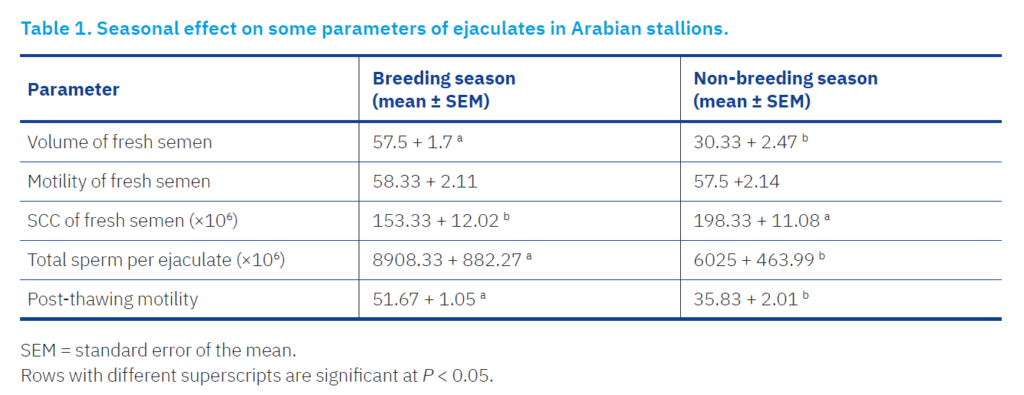
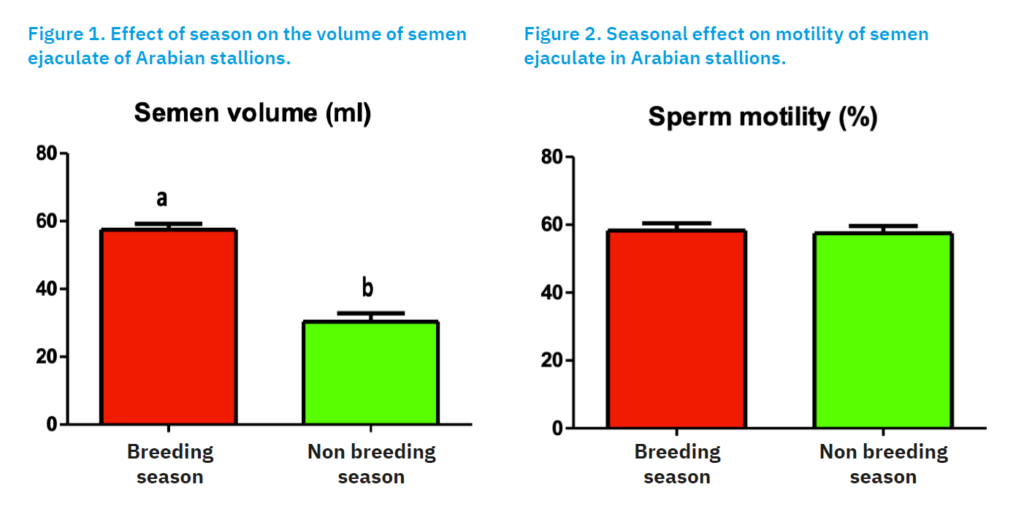
Macroscopic characters of fresh semen are summarised in Table 1 and Figure 1. The colour of semen in Arabian stallions was whitish-grey with a watery consistency. The volume of semen was higher significantly (P < 0.05) in the breeding season than in the non-breeding season.
Microscopic evaluation of semen of Arabian stallions
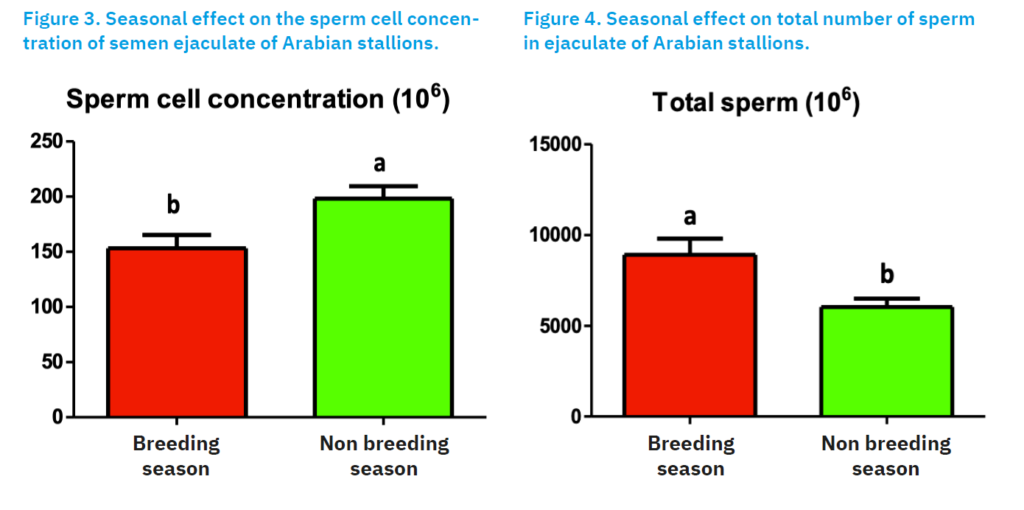
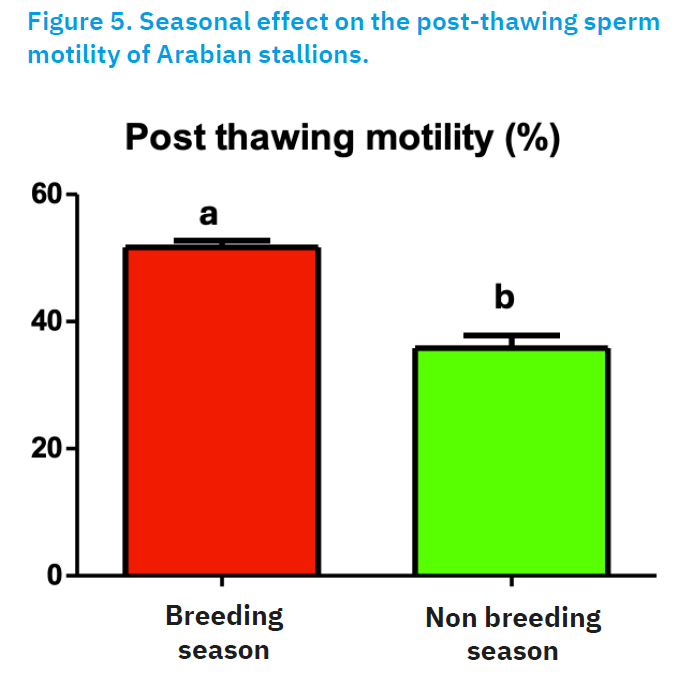
Macroscopic characters of fresh semen are summarised in Table 1 and Figures 2-4. There was no difference (P > 0.05) in the motility of fresh semen of Arabian stallions in different seasons. Sperm cell concentration of fresh semen was higher significantly (P < 0.05) in the non-breeding season than breeding season. The total sperm per ejaculate of fresh semen and sperm post-thawing motility were significantly from each ejaculate (P < 0.05) in the breeding season than in the nonbreeding season.
Discussion
Season is a key factor to be considered during optimising artificial insemination techniques in horse breeding. The findings of the current study revealed that season significantly impacted the quality of Arabian stallion ejaculate.
In the present study, the semen of Arabian stallions exhibited a greyish-white colour. This observation is consistent with the findings reported by Sieme et al. (2004), who indicated that the normal colour of semen in Arabian stallions is typically greyish-white. The semen consistency observed in the collected ejaculates was diluted and watery, which agrees with the observations of Samper (2009), who reported that stallion semen is generally watery in consistency.
In the present study, the ejaculate volume of stallions was significantly higher (P < 0.05) during the breeding season than in the non-breeding season. This finding is consistent with the results reported by Wach-Gygax et al. (2017), who observed that semen volume was higher in summer than winter. However, this result is inconsistent with the findings of Suliman et al. (2020), who reported no significant seasonal variations in the ejaculate volume of stallions.
Here we reported that Arabian stallion sperm motility was similar during both breeding and nonbreeding seasons. This result was in line with Schrammel et al. (2016), who said that there was no difference in the sperm motility of stallions during the different seasons. Contrarily, Kandiel and Khawagah (2018) stated that stallion’s sperm individual motility was improved in the breeding season compared to the non-breeding season.
In the current study, the sperm cell concentration of ejaculates of stallions increased in the non-breeding season than in the breeding season. Similarly, Waddington et al. (2017) observed higher sperm cell concentration of stallion ejaculates in the non-breeding season. Reversely, Suliman et al. (2020) reported no difference in the sperm concentration of stallion ejaculates by season. The present data revealed that total sperm number in ejaculates of Arabian stallions was elevated during the breeding season, as also reported by Janett et al. (2003). On the other hand, the total sperm number was higher during the non-breeding season of stallion semen reported by Crespo et al. (2020).
The present data showed that the post-thawing sperm individual motility of Arabian stallions was upregulated during the breeding season. Supporting of our finding, Wach-Gygax et al. (2017) published higher post-thawing sperm motility of stallion ejaculates during the breeding season than non-breeding season. Of note, the number of stallions included in this study was limited due to logistical and ethical constraints associated with stallion management and semen collection. Similar experimental studies in equine reproduction have used relatively small numbers of stallions (e.g., 3–4 animals), in line with Jillian et al. (2024) because of the limited availability of trained stallions suitable for repeated semen collection and the high cost of maintaining experimental animals. Furthermore, previous research has demonstrated that reliable estimates of stallion semen characteristics can be obtained from a limited number of ejaculates; specifically, two ejaculates per stallion every season (Crespo et al., 2020). Therefore, collecting two ejaculates per stallion during each season provided representative data while minimising animal stress and management limitations.
Conclusion
The cryopreserved semen characteristics of Arabian stallions including volume, sperm concentration, total sperm number per ejaculate, and the post-thawing individual motility were influenced by season. The current study offers fundamental sperm parameters for evaluating semen of Arabian stallions during and outside the breeding seasons, which could be applied on the regular breeding soundness examination of stallions.
Acknowledgement: we would like to thank the clinic members at Giza Governorate where this study was performed.
Conflict of interest: The authors declared that no conflict of interests exists.
References [… show]
Utjecaj sezone parenja na neke parametre svježe sperme i pokretljivost sperme arapskih pastuha nakon odmrzavanja
Mahmoud A. SULTAN1 mahmoud.sultan@vet.usc.edu.eg, orcid.org/0009-0005-5226-7537; Afaf A. KISHTA2 afaf.kishta@vet.usc.edu.eg, orcid.org/0000-0002-9590-6440; Ahmed E. ELWEZA1* (dopisni autor), ahmed.elweza@vet.usc.edu.eg, orcid.org/0000-0002-3108-2366.
1Department of Theriogenology, Faculty of Veterinary Medicine, University of Sadat City, Sadat City, Menofia 32897, Egypt.
2Department of Physiology, Faculty of Veterinary Medicine, University of Sadat City, Sadat City, Menofia 32897, Egypt.Istraživanje je osmišljeno kako bi se proučio utjecaj sezone parenja na neke karakteristike svježeg ejakulata i pokretljivost sperme arapskih pastuha nakon odmrzavanja. Tri arapska pastuha korištena su za prikupljanje sperme pomoću umjetne vagine tipa Missouri. Sjemenu su makroskopski procijenjeni volumen, boja i konzistencija, a mikroskopskom pretragom pokretljivost, koncentracija spermija i ukupan broj spermija u ejakulatu. Sjeme je zamrznuto pomoću ekstendera za zamrzavanje na bazi žumanjka jajeta uz dodatak dimetilformamida. Procijenjena je pokretljivost nakon odmrzavanja. Rezultati su pokazali da su volumen sjemena, ukupan broj spermija u ejakulatu i pokretljivost nakon odmrzavanja u sezoni parenja bili značajno veći (P < 0,05) nego izvan sezone parenja. Koncentracija spermija bila je značajno veća (P < 0,05) izvan sezone parenja nego u sezoni parenja. Nije bilo razlike u boji, konzistenciji i pokretljivosti između sjemena pastuha u sezoni parenja i izvan sezone parenja. Zaključno, sezona parenja ima izravan utjecaj na volumen sjemena, koncentraciju spermija, ukupan broj i pokretljivost spermija arapskih pastuha nakon odmrzavanja.
Ključne riječi: sezona parenja, parametri sperme, arapski pastusi.
