
Implementation and Comparison of Real-Time Molecular Serotyping and Conventional PCR for Listeria monocytogenes Strains in Food
L. Hlebić* L. Peinović D. Tomašković A. Humski M. Dopuđ, S.Duvnjak
Lucija HLEBIĆ1* (corresponding author), hlebic@veinst.hr, orcid.org/0009-0003-9496-4192; Lovran PEINOVIĆ1, peinovic@veinst.hr, orcid.org/0009-0005-9845-491X; Dora TOMAŠKOVIĆ1, stojevic@veinst.hr, orcid.org/0000-0002-2009-5997; Andrea HUMSKI1, humski@veinst.hr, orcid.org/0000-0003-3027-1306; Maja DOPUĐ2, dopud@veinst.hr, orcid.org/0009-0009-0495-9861; Sanja DUVNJAK2, marjanovic@veinst.hr, orcid.org/0000-0002-1308-267X.
1Laboratory for Food Microbiology, Department of Veterinary Public Health, Croatian Veterinary Institute, 10000 Zagreb, Croatia
2Laboratory for Bacterial Zoonoses and Molecular Diagnostics of Bacterial Disease, Department of Bacteriology and Parasitology, Croatian Veterinary Institute, 10000 Zagreb, Croatia

https://doi.org/10.46419/cvj.57.5.4
Abstract
Listeria monocytogenes is an important foodborne pathogen responsible for listeriosis, a severe human infection with high morbidity and mortality. Molecular serotyping is a universally accepted subtyping method for L. monocytogenes. Identification of strain serotype permits differentiation between significant foodborne strains (1/2a, 1/2b, and 4b) and allows a better understanding of their distribution and epidemiological significance. This study evaluated the implementation of real-time molecular serotyping of L. monocytogenes and compared its performance with conventional PCR methods. Eighty L. monocytogenes strains isolated from food and the food chain were analysed. Conventional multiplex PCR and qualitative real-time PCR (ReT-PCR) were used to identify molecular serogroups based on specific genetic markers to define the presence or absence of a particular serogroup of L. monocytogenes in strains. The results showed that ReT-PCR offers faster processing times than the conventional method. These strains belonged predominantly to serogroup IIa, followed by IIc, IIb, and IVb. ReT-PCR is becoming a standard tool for the detection and expression profiling of selected strains. This research highlights the importance of providing a rapid method for the qualitative detection of L. monocytogenes in food and integrating ReT-PCR into routine diagnostic applications.
Keywords: Listeria monocytogenes; ReT-PCR; conventional PCR; molecular serotyping.
Introduction
Listeria monocytogenes is a ubiquitous bacterium responsible for a severe foodborne infection called listeriosis. It is found in soil, water, and decaying vegetation, which serve as its primary reservoir (Félix et al., 2023). Due to its widespread distribution in the environment, L. monocytogenes poses a constant risk, especially in the food industry, where contamination and cross-contamination of food and facilities are of particular importance (Saunders et al., 2016). Microbial analysis of food and detection of pathogens in food and its environment (e.g., production) are essential to ensure food safety (Ríos-Castillo et al., 2022).
Rapid sample processing, precise identification, and typing are crucial for accurate pathogen detection. However, traditional methods for detecting L. monocytogenes are time-consuming, labour-intensive, and expensive (Kim et al., 2014; Zhang et al., 2020). L. monocytogenes is a genetically diverse species classified into 13 serotypes (Orsi et al., 2011). It was categorized into five distinct phylogenetic groups, PCR-designated serogroups: IIa (including serotypes 1/2a and 3a), IIb (1/2b, 3b, and 7), IIc (1/2c and 3c), IVa (4a and 4c), IVb (4b, 4d, 4e), and non-L. monocytogenes species (ANSES, 2017; Doumith et al., 2004).
In recent years, rapid detection methods such as qualitative real-time PCR (ReT-PCR) have been developed to improve the detection of L. monocytogenes (Heo et al., 2014). Compared to conventional PCR, ReT-PCR offers significant advantages, including faster processing times, simplicity, and convenience (Bolzon et al., 2024). These advantages make it a more suitable tool for the detection and characterisation of L. monocytogenes in environmental and food sources. In this study, we analysed 80 L. monocytogenes strains in our collection and compared two detection methods: conventional PCR and ReT-PCR. Our objective was to determine whether ReT-PCR provides a faster, simpler, and more reliable method for the qualitative detection of L. monocytogenes. We aimed to emphasise the importance of transitioning to ReT-PCR methods to improve diagnostic accuracy, streamline workflows, and facilitate rapid identification of L. monocytogenes. The ultimate goal was to integrate ReT-PCR into routine laboratory practice to support more effective and timely microbiological diagnostics.
Materials and methods
Bacterial strains
In total, 80 L. monocytogenes strains were used in this study: 78 were recovered from foods of different origin (meat and meat products), and 2 from the environment (swabs) along the food chain. All strains were identified according to the accredited standard ISO 11290-1:2017 and ISO 1129-2:2017 (ISO 2017a; 2017b) in the Laboratory of Food Microbiology, Croatian Veterinary Institute as part of routine microbiological testing. Samples were stored in tryptone soy broth (TSB) with 15% glycerol at -80°C. All strains were cultured on Columbia agar medium (Columbia Agar Base No 1 (Merck KGaA, Darmstadt, Germany), blood agar containing 5% defibrinated sheep blood, adjusted to pH 7.3±0.2 at 25°C) for 24 hours at 37°C (Oberreuter et al., 2023) and confirmed using a MALDI-TOF device (Brucker Daltonics, Bremen, Germany). Colonies were then collected for DNA isolation.
DNA isolation
DNA was extracted manually using the NucleoSpin Microbial DNA Kit (Macherey-Nagel, Dueren, Germany) with a mechanical disruption at a frequency of 30 Hz for 30 minutes according to the manufacturer’s protocol (Macherey-Nagel, 2022, Rev. 06, Germany). The quality and concentration of extracted DNA were analysed with DS-11 Spectrophotometer (DeNovix, Wilmington, United States) and Qubit 4 Fluorometer (Invitrogen, Carlsbad, USA) using the Qubit dsDNA BR and HS Assay kits (Invitrogen, Carlsbad, USA). The extracted DNA was diluted to the desired concentration of 0.8 ng/µL and then used for molecular serotyping using the conventional multiplex PCR method and ReT-PCR method (Kim et al., 2014).
Conventional PCR
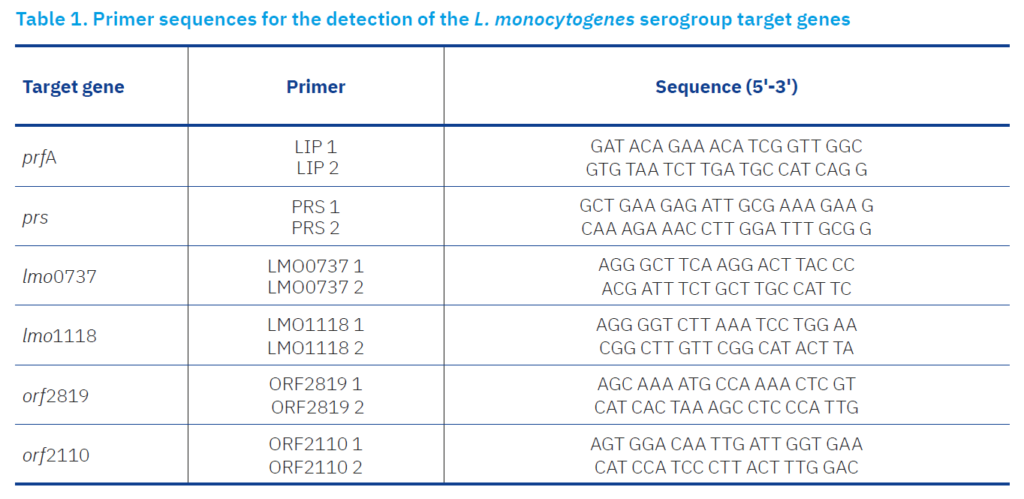
Molecular typing of 80 L. monocytogenes strains was performed using multiplex PCR by amplification of six serogroup-specific marker genes: prfA, prs, lmo0737, lmo1118, orf2819, and orf2110 (Vitullo et al., 2013). The primer sequences are listed in Table 1 (ANSES, 2017). PCR was performed using the Multiplex PCR Master Mix Kit (Qiagen, Hilden, Germany). A total PCR reaction volume of 20 µL was prepared. The mixture consisted of 10 µL 2x master mix, 4 µL 5x Q solution, 4 µL 5x primer mix (concentration of 10 µM), and 2 µL extracted DNA. Positive control DNAs were obtained from ANSES (CLIP collection), and the following reference strains were included in the PCR run: 00EB248LM (serogroup IIa), 00EB249LM (serogroup IIb), 00EB250LM (serogroup IIc), 00EB254LM (serogroup IVa), 00EB256LM (serogroup IVb), and Listeria ivanovii ATCC 19119 (serogroup L). Nuclease-free water was used as the negative control. The PCR thermal cycles included an initial denaturation step at 94ºC for 3 minutes, followed by 35 cycles at 94ºC for 30 seconds, 53ºC for 40 seconds, and 72ºC for 90 seconds. A final extension step was performed at 72ºC for 7 minutes (ANSES, 2017). PCR products were analysed using the Qsep100 (Nippon Genetics, Bunkyo, Tokyo, Japan) capillary gel electrophoresis device (cartridge S2). This automated capillary electrophoresis device enables high-resolution separation and precise sizing of PCR fragments, allowing confirmation of target gene amplification and interpretation of band sizes observed on an agarose gel (Ndraha et al., 2023; Rip and Gouws, 2020).
Qualitative ReT-PCR
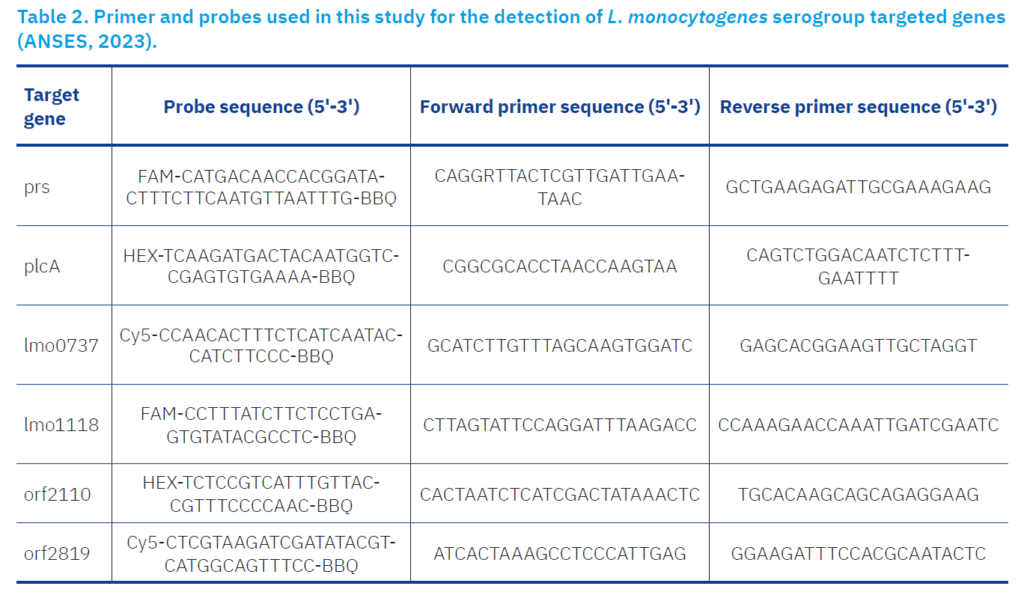
The ReT-PCR assay integrates six markers of the molecular serogrouping scheme by Vitullo et al. (2013) that identify the strain molecular serogroups IIa, IIb, IIc, IVb, IVa, and Listeria sp. through two triplex PCR reactions (ANSES, 2023). In this analysis for L. monocytogenes strains, PCRs were performed as a FAM-HEX-Cy5 triplex. The primers and probes are shown in Table 2. We prepared the PCR mix with a final concentration of 20 µM. The mixture consisted of 10 µL 2x master mix, 4 µL 1.5 µM primer mix (final concentration of each primer in the mix was 0.3 µM), 4 µL 0.15 µM probe mix (final concentration of each probe in the mix was 0.03 µM), and 2 µL DNA. The total reaction volume for the PCR was 20 µL. We include the positive control for all targeted genes and the negative control, which was DNase/RNase-free water. The ReT-PCR was performed on an AriaMx ReT-PCR device (Agilent, Cork, Ireland). Amplification with ReT-PCR thermal cycles included an initial denaturation step at 95ºC for 10 minutes, followed by 40 cycles at 95ºC for 15 seconds and 60ºC for 1 minute (ANSES, 2023).
Statistical analysis
The agreement between conventional multiplex PCR and ReT-PCR in assigning molecular serogroups was assessed using Cohen’s kappa coefficient (κ) with 95% confidence intervals. The analysis was performed using MedCalc version 23.4.3 software. The distribution of molecular serogroups is presented as counts and percentages.
Results and discussion
In the present study, all 80 L. monocytogenes strains from food samples were identified using both conventional PCR and ReT-PCR methods. L. monocytogenes is genetically diverse, and strains in this study were categorised into four molecular serogroups based on the results of both PCR tests (Table 3). Used methods revealed that 65 (81.2%) strains belonged to molecular serogroup IIa, eleven to IIc (13.8%), and two (2.5.%) to each IIb and IVb. These results emphasise the predominance of serogroup IIa (including serotypes 1/2a and 3a) among the strains recovered from food. Conventional PCR and ReT-PCR showed complete concordance in assigning serogroups to all strains and classified each of the 80 strains into the same serogroup without discrepancy. As expected, Cohen’s kappa coefficient demonstrated perfect agreement between methods (κ = 1.00, P < 0.001), confirming that ReT-PCR is fully reliable for routine molecular serogrouping of L. monocytogenes.

Doumith et al. (2004) proposed a PCR test targeting five genes: prs, lmo0737, lmo1118, orf2819, and orf2110. More recently, Vitullo et al. (2013) described the use of a ReT-PCR assay to enable serogrouping of L. monocytogenes and differentiation from other Listeria species. The development of ReT-PCR methods has dramatically improved the rapid detection and differentiation of L. monocytogenes serogroups. It combines the results of two triplex PCRs, the first targeting prs, plcA, lmo0737, lmo1118, orf2110, and orf2819, with high specificity, sensitivity, and stability for molecular serotyping identification (Vitullo et al., 2013). This method is suitable for the identification of major serogroups, including IIa (1/2a and 3a), IIb (1/2b, 3b, and 7), IIc (1/2c and 3c), IVa (4a and 4c), IVb (4b, 4d, and 4e), and non- L. monocytogenes species. Compared to conventional PCR methods, this approach offers half the turnaround time – 1.5 hours versus 3 hours. It is therefore better suited for large-scale sample analysis and extraction of genomic DNA from food and the environment.
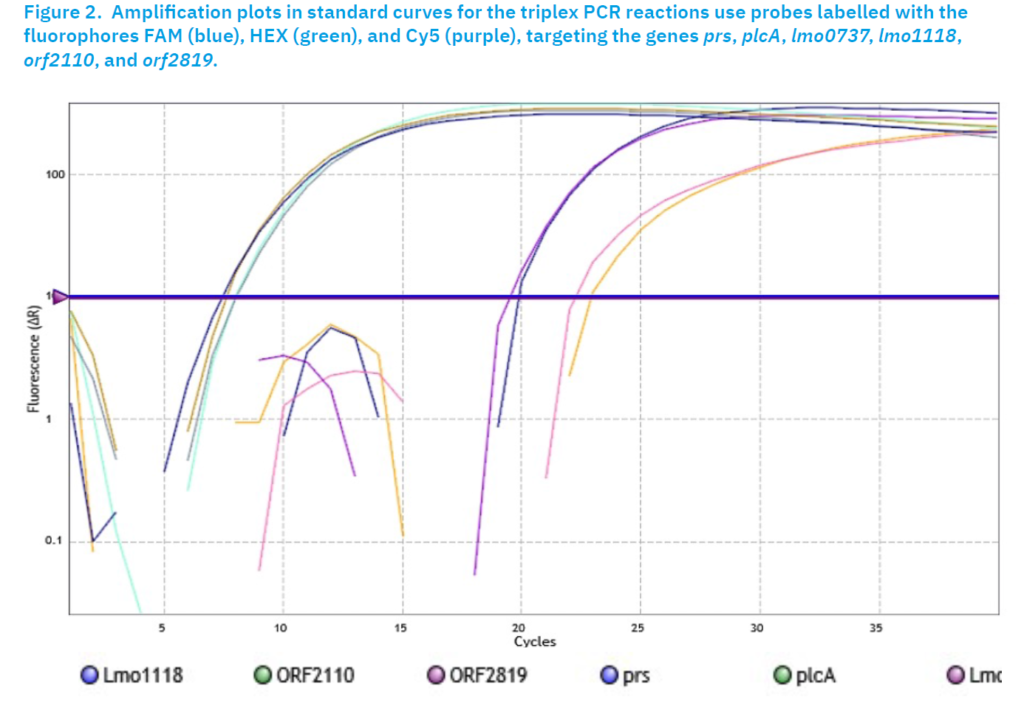
The advantages of ReT-PCR are that it is faster than conventional PCR and does not require post-amplification manipulation for bacterial identification (Melendez et al., 2010). In contrast to gel-based PCR methods, which rely on electrophoresis to detect amplicons, ReT-PCR monitors the amplification of DNA in real time using fluorescent signals (Guilbaud et al., 2005; Ndraha et al., 2023). Figures 1 and 2 illustrate the differences between conventional PCR and ReT-PCR.

Qualitative procedures are used to determine the presence or absence of a specific microorganism in the sample. ReT-PCR methods have proven useful in rapidly detecting L. monocytogenes (Bolzon et al., 2024). While the cost and need for trained personnel remain potential limitations of ReT-PCR, its advantages, including faster processing times and lower contamination risks make it a superior choice compared to conventional gel-based PCR assays (Kérouanton et al., 2010; Vitullo et al., 2013; Chen et al., 2017; Alía et al., 2020; Cheng et al., 2024).
Recent studies have further optimised multiplex PCR systems for the rapid differentiation of L. monocytogenes serogroups. Doumith et al. (2004) developed a gel-based multiplex PCR that can effectively separate the major serotypes into distinct groups, while advances by Alía et al. (2020) and Capitaine et al. (2025) highlight the potential of multiplex ReT-PCR. These results demonstrate that the ReT-PCR method is a rapid and reliable tool for molecular serotyping of foodborne L. monocytogenes strains. Integrating ReT-PCR into routine diagnostics would reduce processing time and streamline workflows while maintaining complete analytical concordance with established multiplex PCR protocols.
This study has limitations. The isolate collection consists of samples from routine diagnostics and does not represent the diversity of L. monocytogenes strains across different food categories. In addition, ReT-PCR was evaluated as a qualitative assay since it was tested on pure bacterial strains. Quantitative analysis and assessment of assay reproducibility directly on different food products were beyond the scope of this study and should be examined in future research. Also, future studies using a larger and more origin-diverse set of strains would further strengthen the conclusions presented here.
Conclusion
The ReT-PCR method is a powerful and efficient approach for the molecular serotyping of L. monocytogenes. Due to its fast and reliable performance, this method is well-suited for integration into routine laboratory diagnostics. In this study, a ReT-PCR method consisting of six primers and probe pairs was developed for detecting L. monocytogenes serogroups. This molecular tool enabled rapid identification of L. monocytogenes serogroups to provide a strong foundation for future studies on quantitative ReT-PCR applications to confirm this method as an alternative for routine detection and characterisation workflows.
References [… show]
Sažetak
Listeria monocytogenes važan je uzročnik bolesti listerioze koja se prenosi hranom. Uzrokuje tešku infekciju kod ljudi s visokom stopom obolijevanja i smrtnosti. Molekularna serotipizacija opće je prihvaćena metoda subtipizacije L. monocytogenes. Identifikacija serotipova sojeva omogućuje razlikovanje značajnih sojeva koji se prenose hranom (1/2a, 1/2b i 4b) te njihovu raspostranjenost i epidemiološki značaj. U istraživanju je ispitana primjenjivost i učinkovitost molekularne serotipizacije L. monocytogenes u stvarnom vremenu u usporedbi s konvencionalnom PCR metodom. Analizirano je ukupno 80 sojeva L. monocytogenes izoliranih iz hrane i prehrambenog lanca. Za određivanje molekularnih serogrupa koristili smo konvencionalni multiplex PCR i PCR u stvarnom vremenu (ReT-PCR). PCR metodama odredili smo molekularne serogrupe na izolatima Listeria monocytogenes. Nadalje, najveći broj izolata svrstan je u serogrupu IIa, nakon koje slijede IIc, IIb i zatim IVb. Dobiveni rezultati ukazuju da PCR u stvarnom vremenu omogućuje značajno bržu i učinkovitiju obradu uzoraka u odnosu na konvencionalni PCR te postaje standardna metoda za detekciju i analizu odabranih sojeva. Ovo istraživanje naglašava važnost primjene brze metode molekularne serotipizacije Listeria monocytogenes u hrani te uvođenje ReT-PCR u rutinske dijagnostičke postupke.
Ključne riječi: Listeria monocytogenes; ReT-PCR; konvencionalni PCR; molekularna serotipizacija.
