
Occurrence of Salmonella spp. in chicken meat in Eastern Croatia in the period 2017 to 2023
I.Perković, M. Lolić*, M. Vukičević, M. Krajina, A. Konjarević, K. Komljen, D. Tomašković, A. Humski, Ž. Šapina, M. Škrivanko and H. Krajina
Irena PERKOVIĆ1, iperkovic@veinst.hr, orcid.org/0000-0001-9790-8725; Marica LOLIĆ1* (corresponding author), lolic@veinst.hr, orcid.
org/0000-0002-7325-3549; Mirta VUKIČEVIĆ1, vukicevic@veinst.hr; Marija KRAJINA1, agicic@veinst.hr; Anastazija KONJAREVIĆ1,
konjarevic@veinst.hr; Katarina KOMLJEN1, komljen@veinst.hr; Dora TOMAŠKOVIĆ2, stojevic@veinst.hr, orcid.org/0000-0002-2009-
5997; Andrea HUMSKI2, humski@veinst.hr, orcid.org/0000-0003-3027-1306; Željka ŠAPINA3, zeljka.sapina@dirh.hr;
Mario ŠKRIVANKO1, skrivanko@veinst.hr, orcid.org/0000-0002-6638-0507; Hrvoje KRAJINA1, krajina@veinst.hr
1 Veterinary Department Vinkovci, Croatian Veterinary Institute, 32100 Vinkovci, Croatia
2 Laboratory for Food Microbiology, Department of Veterinary Public Health, Croatian Veterinary Institute, 10000 Zagreb, Croatia
3 Veterinary Office Osijek, State Inspectorate of the Republic of Croatia, 31000 Osijek
 https://doi.org/10.46419/cvj.57.2.2
Abstract
Bacteria of the genera Salmonella and Campylobacter are the most common causative agents of foodborne bacterial infections, and poultry meat is recognised as the most common source of these infections in humans. Since chicken meat is one of the most commonly consumed meats in the daily diet, the aim of this study was to determine the occurrence of bacteria of the genus Salmonella in chicken meat in eastern Croatia in the period from 2017 to 2023. Sampling was conducted within the framework of an animal-origin food monitoring programme in butcher shops and slaughterhouses in four counties: Vukovar-Srijem, Osijek-Baranja, Brod-Posavina, and Požega-Slavonia. During this period, 1310 samples of fresh chicken meat were analysed in the Laboratory of Food and Feed Microbiology of the Veterinary Institute in Vinkovci. Bacteria of Salmonella spp. were confirmed in 130 (9.92%) samples of chicken meat: 101 samples of legs/thighs (77.69%), 11 samples of wings (8.46%), and 18 samples of breast meat (13.85%). The highest number of Salmonella spp. isolates in relation to the total number of analysed chicken meat pieces tested was found in chicken legs/thighs (10.86%) and wings (10.00%), while the fewest isolates were obtained from breast meat samples (6.67%). Serological typing confirmed that all isolates belonged to the serovar Salmonella ser. Infantis.
Key words: Salmonella spp.; Salmonella Infantis; chicken meats; eastern Croatia
Introduction
Meat is an important source of protein and one of the most important components of the human diet. Meat is also a suitable medium for the development of microorganisms, including those that can cause disease in humans (Subedi et al., 2023). In the European Union (EU), campylobacteriosis and salmonellosis are the two most commonly reported foodborne diseases in humans, and the main sources of infection are contaminated meat and animal products, especially poultry meat and meat products, due to their high nutrient and water content (Antunes et al., 2016; Wessels et al., 2021; EFSA, 2023). It is estimated that salmonellosis causes 90 million cases of gastroenteritis worldwide each year, 155,000 of which are fatal (WHO, 2018). Although salmonellosis is usually reported as a foodborne illness, it has been estimated that around 10% of cases are actually caused by direct contact with animals (Majowicz et al., 2010). It is assumed that 20% of all poultry products worldwide are infected with Salmonella spp. (Vestby et al., 2009). Safe handling of raw meat and other raw ingredients, thorough cooking, and good hygiene practices can prevent or reduce the risks posed by contaminated food (EFSA 2023).
Salmonella spp. is a gram-negative, rod-shaped bacterium belonging to the family Enterobacteriaceae. It grows in a temperature range of 5–45˚C, with an optimum at 35–37˚C and at a water activity of ≥0.95. It is thermolabile and is often destroyed at temperatures of 70°C. Growth of Salmonella spp. is fully inhibited at pH <3.8, water activity <0.94, and a temperature <7°C (Pui et al., 2011). Salmonella spp. is divided into two species: Salmonella Enterica and Salmonella Bongori. The species Salmonella Enterica is phenotypically and genotypically divided into six subspecies: Salmonella Enterica subsp. arizonae, Salmonella Enterica subsp. enterica, Salmonella Enterica subsp. diarizonae, Salmonella Enterica subsp. houtenae, Salmonella Enterica subsp. indica, Salmonella Enterica subsp. salamae (Samiullah, 2013). The subspecies Salmonella Enterica subsp. enterica include almost all forms of Salmonella spp. that are important in human and veterinary medicine. Based on the antigenic properties within the species Salmonella Enterica, more than 2600 serotypes (serovars) have been discovered that cause disease in humans or animals and mainly cause symptoms in the digestive system (Pui et al., 2011; Mezal et al., 2014).
According to an EFSA report, a total of 77,486 cases of salmonellosis in humans were reported in 2023, with an overall stable trend in salmonella infections for the period 2019 to 2023. The report states that five serovars are most commonly affected in human infections in the European Union: Salmonella Enteritidis (67.3%), Salmonella Typhimurium (13.1%), monophase Salmonella Typhimurium (1, 4,[5],12:i:-) (4.3%), Salmonella Infantis (2.3%) and Salmonella Derby (0.89%). Although these serovars continue to be the most important causes of salmonellosis, recent trends indicate the presence of less common serovars that are often resistant to antibiotics.
According to available data, poultry meat is estimated to account for 41% of global meat-based protein sources by 2030 (Tan et al., 2022). With the increasing globalisation of food products, particularly poultry meat as one of the most consumed meat products worldwide, new problems in the control of salmonellosis may arise (Antunes et al., 2016).
The aim of this study was to determine the presence of bacteria of the genus Salmonella in poultry meat available in eastern Croatia and to perform serological typing to identify the serovars of Salmonella spp. most commonly found in chicken meat.
Materials and Methods
Sampling
In the period from 2017 to 2023, the implementation of a programme to monitor food of animal origin for the presence of Salmonella spp. included the sampling and analysis of 1310 samples of fresh chicken meat. Sampling was carried out in slaughterhouses and butcheries in four counties in eastern Croatia (Vukovar-Srijem, Osijek-Baranja, Brod-Posavina and Požega-Slavonia). The samples were taken at the end of the production process in the dispatch phase from the slaughterhouse or in the retail store. The samples (chicken legs/thighs, wings, breasts) were analysed in the Laboratory of Food and Feed Microbiology, Veterinary Department Vinkovci, Croatian Veterinary Institute.
Isolation and confirmation of Salmonella spp.
Chicken meat was tested for Salmonella spp. using the standardised method (HRN EN ISO 6579-1:2017; HRN EN ISO 6579-1:2017/A1:2020). For the analysis, a 25 g sample of chicken meat was weighed and added to 225 mL buffered peptone water (Biolife, Italy). Two liquid selective broths were used: Rappaport-Vassiliadis soy (RVS) (Biolife, Italy) and Müller-Kauffmann tetrathionate base broth (MKTTn) (Biolife, Italy). After incubation at 37⁰C and 41⁰C for 24 h, the broth cultures were inoculated onto two solid selective agars: xylose-lysine deoxycholate agar (XLD) (Biolife, Italy) and chromogenic Salmonella agar (CSA) (Biolife, Italy). For the biochemical confirmation of the bacterial species Salmonella spp.: Triple sugar iron agar (TSI) (Biolife, Italy), Lysine decarboxylation medium (LDC) (Biolife, Italy), UREA agar (Biolife, Italy) and the VITEK2 Compact automated bacterial detection system (bioMérieux, France) with the application of the VITEK2 ID GN identification card. The results of the biochemical confirmation of the VITEK2 system were expressed as a percentage of reliable identification. Both polyvalent and monovalent serums (Bio-rad, France) were used for serological confirmation. After elimination of the autoagglutination strains, agglutination on the slide confirmed the presence of bacteria of the genus Salmonella spp. The isolated bacterial isolates of Salmonella spp. were forwarded to the Laboratory of Food Microbiology, as the national reference laboratory of the Croatian Veterinary Institute, for further serovar identification according to the White-Kauffmann-Le Minor scheme (Grimont and Weill, 2007).
Results
A total of 1310 samples of chicken meat were tested for the presence of bacteria of the genus Salmonella as part of regular monitoring in the Laboratory of Food and Feed Microbiology, Veterinary Department Vinkovci. The presence of Salmonella spp. was confirmed in 130 (9.92%) of the samples tested.
Table 1. Total number of analysed and positive samples of chicken meat for the presence of Salmonella spp. in eastern Croatia in the period from 2017 to 2023
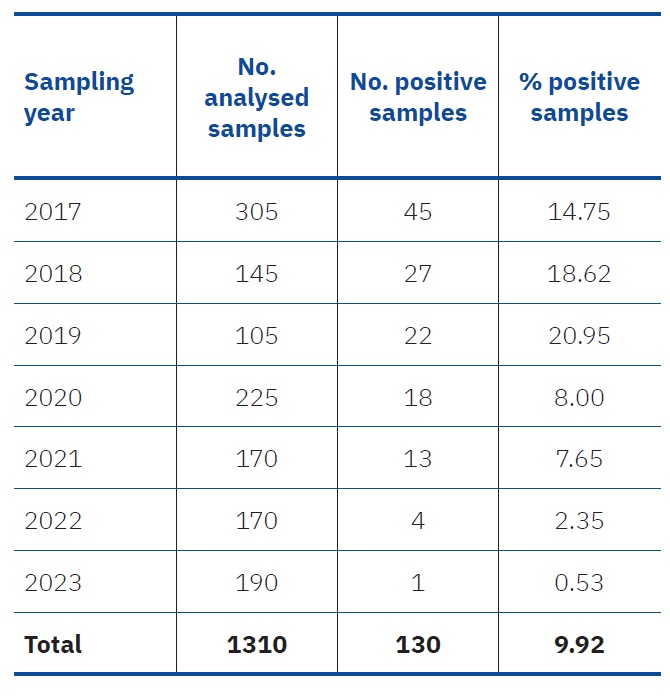
The highest number of samples (305) was analysed in 2017, while the highest percentage of positive samples in relation to the total number (20.95%) was recorded in 2019, when the smallest sample of chicken meat was analysed. The fewest positive samples were found in 2023, when Salmonella spp. was confirmed in only one sample (0.53%) of chicken meat (Table 1). Serological typing revealed that all isolated strains belonged to the serovar S. Infantis, which was most frequently isolated in samples of chicken legs/thighs and least frequently in chicken breast (Figure 1).

Figure 1. Total number of positive samples for Salmonella spp., specifically S. Infantis, in different cuts of chicken meat during the study period from 2017 to 2023 in eastern Croatia
Discussion
In 2023, salmonellosis was the second most frequently reported zoonosis after campylobacteriosis. An increase in the number of cases was recorded for both pathogens compared to 2022 (EFSA, 2023). According to the EFSA 2023 report, Salmonella spp. were most frequently isolated from samples of fresh poultry meat. Of the total number of samples fresh meat samples, 2.1% (N=396,548) of samples were positive for Salmonella spp. Within this category, the highest number of positive samples was reported for “fresh turkey meat” (4.1%, N = 16,110) and “fresh broiler meat” (3.9%, N = 98,929). In comparison with the preceding three-year period (2020–2022), no significant changes were observed in the incidence of Salmonella spp. (EFSA, 2023). However, given the impact of these infections on human health, further caution is needed, and efforts should be made to reduce the number of cases of infection. EFSA estimates that the total economic burden of salmonellosis could be up to EUR 3 billion per year. According to Moe et al. (2017), the occurrence of bacteria of the genus Salmonella is higher in the whole chicken than in individual pieces of meat, as the whole chicken is covered with more skin, which is more susceptible to Salmonella spp. contamination. In this study, individual chicken parts (leg/thigh, wing, breast) were sampled and Salmonella spp. was isolated at similar percentages from the meat of leg/thigh and wing but least from breast meat as most samples were skinless, which is consistent with the report by Moe et al. (2017). Hengl et al. (2016) also found similar results, with 50% of Salmonella spp. isolated from boneless meat of leg and thigh. In the present study, all isolated strains from the tested samples of fresh chicken meat belonged to the serovar S. Infantis. Similar results for chicken meat were reported by Jaki Tkalec et al. (2021) for northwestern Croatia, where serological typing confirmed S. Infantis as the most common serovar (63.2%). Hengl et al. (2016) also reported that S. Infantis was the most common serovar (88.2%) isolated in analysed chicken meat samples in Croatia at the national level.
Since Salmonella spp. in poultry usually originates from primary production, Jurinović et al. (2015) investigated the presence of Salmonella spp. in the faeces of broiler chicks in Croatia in the period from 2010 to 2014 and reported the presence of Salmonella spp. in 357 (1.9%) analysed samples, of which S. Infantis was detected in 81 samples (22.69% of positive samples). Similar results in Croatia for the period 2010 to 2020 were reported by Lolić et al. (2022), where S. Infantis was detected in 0.3% of the analysed flocks, and the highest percentage of positive flocks was found in 2017 (1.42%) and 2018 (1.69%). Listeš et al. (2013) described the incidence of Salmonella spp. serovars in food and feed in the Dalmatia region in the period from 2007 to 2009. They reported an incidence of 8.3% of positive samples of poultry meat, which were predominantly infected with the serovars S. Typhimurium, S. Enteritidis, S. Montevideo and S. Tennessee.
The presence of bacteria of the genus Salmonella in chicken meat is monitored in many countries around the world. Kaushik et al. (2014) reported an incidence of Salmonella spp. in chicken meat in India of 23.7%, which is much higher than that reported here. The serovars present also differ, with Indian chicken meat containing S. Typhimurium (6.1%), S. Newport (2.6%), and S. Gallinarum (1.7%), while S. Infantis was isolated in only 0.4% of samples. In Japan, 512 samples of poultry meat were analysed as part of a surveillance programme in 2015-2016, and 55.9% of the samples were found to be contaminated with nine serovars of Salmonella spp. The most common serovars were S. Infantis and S. Schwarzengrund, which together accounted for 78.2% of isolates (Mori et al., 2018). In China, Sun et al. (2021) examined Salmonella in poultry meat from retail stores and found that chicken meat was most frequently contaminated with Salmonella spp. (26.4%) and that the predominant serovars were S. Enteritidis, S. Indiana and S. Typhimurium.
In 2017, the most common infections in humans were caused by the serovars S. Enteritidis and S. Typhimurium, although there has been a significant incidence of S. Infantis in recent years. In the EU, S. Infantis was the most commonly reported serovar isolated from broiler flocks and meat, although this serovar is also of public health importance due to the frequent infections in humans. S. Infantis is one of the ten most commonly isolated Salmonella serovars worldwide. Compared to other serovars, S. Infantis colonises the food chain of chicks more aggressively, although its presence in the reproductive tract and transmission to the eggs are not yet fully understood. The time of year also plays an important role in microbial contamination, as infections are more common in the warmer months of the year (Samiullah, 2013). High temperatures are suitable for bacterial multiplication and thus have a significant impact on the occurrence of infectious diseases such as salmonellosis (Kovats et al., 2004; Mills et al., 2010; Robinson et al., 2022; Billah et al., 2024).
Worldwide scientific studies have recognised that poultry meat is a potential source of S. Infantis. In Finland, S. Infantis has been the main source of contamination in the broiler production chain since the early 1970s, along with S. Typhimurium. Poultry meat in which S. Infantis has been detected poses a risk to human health, especially to children, the elderly and immunocompromised persons. Thorough cooking, including boiling and baking, kills S. Infantis, and proper hygiene measures are required when preparing poultry meat to avoid cross-contamination of dishes, utensils and cooking surfaces. The increased incidence of S. Infantis in chicken meat could be the result of measures to control S. Enteritidis and S. Typhimurium in primary production, i.e., vaccination of poultry with these serovars. The decline in the incidence of these serovars has led to an increase in S. Infantis, which is currently the dominant serovar in poultry production in the EU. The increase in infections with S. Infantis in humans started around 2011, while the increase in poultry carcasses was reported around 2015. Although the consumption of chicken meat undoubtedly contributes to the incidence of human infection with S. Infantis, the initial increase in reported human cases was likely the result of other routes of transmission, e.g., via water, between humans, through contact with animals, from the environment or from other food sources (Powell & Williams, 2024). The increased incidence of serovar S. Infantis could also be due to inadequate hygiene practices in slaughterhouses and poultry meat processing, cutting and packaging plants. Salmonella control measures should therefore be implemented at all stages of production (HAH, 2017).
Conclusions
Based on previous studies on the presence of bacteria of the genus Salmonella in fresh chicken meat in the Republic of Croatia and the results presented here, it can be concluded that bacteria of the genus Salmonella spp. are present in fresh chicken meat in significant quantities (9.92%) and that this type of meat should continue to be controlled in order to protect the health of consumers. Food producers have an important role to play in preventing the transmission of Salmonella spp. to consumers by ensuring safe food handling, monitoring and the application of hygiene standards during production. Consumers also need to be made aware of this type of foodborne pathogen and educated about good household hygiene practices that can help reduce the presence of Salmonella spp. in fresh chicken meat.
References [… show]
Pojavnost Salmonella spp. u pilećem mesu s područja istočne Hrvatske u razdoblju od 2017. do 2023. godine
Irena PERKOVIĆ1, iperkovic@veinst.hr, orcid.org/0000-0001-9790-8725; Marica LOLIĆ1* (dopisni autor), lolic@veinst.hr, orcid.org/0000-0002-7325-3549; Mirta VUKIČEVIĆ1, vukicevic@veinst.hr; Marija KRAJINA1, agicic@veinst.hr; Anastazija KONJAREVIĆ1, konjarevic@veinst.hr; Katarina KOMLJEN1, komljen@veinst.hr; Dora TOMAŠKOVIĆ2, stojevic@veinst.hr, orcid.org/0000-0002-2009-5997; Andrea HUMSKI2, humski@veinst.hr, orcid.org/0000-0003-3027-1306; Željka ŠAPINA3, zeljka.sapina@dirh.hr; Mario ŠKRIVANKO1, skrivanko@veinst.hr, orcid.org/0000-0002-6638-0507; Hrvoje KRAJINA1, krajina@veinst.hr
1 Veterinarski zavod Vinkovci, Hrvatski veterinarski institut, 32100 Vinkovci
2 Laboratorij za mikrobiologiju hrane, Odjel za veterinarsko javno zdravstvo, Hrvatski veterinarski institut, 10000 Zagreb
3. Veterinarski ured Osijek, Državni inspektorat Republike Hrvatske, 31000 Osijek
Bakterije roda Salmonella, uz Campylobacter, prouzroče najčešće bakterijske infekcije koje se prenose hranom, a meso peradi je prepoznato kao njihov najčešći izvor zaraze kod ljudi. Budući je pileće meso jedno od najzastupljenijih vrsta mesa u svakodnevnoj ljudskoj prehrani, cilj je ovog istraživanja bio utvrditi pojavnost bakterija roda Salmonella u pilećem mesu s područja istočne Hrvatske u razdoblju od 2017. do 2023. godine. Uzorkovanje je provedeno u okviru monitoringa hrane životinjskog podrijetla u mesnicama i klaonicama na području Vukovarsko-srijemske, Osječko-baranjske, Brodsko-posavske i Požeško-slavonske županije. U navedenom razdoblju u Laboratoriju za mikrobiologiju hrane i hrane za životinje Veterinarskog zavoda Vinkovci ukupno je analizirano 1310 uzoraka svježeg pilećeg mesa. Bakterije Salmonella spp. ustanovljene su u 130 (9,92 %) uzoraka pilećeg mesa: batak/zabatak 101 (77,69 %), krila 11 (8,46 %) i prsa 18 (13,85 %). Najveći broj izolata Salmonella spp. u odnosu na ukupni broj analiziranih dijelova pilećeg mesa prikupljen je iz uzoraka pilećih bataka – zabataka 101 (10,86 %) i krila 11 (10,00 %) dok je najmanji broj izolata prikupljen iz uzoraka prsa 18 (6,67 %). Serološkom tipizacijom je ustanovljeno da svi izolati pripadaju serovaru Salmonella ser. Infantis.
Ključne riječi: Salmonella spp., Salmonella Infantis, pileće meso, istočna Hrvatska
