
Prediction of Frozen Chicken Meat Storage Time through Artificial Neural Network Analysis of Colour Parameters
M.Megaache* and H. Akkari
Mounia MEGAACHE1* (corresponding author), mounia.megaache@univ-batna.dz, orcid.org/0000-0003-4980-6067; Hafsa AKKARI2, hafsa.akkari@univ-biskra.dz, orcid.org/0009-0002-0264-9519.
¹Laboratory of Health, Animal Production and Environment, Department of Veterinary Sciences, Institute of Veterinary and Agricultural Sciences, University of Batna 1, 05000 Batna, Algeria
2Department of Veterinary Sciences, Faculty of SNV-STU, University of Biskra, 07000 Biskra, Algeria

https://doi.org/10.46419/cvj.57.5.6
Abstract
Poultry meat colour deteriorates during prolonged frozen storage, affecting consumer perception and product value. This study investigated changes in colour parameters (L*, a*, b*) of frozen chicken breast meat, and developed an artificial neural network to predict storage time non-destructively. Ten chicken breast samples were analysed at different freezing storage times (0, 3, 6, 9, and 12 weeks) at -18°C, with colour measurements performed directly on each sample. Lightness (L*) increased from 51.82 ± 1.1 to 58.21 ± 1.0 units, redness (a*) decreased from 3.25 ± 0.2 to 2.12 ± 0.2 units, and yellowness (b*) increased from 8.12 ± 0.5 to 9.91 ± 0.6 units, resulting in a total colour difference of ΔE = 6.87, and all changes were statistically significant. The multilayer perceptron artificial neural network showed good agreement between predicted and actual storage times (R² ≈ 0.98), demonstrating the potential of colour-based modelling as a rapid, non-destructive tool for monitoring frozen chicken meat quality.
Keywords: colourimetry; MLP neural network; frozen poultry; storage prediction; non-destructive analysis.
Introduction
Poultry meat is widely accepted as an important global source of animal protein, due to its beneficial nutritional profile, high digestibility, and affordability (FAO, 2023). Poultry consumption is on the rise, surpassing beef in many countries, and outweighing cow’s milk consumption in numerous countries.
However, chicken meat is highly perishable, and when chicken meat is stored at improperly cold temperatures, it deteriorates quickly. Deterioration of poultry meat refers to changes that can occur biologically, physicochemically, and/or microbiologically when meat is frozen for extended periods of time, which can affect its sensory eating quality and nutritional profile (Zhang et al., 2017; Lee et al., 2019). Freezing will delay microbial growth and enzymatic breakdown, though it cannot also stop the loss of colour, nutrients, or moisture, oxidation of lipids, or denaturation from protein sources (Leygonie et al., 2012). Among quality attributes, colour is important as it has a considerable impact on consumer perception of meat products. Visual/colour characteristics are evaluated visually using three parameters; lightness (L*), redness (a*) and yellowness (b*), which are all important indicators of freshness and oxidative stability of meat products (Hunt et al., 1991; Qiao et al., 2001).
Analytical techniques for assessing meat quality using chemical and microbiological analyses are usually time-consuming, destructive, or require specialised equipment (Ologhobo & Shehu, 2021). As a result, the food industry is demanding quicker, non-invasive analytical approaches that provide reliable quality assessments without modifying samples. Artificial neural networks (ANN) have shown promise as modelling tools for estimating complex non-linear associations between measurable product attributes and overall indicators of quality (Khosravi et al., 2020; Wójcik et al., 2021). Several researchers have successfully applied ANNs to predict the freshness of meat and fish using instrumental colour or spectral data (Bahmanyar et al., 2021; Lakehal & Lakehal, 2023).
This study evaluated changes in colour parameters (L*, a*, b*) of chicken breast meat over a 12-week period of storage at -18°. An ANN was developed to predict storage time non-destructively from these measurements. This would be a simple, practical tool to estimate frozen chicken meat freshness, and may improve quality management within the poultry industry.
Materials and methods
Sample preparation
Fresh chicken breast meat (pectoralis major) was obtained from local poultry retailers in Aïn Touta (Batna, Algeria). At each frozen storage time (0, 3, 6, 9, and 12 weeks), ten independent chicken breast portions (100 g each) were prepared (n = 10 per storage time; total n = 50). Each portion was vacuum-packed in polyethylene bags and stored at -18°C until analysis. Samples were thawed at 4°C for 12 h prior to colour measurements (Leygonie et al., 2012; Lee et al., 2019).
Colour measurement
Surface colour measurements were performed directly on each 100 g chicken breast portion using a colorimeter (model CR-400, Konica Minolta, Japan), calibrated with a standard white plate before each measurement session. For each sample, three technical measurements were taken at different surface locations, and the mean values of L* (lightness), a* (redness), and b* (yellowness) were used for statistical analysis. Total colour difference (ΔE) between fresh and stored samples was calculated according to the CIE Lab* colour space using the following equation (Hunt et al., 1991):

where 0 is the value for the fresh meat sample and t is the value for the week of storage.
Artificial Neural Network (ANN) modelling
Mean colour values (L*, a*, b*) at each storage time (n = 5 time points) were used as the ANN inputs. Due to the limited dataset size, the ANN model was developed as a proof-of-concept. The ANN was implemented in MATLAB R2023a (MathWorks, USA) as a multilayer perceptron (MLP) with three input neurons (L*, a*, b*), one hidden layer with 20 neurons, and one output neuron (storage time in weeks). Model training was performed using the Levenberg–Marquardt algorithm with early stopping to avoid overfitting. Model performance was evaluated using R², MAE, RMSE, MSE, and MAD (Bahmanyar et al., 2021).
Statistical analysis
Data were analysed using IBM SPSS Statistics v22. Normality was verified with Shapiro-Wilk test (p>0.05). One-way ANOVA assessed storage time effects on colour parameters, followed by Tukey’s post-hoc test for multiple comparisons (p<0.05).
Results
Colour Parameters Changes During Frozen Storage
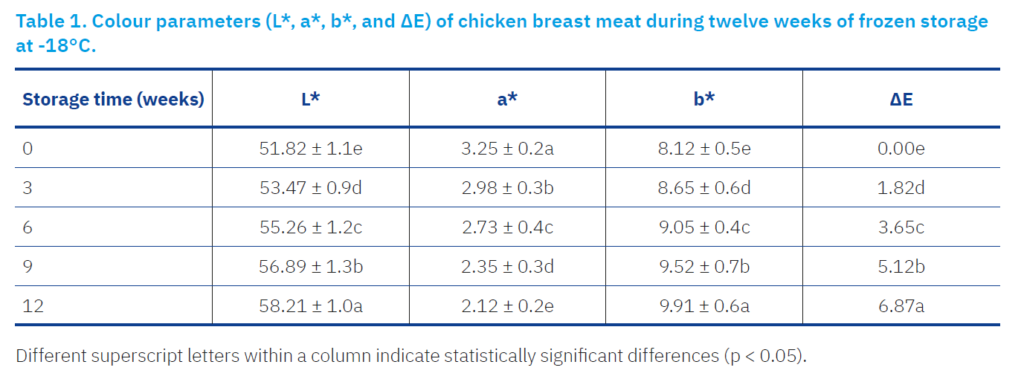
Chicken breast colour parameters changed significantly during 12 weeks at -18°C (Table 1). Lightness (L*) increased from 51.82±1.1 to 58.21±1.0 (p<0.05). Redness (a*) decreased from 3.25±0.2 to 2.12±0.2 (p<0.05). Yellowness (b*) increased from 8.12±0.5 to 9.91±0.6 (p<0.05). The total colour difference (ΔE) rose from 0.00 to 6.87.
Performance of the artificial neural network
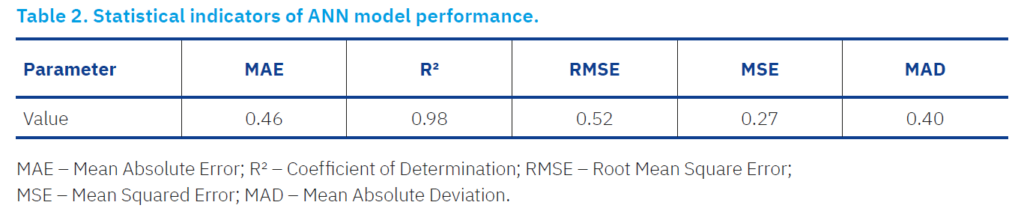
Following the observed changes in colour parameters, an artificial neural network (ANN) was developed to predict storage time from L, a, and b* values. The MLP-ANN predicted storage time with good accuracy, achieving an R² of approximately 0.98, a mean absolute error (MAE) of 0.46 weeks, and a root mean square error (RMSE) of 0.52 weeks on the validation dataset (Table 2).
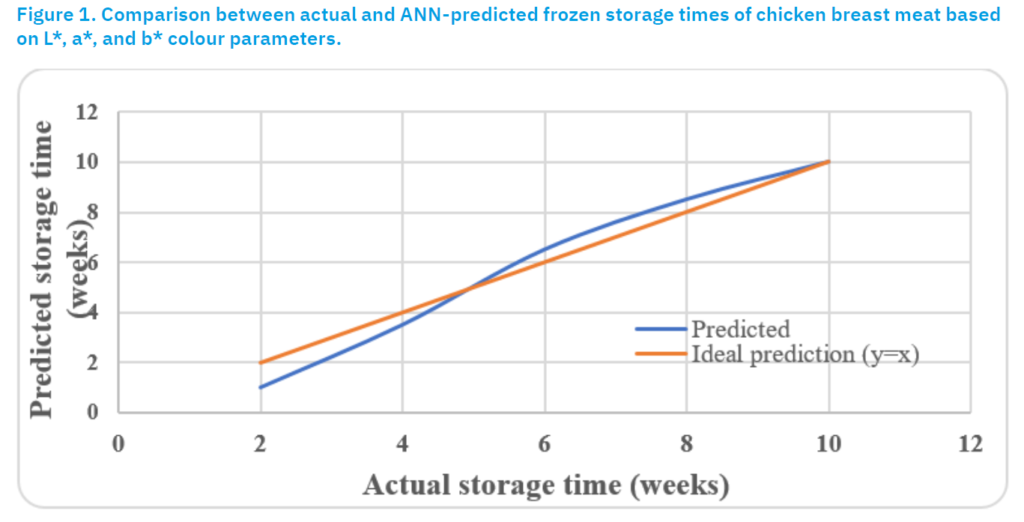
The comparison between the actual and ANN-predicted storage times of chicken breast meat based on L, a, and b* values is shown in Figure 1. The ANN model showed good agreement between predicted and actual storage times, with a coefficient of determination of approximately R² = 0.98 and a root mean square error of approximately 0.52 weeks.
Discussion
Colour Parameters
The observed colour changes confirm oxidative and structural processes during frozen storage. Lightness (L*) increased 12.3% (51.82→58.21), consistent with protein denaturation and surface dehydration (Leygonie et al., 2012; Lee et al., 2019). L* rose (+6.39 units), corroborating the findings of Savadkoohi et al. (2014), who reported a +4.2 unit increase in chicken meat after freezing.
Redness (a*) decreased by 34.8% (3.25→2.12), indicating myoglobin oxidation to metmyoglobin, reducing pinkness (Hunt et al., 1991). This -1.13 unit drop matches Vieira et al. (2009) reporting -1.5 units in frozen rustic chicken, and Henriott et al. (2020), confirming metmyoglobin formation during frozen storage due to ice crystal disruption.
Yellowness (b*) increased 22.0% (8.12→9.91), likely from lipid oxidation products accumulating on the surface (Savadkoohi et al., 2014). These changes align with Wereńska et al. (2022), who reported a b* rise in chicken breast linked to prolonged -18°C storage.
Total colour difference (ΔE=6.87) exceeds the human just-noticeable difference threshold (ΔE>2-3), confirming visually perceptible changes commercially relevant for poultry display (Vieira et al., 2009; Ali et al., 2015).
Performance of the artificial neural network
The ANN model demonstrated good agreement between actual and predicted frozen storage times of chicken breast meat, with a coefficient of determination of approximately R² = 0.98 and a root mean square error of approximately 0.52 weeks. These results indicate that colour parameters (L*, a*, and b*) capture relevant information related to storage-related quality changes.
The predictive performance obtained in this study is comparable to previously reported ANN-based approaches for meat quality evaluation. For example, Bahmanyar et al. (2021) reported an R² of 0.92 for chicken freshness prediction using image processing techniques, while Lakehal and Lakehal (2023) reported RMSE values of approximately 0.12 for frozen meat quality prediction using spectral data. Although a direct comparison between studies is limited by differences in datasets and methodologies, the present results demonstrate that simple tristimulus colour measurements can provide useful input variables for ANN-based prediction of frozen storage time.
Artificial neural networks are well suited for modelling nonlinear relationships between colour parameters and storage duration, offering a rapid and non-destructive alternative to traditional quality assessment methods (Kamruzzaman et al., 2016; Khosravi et al., 2020). Given the relatively limited dataset size, the ANN model presented here should be considered a proof-of-concept, highlighting the potential of colour-based ANN approaches for supporting poultry meat quality control and reducing product losses. The number of hidden neurons was selected to balance model complexity and prediction accuracy while avoiding overfitting given the dataset size.
Conclusion
Frozen storage at -18°C significantly affected the colour characteristics of chicken breast meat, with a progressive increase in lightness and yellowness and a decrease in redness over twelve weeks. These changes resulted in a total colour difference (ΔE) exceeding the threshold of visual perception, indicating commercially relevant quality deterioration. The multilayer perceptron artificial neural network (MLP-ANN) developed in this study demonstrated good agreement between predicted and actual storage times based solely on L*, a*, and b* colour parameters (R² ≈ 0.98). This rapid and non-destructive approach shows potential as a practical tool for monitoring frozen chicken meat quality and may support quality control and decision-making in the poultry industry.
Conflict of Interest
The authors declare no conflicts of interest.
References [… show]
Predviđanje vremena skladištenja smrznutog pilećeg mesa analizom parametara boje umjetnom neuronskom mrežom
Mounia MEGAACHE¹* (dopisni autor), mounia.megaache@univ-batna.dz, orcid.org/0000-0003-4980-6067; Hafsa AKKARI², hafsa.akkari@univ-biskra.dz, orcid.org/0009-0002-0264-9519.
¹Laboratory of Health, Animal Production and Environment, Department of Veterinary Sciences, Institute of Veterinary and Agricultural Sciences, University of Batna 1, 05000 Batna, Algeria
²Department of Veterinary Sciences, Faculty of SNV-STU, University of Biskra, 07000 Biskra, AlgeriaBoja mesa peradi mijenja se tijekom duljeg skladištenja u smrznutom stanju, što utječe na percepciju potrošača i kvalitetu proizvoda. Ovo istraživanje odnosi se na promjene parametara boje (L*, a*, b*) smrznutog mesa pilećih prsa i razvoj umjetne neuronske mreže za nerazorno predviđanje vremena skladištenja. Deset uzoraka pilećih prsa (100 g svaki) analizirano je u smrznutom stanju tijekom različitih vremena skladištenja (0, 3, 6, 9 i 12 tjedana) na -18 °C, a mjerenje boje provedeno je izravno na svakom uzorku. Svjetlina (L*) značajno se povećala s 51,82 ± 1,1 na 58,21 ± 1,0 (+6,39 jedinica, p < 0,05), crvenilo (a*) smanjilo se s 3,25 ± 0,2 na 2,12 ± 0,2 (-1,13 jedinica, p < 0,05), a žutilo (b*) povećalo se s 8,12 ± 0,5 na 9,91 ± 0,6 (p < 0,05), što je rezultiralo ukupnom razlikom u boji od ΔE = 6,87. Višeslojna perceptronska umjetna neuronska mreža pokazala je dobru podudarnost između predviđenog i stvarnog vremena skladištenja (R² ≈ 0,98), demonstrirajući potencijal modeliranja umjetne neuronske mreže temeljene na boji kao brzog, nerazornog alata za praćenje kvalitete smrznutog pilećeg mesa.
Ključne riječi: kolorimetrija; umjetna neuronska mreža; smrznuto meso peradi; predviđeno vrijeme skladištenja; nerazorna analiza.
