
Prevalence of Salmonella spp. and Escherichia coli in Purple Dye Murex, Bolinus brandaris, Harvested from the Adriatic Sea off the Western Coast of Istria
B. Boljkovac Begić*, K. N. Barać, M. Sablić, N. Džafić
Barbara BOLJKOVAC BEGIĆ* (corresponding author), boljkovac.vzr@veinst.hr, orcid.org/0009-0000-1423-0075; Karmela Nina BARAĆ, barac.vzr@veinst.hr, orcid.org/0009-0003-9474-6363; Mirela SABLIĆ, sablic@veinst.hr, orcid.org/0009-0003-6298-7664; Natalija DŽAFIĆ, dzafic.vzr@veinst.hr, orcid.org/0000-0001-7658-5517.
Laboratory for Microbiology and Analytical Chemistry, Veterinary Department Rijeka, Croatian Veterinary Institute, 51000, Rijeka, Croatia

https://doi.org/10.46419/cvj.57.5.5
Abstract
The purple dye murex (Bolinus brandaris), a species of edible marine gastropod, is caught for human consumption in Mediterranean countries, including Croatia. When harvested for human consumption, marine gastropods are subject to European Food safety legislation. In this study, standard microbiological methods were used to determine the presence of Salmonella spp. and Escherichia coli in 48 samples of Bolinus brandaris caught in the Adriatic Sea off the western coast of Istria. Salmonella spp. were absent in all of the samples. E. coli was below the quantification limit of the method in 85.4% of samples. Four samples (8.3%) contained the most probable number (MPN) of E. coli between 18 and 230. Three samples (6.3%) contained E. coli in amounts between 230 and 700, and none of the samples exceeded 700 MPN/100g. While these marine gastropods contained low numbers of E. coli, and were safe regarding Salmonella, further studies are required to assess the presence of other microorganisms and contaminants.
Keywords: Bolinus brandaris, Salmonella, MPN, Escherichia coli, Adriatic Sea, Istria
Introduction
The total global production of aquatic animals has increased over the decades, from 19 million tonnes (live weight equivalent) in 1950 to over 185 million tonnes in 2022, at an average annual growth rate of 3.2%. During this period, global aquaculture experienced significant growth until the 2010s (6.1% per year in the 2000s, 4.4% in the 2010s, and 3.7% in the first three years of the 2020s). Global capture fisheries production has been relatively stable since the late 1980s and fluctuates between 86 million tonnes and 94 million tonnes per year, with a peak of 96 million tonnes in 2018, with China and Indonesia leading in global production. In 2022, finfish accounted for 66% of global fisheries and aquaculture, algae for 17%, crustaceans for 8%, and molluscs for 11%, with 6.15 million tonnes of molluscs caught (FAO, 2024).
Croatia is known for its long tradition in fisheries, and as a developed country, its aquaculture production follows global trends. Croatian marine aquaculture is divided into fish and molluscs, with bluefin tuna (Thunnus thynnus), gilthead sea bream (Sparus aurata), European sea bass (Dicentrarchus labrax), Mediterranean mussel (Mytilus galloprovincialis) and flat oyster (Ostrea edulis) as the most important farmed species. Marine capture fishing in Croatia takes place in the Adriatic Sea and is characterised by multispecies fisheries. Catches consist mainly of small pelagic species. Although 110 species are commercially caught in Croatia, four species account for more than 89% of the total landed weight: sardine (Sardina pilchardus), anchovy (Engraulis encrasicolus), red mullet (Mullus barbatus) and hake (Merluccius merluccius). The remaining catches include other fish species (6%), bivalve molluscs, and cephalopods (4%) (FAO, 2022).
According to Regulation (EC) No 853/2004 (European Commission, 2004), marine gastropods may be marketed via a dispatch centre, an on-shore or off-shore establishment for the reception, conditioning, washing, cleaning, grading, wrapping and packaging of live bivalve molluscs and marine gastropods fit for human consumption.
One of the mollusc species caught in Croatia is the purple dye murex, Bolinus brandaris (Linnaeus, 1758), an edible sea snail species. It is caught for human consumption in Mediterranean countries such as Portugal (Vasconcelos et al., 2008a), Spain (Mallol et al., 2004), France (Tessier et al., 2014), Italy (Madia et al., 2024), Greece (Katsanevakis et al., 2011) and occasionally in Turkey (Ramón and Flos, 2001) and Tunisia (Elhasni et al., 2013). In Croatia, the purple dye murex is most commonly caught as bycatch, captured in bottom fishing tools such as bottom trawls, rampons, and traps (Milišić, 1991; Ugarković, n.d). B. brandaris is a carnivore, feeding on bivalve molluscs, gastropods, and barnacles, though it is also a scavenger and cannibal (Ramón and Flos, 2001).
Marine environments can become contaminated when pathogenic microorganisms enter from various sources, including soil, air, ballast water, recreational bathers, and, most notably, the discharge of municipal wastewater. Among the most important bacterial pathogens detected in seawater are members of the genera Salmonella, Shigella, Vibrio, Staphylococcus, Pseudomonas, and enteropathogenic Escherichia coli, among others (Krstulović and Šolić, 2006). Marine gastropods and shellfish are highly susceptible to environmental contaminants and have been shown to accumulate metals, marine biotoxins, and pathogenic bacteria (Bilandžić et al., 2015; Biessy et al., 2019; Serratore et al., 2019, 2021; Kvrgić et al., 2022; Lorito, 2022; Džafić et al., 2025). Molluscs are often eaten raw or only partially cooked, increasing the risk of infectious diseases caused by microorganisms that would otherwise be killed or inactivated by heat (Galaviz-Silva et al., 2008). Most seafood-related diseases are associated with the consumption of raw molluscs harvested from waters contaminated with human sewage and manifest as gastroenteritis, often of unidentified aetiology (Institute of Medicine, 1991).
To assess faecal contamination, and potential public health risk, indicator bacteria that naturally inhabit the gastrointestinal tract of humans and animals are commonly used. One of the most widely used and scientifically validated faecal indicators, which is also legally required for monitoring the quality of seawater and shellfish, is Escherichia coli (Price and Wildeboer, 2017; Anon, 2024).
Salmonella species cause typhoid and paratyphoid fever, food poisoning, and gastroenteritis in humans, and are widely distributed in marine environments. Studies have found Salmonella spp. in Mediterranean seawater at high concentrations. Although Salmonella spp. does not survive long in seawater, it can accumulate in molluscs (Krstulović and Šolić, 2006; Lopatek et al., 2022; Mudadu et al., 2022).
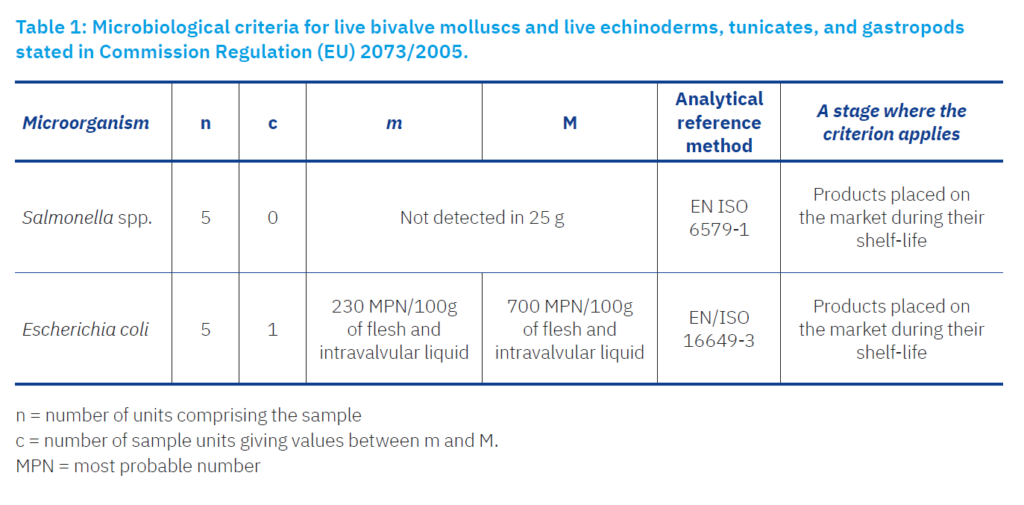
According to Commission Regulation (EC) No 2073/2005 (European Commission, 2005) and its amendments, E. coli and Salmonella spp. are microbiological parameters used to assess the safety of gastropods intended for human consumption, with E. coli serving as an indicator of faecal contamination. Microbiological criteria are listed in Table 1. Regulation (EC) No 853/2004 (European Commission, 2004) laying down specific hygiene rules for food of animal origin, also applies.
Although B. brandaris can be contaminated with bacteria (Serratore et al., 2019) and biotoxins such as paralytic shellfish poison (Hwang et al., 1995; Asakawa, 2017), to the best of the authors’ knowledge, this species not been studied in Croatia with regard to food safety. The aim of this study was to determine the presence of Salmonella spp. and the most probable number (MPN) of E. coli in B. brandaris harvested from the Adriatic Sea off the western coast of Istria.
Materials and methods
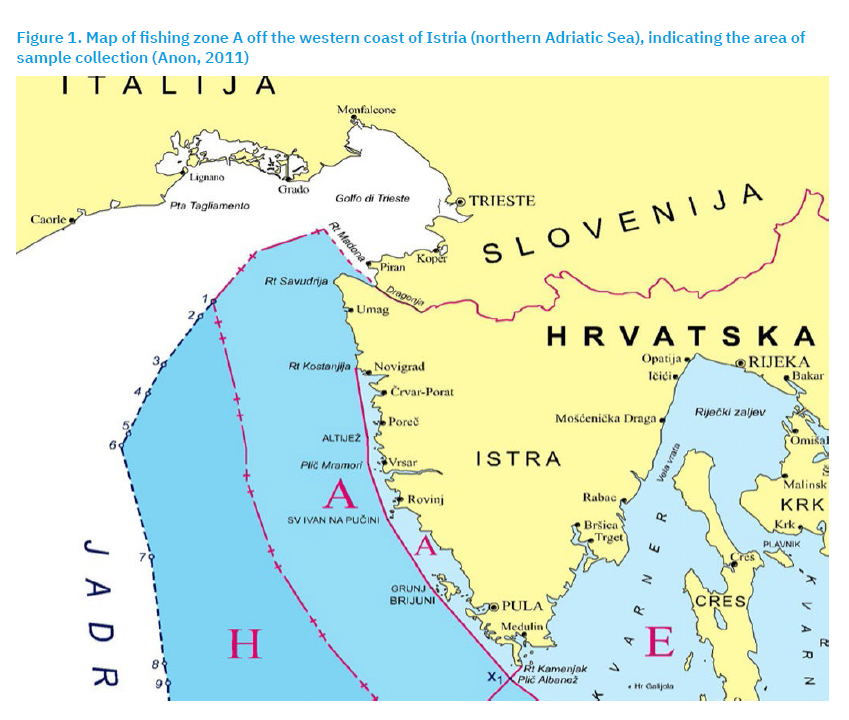
A total of 48 specimens of B. brandaris were collected between 2015 and 2023. Samples were obtained from the offshore dispatch centre, where they were delivered as bycatch from routine bottom-trawling activities conducted in fishing zone A off the western coast of Istria in northern Adriatic Sea.
Samples were delivered to the laboratory within three hours of capture under refrigerated conditions. Upon arrival, they were stored at 3 ± 2°C until analysis, which commenced no later than 24 hours after sampling.
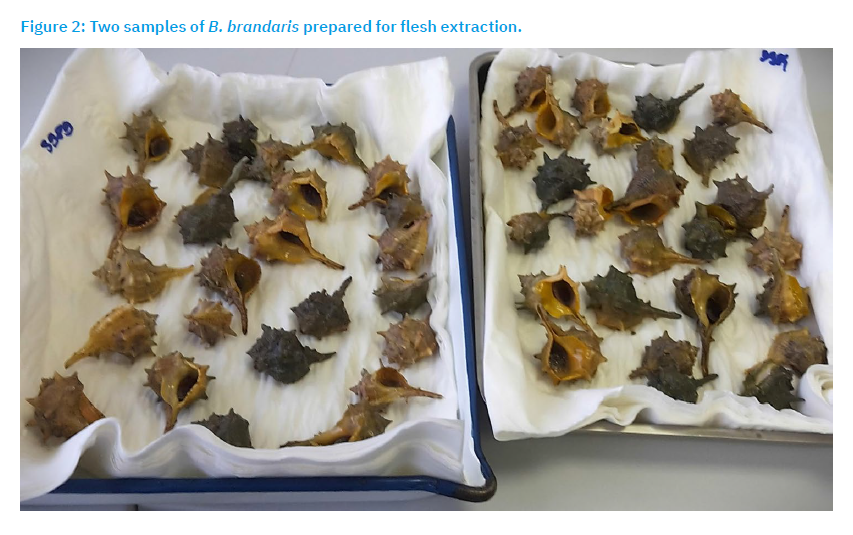
Test samples were prepared according to HRN EN ISO 6887-3:2017/A1:2020, which specifies that a sample of marine gastropods should consist of at least ten individuals. Additionally, the protocol described by Stockley (2024) states that the combined weight of shellfish flesh and intravalvular liquid used for the determination of E. coli should be at least 50 g. Therefore, 20 to 30 suitable snails were prepared for analysis by scrubbing off mud and sediment under running cold tap water, after which the gastropod meat was extracted using sterile forceps. After extraction, the flesh was diced with scissors to facilitate homogenisation. Then, 25 g flesh was weighed for Salmonella spp. detection, while the remaining extracted meat was used for determination of the MPN of E. coli.
For the detection of Salmonella spp., the method according to HRN EN ISO 6579-1:2017 and its Amendment 1 was applied, using XLD agar ISO formulation (Biolife Italiana S.r.l, Italy) and Chromogenic Salmonella Agar (Biolife Italiana S.r.l, Italy) for plating. Taylor Lysine Decarboxylase Broth, Urea agar prepared according to Christensen and Triple Sugar Iron Agar ISO (Biolife Italiana S.r.l, Italy) were used to determine the biochemical characteristics of the presumptive Salmonella spp.
After initial dilution and homogenisation in a peristaltic homogeniser, the method according to HRN EN ISO 16649-3:2015 was applied. Selective enrichment was performed using five tubes of 10 mL Glutamate Broth Modified (Biokar Diagnostics, France), after which, Tryptone Bile X-gluc (TBX) Agar (Biolife Italiana S.r.l, Italy) was used for plating, while the MPN tables (Stockley, 2024) were used to determine the MPN of E. coli in 100 g samples.
Results
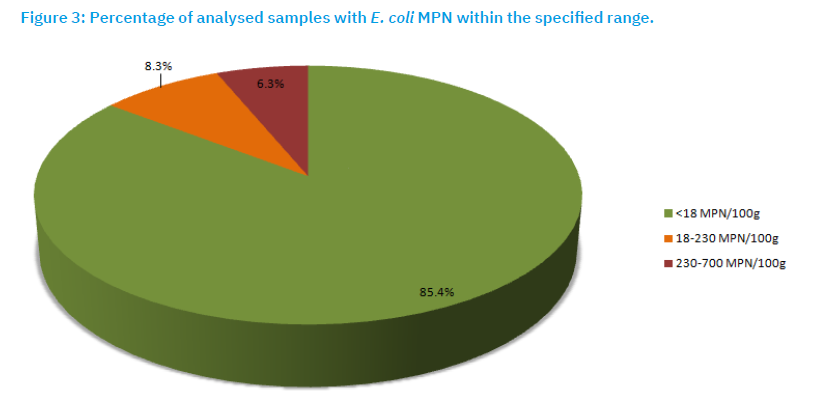
Salmonella spp. was not detected in any of the 48 tested samples. In 41 samples, the E. coli MPN was below the method limit of quantification, i.e., <18 MPN/100g. Four samples ranged from 18 to 230 MPN/100g, while three samples had E. coli levels between 230 and 700 MPN/100g, with a maximum of 490 MPN/100g. No samples exceeded 700 MPN/100g. The results are shown in Figure 3.
Discussion
According to Commission Regulation (EC) No 2073/2005, samples must consist of five units and the results can only be interpreted if all five units have been analysed. Nevertheless, a comparison of the analytical results with the criteria given in the Regulation can give an indication of the microbiological status of the samples.
Salmonella spp. was not detected in any of the 48 tested samples, while E. coli was below the method quantification limit (<18 MPN/100g) in 85.4% of the samples. In four samples (8.3%), E. coli was detected in concentrations ranging from 18 to 230 MPN/100g, corresponding to the lowest quantifiable level and the “m” threshold specified in Commission Regulation (EC) 2073/2005, meaning that a total of 45 samples (91.6%) had E. coli counts below 230 MPN/100g, i.e., below the “m” limit.
Three samples (6.3%) contained E. coli at levels between “m” and “M” limits, while none of the samples exceeded 700 MPN/100g, or “M” threshold.
The Croatian annual monitoring plan for marine and shellfish quality (Anon, 2024) requires samples consisting of one unit, while the Regulation on microbiological classification of production areas (Anon, 2022) considers 230 MPN/100g E. coli as a compliant result. Therefore, 91.6% of samples can be considered acceptable for E. coli.
These results are consistent with a study of E. coli and Vibrio spp. carried out on seven batches of B. brandaris and 21 batches of Nassarius mutabilis from the Adriatic Sea in Italy, where all batches were negative for E. coli (Serratore et al., 2019). A similar study was conducted by Lorito (2022) with Tritia mutabilis and B. brandaris, with comparable results in the absence of E. coli. A notable result was contamination with Vibrio spp. in both studies.
Corresponding results were obtained in studies in Turkey on another predatory marine gastropod species, Rapana (R.) venosa. Altuğ and Güler (2002) found E. coli ranging from 7×10 to 1.1×10³ MPN/100g analysing 75 sample groups of R. venosa. However, in that study Salmonella spp. were detected in two sample groups, while in our study Salmonella was not detected in any of the samples, similar to a study on antimicrobial resistance genes in R. venosa in which several bacterial species were identified, but E. coli and Salmonella spp. were not detected (Ozbey et al., 2023).
Our negative results for Salmonella spp. are consistent with findings in other molluscs from the Mediterranean and Adriatic regions, where small percentages of positive samples were detected only in larger sample sizes. For example, Mudadu et al. (2022) detected Salmonella in 0.6% of 2330 samples of live bivalve molluscs marketed in Sardinia, while E. coli was below 230 MPN/100g in 97.6% of the samples. In Spain, Salmonella spp. was detected in 1.8% of 2980 samples of live molluscs (Martinez-Urtaza et al., 2003). A study by Fusco et al. (2013) on 59 samples of Italian bivalve molluscs found E. coli counts higher than 230 MPN/100g in nine (15%) samples, while Salmonella spp. was not detected. Ripabelli et al. (1999) did not detect Salmonella spp. in any of the 62 samples of mussels from the Adriatic Sea, similar to another study on ten samples of bivalve molluscs from the Adriatic Sea where Salmonella was not detected, while E. coli was found in four of ten samples, ranging from of 1.9×10² to 3.5×10² in 100g (Čanak et al., 2018). Croci et al. (2007) conducted a study on 235 shellfish samples obtained from different sites in the northern Adriatic Sea. None of the samples were positive for Salmonella, and the majority (93%) the number of E. coli was below the European legislative limit of 230 MPN/100g.
The European Food Safety Authority (EFSA) and the European Centre for Disease Prevention and Control (ECDC) annually report zoonosis data from European Union Member States, the United Kingdom (Northern Ireland), and eight non-Member States, including information on Salmonella spp. in live bivalve molluscs as well as live echinoderms, tunicates, and gastropods. The data reported by EFSA and ECDC for the period from 2020 to 2024 (EFSA and ECDC, 2021, 2022, 2023, 2024, 2025) are presented in Table 2.
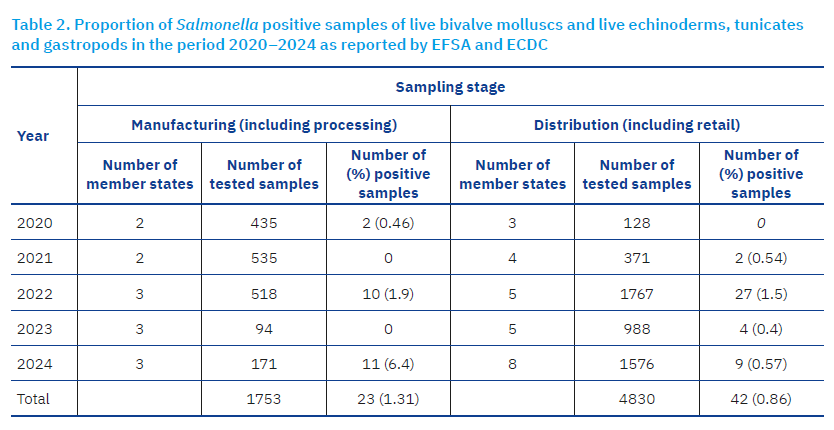
Due to the small sample size, the results of this study are limited and further research on a larger scale is needed. However, they are consistent with findings from other research conducted in the Mediterranean region, including the Adriatic Sea, as well as data reported by EFSA and ECDC.
In contrast, larger quantities of these bacteria were found in studies on filter feeding gastropods in other parts of the world. For example, in a study on periwinkles and other seafood in Nigeria, 6.11–6.76 log10 cfu/g of E. coli and 6.34–6.54 log10 cfu/g of Salmonella were found (Eze et al., 2014). In a study on Cerithidea obtusa from Malaysia and Indonesia, Salmonella was detected in 14.2% of samples, coliform bacteria were present in all 14 samples in numbers greater than 1000 cfu/g, and E. coli was detected in 21.4% of samples (Hazri et al., 2016). Vibrio spp. were found in both studies on filter feeding gastropods, corresponding to the above-mentioned research on predatory gastropods.
Conclusion
Salmonella was not detected in any of the 48 samples, while E. coli was below the quantification limit of the method in 85.4% of the samples, and 91.6% of the samples contained E. coli at a level of less than 230 MPN/100g.
While the present study demonstrated that most samples of marine gastropod B. brandaris were not contaminated with faecal matter and were negative for Salmonella spp., the limited sample size should be taken into account when assessing the safety of B. brandaris for public health. Furthermore, previous studies have reported the presence of Vibrio spp. and marine biotoxins in marine gastropods, highlighting the potential risk to human health. Therefore, further research with a larger number of samples and a wider range of analyses is needed to provide a more complete assessment of their safety for public health. These findings reinforce the importance of proper heat treatment before consumption to ensure consumer safety.
Acknowledgements
The authors thank Mr Krešimir Putinja for his valuable insights into local fishing practices.
References [… show]
Prevalencija Salmonella spp. i Escherichia coli u bodljikavim volcima, Bolinus brandaris, ulovljenim u Jadranskom moru uz zapadnu obalu Istre
Barbara BOLJKOVAC BEGIĆ* (dopisni autor), boljkovac.vzr@veinst.hr, orcid.org/0009-0000-1423-0075; Karmela Nina BARAĆ, barac.vzr@veinst.hr, orcid.org/0009-0003-9474-6363; Mirela SABLIĆ, sablic@veinst.hr, orcid.org/0009-0003-6298-7664; Natalija DŽAFIĆ, dzafic.vzr@veinst.hr, orcid.org/0000-0001-7658-5517.
Laboratorij za mikrobiologiju i analitičku kemiju, Veterinarski zavod Rijeka, Hrvatski veterinarski institut, 51000 Rijeka, Hrvatska
Sažetak
Bodljikavi volci (Bolinus brandaris), vrsta jestivih morskih puževa, love se za ljudsku prehranu u mediteranskim zemljama uključujući i Hrvatsku. Kada su namijenjeni za ljudsku prehranu, morski puževi podliježu europskom zakonodavstvu o sigurnosti hrane. U ovom istraživanju korištene su standardne mikrobiološke metode za određivanje prisutnosti Salmonella spp. i Escherichia coli u 48 uzoraka Bolinus brandaris ulovljenih u Jadranskom moru na zapadnoj obali Istre. Bakterije roda Salmonella nisu bile nađene niti u jednom uzorku. Bakterija E. coli bila je ispod granice kvantifikacije metode u 85,4% uzoraka. Četiri uzorka (8,3%) sadržavala su E. coli između 18 i 230 MPN/100g. Tri uzorka (6,3%) sadržavala su E. coli u vrijednosti između 230 i 700, dok niti jedan uzorak nije prelazio 700 MPN/100g. Iako su u ovoj studiji morski puževi sadržavali mali broj E. coli i bili sigurni u pogledu Salmonella spp., potrebna su daljnja istraživanja kako bi se procijenila prisutnost drugih mikroorganizama i kontaminanata.
Ključne riječi: Bolinus brandaris, Salmonella, MPN, Escherichia coli, Jadransko more, Istra
