
Seasonal variations in the somatic cell count in cow’s milk: a key indicator of mammary gland health
A. Ćutuk*, K. Karamatić, P. Bejdić, N. Hadžimusić, E. Šaljić, B. Pehar and B. Čengić
Amel ĆUTUK1* (corresponding author), amel.cutuk@vfs.unsa.ba; Kristijan KARAMATIĆ2; Pamela BEJDIĆ3; Nejra HADŽIMUSIĆ3;
Ermin ŠALJIĆ3; Bianca PEHAR3; Benjamin ČENGIĆ3.
1 Department of Clinical Sciences, Faculty of Veterinary Medicine University of Sarajevo, 71000 Sarajevo, Bosnia and Herzegovina
2 Vita-Vi Dairy Farm, 88300, Čapljina, Bosnia and Herzegovina
3 Faculty of Veterinary Medicine, University of Sarajevo, 71000 Sarajevo, Bosnia and Herzegovina
 https://doi.org/10.46419/cvj.57.2.10
Abstract
Evaluating the somatic cell count (SCC) at the level of the herd or individual cows allows for efficient monitoring of mammary gland health. By analysing SCC, it is possible to identify subclinical cases of mastitis that do not manifest through visible clinical signs on the udder or changes in milk. This study was conducted on a modern dairy farm of the Holstein-Friesian breed in the municipality of Čapljina, Bosnia and Herzegovina. The total number of cows included in the study during 2022 and 2023 ranged between 325 and 335. Milk samples were preserved with azidiol and transported to the laboratory. Milk quality was assessed by determining the SCC in milk using the Fluoro-opto-electronic method, and by analysing the fat, protein, and lactose contents. The devices used in the study were CombiFoss 6200 – MilkoScan FT and Fossomatic FC 6000. A strong positive correlation was found between SCC and milk proteins, but not with milk fat. A significant negative correlation was found between SCC and lactose. There was no significant difference in the number of somatic cells by year, although there was a significant difference by season within the studied years. Winter stands out as the season with the lowest SCC, followed by spring and summer, while autumn had the highest count. Autumn also showed the largest oscillations in SCC, while spring had the smallest. Somatic cell counts over 200,000/mL were recorded from July to December 2022 and from May to November 2023. Zoohygiene conditions and milking hygiene measures should be additionally adjusted in summer and autumn to maintain the desired standards achieved in winter and spring.
Key words: cow; somatic cells count; mastitis; milk; season; oscillations
Introduction
The milk gland or udder in cows (glandula lactifera) is a specialised skin gland consisting of four separate secretory glands or quarters in which milk is produced. Each quarter of the mammary gland consists of the glandular part and the teat. The glandular part or parenchyma has a lobed structure containing the mammary alveoli, representing the functional part of the mammary gland responsible for milk production. The standard lactation period spans from calving to dry-off, typically lasting 305 days, while the ideal dry period ranges between 50 to 60 days (Bachman and Schairer, 2003). Cow’s milk consists of water and dry matter, which is mainly comprised of protein, milk fat and lactose. The ratio of these components varies due to factors like lactation stage, nutrition, age, milking routine and udder health (Tratnik, 1998). A decrease in lactose concentration can precede clinical signs of mastitis, making its monitoring useful for early detection of subclinical mastitis (Havranek and Rupić, 2003). Disruption in the chemical composition of milk, as a result of mastitis, leads to weaker curdling, poorer processing of milk, and a shorter shelf life of the product due to higher water content (Harmon, 1994).
Routine milk screening includes testing for the somatic cell count (SCC), or counting the numbers of sloughed udder epithelial cells and leukocytes in the blood that play a crucial role in defending the mammary gland against infections. These cells are part of the udder’s innate immune system and include leukocytes (neutrophil granulocytes, macrophages, and lymphocytes), and a smaller number of sloughed epithelial cells (Benić et al., 2018; Sumon et al., 2020). SCC is a key indicator for diagnosing subclinical mastitis and is considered the gold standard. Measurement methods for SCC include both indirect and direct methods. Indirect methods for determining the number of somatic cells include: California mastitis test (CMT), Wisconsin mastitis test (WMT) and Zagreb mastitis test (ZMT) (Maćešić et al., 2016). The direct microscopic somatic cell count (DMSCC) method is a simple and inexpensive technique for enumerating various cell types such as lymphocytes, neutrophils and macrophages in milk samples, using fluorescence cytometry (Dang et al., 2008).
There are many factors that influence the somatic cell count at the individual and herd levels (Dong et al., 2013; Tomanić et al., 2024), including genetics, age, body condition, housing conditions, season, stress, lactation stage, udder anomalies, milking hygiene, and inflammatory conditions, where a higher SCC is often associated with inflammation caused by bacterial infection (França et al., 2017; Wollowski et al., 2019; Stocco et al., 2020; Lamari et al. 2021). SCC is associated with inflammatory processes, both infectious and non-infectious, and can be used as a diagnostic tool to assess udder health (Cvetnić et al., 2016; Ivanov et al., 2016). A high SCC alters the quality and composition of milk, making it unsuitable for processing and safe human consumption (Antunac et al., 1997; Sharma et al., 2011; Dos Reis et al., 2013; Kull et al., 2019; Stocco et al., 2020).
Pasteurisation can kill most pathogenic bacteria found in milk, though some bacteria can still survive, such as Mycobacterium avium, Mycobacterium paratuberculosis, Listeria monocytogenes, Bacillus spp. and Clostridium spp. (Grant et al., 1996; Binderova and Rysanek, 1999; Gunasekera et al., 2002; NMC, 2016). Pasteurisation is unable to neutralise toxins already released by pathogenic microorganisms in milk (NMC, 2016).
Zoohygienic conditions in which the animal resides also affect the animal’s health (Cvetnić et al., 2022). When dairy cows are exposed to conditions that exceed their thermal comfort zone, such as high temperatures, relative humidity, solar radiation, air circulation, and precipitation, they experience heat stress. Heat stress is associated with a decline in reproductive performance, milk yield, and economic profit (Malek et al., 2013). According to several studies (Reneau et al., 1986; Schultz et al., 1990; Reents et al., 1995; Skrzypek, 2002; Skrzypek et al., 2003; Dakić et al., 2006; Oudah, 2009), season is an important factor for variations of the number of somatic cells in milk. Variations in SCC are present during the change of seasons, where it has been found that high ambient temperature and humidity lead to an increase in the number of pathogens and a higher incidence of mastitis, especially in summer and autumn (Rice and Bodman, 1993; Harmon, 1994; Khate and Yadav, 2010).
Dakić et al. (2006) suggest that extreme temperatures can have a stressful effect on cows, resulting in an increase in the number of somatic cells in milk from May to September. However, this may not always be the rule, as other researchers reported the highest SCC in winter (Dobranić et al., 2008) or from August to December (Yang et al., 2013). Other studies have shown that the SCC increases during summer, and decreases during winter (Labhom et al., 1998). Vecht et al. (1989) noted a lower SCC during summer compared to autumn, with an increase from summer to autumn, and decrease during the winter and spring.
The objective of this study was to monitor the fluctuations in the number of somatic cells across the seasons over a period of two years.
Materials and Methods
This study was conducted on a Holstein-Friesian dairy cattle farm located in the municipality of Čapljina, southern Bosnia and Herzegovina. The total number of examined animals during the study period in 2022 and 2023 ranged from 325 to 335 animals, depending on the beginning and end of the dry period. The average milk yield per cow was 9,800.75 litres over an average lactation period of 305 days. Cows were kept in a free-range system in four buildings and distributed according to various criteria, such as lactation stage, lactation number, pregnancy, and milk yield.
The housing facilities are equipped with modern automated equipment for cleaning walking surfaces, ensuring regular hygiene and cleanliness of the space where the cows live. Additionally, the buildings are equipped with a ventilation system that allows proper air circulation and maintains optimal temperatures and humidity. The water supply system is regulated by automatic pumps. Cows are fed three times a day with a nutritionally balanced diet based on silage, concentrate, hay, and mineral-vitamin supplements.
Lying areas are insulated from the concrete flooring using rubber mattresses, subjected to regular mechanical washing. After washing, the bedding is sprinkled with a mixture of 30% lime and 70% sawdust. All machinery and equipment used in milking parlour are from the manufacturer DeLaval. The milking parlour is designed in a herringbone configuration with two entrances, each capable of simultaneously accommodating up to 16 cows. Prior to milking, udders were thoroughly washed with warm water. The teats were then dried with a paper towel, and immersed in a disinfectant solution, i.e., pre-dip (Euwash, Arthur Schopf Hygiene, Germany). After the solution was applied, the papillae were dried with a paper towel after 30 seconds.
Before milking, the first three jets were milked and discarded to eliminate any impurities or bacteria. After milking, teats were again dipped in disinfectant, i.e., post-dip (Dip es io-film, Arthur Schopf Hygiene, Germany). Disinfectants are changed regularly every three months to ensure maximum disinfection efficiency and prevent the emergence of resistance.

Milk samples from cows in the study were collected once a month during the midday milking. Milk samples were carefully stored in sterile PVC vials with a volume of approximately 125 mL, with addition of the preservative azidiol to ensure sample stability and integrity. Immediately after storage in PVC bottles, samples were cooled to a temperature of 6–8°C to prevent possible degradation and changes in the milk composition. Samples were then transported to the Federal Institute of Agriculture in Sarajevo following a strictly controlled cold chain.
Analysis of the somatic cell count in milk was carried out according to the BAS ISO 13366-2:2010 standard using the Fluoro-opto-electronic method. Milk quality was assessed according to the BAS ISO 9622:2013 standard, analysing the content of protein, fat and lactose.
CombiFoss 6200 – MilkoScan FT and Fossomatic FC 6000 devices were used for the analysis, in accordance with standard operating procedures (SOP7 and SOP10) and the manufacturer’s instructions. All samples were analysed within 24 hours of collection.
Various statistical methods were applied to process the obtained results, including Pearson’s correlation coefficient, Mann-Whitney U-test, Kruskal-Wallis H-test and Two Sample t-test. Statistical significance of differences was determined at the P<0.05 level. The Statistics Kingdom 2017 software program was used for data analysis, while the results were presented graphically using Microsoft Office Excel 2019.
The study was approved by the Ethics Committee of the Faculty of Veterinary Medicine, University of Sarajevo, Bosnia and Herzegovina (Class no. 07-03-590-2/25 and Reg no. 07-03-590-3/25).
Results
Table 2 presents the mean values of the basic statistical indicators for the daily amount of milk, total milk yield per lactation, somatic cell count, and the percentage of protein, milk fat, and lactose in milk on the examined farm during 2022 and 2023.

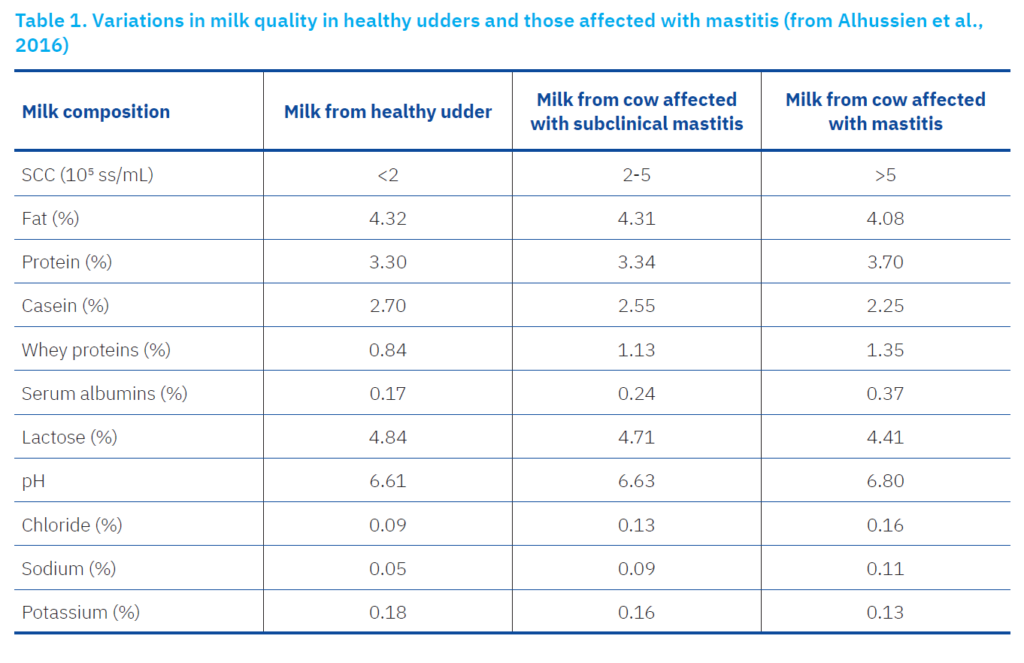
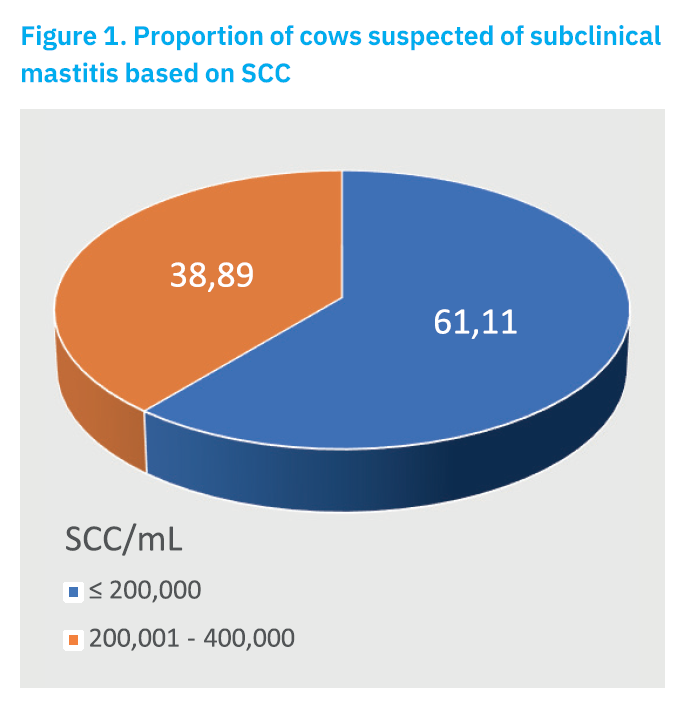
After evaluating the somatic cell count in milk, it was determined that 38.89% of cows on the farm were suspected of having subclinical mastitis, while 61.11% showed no signs of an inflammatory process (Figure 1).
Changes of the protein, milk fat and lactose content depending on the somatic cell counts are presented in Figure 2. Based on the analysis of Pearson’s correlation coefficients, the relationship between SCC in cow’s milk and physicochemical parameters was investigated.
First, for the variables SCC and protein, a strong and significant (P<0.05) positive correlation coefficient was found (r=0.7969) . This indicates that an increase in the somatic cell count leads to an increase in protein levels in milk.
For the variables SCC and milk fat, a statistically insignificant (P>0.05) but weakly positive correlation coefficient (r=0.1415) was found. This means that there is a minimal relationship between the somatic cell count and the fat content in milk.
For the variables SCC and lactose, a significant (P<0.05) and strong negative correlation coefficient was determined (r=-0.9066). This correlation suggests an opposite tendency between the somatic cell count and lactose levels in milk, meaning that increasing the number of somatic cells leads to a decrease in lactose content.

Figure 3 shows the SCC comparison by season, with data grouped into seasons by year: winter 2022 (January, February and December) and winter 2023 (January and December); spring 2022 (March, April and May) and spring 2023 (March and May); summer 2022 (June, July and August) and summer 2023 (July); autumn 2022 (September and October) and autumn 2023 (September, October and November). For all four seasons, the Mann-Whitney U test showed that the differences in SCC values between seasons in 2022 and 2023 were not statistically significant (P>0.05).
Furthermore, the influence of the season on SCC in milk was examined by grouping the data into four seasons regardless of year: winter (January, February, December 2022, January, December 2023); spring (March, April, May 2022, March, May 2023); summer (June, July, August 2022, July 2023); autumn (September, October 2022, September, October, November 2023).
Figure 4 shows the analysis performed using the Kruskal-Wallis H test. A statistically significant difference (P<0.05) was found between the mean values of somatic cell count by season. The group of values marked with different letters (a, b, c, d) were statistically significant (P<0.05). During measurements, the highest SCC was recorded in autumn, followed by summer and spring, while winter had the lowest number of somatic cells. Autumn was the season with the highest oscillations in SCC, while spring is the season with the lowest oscillations in SCC.

Figure 5 shows the monthly fluctuations of SCC throughout the examined period with the standard error of the mean. Months with an SCC >200,000/mL were identified from July to December in 2022, and from May to October in 2023.
The results of the two Sample t-test showed no statistically significant difference in the somatic cell count (P>0.05) during the study period. This suggest that there were no significant changes in the SCC between these months in different years. However, the analysis for May showed a statistically significant difference in the SCC (P<0.05) between the two study years.

Finally, Figure 7 provides a monthly view of the SCC, sorted from the lowest to highest values recorded during the study period. This allows for precise monitoring of variations in the SCC over different months. January 2023 had the lowest SCC of 145,750, while September 2023 had the highest SCC of 245,750 during the study period.
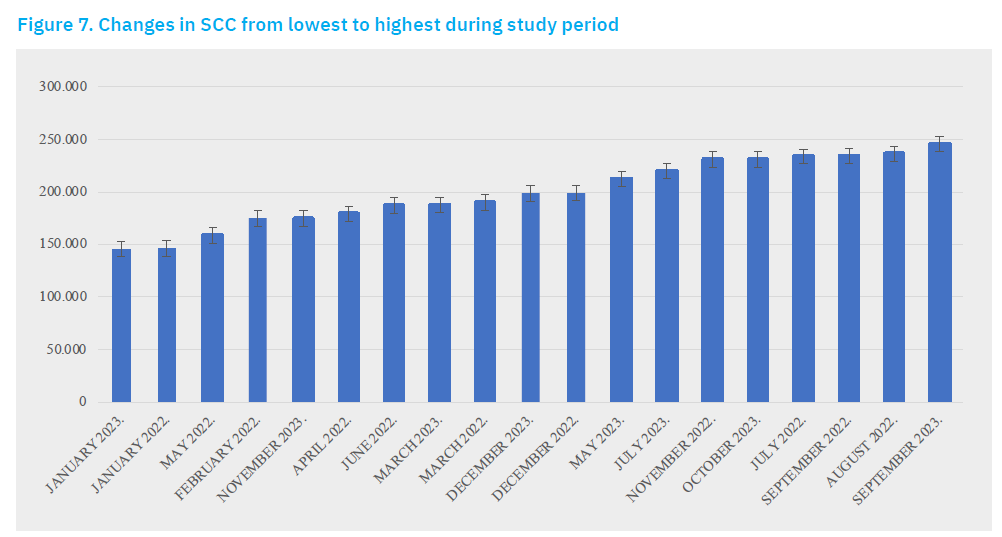
Based on data analysis and the application of the Two Sample t-test, there was a statistically significant difference (P<0.05) in the mean SCC between January 2023 and September 2023.
Discussion
Of the samples analysed, 61.11% had fewer than 200,000 somatic cells indicating a healthy udder (Skrzypek, 1996; Auldist and Hubble, 1998; Barret, 2002). The study found a strong positive correlation between SCC and protein levels in milk. The increased protein content in milk with a higher SCC can be attributed to an increase in the permeability of the udder for large serum proteins during early mastitis development.
Unfortunately, this increase does not affect casein, the high-quality main protein in milk, which decreases with increasing somatic cells. Instead, it raises whey proteins, serum albumin, immunoglobulins, transferrin, and other low-quality proteins due to higher vascular permeability. The present study shows a significant protein increase in milk when somatic cells exceed 200,000/mL, particularly in summer and autumn, affecting cheese production quality.
A low-intensity positive correlation was identified between SCC and milk fat content, but no correlation was seen in the variation of fat content with changes in SCC. Conversely, a negative correlation was observed between SCC and lactose concentration. The decrease in lactose levels in milk corresponding to an increase in somatic cells is attributed to the transfer of lactose from the mammary gland into the bloodstream. It is considered that milk containing less than 4.5% lactose originates from the udder affected by the inflammatory process (Antunac et al., 1997). The periods with the most significant drop in lactose concentration in this study were recorded during the summer and autumn, when SCC levels were higher. In this study, winter had the lowest SCC (172,950), followed by spring (185,570.90), summer (219,343.75), and autumn with the highest count (223,350).
These results corroborate other studies (Schultz et al., 1990; Skrzypek, 2002; Dakić et al., 2006) that have emphasised the importance of season in the variation of the SCC in milk. Their results showed that the lowest SCC was recorded in spring, winter and summer had intermediate values, while autumn had the highest number of somatic cells. Exposure to high temperatures in the summer and increased humidity in autumn can increase the susceptibility of animals to udder infections, resulting in increased SCC (Rice and Bodman, 1993). Additionally, Dakić et al. (2006) confirmed high levels of somatic cells during summer and winter, which they linked to extreme conditions such as high humidity in winter and high temperatures in late spring and summer. However, this study identified high levels of somatic cells during summer and autumn, suggesting that extreme temperatures may have a stressful effect on cows, resulting in an increase in SCC.
SCC exceeded 200,000/mL from July to December 2022, and again from May to November 2023, which partially coincides with Skrzypek et al. (2003), who also observed a high number of somatic cells in milk from May to September. Olde-Riekerink et al. (2007) determined seasonal variations in the SCC in Holstein cows, with a significant increase in SCC from August to September, likely related to heat stress.
Ivkić et al. (2007) highlighted the significant influence of season on SCC. Their analysis showed that the highest SCC was recorded during autumn, winter, summer and spring, with noticeable differences between the seasons, which partially agrees with our findings. From that study, it follows that SCC increases mainly during summer and autumn due to high temperatures and humidity that lead to temperature stress. In order to reduce the SCC increase, cold drinking water (below 10°C) can be made available to the cows, and the air flow in the buildings can be increased by natural and artificial ventilation or by creating tunnel ventilation. It is advisable to sprinkle water on the cows, ensuring that the udders are not soaked. Additionally, all feeders and watering stations within the facilities should be relocated to areas devoid of direct sunlight. Introducing feeding during the cooler part of the day is crucial. Moreover, meals should always be provided fresh, as this further mitigates the adverse effects of temperature stress on milk production and milk quality in dairy cows. The proportion of concentrated nutrients in the meal should be reduced, i.e., reducing the energy value per kg of dry matter and increasing the supply of non-degradable proteins in the rumen (UDP proteins, so-called Bypass proteins). In situations like these, because of the reduced consumption of dry matter per cow, it is necessary to increase the supply of minerals, especially Na and P, and vitamins, especially A and E.
Conclusions
Despite the implementation of proper zoohygienic measures and milking hygiene protocols, nearly 39% of the examined cows showed signs of suspected subclinical mastitis. An increase in SCC in milk was associated with higher total protein levels and a decrease in lactose content, making these parameters useful for diagnosing subclinical mastitis. No statistically significant differences in total SCC were observed at the annual level or in comparation of the same season between years, though significant variation was found between seasons in each studied years. Winter had the lowest SCC, followed by spring, and summer, while autumn recorded the highest SCC. Monthly SCC levels exceeding 200,000/mL were observed from July to December 2022 and from May to November 2023. Based on these findings, improvements in zoohygienic conditions and management practices particularly concerning temperature control, humidity regulation, and disinfectant rotation are necessary during summer and autumn to achieve optimal udder health and milk quality.
References [… show]
Dinamika promjene broja somatskih stanica u mlijeku krava kao indikator zdravlja mliječne žlijezde
Amel ĆUTUK1* (dopisni autor), amel.cutuk@vfs.unsa.ba; Kristijan KARAMATIĆ2; Pamela BEJDIĆ3; Nejra HADŽIMUSIĆ3; Ermin ŠALJIĆ3; Bianca PEHAR3; Benjamin ČENGIĆ3.
1 Department of Clinical Sciences, Faculty of Veterinary Medicine University of Sarajevo, 71000 Sarajevo, Bosnia and Herzegovina
2 Vita-Vi Dairy Farm, 88300, Čapljina, Bosnia and Herzegovina
3 Faculty of Veterinary Medicine, University of Sarajevo, 71000 Sarajevo, Bosnia and Herzegovina
Procjena broja somatskih stanica (SCC) za cijelo stado ili pojedinačne krave omogućuje učinkovito praćenje zdravlja mliječnih žlijezda. Analizom SCC-a moguće je identificirati subkliničke slučajeve mastitisa koji se ne manifestiraju vidljivim kliničkim znacima na vimenu ili promjenama u mlijeku. Istraživanje je provedeno na suvremenoj mliječnoj farmi holštajn-frizijske pasmine, u općini Čapljina. Ukupan broj krava uključenih u istraživanje tijekom 2022. i 2023. godine iznosio je između 325 i 335. Uzorci mlijeka konzervirani su azidiolom i transportirani u laboratorij. Kakvoća mlijeka procijenjena je pomoću SCC-a u mlijeku korištenjem fluoro-opto-elektronske metode i analizom sadržaja masti, proteina i laktoze. Uređaji korišteni u studiji bili su CombiFoss 6200 – MilkoScan FT i Fossomatic FC 6000. Utvrđena je jaka pozitivna korelacija između SCC i proteina mlijeka, ali ne i mliječne masti. Dodatno, utvrđena je značajna negativna korelacija između SCC-a i laktoze. Nije bilo značajne razlike u SCC između 2022. i 2023. godine, iako je postojala značajna razlika s obzirom na godišnja doba unutar proučavanih godina. Zima se ističe kao godišnje doba s najmanjim SCC, a slijede proljeće, ljeto i jesen s najvećim. Jesensko razdoblje je pokazalo najveće oscilacije u SCC-u, dok ih je u proljeće bilo najmanje. SCC preko 200.000/mL javljao se od srpnja do prosinca 2022. i od svibnja do studenog 2023. Zoohigijenske uvjete i mjere higijene mužnje treba dodatno prilagoditi ljeti i u jesen da bi se održali poželjni standardi postignuti zimi i u proljeće.
Ključne riječi: krava, broj somatskih stanica, mastitis, mlijeko, godišnje doba, oscilacije
