
Urban Wild Boars – from Biodiversity to a Potential Public Health Concern
D.Jaić, B. Reindl, M. Bujanić, A. Gašpar, D. Želježić, Lj. Barbić, K. Krapinec and D. Konjević*
Dejan JAIĆ1, dejan.jaic@zagreb.hr; Branimir REINDL2, branimir.re@gmail.com; Miljenko BUJANIĆ3, miljenko.bujanic@vef.hr, orcid.org/0009-0000-1421-3339; Anđelko GAŠPAR4, hvk@hvk.hr; Darko ŽELJEŽIĆ5, zeljezic@veinst.hr; Ljubo BARBIĆ3, ljbarbic@vef.unizg.hr, orcid.org/0000-0002-5170-947X; Krešimir KRAPINEC6, kkrapinec@sumfak.unizg.hr, orcid.org/0000-0002-8815-7568; Dean KONJEVIĆ3* (corresponding author), dean.konjevic@vef.unizg.hr, orcid.org/0000-0002-8584-9825;
1City of Zagreb, City Office for Economy, Environmental Sustainability and Strategic Planning, Sector for Agriculture, Forestry and Hunting, 10000 Zagreb, Croatia
2Wilderness Research and Management j.d.o.o., 10314 Novoselec, Croatia
3 Faculty of Veterinary Medicine, University of Zagreb, 10000 Zagreb, Croatia,
4Croatian Veterinary Chamber, Heinzelova 55, 10000 Zagreb, Croatia;
5Croatian Veterinary Institute, Savska cesta 143, 10000 Zagreb, Croatia;
6 Faculty of Forestry, University of Zagreb, 10000 Zagreb, Croatia
Abstract
The growth of the human population, the expansion of settlements and the entry of people into the habitats of wild animals result in an increasingly frequent occurrence of wild animals in cities. Within urban areas, some wild species can find adequate conditions for survival, which are sometimes even more suitable than those in natural habitats. This has a positive impact on biodiversity, though such species can also have a negative impact on species already present in cities. Consequently, the impact of each species on the population of humans, domestic and wild animals should be observed separately. One species of particular importance is the wild boar (Sus scrofa), which adapts exceptionally well to the urban habitat. Green corridors, green areas in the city, abandoned orchards and vineyards, and inadequate waste disposal represent the basic prerequisites for their entry and survival in urban environments. Additionally, many studies have described the fundamental adaptations of wild boars to new, anthropogenic habitats. However, wild boars can cause problems in traffic, relationship with pets and people, and serve as a potential source of pathogens, though the available data suggest a lower prevalence of certain zoonotic pathogens (such as the hepatitis E virus, Campylobacter spp., Arcobacter spp., Streptococcus suis, Toxoplasma gondii, Trichinella spp., etc.) than from animals from rural areas. Nevertheless, the greater possibility of contact with wild boar excretions (primarily faeces) in cities emphasises the need to monitor the health status of wild boars and to conduct risk analysis for infection/invasion. Both activities are fundamental for the transfer of information and raising awareness as to the risks and protection of human health in urban areas.
Key words: wild boars; urbanisation; urban wildlife; public health
Introduction
In 1960, Edward S. Deevey Jr. stated that the human population numbered about 2.7 billion people, and that with a predicted increase of 1 to 3%, it would reach about 6.2 billion by 2000. According to data from the Worldometer database on October 2025, the human population was around 8.2 billion. From this, it is obvious that previous predictions of potential differences in the ratio of births and deaths, were relatively accurate. Such population growth brings with it an understandable need for the increased use of natural resources, including space, which is already beginning to pose a serious problem for the human population. Even Malthus (1798) stated that such an increase in human needs would become of crucial importance for the sustainability not only of humanity, but also of wildlife and ecosystems in general, and that the potential for human population growth could exceed the capacity of the habitat to maintain it. When it comes to spatial resources, this is not uniform for different types of settlements, since the main centres of human expansion are cities. In 2008, for the first time in history, more people were recorded in cities than in other types of settlements. This trend has continued, and is particularly present in more developed countries. In Europe, it is estimated that almost 80% of people live in cities (Antrop, 2004), and Croatia is no exception. As an example, we describe the development of the City of Zagreb, although many other cities in Croatia and in the world exhibit similar issues of settlement expansion and urbanisation of wildlife. One of the first steps in the growth of Zagreb as an urban settlement occurred on 7 September 1850, when Gradec and its suburbs were legally merged with the diocese and other neighbouring settlements (Pongrac, 2013). By the end of the 19th century, industrialisation led to a more pronounced population increase in the town, with the 1880 census recording 215 more households than in 1869 (Goldstein, 2012). The growth of the city’s population and the city itself naturally continued, in line with global trends, and this population growth was accompanied by a need for the spatial expansion of the city. This was initially achieved by demolition of the Gradec walls and the majority of the city gates (Radović Mahečić, 2010), with further expansion towards the slopes of Mt. Medvednica to the north, and across the Sava River to the south.
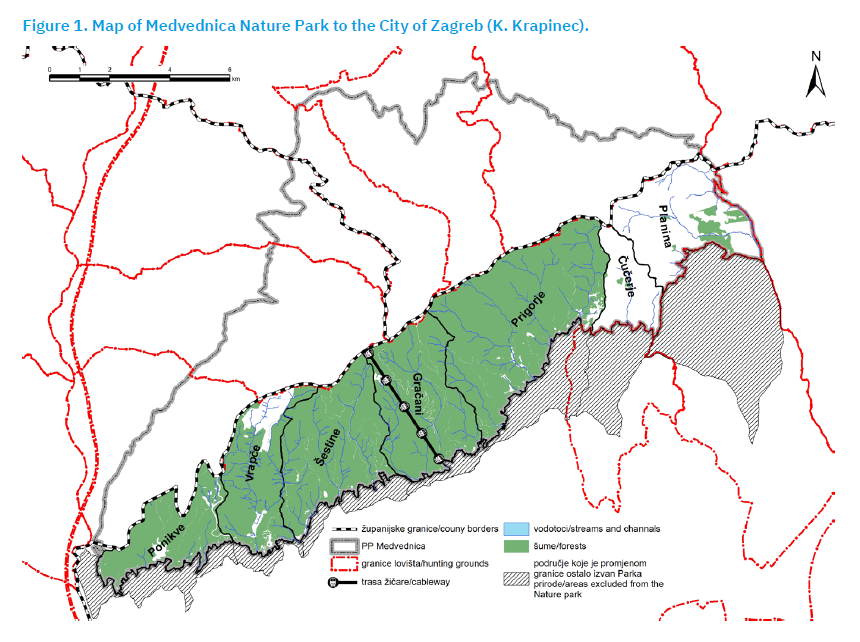
The currently valid game protection programme for the Medvednica Nature Park shows a reduction in the park area and expansion of the urban zone (Krapinec, 2020) (Fig. 1).
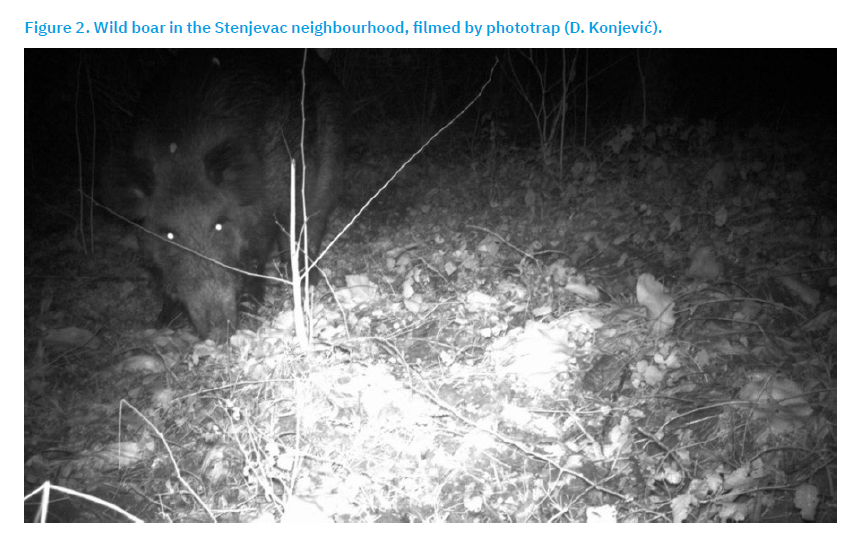
Why is this important? As human settlements and infrastructure expand into previously unoccupied zones, habitats become fragmented and wild species are forced to become regular inhabitants of cities. One of these species is the wild boar (Fig. 2).
Urban wild boars in the sense of biodiversity
Compared to the natural environment, urban areas have decreased biodiversity and species abundance (Faeth et al., 2011). This is one of the reasons for an increasing demand for the creation and support of a higher proportion of green, non-managed areas (Müller et al., 2018), which in general supports all species in the city, in comparison to suburban and rural areas. Another view is based on individual animal species. Some have suggested that the presence of wild boars in cities is positive from a biodiversity standpoint, as it represents at least one more animal species in the city. Whether each new species really represents an increase in biodiversity is highly questionable. Namely, certain species adapt easily to urban environments and can indirectly affect the survival of ”more sensitive” species, but they can also affect them directly through the killing of juveniles, destruction of nests, etc. A good example are the members of the crow family (including magpie, hooded crow, raven, etc.). Its members directly attack nests, young and even adults of other bird species, such as sparrows, finches, blackbird, pigeons, turtledoves, etc. In this way, one species can increase biodiversity, but when examined more carefully, it can suppress other species and in turn have exactly the opposite effect. Therefore, the issue of increasing biodiversity is highly questionable and requires detailed study for each species.
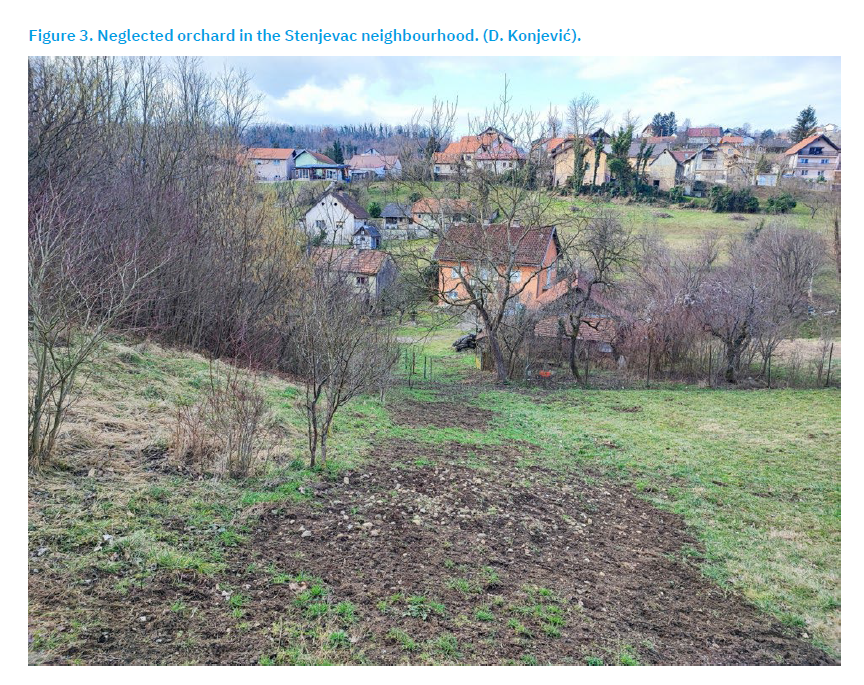
Wild boar is highly adapted to urban environments, and as such is starting to pose a problem in many cities (Dinter, 1991; Cahill et al., 2003, 2012; Jansen et al., 2007; Podgorski et al., 2013). Why are wild boars so successful? Firstly, due to their high adaptability. In urban environments, wild boars are more likely to encounter people and pets, especially dogs, and in such situations, they either completely retract from that area or adjust to the new conditions. Research on wild boar behaviour in a so-called “environment of fear” has shown that the flight reaction from an unpleasant situation in urban wild boars is one third weaker than in rural ones, and that individuals more rapidly return to the location of the disturbance, including traps (Stillfried et al., 2017). This change in behaviour towards danger indicates an easier acceptance of risk, which in turn increases the chances of exploiting the available resources. Secondly, wild boars take advantage of easily accessible food sources. In the City of Zagreb, this includes numerous neglected orchards and vineyards that still bear fruit, unfenced or inadequately fenced gardens, discarded food, improperly stored household waste, etc. (Fig. 3). Small, fragmented green areas nowadays represent a highly favourable habitat for wild boars. This observation is confirmed by wild boar sightings reported by Zagreb citizens, but also by the locations where wild boars have successfully been removed from the city (Konjević and Krapinec, 2025). Such a distribution of wild boars in the city is not unusual. Castillo-Contreras et al. (2018) monitored 3184 wild boars and conducted Boosted Regression Tree modelling analysis to find that wild boars tend to continuously use the same entrances into the city from nearby habitats, and these can be considered natural corridors for unhindered passage to isolated green areas. In Zagreb, wild boars have been found in isolated, uncultivated and undeveloped areas located either near Medvednica Nature Park or along the Sava River (Konjević and Krapinec, 2025), and their presence has a distinct seasonality. For example, in Spain, a higher number of wild boars was found in the spring, attributable to an increase in the population due to newborn piglets. In Zagreb, a decrease in numbers was found during the winter, likely due to a lack of shelter (after leaf fall) and food availability, as wild boars partially retreat to peri-urban areas (Konjević and Krapinec, 2025). In any case, it is likely that the urban environment is favourable habitat for wild boars. Castillo-Contreras et al. (2021) found that wild boars in cities achieve a greater body mass and are generally larger than rural wild boars, which also supports these findings.
In addition to the potential impact on urban flora and fauna, wild boars also pose a potential traffic issue (wildlife-vehicle collisions) and can also have negative interactions with pets, especially dogs (Cahill et al., 2012; Morelle et al., 2013; Šprem et al., 2013; Sütő et al., 2020). There is generally a minimal risk of wild boar attacks against humans, unless disturbed, especially sows with piglets and yearlings. However, regardless of the low risk, the wild boar presence arouses fear and discomfort among much of the population.
Possible public health concern
Wild boars are potential carriers of various pathogens, including those of zoonotic potential, emphasising the need to monitor the health status of this species, especially in areas where they are in potentially close contact with humans. This paper lists several of these pathogens with zoonotic potential.
González-Crespo et al. (2023) developed mathematical models to predict the transmission of hepatitis E virus, African swine fever virus and Campylobacter spp. by wild boars in five areas in Spain. According to the model, the main source for the spread of hepatitis E virus and Campylobacter spp. is wild boar faeces. Schielke et al. (2009) analysed liver samples from 148 wild boars and determined a 14.9% prevalence of the hepatitis E virus, which was significantly lower in urban than rural wild boars (Berlin/Potsdam P=4.1%). In Spain, a 23.2% prevalence was determined in a sample of 142 wild boars (Rivero-Juarez et al., 2018). Krapinec and Konjević (2025) determined a prevalence of hepatitis E at almost 50% of wild boars from Medvednica Nature Park. Jemeršić et al. (2019) reported that seroprevalence for hepatitis E virus in wild boars ranged from 6.2 to 31.1% depending on the year of sampling. In our case, there are no data on the prevalence of this virus among urban wild boars, although the higher prevalence in peri-urban areas could suggest a higher prevalence among urban wild boars compared to other countries. Although it is evident that the prevalence is lower among urban wild boars, there is the possibility of contact with wild boar faeces and thus of potential risk of contracting the virus. A high prevalence of antibodies to the hepatitis E virus has been detected in foresters and hunters, and accordingly it is considered an occupational disease (Carpentier et al., 2012; Bauman-Popczyk et al., 2017).
Recently, bacteria from the genera Arcobacter have attracted particular attention (Kerkhof et al., 2022), alongside members of the genus Campylobacter that have long been recognised as a significant public health concern. Bacteria from the genus Arcobacter were initially classified in the genus Campylobacter, before being transferred into a separate genus (Vandamme et al., 1991). Several species of the Arcobacter genus are known to cause infections in humans, with two species (A. butzleri and A. cryaerophilus) classified as foodborne pathogens of emerging importance. Kerkhof et al. (2022) analysed faecal samples from 76 wild boars in the Campania region, Italy, and determined the presence of Campylobacter spp. in 38 samples (50.0%), while eight samples were positive for Arcobacter spp. (10.5%). Navarro-Gonzalez et al. (2013) found C. coli in 4.88% of samples collected from urban wild boars in Barcelona. Ziomek et al. (2023) found a 44.56% prevalence of Campylobacter spp. Of these, 42.62% of faecal samples were positive, in addition to 18.18% of carcass samples, 4.81% of liver samples and 1.97% of bile samples. Four species were identified, C. coli, C. lanienae, C. jejuni and C. hyointestinalis. From these studies, it is evident that wild boars represent a potential source of these bacteria, especially in cases of poor hygiene practice during skinning and evisceration of hunted wild boars.
Wild boars can also be carriers of Streptococcus suis, and, importantly, strains with the cps2 gene (cause of meningitis in humans and pigs) and strains with the same molecular profile as those that cause severe infections in humans (Fernández-Aguilar et al., 2018). Baums et al. (2006) found a 92% prevalence of S. suis in a sample of 200 wild boars. Additionally, research on antibiotic-resistant strains is currently attracting particular attention in scientific communities.
Toxoplasma spp. and Trichinella spp. are parasites that can cause disease in humans, and have been identified in wild boars. Transmission of both parasites to humans is associated with meat consumption. In Switzerland, Berger-Schoch et al. (2011) analysed wild boars for the antibodies against T. gondii and found a seroprevalence of 6.7% in wild boars, while Papini et al. (2018) found a seroprevalence of 12.2% in Italy. However, Villa et al. (2023) found a prevalence of 53.1% in the population of wild boars from the Po Valley, an area of high human activity. Sgroi et al. (2010) analysed tissue samples from 338 wild boars in the Campania region and found a prevalence of 39.6%, with the highest prevalence in the masticatory muscles, and slightly lower levels in the heart and brain. Regarding infection with Trichinella spp., Rostami et al. (2018) conducted a literature meta-analysis and found an average prevalence of around 7% in wild boars in Europe, while the average infection rate was around 9% in North America, 3% in Asia and 3% in Oceania. According to analyses of the European Food Safety Authority, the prevalence of trichinellosis in wild boars is less than 1% (EFSA, 2018). A similar prevalence (2.03–2.13%) was reported for Spain between 2006 and 2019, with the exception of two hunting seasons in the province of Catalonia (Moral Moral et al., 2022). In Croatia, a prevalence of 0.17% was found on a sample of 183,184 analysed wild boars in the period from 2010 to 2017 (Balić et al., 2020), during which time the trend in prevalence was relatively stable.
Conclusion
Wild boars can be a potential source of various pathogens, including those of importance for the health of domestic animals and humans. With the parallel increase in the human and wild boar populations, the increase in the urban population and the expansion of settlements into wild boar habitats (such as the slopes of Mt. Medvednica), this game species is increasingly entering settlements, both occasionally and permanently. Accordingly, it is necessary to monitor the epidemiological situation related to wild boars, and to conduct regular training of hunters concerning zoonotic diseases and hygiene measures during the evisceration and processing of wild boar carcasses.
References [… show]
Divlje svinje u gradovima – od bioraznolikosti do potencijalnog javnozdravstvenog problema
Dejan JAIĆ1, dejan.jaic@zagreb.hr; Branimir REINDL2, branimir.re@gmail.com; Miljenko BUJANIĆ3, miljenko.bujanic@vef.hr, orcid.org/0009-0000-1421-3339; Anđelko GAŠPAR4, hvk@hvk.hr; Darko ŽELJEŽIĆ5, zeljezic@veinst.hr; Ljubo BARBIĆ3, ljbarbic@vef.unizg.hr, orcid.org/0000-0002-5170-947X; Krešimir KRAPINEC6, kkrapinec@sumfak.unizg.hr, orcid.org/0000-0002-8815-7568; Dean KONJEVIĆ3* (dopisni autor), dean.konjevic@vef.unizg.hr, orcid.org/0000-0002-8584-9825;
1Grad Zagreb, Gradski ured za gospodarstvo, ekološku održivost i strategijsko planiranje, Sektor za poljoprivredu, šumarstvo i lovstvo, 10000 Zagreb, Hrvatska
2Wilderness Research and Management j.d.o.o., 10314 Novoselec, Hrvatska
3 Veterinarski fakultet Sveučilišta u Zagrebu , 10000 Zagreb, Hrvatska
4 Hrvatska veterinarska komora, 10000 Zagreb, Hrvatska
5 Hrvatski veterinarski institut, 10000 Zagreb, Hrvatska
6 Fakultet šumarstva i drvne tehnologije Sveučilišta u Zagrebu, 10000 Zagreb, HrvatskaSažetak
Rast ljudske populacije, širenje naselja i ulazak ljudi u staništa divljih životinja rezultiraju sve češćim zadržavanjem divljih životinja u gradskim područjima. Neke od divljih vrsta u gradovima nalaze zadovoljavajuće uvjete za opstanak, pa čak povremeno i prikladnije od onih u prirodnim staništima. Takav razvoj događaja se s jedne strane pozitivno odražava na bioraznolikost (ulaz novih vrsta), a s druge strane neke od tih vrsta mogu djelovati negativno na vrste koje su otprije prisutne u gradovima. Slijedom navedenoga, utjecaj svake vrste na populaciju ljudi, domaćih i divljih životinja treba promatrati zasebno. Jedna od vrsta od posebnoga značaja danas su divlje svinje, koje se iznimno dobro prilagođavaju urbanom staništu. U tome je očigledno da zeleni koridori, zeleni otoci u gradu, napušteni voćnjaci i vinogradi te neadekvatno odlaganje otpada predstavljaju temeljne preduvjete za njihov ulazak i ostanak u urbanim sredinama. Pored toga, brojna istraživanja ukazuju na temeljne prilagodbe svinja novim, antropogenim staništima. Pri tome, osim izravnih potencijalnih problema u prometu, odnosu prema kućnim ljubimcima i ljudima, divlje svinje predstavljaju i potencijalan izvor uzročnika bolesti. Ipak, prema dostupnim podatcima prevalencija određenih uzročnika sa zoonotskim potencijalom (virus hepatitisa E, Campylobacter spp., Arcobacter spp., Streptococcus suis, Toxoplasma gondii, Trichinella spp.) je niža u usporedbi s ruralnim sredinama. Unatoč tome, veća mogućnost kontakta s izlučevinama divljih svinja (primarno izmet) naglašava potrebu praćenja zdravstvenog statusa divljih svinja u urbanim sredinama te provedbu analiza rizika za potencijalne infekcije/invazije. Obje aktivnosti temelj su za prijenos informacija i edukaciju pučanstva o rizicima i zaštiti zdravlja ljudi u urbanim sredinama.
Ključne riječi: divlje svinje; urbanizacija; divljač u gradu; javno zdravstvo.
Figure legend
Figure 1. Map of Medvednica Nature Park to the City of Zagreb (K. Krapinec).
Figure 2. Wild boar in the Stenjevac neighbourhood, filmed by phototrap (D. Konjević).
Figure 3. Neglected orchard in the Stenjevac neighbourhood. (D. Konjević).
