
Comparison of pregnancy rates of lactating Holstein dairy cows following the implementation of Presynch-Ovsynch, G6G, and Double- Ovsynch protocols during the cool months of the year in the Qazvin plain of Iran
H. Kohsari, K. Berenjian, F. Mohammadi
Hesam KOHSARI, Department of Veterinary Medicine, Ker. C., Islamic Azad University, Kermanshah, Iran, (Corresponding author, e-mail:
hesamkohsari@iau.ac.ir); Khatereh BERENJIAN, Technical manager of Shaghayegh Gharb Pakhsh Veterinary Pharmaceutical Company,
Kermanshah, Iran; Forogh MOHAMMADI, Department of Veterinary Medicine, Ker. C., Islamic Azad University, Kermanshah, Iran
 https://doi.org/10.46419/cvj.57.1.4
Abstract
This study evaluated the effects of three protocols on the pregnancy rate of cyclic lactating Holstein cows 30 days after 18-h fixed-time artificial insemination (FTAI): Presynch-Ovsynch (PO; PGF2α–14 d-PGF2α –12 d-Ovsynch (OVS: GnRH-7 d-PGF2α (PG) –2d– GnRH)–18 h FTAI; n = 210), G6G (PGF2α-2 d–GnRH–6 d-OVS+FTAI; n = 216), and Double-Ovsynch (DO; GnRH–7 d- PGF2α– 3 d–GnRH–7 d– OVS+FTAI; n = 226). The overall pregnancy rates 30 days post- FTAI for cows in the PO, G6G, and DO protocols were 39.5%, 41.2%, and 43.3%, respectively (P > 0.05). The highest and the lowest circulatory concentrations of progesterone were obtained in the DO and PO protocols, respectively (P < 0.01). The double-Ovsynch protocol significantly increased the pregnancy rate in primiparous compared to multiparous cows (P = 0.04), and also compared to the PO protocol (P = 0.04). The use of PO, G6G, and DO protocols in a fixed-time insemination program for cyclic lactating cows did not result in a significant difference in the pregnancy rate 30 days post-insemination, and therefore, a protocol that costs less and is less labour-intensive should be considered.
Key words: Double–Ovsynch; G6G; Presynch–Ovsynch; presynchronisation; dairy cattle
Introduction
Ovulation synchronisation programmes have been developed to improve reproductive efficiency in dairy cows (Ayad et al., 2015). Presynch–Ovsynch (PO), G6G, and Double–Ovsynch (DO) are commonly used ovulation synchronisation protocols for dairy cattle breeding that use gonadotropin– releasing hormone (GnRH) and prostaglandin F2 alpha (PGF2α). These protocols allow cows to be inseminated at a fixed time, thereby eliminating the need for heat detection. This reduces the risk of undetected heat, especially in large herds (Astiz and Fargas, 2013; Dirandeh et al., 2015; Giordano et al., 2016; Abdel-Aziz and Abdel-Wahab, 2017).
A study showed that when the majority of cows were cyclic, the implementation of the Presynch–Ovsynch (PO) and Double–Ovsynch (DO) protocols resulted in similar pregnancy rates (56.8 vs. 59.1%, respectively) in grazing dairy cows (Ribeiro et al., 2012). In another study, implementation of the DO protocol significantly increased the pregnancy rate of dairy cows compared with the PO protocol (Souza et al., 2008). A study compared the pregnancy rates of dairy cows following the implementation of the PO and DO protocols and found a benefit in primiparous cows that received DO protocol for the first postpartum TAI, while this benefit was not observed in multiparous cows (Borchardt et al., 2017). This could be attributed to the stimulation of ovulation in anovular cows following a presynchronisation programme in the DO protocol. In a study in which cows were inseminated on average 86.6 ± 1.9 d postpartum, implementation of the G6G protocol significantly increased the pregnancy rate of cows in comparison to the PO protocol. This may be attributed to the increase in serum concentrations of progesterone (P4) before the final PGF2α injection following the implementation of the G6G compared to the PO protocol (Kohsari and Berenjian, 2022). The implementation of G6G tends to be associated with higher pregnancies per AI (P/AI) than the DO protocol in multiparous cows, though the opposite was observed in primiparous cows (Astiz and Fargas, 2013). The use of presynchronisation in dairy cows with G6G also tends to improve P/AI in comparison to the Ovsynch protocol since it optimises the follicular dynamics and ovulation to the first GnRH injection in the Ovsynch+FTAI programme (Giordano et al., 2016).
The purpose of this study was to compare the pregnancy rates of cyclic lactating dairy cow synchronised using a PO, G6G, or DO protocol for the first postpartum AI. The hypothesis of the current study was that adding injections of GnRH to the presynchronisation protocol, in the form of the G6G and DO protocols, can increase synchrony rate, follicle and oocyte quality, and hormone dynamics, and improve the pregnancy rate of cyclic lactating cows compared with the conventional PO protocol.
Materials and methods
Animals, feeding, housing
This study included 652 cyclic lactating Holstein dairy cows from an industrial dairy farm near Qazvin province, Iran. The study was conducted from September 2023 and May 2024 to eliminate the harmful effects of heat stress on the reproductive performance of cows. Cows without complications such as dystocia, retained placenta, clinical and puerperal metritis, lameness, clinical mastitis, respiratory, and digestive system diseases following the recent parturition were included in the study. The cows had free access to fresh water and were fed twice a day in stalls with a total mixed ration consisting of corn silage, hay as forage, soybean meal-based concentrate, minerals, and vitamins balanced to meet requirements for lactating dairy cows, under the supervision of a nutrition specialist. The forage to concentrate ratio in the diet was 50:50. The amounts of concentrates fed were based on milk production, such as 1 kg of concentrate per 3 kg of milk production. Cows were housed in free stall barns with self-catching head-locks. Free stalls were bedded with mattress and straw. The cyclicity of the studied cows was confirmed based on history or by ultrasonography examinations of ovarian dynamics ten days apart that began two weeks before the initiation of synchronisation protocols, and during at least one examination, a corpus luteum (CL) had to be present. The history was based on the detection of oestrus with the aid of tail paint. Visual oestrus detection was performed four times per 24-hr period for 30 min (i.e., at 6 hr intervals).
Cows were milked twice daily. On average, days in milk (DIM) at AI was 94.3 days for the studied cows. Cows were divided into two groups based on DIM at AI: cows ≤ 90 d (n = 340) and cows > 90 d (n = 312). In terms of milk yield, on the day of AI, cows were divided into two subgroups: ≤ 37 kg/d (n = 338) and > 37 kg/d (n = 314). Cows were classified as primiparous (n = 283) or multiparous (n = 369) based on the number of lactations. Serum concentrations of P4 at PG were measured and cows were classified as either having ≤ 4.4 ng/mL (n = 344) or > 4.4 ng/mL (n = 308). Classification of the studied variables (DIM, milk yield, and serum concentration of P4 at PG) into two subgroups was done based on the median determination.
The pregnancy diagnosis tests were determined using a 7.5 MHz linear probe (Aloka SSD–900V, Aloka Co. Ltd., Wallingford, CT, USA) at 30 days post-AI. The cows that were diagnosed in standing heat between AI to pregnancy diagnosis test interval were considered non-pregnant and were inseminated at the proper time based on the a.m.-p.m. rule. This study was performed in accordance with the local Bioethics Committee of the Medical Faculty of Kermanshah University (approval ID: IR.KUMS. REC.1399.448).
Treatments and AI
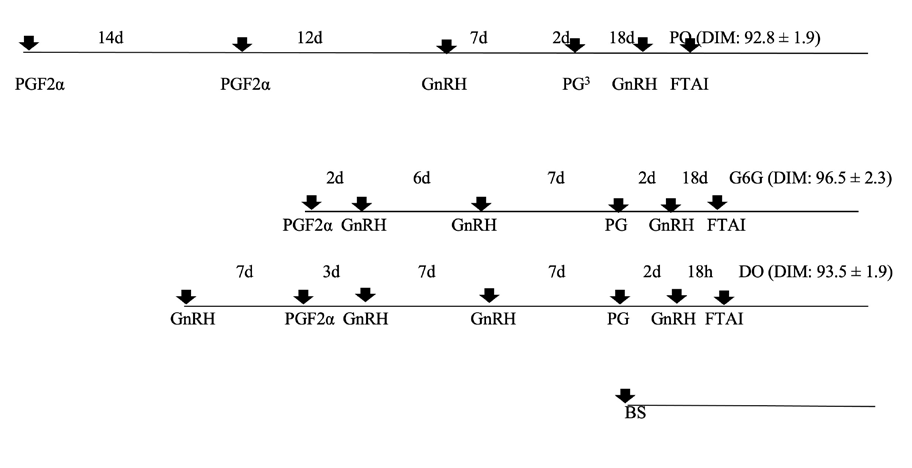
Each week, a cohort of cows at 58 ± 1.2 DIM were stratified by parity, milk yield, and DIM and randomly distributed into one of three treatment protocols: PO (n = 210), G6G (n = 216), and DO (n = 226). The timing of hormonal injections in PO, G6G, and DO protocols is shown in Figure 1. The GnRH used in the current study was 100 μg per injection of gonadorelin acetate (GONAbreed, Parnell, Alexandria NSW 2015, Australia). The PGF2α used in the recent study was 500 μg per injection of cloprostenol sodium (estroPLAN, Parnell, Alexandria NSW 2015, Australia). Three technicians performed the AI of cows and used two types of conventional semen.
Figure 1. Schematic image of hormonal injections, blood samplings, and FTAI for the cows in the PO, G6G, and MDO protocols.
Hormonal assays
Blood sampling was performed (n = 652) to measure the serum concentrations of P4 hormone just before PG. All blood samples were taken from the coccygeal vein using vacutainer tubes without an anticoagulant agent (BD Vacutainer®, Becton, Dickinson and Company, Plymouth, United Kingdom). Samples were refrigerated and centrifuged at 3000 × g for 20 min within 1 hour after collection, and serum collected was kept at -20°C until P4 was measured.
The serum concentrations of P4 were determined in a single run using a commercially available RIA kit (Coat–ACount Progesterone; Diagnostic Products Corporation, Los Angeles, CA, USA). The intra- and inter-assay coefficients of variation were 5.14% and 7.96%, respectively. The sensitivity of the assay was 0.1 ng/mL.
Statistical analyses
Binomially distributed data (P/AI, DIM, milk yield (kg/day), number of parities, and serum concentration of P4 at PG ng/mL) were analysed by logistic regression, using the GLIMMIX procedure of SAS (version 9.1, SAS Inst. Inc., Cary, NC, USA). Explanatory variables considered in the models were treatment (PO, G6G, and DO), DIM (categorised as ≤ 90 or > 90 days), milk yield (categorised as ≤ 37 or > 37 kg/day), number of parities (primiparous or multiparous), serum concentration of P4 at PG (categorised as ≤ 4.4 or > 4.4 ng/mL), technician, type of semen, month of AI, and interactions. The final logistic regression model removed variables by a backward elimination based on the probability value statistics criterion when P > 0.1. For analysis of pregnancy status 30 d post-AI, the final model included the effects of protocol (PO, G6G, and DO), parity (primiparous or multiparous), serum concentration of P4 at PG (categorised as ≤ 4.4 or > 4.4 ng/ mL), and interactions between protocol and parity, protocol and DIM, and parity and DIM.
Table 1. Mean (± SEM) effects of treatments on DIM, milk yield, number of parities, serum concentration of P4 at PG, and overall pregnancy rate in lactating dairy cows
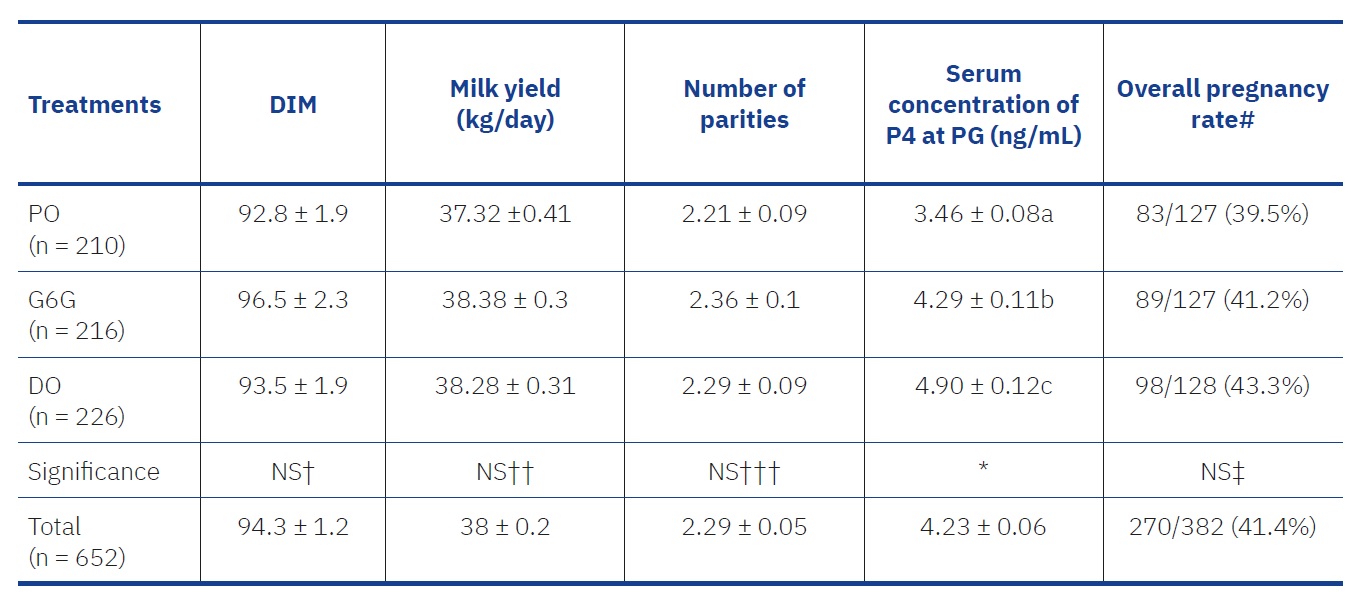
DIM=Days in milk; P4=Progesterone; PG=Last PGF2α; PO=Presynch–Ovsynch; DO=Double–Ovsynch; NS=not significant. #This analysis was done with GLIMMIX and accounted for serum concentrations of P4 hormone at PG, and parity. abcDifferent superscripts in each column show significant difference. *P > 0.01. †Difference between PO and G6G, PO and DO, and G6G and DO at the levels of P = 0.43, P = 0.97, and P = 0.55, respectively; ††difference between PO and G6G, PO and DO, and G6G and DO at the levels of P = 0.53, P = 0.49, and P = 0.83, respectively; †††difference between PO and G6G, PO and DO, and G6G and DO at the levels of P = 0.63, P = 0.85, and P = 0.87, respectively; ‡difference between PO and G6G, PO and DO, and G6G and DO at the levels of P = 0.49, P = 0.08, and P = 0.2, respectively
A univariable analysis using Proc GLIMMIX was used for analyses of protocol effects on DIM, milk yield, parity, and serum concentration of P4 ng/ mL at PG. Statistical significance was declared at P < 0.05.
Results
Comparison of the average of DIM, milk yield, and number of parities were not statistically different between treatment protocols (Table 1).
There was a statistically significant difference between the studied protocols in the mean serum concentration of P4 at PG (P < 0.01, Table 1). For analysis of pregnancy status 30 d post-AI, the effects of DIM (P = 0.68), milk yield (kg/d, P = 0.49), technician (P = 0.48), type of semen (P = 0.29), interaction between protocol and technician (P = 0.64), interaction between protocol and semen (P = 0.87), and interaction between protocol and month (P = 0.43) were not significant, therefore were removed from the final model. Similar P/AIs were achieved for cows after FTAI during all months (September, 16/43 (37%), October, 19/50 (38%), November, 38/80 (47%), December, 35/78 (44%), January, 32/73 (43%), February, 37/90 (41%), March 39/95 (41%), April, 29/75 (38%), and May, 25/68 (36%); P = 0.65).
The overall pregnancy rate for all cows studied was 41.4%. Separately, pregnancy rates for cows in PO, G6G, and DO protocols were 39.5%, 41.2%, and 43.3%, respectively (P > 0.05, Table 1).
There was a tendency to increase the pregnancy rate of cows in the DO protocol compared to the PO protocol (P = 0.08, Table 1).
Effect of the parity on P/AI following implementation of PO, G6G, and DO protocols on the studied cows is shown in Table 2.
The DO protocol significantly increased the pregnancy rate for primiparous cows compared with multiparous cows (P = 0.04, Table 2). In the subgroup of primiparous cows, the DO protocol significantly increased the pregnancy rate compared to the PO protocol (P = 0.04, Table 2).
Effect of serum concentration of P4 ng/ mL at PG on P/AI following implementation of the PO, G6G, and DO protocols on the studied cows is shown in Table 3.
For all treatment protocols, the pregnancy rate of cows that had high serum concentrations of P4 > 4.4 ng/mL at PG was significantly higher than that of cows with low serum concentrations of P4 ≤ 4.4 ng/mL at this time (Table 3).
Discussion
This study was performed during the cool months of the year to eliminate the destructive effects of heat stress on the reproductive performance of dairy cows. The study found that the pregnancy rates of cyclic cows, 30 d post AI, did not differ following the implementation of the PO, G6G, and DO protocols, although there was a tendency to increase the pregnancy rate of the cows following the implementation of the DO protocol compared to the PO protocol (P = 0.08). In a study where GnRH and PGF2α were injected simultaneously 7 d before the implementation of the OVS+FTAI protocol, the pregnancy rates of cows were similar to dairy cows receiving the PO protocol (Martins et al., 2017). It has been shown that implementation of DO in comparison with the PO protocol significantly increased the pregnancy rate of dairy cows in the first postpartum AI (Souza et al., 2008). These results were attributed to the induction of ovulation in non-cycling cows and improving the synchrony rate in cycling cows following the implementation of the DO protocol. Similar to this study, Astiz and Fargas (2013) found no difference between the pregnancy rates of cows in the first postpartum AI following the implementation of a DO or G6G protocols. Some studies have reported that a DO protocol in comparison with G6G and PO protocols are more beneficial for cows with inactive, cystic ovaries, or that experience postpartum uterine infections (Herlihy et al., 2012; Astiz and Fargas, 2013)
Table 2. Effect of number of parities on pregnancies per AI (P/AI) of cows following the implementation of PO, G6G, and DO protocols
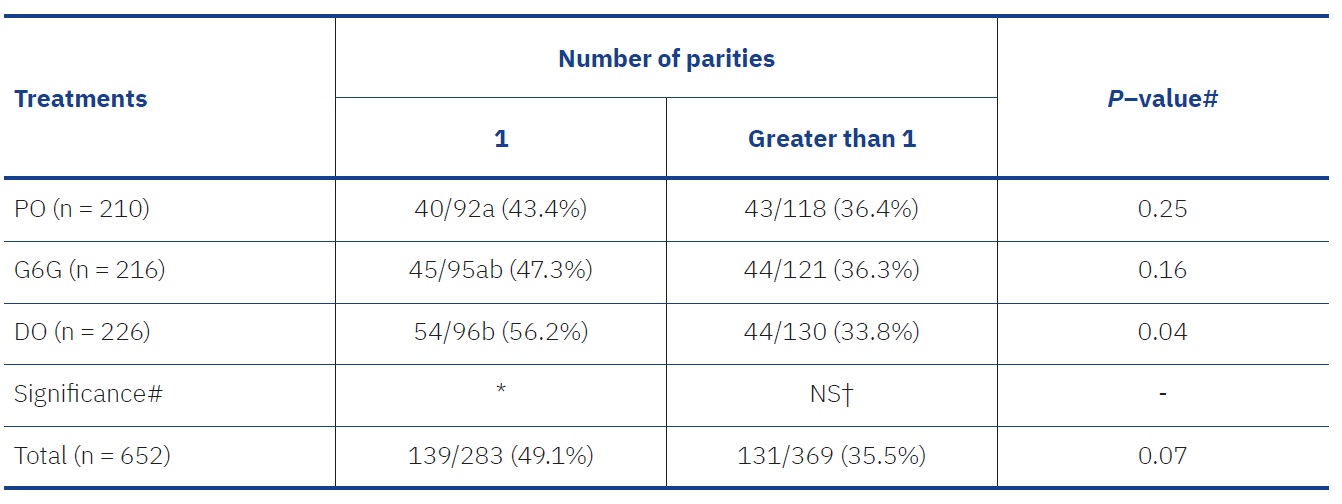
PO=Presynch–Ovsynch; DO=Double–Ovsynch; NS=not significant. P4=Progesterone; PG=Last PGF2α. #This analysis was done with GLIMMIX and accounted for serum concentrations of P4 hormone at PG. abDifferent superscripts in each column show significant difference (P < 0.05). *Difference between PO and G6G, PO and DO, and G6G and DO at the levels of P = 0.3, P = 0.04, and P = 0.21, respectively. †Difference between PO and G6G, PO and DO, and G6G and DO at the levels of P = 0.89, P = 0.32, and P = 0.48, respectively.
In the current study, cyclic cows without reproductive disorders were selected, therefore, the DO protocol could not significantly increase the pregnancy rate of cows compared to the PO and G6G protocols. Presynchronisation of the DO protocol has been shown to stimulate the ovarian cycles in anoestrus cows and is useful for the treatment of ovarian cysts and uterine infections (Astiz and Fargas, 2013). However, the cows included in this study did not have these disorders.
Serum concentrations of P4 at PG were significantly increased with the greater number of GnRH injections in the treatment (Table 1). The higher the number of GnRH injections in the presynchronisation protocol, as in the G6G and DO protocols, formation of accessory CL was possibly stimulated and there were accessory CLs on the ovaries at PG, and therefore the P4 serum concentrations were higher in the preinsemination luteal phase in DO and G6G protocols in comparison to the PO protocol (Table 1). These results are similar to those observed by Bello et al. (2006), who reported that following a G6G protocol in comparison with a Ovsynch protocol, P4 serum concentrations at the time of the PGF2α injection in the OVS+FTAI protocol were higher in cows receiving the G6G protocol (5.3 ± 0.5 vs. 3.8 ± 0.5 ng/mL, respectively). This result was attributed to the increase in the formation of accessory CLs, which was caused by the injection of GnRH, prior to the implementation of the Ovsynch program in the G6G protocol (2.5 ± 0.2 vs 1.9 ± 0.4 ng/mL, respectively). On the other hand, in the current study, the serum concentration of P4 at PG for the DO protocol was significantly higher than in the G6G protocol (P < 0.01, Table 1). Various studies have shown that high serum concentrations of P4 in the luteal phase before insemination have positive effects on increasing the pregnancy rate in dairy cows (Fonseca et al., 1983; Xu et al., 1997; Saad et al., 2019). For all treatment groups, the pregnancy rate of cows with a high serum concentration of P4 at PG was higher than cows with a low P4 serum concentration (Table 2).
The incidence of reproductive disorders and metabolic diseases in dairy cows increases with age (De Kruif, 1978). Therefore, for all treatment groups in the recent study, the pregnancy rate of multiparous cows was lower than primiparous cows (Table 2). With the increasing number of GnRH injections in the presynchronisation program, such as in the G6G and DO protocols, there may be an improvement on the quality of the ovulatory follicle, oocyte and stimulation of cyclicity. As the incidence of reproductive complications from reproductive and metabolic diseases is increased with increasing number of parities, improving the quality of the ovulatory follicle can improve the pregnancy rate in primiparous cows in comparison to multiparous cows. A study showed that implementation of DO protocol resulted in a higher pregnancy rate than the PO protocol in primiparous, but not in multiparous cows (Souza et al., 2008). Another study found a beneficial effect of implementation of the DO protocol on pregnancy rates of primiparous cows at the first postpartum insemination compared with the PO protocol (Borchardt et al., 2017). These results were attributed to the stimulation of ovulation in anovular cows following presynchronisation of the DO protocol. Additionally, it was demonstrated that implementation of the G6G protocol tended to be associated with a higher P/AI than DO in multiparous cows, and that the opposite was observed in primiparous cows (Astiz and Fargas, 2013).
High-yielding dairy cows have lower serum concentrations of P4 and E2 hormones compared to low-yielding cows due to the high rate of catabolism (Binelli et al., 2001; Thatcher et al., 2001). Although GnRH injection(s) in the presynchronisation programme increases the concentration of P4 in the luteal phase before FTAI, this increase is limited in multiparous compared with primiparous cows. However, a significant effect of the presynchronisation programme on increasing the pregnancy rate of primiparous cows compared to multiparous cows was seen only in the DO protocol (P = 0.04, Table 2). Implementation of the DO protocol significantly increased the pregnancy rates in primiparous cows compared with the PO protocol (P = 0.04). These results may be attributed to the increased quality of the ovulatory follicle or oocyte following the GnRH injections in the presynchronisation programme of the DO protocol. In a study performed on cows 86.6 ± 1.9 d postpartum, implementation of the G6G protocol significantly increased the pregnancy rate compared to cows that received the PO protocol (Kohsari and Berenjian, 2022). This result was attributed to the increase in serum concentrations of P4 in the luteal phase before insemination following the implementation of the G6G compared to the PO protocol. The G6G and DO protocols did not increase the pregnancy rate of cyclic dairy cows in the first postpartum insemination compared to the PO protocol. A DO protocol significantly increased the pregnancy rate of primiparous cows but not multiparous cows.
Table 3. Effect of serum concentration of P4 ng/mL at PG on pregnancies per AI (P/AI) of cows following the implementation of the PO, G6G, and DO protocols
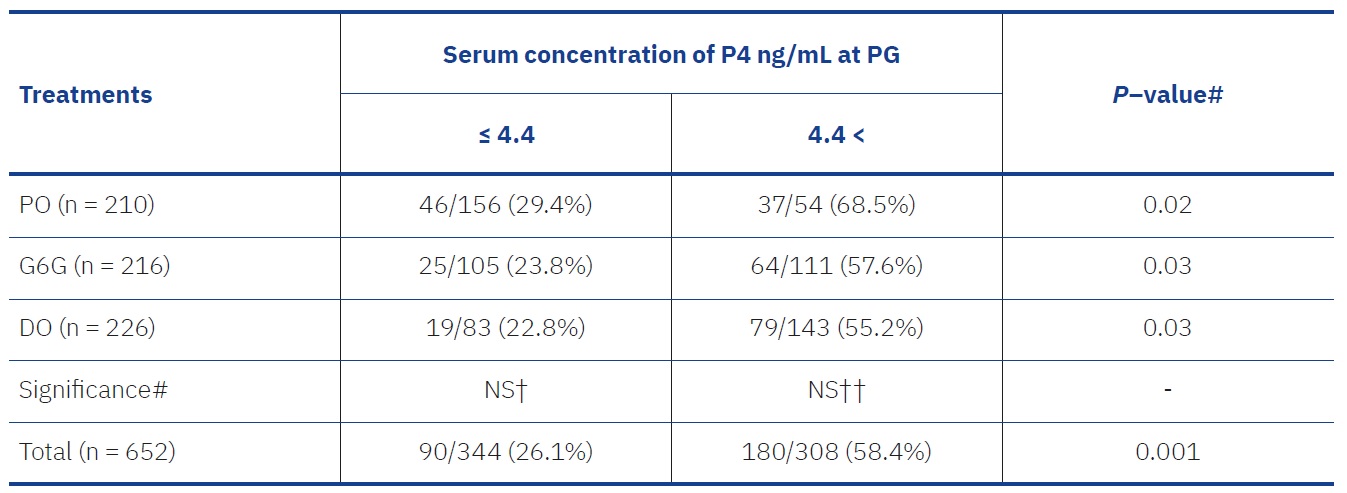
P4=Progesterone; PG=Last PGF2α; PO=Presynch–Ovsynch; DO=Double–Ovsynch; NS=not significant.
#This analysis was done with GLIMMIX and accounted for parity. †Difference between PO and G6G, PO and
DO, and G6G and DO at the levels of P = 0.54, P = 0.33, and P = 0.62, respectively; ††difference between PO
and G6G, PO and DO, and G6G and DO at the levels of P = 0.19, P = 0.14, and P = 0.59, respectively.
Conclusions
This study found no difference in P/AI for dairy cows subjected to a PO, G6G, or DO protocol for first insemination. Therefore, a lower cost protocol is recommended due to the savings in medical costs and labour. However, the DO protocol is recommended to increase the pregnancy rate in primiparous cows, as compared to the PO and G6G protocols.
References [… show]
Usporedba stopa gravidnosti mliječnih krava pasmine Holstein u laktaciji slijedom primjene protokola Presynch-Ovsynch, G6G i dvostrukog Ovsynch tijekom hladnih mjeseci u Kazvinskoj ravnici u Iranu
Hesam KOHSARI, Department of Veterinary Medicine, Ker. C., Islamic Azad University, Kermanshah, Iran, (Corresponding author, e-mail: hesamkohsari@iau.ac.ir); Khatereh BERENJIAN, Technical manager of Shaghayegh Gharb Pakhsh Veterinary Pharmaceutical Company, Kermanshah, Iran; Forogh MOHAMMADI, Department of Veterinary Medicine, Ker. C., Islamic Azad University, Kermanshah, Iran.
Ovo je istraživanje procjenjivalo učinke tri protokola na stopu graviditeta ciklički latkirajućih krava pasmine Holstein, 30 dana nakon 18 h umjetnog osjemenjivanja (fixed-time artificial insemination; FTAI): Presynch-Ovsynch (PO; PGF2α–14 d-PGF2α –12 d-Ovsynch (OVS: GnRH-7 d -PGF2α (PG) –2d–GnRH)– 18 h FTAI; n = 210), G6G (PGF2α-2 d–GnRH–6 d-OVS+FTAI; n = 216) i dvostruki-Ovsynch (DO; GnRH–7 d- PGF2α– 3 d–GnRH–7 d–OVS+FTAI; n = 226). Sveopće stope graviditeta 30 dana nakon umjetnog osjemenjivanja za krave kod protokola PO, G6G i DO bile su 39,5 %, 41,2 %, i 43,3 % (P > 0,05). Najviše, odnosno najniže cirkularne koncentracije progesterona dobivene su kod DO i PO protokola (P < 0,01). Dvostruki-Ovsynch protokol značajno je povisio stope gravidnosti u primiparnih krava u usporedbi s multiparnim kravama (P = 0,04). Protokol dvostruki-Ovsynch značajno je povećao stopu graviditeta primiparnih krava u usporedbi s protokolom PO (P = 0,04). Uporaba protokola PO, G6G i DO u programu osjemenjivanja određenog vremena za krave koje ciklički laktiraju nije rezultirao značajnom razlikom kod stope gravidnosti 30 dana nakon osjemenjivanja, stoga se preporuča odabrati protokol koji košta manje, a iziskuje manje rada u svojoj primjeni.
Ključne riječi: Dvostruki–Ovsynch, G6G, Presynch–Ovsynch, presinkronizacija, mliječne krave
