

Estimation of heritability for early weights in Santa Inés sheep from Brazil and Colombia
S. J. Calvo Cardona* , M. Espejo-Valencia, J. A. Urango- Arboleda, L. C. Caballero Méndez, S. Idárraga-Bedoy, J. A. Alzate Ramírez, C. F. Bedoya Ospina, C. S. Escobar Restrepo, W. Hauss de Souza, L. Mendonça de Menezes
Samir J. CALVO CARDONA*, Zoot, PhD (Corresponding author, email: samir.calvo@utp.edu.co), BIOPEC Research Group, Profesor de Medicina Veterinaria y Zootecnia, Facultad de Ciencias de la Salud, Universidad Tecnológica de Pereira, Pereira, Colombia; Mateo ESPEJO-VALENCIA, Zoot, MSc, Grupo de investigación BIOECOS, Profesor de Medicina Veterinaria y Zootecnia Facultad de Ciencias de la Salud, Universidad Tecnológica de Pereira, Pereira, Colombia; Juan A. URANGO-ARBOLEDA, MVZ, Grupo de investigación BIOECOS, Profesor de Medicina Veterinaria y Zootecnia Facultad de Ciencias de la Salud, Universidad Tecnológica de Pereira, Pereira, Colombia; Lyda C. CABALLERO MÉNDEZ, Grupo de investigación BIOECOS, Profesora de Medicina Veterinaria y Zootecnia Facultad de Ciencias de la Salud, Universidad Tecnológica de Pereira, Pereira, Colombia; Samuel IDÁRRAGA-BEDOYA, MVZ, MSc, BIOECOS Research Group, Universidad Tecnológica dePereira, Pereira, Colombia; Jovany A. ALZATE RAMÍREZ, Zoot, Universidad Católica de Oriente, Rionegro, Colombia; Christian F. BEDOYA OSPINA , Zoot, Universidad Católica de Oriente, Rionegro, Colombia; Carlos S. ESCOBAR RESTREPOC, PhD, Grupo de Investigación INCA-CES, Facultad de Medicina Veterinaria y Zootecnia, Universidad CES, Medellín, Antioquia, Colombia; Wandrick HAUSS DE SOUSA, Ph.D., Empresa Estadual de Pesquisa Agropecuária da Paraíba – EMEPA – PB. Rodovia Ministro Aberlado Jurema, PB 008, Km 7, Jacarapé III CEP 58047-000 João Pessoa PB, Brasil; Lenice MENDONÇA DE MENEZES, PhD, Empresa Estadual de Pesquisa Agropecuária da Paraíba – EMEPA – PB. Rodovia Ministro Aberlado Jurema, PB 008, Km 7, Jacarapé III CEP 58047-000 João Pessoa PB, Brasil
 https://doi.org/10.46419/cvj.57.1.9
Abstract
Knowing the heritable fraction of productive traits, such as birth weight and weaning weight, is an indispensable tool for selecting animals with higher genetic merit, facilitating decision-making in crossbreeding programmes. This study aimed to genetically evaluate populations of Santa Inés sheep in Brazil and Colombia using Bayesian inference analysis. The study was conducted using information from three sheep farms. The first was located in the Municipality of La Ceja, Antioquia (Colombia), the second in the municipality of Barbosa, Antioquia (Colombia), and the third in the municipality of Campo Santana (Brazil). The model included the additive genetic effect and maternal genetic effect, and considered sex, delivery type, and contemporary group as fixed effects. Components of variance and genetic parameters were estimated. The mean and standard deviation for birth weight (BW) and weaning weight adjusted to 90 days (WW90) were 3.36 kilograms (kg) ± 0.8 and 3.19 kg ± 0.861 for Brazil, and 7.76 kg ± 4.76 and 20.18 kg ± 5.31 for Colombia. The mean of direct heritability (h²d) of BW and WW90 was 0.31 and 0.27 for Brazil, and 0.61 and 0.30 for Colombia. It can be concluded that it is essential to keep accurate records at all sheep farms to ensure a good selection of animals for breeding programmes, to ensure animals with greater genetic and productive potential.
Key words: heritability; R Studio; Bayesian inference, birth weight; weaning weight
Introduction
According to the Colombian livestock census conducted by the National Agricultural Institute (ICA), the livestock species with the smallest number of individuals in Colombia is sheep, with only 1,779,697 head on record. Sheep in Colombia is distributed mainly in the departments of Guajira (43.6%), Magdalena (10.8%), Cesar (9.3%), Boyacá (8.3%), and Córdoba (4.0%) (ICA, 2021). The sheep inventory in Brazil is close to 18 million for 2018, mostly distributed in the northeast and south of the country. This inventory increased 30.4% from 1998 to 2018 (Gonçalves Monteiro et al., 2021). This wide distribution confirms the adaptability and robustness of sheep to adapt to adverse agro-ecological conditions.
The Santa Inés breed originated in northeast Brazil through the crossing of Creole, Morada Nova, and Bergamácia breeds, followed by a period of selection and/or evolution for the absence of wool (Figueiredo, 1986). The Santa Inés breed has traits of reproductive interest such as good maternal ability, high fertility percentages, and twin births; for this reason, it is widely used to breed animals for meat production. Therefore, genetic evaluation of the San Inés breed is indispensable for selecting animals with high genetic merit to carry out crossbreeding programmes that allow for heavier animals with higher meat yields of good quality.
The estimation of genetic parameters for productive traits is necessary to provide sufficient information to calculate indicators such as heritability. As a result, it is possible to calculate how transmissible a trait is over generations and how it influences the reliability of the genetic value or the estimated breeding value for each animal (Lynch & Walsh, 1998). Heritability is a genetic parameter of economic importance in sheep farms. It allows knowing how much of the variation of a population is attributed to the direct effect of the genes. Falconer and Macay (1996) defined heritability as the relationship between the additive genetic variance over the phenotypic variance.
Currently, in Colombia, there is a lack of information on weight traits in sheep and therefore there are non-genetic parameters to determine the genetic value of each animal. Consequently, there is no criterion to select individuals with greater genetic merit. Conversely, in Brazil there are different studies that have estimated genetic parameters in early growth traits in sheep; these studies have a greater number of productive and genealogical records (Santana et al., 2013; Barbosa et al., 2015; Kiya et al., 2019; Oliveira et al., 2021). Therefore, this study aimed to genetically evaluate a population of Santa Inés sheep in Colombia and Brazil using Bayesian inference analysis.
Materials and methods
Location
Data were obtained from three sheep farms. The first farm “Ovinos de la Sierra” was located in the municipality of La Ceja in the department of Antioquia, Colombia, (6°01′40″N, 75°25′52″W) at an altitude of 2200 m, with average air temperature of 15°C, relative humidity of 60%, and annual rainfall of 2171 mm. The second farm “El Charrascal” was located in the municipality of Copacabana in the department of Antioquia, Colombia, (6°20’55″N, 75°30’37″W) at an altitude of 1454 m, with average air temperature of 23°C, relative humidity of 80%, and annual rainfall of 1604 mm. The third farm “State agricultural research company (EMEPA)” was located in northeast Brazil in the municipality of Campo de Santana (6°29’18″S, 35°38’14″W) at an altitude of 168 m, with average air temperature of 29°C, relative humidity of 70%, and annual precipitation of 800 mm.
Feeding
The farm “Ovinos de la Sierra” has a semi-confined system. In the feedlot, animals were fed with pangola hay (Digitaria decumbens) and a commercial mineral salt containing 6% phosphorus. When animals graze, they eat kikuyu (Pennisetum clandestinum) and estrella (Cynodon plectostachius – Cynodon nlemfluensis) grasses. At the farm “El Charrascal”, animals were fed with Estrella grass (Cynodon plectostachius – Cynodon nlemfluensis), pangola hay (Digitaria decumbens), maize silage, and a commercial salt containing 6% phosphorus. Animals at the EMEPA farm were fed two varieties of grass, campin buffel (Cenchrus ciliaris L.) and capim corriente (Urochloa mosambicensis) which were rotationally managed. The grazing time varied according to season.
Data collection
The records were provided by the farms under study for subsequent study and analysis. This study was approved by the Animal Bioethics Committee at the Universidad Católica de Oriente, located in Rionegro (Antioquia), Colombia.
The traits evaluated in the present study were birth weight (BW) and weaning weight adjusted to 90 days (WW90), both measured in kg. The total number of records for BW and WW90 were 1258 and 920 for Brazil and 724 and 428 for Colombia, respectively. Data were collected between 1991 and 2007 for Brazil and between 2014 and 2017 for Colombia.
Weaning weight adjusted to 90 days was calculated using the following formula:
WW90 = (ACTUAL WEIGHT – BW / AGE AT WEANING IN DAYS)*90+BW (1), where WW90 is the weaning weight adjusted to 90 days and BW is the birth weight, both expressed in kg.
Statistical model
The components of variance for BW and WW90 were estimated by Bayesian inference using uni-character models through the MCMCglmm library (Hadfield, 2010) included in the R-project package (RStudio Team, 2015; R Development Core Team, 2017) and considering the following mixed linear model with maternal effect:
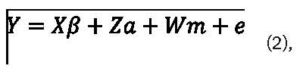
where Y is the phenotypic record for BW and WW90, and β (p x 1) is a vector of systematic fixed effects, associated with the observations through the incidence matrix X (n x p). The random vector (a) of order (q x 1), contains the breeding values or additive genetic effects of the individuals in the kinship matrix and is related to the observations through the incidence matrix Z (n x q). The random vector (m) of order (q x 1), contains the breeding values or maternal genetic effects of the individuals in the kinship matrix and is related to the observations through the incidence matrix W (n x q). Finally, e (n x 1) is the random vector of individual errors.
The additive, maternal, and residual genetic random effects were defined a priori with a normal distribution. The following formulas were used for the prior distribution of genetic variance, permanent environmental variance, and residual variance, respectively

For the components of variance σ2a, σ2m y σ2e, independent scaled-inverted Chi-square distributions were used (Wang, 1994):
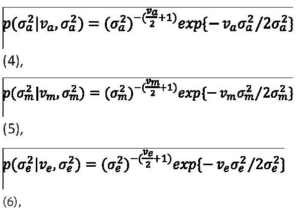
where is the probability, the variances ∂2a; ∂2m and ∂2e are the hyperparameters and ʋa; ʋm and ʋe the degrees of credibility for ∂2a; ∂2m and ∂2e, respectively.
A chain of a total of 1,000,000 cycles or iterations was generated by implementing the model described above. The first 200,000 iterations were discarded as a “burn-in” process. To initialise the program, the values of hypervariance (∂2a, ∂2m y ∂2e) were obtained from previous estimations in REML using the values acquired from the same data run in the MTDF-REML program (Boldman et al., 1995). The degrees of credibility were set at 50 (ʋa = ʋe = ʋm = 50) to reflect a relatively low degree of uncertainty. Additionally, every 50 cycles a sample was saved with the additive variance (σ2a), maternal variance (σ2m), residual (σ2e), direct heritability h2d= σa² (σa²/σe²), and maternal heritability h2m= σm² (σm²/σe²).
Convergence was evaluated using the Geweke method, using the BOA package of the R software (Smith, 2005) and the analysis of the graphics of the chains. This method compares the estimated mean in an early segment of the chain with an average of a late segment, obtaining a Z value with its respective significance value (P) as evidence of convergence between the two sequences. At P > 0.05, there is evidence of convergence (Geweke, 1992).
Results
The mean and standard deviation found for BW in Brazil and Colombia was 3.36 kg ± 0.8 and 3.19 kg ± 0.86, with a coefficient of variation (CV) of 23.82% and 27%, respectively (Table 1). For WW90, the mean and standard deviation found was 17.76 kg ± 4.76 and 20.18 kg ± 5.31, with a coefficient of variation of 26.8% and 26.41% for Brazil and Colombia, respectively (Table 1)For the Geweke test (Z-score and p-value), all variance components converged (P>0.05) except for the maternal variance for BW in Brazil, where a value of P=0.04 was obtained. All convergence values are shown in Table 2.
The mean, standard deviation, and median for σ²d, σ²p, σ²e, h²d, and h²m of the evaluated traits had different values for each country, and the high-density interval for these variances can be seen in Table 3.
All distributions were leptokurtic and symmetrical, except the distribution of direct heritability for BW in Colombia (h2BW Colombia), which was not symmetrical and was skewed to the right.
Table 1. Descriptive statistics for the characteristics of birth weight and weaning weight adjusted to 90 days in Santa Inés sheep in Brazil and Colombia
|
Characteristics |
Country |
N |
x̄ ± STDEV |
CV (%) |
Min |
Max |
| BW |
Brazil |
1258 | 3.36 ± 0.8 | 23.82 | 1.2 | 6 |
| WW90 | 920 | 17.76 ± 4.76 | 26.8 | 10 | 35 | |
| BW |
Colombia |
724 | 3.19 ± 0.86 | 27 | 0.8 | 6 |
| WW90 | 428 | 20.18 ± 5.31 | 26.41 | 10 | 34 |
BW= Birth weight. WW90= weaning weight adjusted to 90 days. N= Number of samples. = Mean (kg). STDEV= Standard deviation (kg). CV= coefficient of variation. Max = Maximum weight (kg). Min= Minimum weight (kg).
Table 2. Geweke test (Z-score and p-value) to evaluate the convergence of variance components in sheep of the Santa Inés breed in Brazil and Colombia
|
|
|
BW |
WW90 |
|||
|
P-value |
Z-Score |
P-value |
||||
| σ²d |
Brazil |
0.61 | 0.53 | 0.62 | 0.52 | |
| σ²m | 45779 | 0.04 | 0.32 | 0.74 | ||
| σ²e | -0.54 | 0.58 | -0.87 | 0.38 | ||
| σ²p | 13881 | 0.16 | -0.05 | 0.96 | ||
| h²d | 0.21 | 0.82 | 0.70 | 0.48 | ||
| h²m | 27030 | 0.08 | 0.27 | 0.78 | ||
| σ²d |
Colombia |
14977 | 0.15 | 0.73 | 0.46 | |
| σ²m | -0.04 | 0.96 | 47119 | 0.19 | ||
| σ²e | -1.83 | 0.06 | -1.48 | 0.13 | ||
| σ²p | 0.88 | 0.37 | -0.26 | 0.79 | ||
| h²d | 45809 | 0.1 | 0.9 | 0.37 | ||
| h²m | -0.56 | 0.57 | 13881 | 0.16 |
σ²d= Direct additive genetic variation. σ²m= Maternal genetic variance. σ²e= Error variance. σ²p= Phenotypic variance. h²d= Direct heritability. h²m= Maternal heritability. BW= Birth weight. WW90= weaning weight adjusted to 90 days.
Discussion
The means and medians of the estimates for the genetic parameters were similar for birth weight, as expected for normally distributed data. Barbosa et al. (2015) and Yazdi et al. (1999) also observed similarities between the mean and median of BW in the Santa Inés and Baluchi breeds. Likewise, for WW90 in Colombia, no similarities were observed between the means and medians of some variances (σ²d and σ²m), which possibly indicates an asymmetry of the a posteriori distribution of these variances.
For BW in Brazil and Colombia, heritability values of 0.31 and 0.61 were estimated, respectively (Table 3). This marked difference is due to the high genetic dispersion of the sheepfolds or the genetic and phenotypic variation that exists in the two countries. This disparity indicates greater genetic variability in Colombian sheep due to the non-selection of animals that improve early growth traits and also makes the phenotypic and genotypic distribution of the sheep in Colombia more diverse. Other studies have found lower values for direct heritability of 0.23 in sheep of the Santa Inés breed in Brazil (Sarmento et al., 2006). Yazdi et al. (1999) observed lower mean values of heritability (0.15), with lower high-density intervals more comparable (0.09 to 0.23) to those found in this study (0.22 to 0.4) for Brazil and (0.39 to 0.79) for Colombia.
The results of this study indicate that there is genetic variability for the selection of BW traits. However, the literature shows that the heritability of BW is inconclusive and highlights the necessity of proper use of databases, including a correct statistical methodology for the estimation of genetic parameters. According to Sousa et al. (1999), to increase the genetic gain in breeding programmes that select traits influenced by the maternal effect, it is necessary to obtain more information about this effect. Heritability can be overestimated if important maternal genetic effects of the models are omitted or if inadequate methodologies are used for the type and amount of data. If so, this reduces the efficiency in the selection of animals with high genetic merit.
The mean for h²d of WW90 in Brazil and Colombia was 0.27 and 0.3, respectively. These estimates were lower than those of BW (0.31 and 0.61) in both countries, due to the greater influence of the environment (nutrition, management, etc). Other authors reported higher values of h²d for adjusted weights. Lôbo et al. (2006) reported a higher heritability of 0.56 for weaning weight at 90 days and Maria et al. (1993) reported a heritability of 0.34 for weaning weight at 60 days of age. However, Barbosa et al. (2015) obtained low values (0.09), lower than the estimate for WW90 (0.24) of the present study. Similar results were observed by Sousa et al. (1999) who obtained estimates for weaning weight of 0.04 at an age of 112 days concerning the heritability of birth weight (0.37).
Boujenaje and Kansari (2002) and De Sousa et al. (2006) also obtained low estimates of heritability (0.06 and 0.11, respectively) for weaning weight at 90 days of age. According to Hassen et al. (2003), direct heritability generally tends to be greater than maternal heritability for growth traits, which coincides with the present study for both countries. This could be an important aspect for developing breeding programmes for the Santa Ines breed in both countries, since it has a better response to the direct selection of males and females and can therefore obtain higher yields and genetic gains in the next generations.
The means obtained for the maternal heritability of the BW trait in Brazil and Colombia was 0.22 and 0.25, respectively. Similar values were reported by Quesada et al. (2002), who obtained a maternal heritability of 0.22. The heritability estimated in this study was higher than that obtained by Yazdi et al. (1999) and Lôbo et al. (2009), who reported values of 0.14 and 0.17, respectively. Boujenane and Kansari (2002) reported an even lower value (0.05). Alternatively, Barbosa et al. (2015) obtained higher values for the mean maternal heritability (0.34). Sarmento et al. (2006), observed a similar value (0.32), indicating a strong maternal effect for this trait in the sheep of Brazil, highlighting the importance of the maternal effect under non-housed conditions.
The mean for maternal heritability for the WW90 characteristic in Brazil and Colombia was 0.13 and 0.11, respectively. These values are similar to those reported by Riggio et al. (2008), who reported an estimate of 0.12 for the weaning weight at 90 days. Barbosa et al. (2015) found higher values of this trait (0.24). In addition, Sousa et al. (1999) and Sarmento et al. (2006), reported higher values for weight at 112 days of age than those reported in the present study (0.26 and 0.24, respectively), and Lôbo et al. (2006), obtained an estimate of 0.27 for the weight at 90 days of age. Maternal heritability varies widely in the different studies, possibly due to the management programmes implemented in each country.
Conclusions
This study of estimation of genetic parameters carried out independently in both countries could verify that there is a significant difference between the farms and genetic improvement in Brazil compare to Colombia, due to the greater collection of data and decision-making at the production and genetic levels.
It is essential to keep accurate records in all sheep farms for proper selection in breeding programmes, ensuring animals with superior genetic and productive potential, and thus, improving traceability and economic parameters.
This study shows that a good record-keeping strategy needs to have good estimates of genetic parameters so as to improve decision-making in animal selection of the Santa Ines breed in these two environments.
Funding
This study was supported by the Directorate of Research and Development of the Universidad Católica de Oriente, Antioquia, Colombia [internal project “Estimation of genetic selection parameters for weight characteristics in sheep in Brazil and Colombia” 2016].
Table 3. Components of variance and direct and maternal heritability in Santa Inés sheep in Brazil and Colombia.
|
Parameter |
Country |
BW |
WW90 |
||
|
Z-Score |
P-value |
Z-Score |
P-value |
||
Birth weight (95% HPD)
| σ²d |
Brazil |
0.15 | 0.14 | 0.10 | 0.19 |
| σ²m | 0.10 | 0.10 | 0.08 | 0.13 | |
| σ²e | 0.22 | 0.22 | 0.18 | 0.26 | |
| σ²p | 0.48 | 0.48 | 0.44 | 0.52 | |
| h²d | 0.31 | 0.31 | 0.22 | 0.40 | |
| h²m | 0.22 | 0.22 | 0.16 | 0.26 | |
| σ²d |
Colombia |
0.48 | 0.50 | 0.27 | 0.66 |
| σ²m | 0.20 | 0.19 | 0.13 | 0.26 | |
| σ²e | 0.09 | 0.08 | 0.01 | 0.21 | |
| σ²p | 0.79 | 0.77 | 0.67 | 0.88 | |
| h²d | 0.61 | 0.64 | 0.39 | 0.79 | |
| h²m | 0.25 | 0.25 | 0.17 | 0.33 |
Weaning weight adjusted to 90 days
| σ²d |
Brazil |
3.89 | 3.82 | 2.51 | 5.39 |
| σ²m | 1.82 | 1.80 | 1.04 | 2.63 | |
| σ²e | 8.41 | 8.41 | 7.00 | 9.77 | |
| σ²p | 14.13 | 14.12 | 12.85 | 15.57 | |
| h²d | 0.27 | 0.27 | 0.18 | 0.37 | |
| h²m | 0.13 | 0.13 | 0.08 | 0.18 | |
| σ²d |
Colombia |
8.83 | 8.30 | 3.84 | 15.04 |
| σ²m | 3.29 | 3.07 | 1.15 | 5.87 | |
| σ²e | 16.74 | 16.8 | 11.40 | 22.09 | |
| σ²p | 28.86 | 28.74 | 24.78 | 32.99 | |
| h²d | 0.30 | 0.29 | 0.13 | 0.49 | |
| h²m | 0.11 | 0.11 | 0.04 | 0.20 |
σ²d = Direct genetic variance. σ²m = Maternal genetic variance. σ²e = Error variance. σ²p = Phenotypic variance. h²d = Direct heritability. h²m = Maternal heritability. (95% HPD) = Highest posterior den
Acknowledgment
We thank the sheep farms “Ovinos de la Sierra”, “el Charrascal” and “EMEPA” for the records that made this investigation possible. To the “Católica de Oriente University UCO” for its invaluable professional training. To the research group in Agronomy and Zootechnics GIAZ for its academic and scientific support. To the Directorate of Research and Development of the UCO for its funding and support to the macro project entitled “Estimation of genetic selection parameters for weight characteristics in sheep in Brazil and Colombia” internal project 2016.
References [… show]
Procjena heritabilnosti ranih težina u ovaca pasmine Santa Inés iz Brazila i Kolumbije
Samir J. CALVO CARDONA, Zoot, PhD, BIOPEC Research Group, Universidad Tecnológica de Pereira, Pereira, Colombia; Mateo ESPEJO-VALENCIA, Zoot, MSc, Grupo de investigación BIOECOS, Profesor de Medicina Veterinaria y Zootecnia Facultad de Ciencias de la Salud, Universidad Tecnológica de Pereira, Pereira, Colombia; Juan A. URANGO-ARBOLEDA, MVZ, Grupo de investigación BIOECOS, Profesor de Medicina Veterinaria y Zootecnia Facultad de Ciencias de la Salud, Universidad Tecnológica de Pereira, Pereira, Colombia; Lyda C. CABALLERO MÉNDEZ, Grupo de investigación BIOECOS, Profesora de Medicina Veterinaria y Zootecnia Facultad de Ciencias de la Salud, Universidad Tecnológica de Pereira, Pereira, Colombia; Samuel IDÁRRAGA-BEDOYA, MVZ, MSc, BIOECOS Research Group, Universidad Tecnológica dePereira, Pereira, Colombia; Jovany A. ALZATE RAMÍREZ, Zoot, Universidad Católica de Oriente, Facultad de Ciencias Agropecuarias, Grupo de investigación en agronomía y zootecnia GIAZ, Rionegro, Antioquia, Colombia; Christian F. BEDOYA OSPINA, Zoot, Universidad Católica de Oriente, Facultad de Ciencias Agropecuarias, Grupo de investigación en agronomía y zootecnia GIAZ, Rionegro, Antioquia, Colombia; Carlos S. ESCOBAR RESTREPOC, PhD, Grupo de Investigación INCA-CES, Facultad de Medicina Veterinaria y Zootecnia, Universidad CES, Medellín, Antioquia, Colombia; Wandrick HAUSS DE SOUZA, Ph.D., Empresa Estadual de Pesquisa Agropecuária da Paraíba – EMEPA – PB. Rodovia Ministro Aberlado Jurema, PB 008, Km 7, Jacarapé III CEP 58047-000 João Pessoa PB; Lenice MENDONÇA DE MENEZES, PhD, Empresa Estadual de Pesquisa Agropecuária da Paraíba – EMEPA – PB. Rodovia Ministro Aberlado Jurema, PB 008, Km 7, Jacarapé III CEP 58047-000 João Pessoa PB; Colombia.
Poznavanje nasljednog udjela u proizvodnim osobinama kao što su težina pri janjenju i težina pri odbiću neophodno je kod odabira životinja s boljim genetskim vrijednostima, što olakšava donošenje ispravnih odluka u provođenju programa križanja. Stoga je cilj ovoga istraživanja genetička procjena populacije ovaca pasmine Santa Inés u Brazilu i Kolumbiji korištenjem Bayesove analize. Istraživanje je provedeno uporabom podataka od triju proizvođača ovaca. Prvi je iz grada La Ceja, Antioquia (Kolumbija), drugi iz grada Barbarosa, Antioquia (Kolumbija) a treći iz grada Campo Santo, (Brazil). Koristio se model koji je uključivao dodatni genetički učinak i materinji genetički učinak, dok su spol, način janjenja i sadašnja skupina postavljeni kao fiksne varijable. Procijenjeni su komponente varijacija i genetičkih parametara. Prosjek i standardna devijacija težine pri janjenju (TJ) i težine pri odbiću prilagođena na 90 dana (TO90) bila je 3,36 ± 0,8 i 3,19 ± 0,861 kg za Brazil, odnosno 7,76 ± 4,76 i 20,18 ± 5.31 kg za Kolumbiju. Prosjek izravne heritabilnosti (h2d) TJ-a i TO90 bio je 0,31 i 0,27 za Brazil, odnosno 0,61 i 0,30 za Kolumbiju. Može se zaključiti da je vođenje točnih evidencija na svim farmama ovaca nužno da bi se izvršio dobar odabir životinja za programe uzgoja te na taj način dobivalo životinje boljeg genetičkog i proizvodnog potencijala.
Ključne riječi: heritabilnost, R Studio, Bayesova analiza, težina pri janjenju, težina pri odbića
