
Evaluation of greater wax moth (Galleria mellonella) larvae as an alternate host to study the virulence of Vibrio harveyi
Ivana Giovanna ZUPIČIĆ, Andrew Paul DESBOIS, Sean MONAGHAN, Dražen ORAIĆ, Snježana ZRNČIĆ, Dorotea GRBIN* and Matea ALFIER
Ivana Giovanna ZUPIČIĆ, PhD, Research Associate, Croatian Veterinary Institute, Zagreb, Croatia; Andrew Paul DESBOIS, Senior Lecturer, Sean MONAGHAN, Senior Lecturer, University of Stirling, Stirling, UK; Dražen ORAIĆ, PhD, Senior Scientist in Tenure, Snježana ZRNČIĆ, PhD, Senior Scientist in Tenure, Dorotea GRBIN*, PhD, Expert Associate, (Corresponding author, e-mail: grbin@veinst.hr), Matea ALFIER, PhD student, Croatian Veterinary Institute, Zagreb, Croatia.
 https://doi.org/10.46419/cvj.57.1.3
Abstract
This study evaluated the suitability of Galleria mellonella larvae as an alternative model for investigating the virulence of Vibrio harveyi, a significant fish pathogen in marine aquaculture. Traditional vertebrate models for studying aquatic pathogens are costly, raise ethical concerns, and are subject to regulatory restrictions. In contrast, G. mellonella larvae offer advantages such as low cost, minimal infrastructure requirements, rapid infection cycles, and greater ethical acceptibility. Larvae were injected with V. harveyi suspensions, supernatants, or heat-killed bacteria, and survival rates were monitored. No mortality was observed in control groups or larvae injected with heat-killed bacteria, confirming that viable bacteria are necessary for pathogenic effects. Survival rates of larvae inoculated with bacterial supernatants at 1×10⁹ cfu/mL were strain-dependent but relatively high, with a range of 86.67–93.33% at 168 h. The strain FR-5 exhibited no apparent pathogenicity in larvae. These findings suggest that G. mellonella may not be a reliable alternate host for studying V. harveyi infections, underlining the need to validate the suitability of alternate hosts in the study of the virulence of specific pathogenic species.
Key words: alternate model; Croatian Adriatic Sea; Galleria mellonella; Vibrio harveyi; vibriosis
Introduction
To tackle the challenges posed by microbial diseases in aquaculture, it is essential to gain a deeper understanding of infection mechanisms, as this knowledge can inform the development of improved treatments, vaccines, and management strategies. Traditionally, many studies of aquatic pathogens have relied on vertebrate hosts such as zebrafish (Danio rerio). However, these studies require specialised facilities, such as aquaria and stringent biosecurity protocols, particularly when working with zoonotic pathogens, to ensure the safety of both researchers and aquatic species (Froquet et al., 2007). Additionally, vertebrate animal studies are often expensive, subject to strict regulatory oversight, and do not easily allow high-throughput experimental approaches (Zak and O’Reilly, 1991; Chamilos et al., 2007).
In recent years, the larvae of the greater wax moth (Galleria mellonella) have been increasingly utilised as an alternative infection model to study microbial pathogens and evaluate antimicrobial agent activity (Desbois and Coote, 2011; Desbois and McMillan, 2015; Tsai et al., 2016; Cutuli et al., 2019; Piatek et al., 2020; Dinh et al., 2021). This shift has been driven by efforts to reduce, replace, and refine (the 3Rs) the use of vertebrate animals in scientific research (Graham and Prescott, 2015). G. mellonella offers several advantages: (1) low acquisition and maintenance costs, (2) no need for specialised equipment or infrastructure, (3) ability to perform experiments at a range of incubation temperatures, (4) fewer ethical restrictions on use, (5) rapid infection cycles that support medium- to high-throughput data generation, and (6) the presence of only an innate immune system, enabling the study of immune response without interference from adaptive immunity (Desbois and Coote, 2012; Asai et al., 2019). Non-mammalian models like G. mellonella allow for faster early-stage results, which are crucial for rapid decision-making in experimental settings to guide and prioritise follow up studies (Hunter, 2023).
Alternative infection models, such as G. mellonella, are also valuable for studying the microbial pathogens of farmed fish, as many innate immune responses are conserved across taxa, and pathogens often use similar mechanisms to infect diverse hosts (Chamilos et al., 2007). Although alternate hosts for studying fish pathogens are relatively rare, several exist, including cell culture models (Ormonde et al., 2000; Li et al., 2008; Mou et al., 2013), the amoeba Dictyostelium discoideum (Froquet et al., 2007), the nematode Caenorhabditis elegans (Brackman et al., 2011), the freshwater ciliate Tetrahymena thermophila, the crustacean Artemia franciscana (Pang et al., 2012), and zebrafish larvae (van Soest et al., 2011; Harvie et al., 2013). The moth G. mellonella has also gained attention due to its simplicity, ease of handling, and the reproducibility of infections (Desbois and Coote, 2012). Moreover, the innate immune response of G. mellonella shares functional similarities with fish, particularly regarding pathogen recognition, antimicrobial peptide expression, generation of reactive oxygen species, phagocytosis, and clotting cascades (Neumann et al., 2001; Magnadottir, 2006; Cytrynska et al., 2007; Jiang et al., 2010). The larva’s manageable size (2–3 cm), lack of feeding requirements, minimal space needs, and low cost make them an accessible model for infection studies (Desbois and Coote, 2012). However, when adopting an alternate host for infection trials, validating its suitability for each specific pathogen is essential to ensure that the infection process mirrors that of the native host, and that virulence mechanisms are conserved.
The objective of this study was to assess the suitability of G. mellonella as an alternate host for investigating the virulence and pathogenicity of Vibrio harveyi, a well-known Gram-negative bacterium responsible for infections of a range of farmed species, incurring significant economic losses in marine aquaculture (Ortigosa et al., 1989; Garay et al., 1995; Company et al., 1999; Pujalte et al., 2003; Sitja-Bobadilla et al., 2007).
Material and Methods
Bacterial strains
For this study, three V. harveyi strains (94/17, A2 and FR-5) were isolated from diseased European sea bass (Dicentrarchus labrax), and one strain (ESP) was isolated from diseased gilthead seabream (Sparus aurata). All fish originated from the Croatian part of the Adriatic Sea. One bacterial strain was obtained at a fish farm during a routine health check, while the remaining strains were obtained from samples of diseased sea bass transported to the laboratory as fresh carcasses packed in ice. All materials were cultivated on marine agar (MA) (Difco, USA), and incubated at 23 ± 2°C for 24–48 h. Bacterial colonies were re-streaked on fresh MA to obtain pure bacterial colonies. Bacterial colony identification was confirmed by PCR targeting the toxR gene (Pang et al., 2012). Once identified, pure colonies were stored on CryoInstant beads (Deltalab, Spain) at -80°C until further analyses. After thawing and plating on MA, single colonies were inoculated into 100 mL marine broth (Condalab, Spain) for 24 h at 22°C, on a shaking incubator (MAXQ4000, Thermo Scientific) at 150 rpm.
Inoculum preparation
Bacterial cultures were centrifuged (4K15, Sigma) at 3500 rpm for 10 minutes at 4°C to form a cell pellet. The supernatant was carefully poured off and filtered using a 0.22 μm syringe filter to remove any remaining bacteria (Minisart, Sartorius). Meanwhile, the cell pellet was resuspended in 10 mL phosphate-buffered saline (PBS) and vortexed thoroughly to ensure complete dispersion. The suspension was re-centrifuged as before, with the cell pellet washed once more by resuspension in PBS and centrifugation under the same conditions. This washing process ensured the removal of any extracellular debris or culture medium. The bacterial suspension was analysed for cell density by measuring absorbance at 600 nm using a spectrophotometer (C08000, WPA biowave). Absorbance readings were compared to a standard curve generated in previous experiments, and bacterial suspensions were prepared to achieve final concentrations of 1 × 10⁹cfu/ mL.
- mellonella larvae
- mellonella larvae were purchased from UK Waxworms Ltd. (Sheffield, UK). Moribund, discoloured and dead larvae were removed and only those with uniform cream colouration and weight of 250–350 mg were used. Routinely, larvae were kept in the dark in Petri dishes at 4°C and used within one week of receipt.
Injection of G. mellonella larvae
The experimental design consisted of three experimental groups and two control groups, each consisting of 15 larvae selected at random. In all three experimental groups, larvae were injected with 10 μL of solution containing the bacterial suspension or supernatant. Before injection, larvae were cooled on ice for 5 min. For injection, a 50 μL Hamilton syringe (Sigma Aldrich Ltd, USA) was used and larvae were injected into the haemocoel via the last left pro-leg. The syringe was cleaned between experimental groups using consecutive washes of 1% (w/v) sodium hypochlorite solution, 70% ethanol and sterile water.
Experiments were carried out as follows for each bacterial isolate: (a) one group of larvae were injected with bacterial suspension at 1 × 10⁹ cfu/mL, (b) one group of larvae was injected with sterile-filtered bacterial supernatant, (c) one group of larvae was injected with heat-killed bacterial suspension. To examine the effects of heat-killed bacteria on larval survival, bacterial suspensions were adjusted to 1 × 10⁹cfu/mL with PBS and then heat-killed using a thermocycler (Thermomixer Comfort, Eppendorf) at 60°C for 25 minutes. Successful heat-killing was confirmed by the absence of colony formation when 100 μL bacterial suspension was plated onto MA plates and incubated at 22°C for 24-48 h.
Two control groups were included in each experiment: one group of G. mellonella larvae received injections of PBS only to assess the impact of physical trauma, while the second, unmanipulated group received no injections and was used to evaluate background larval mortality.
Incubation and monitoring
Following inoculation, larvae were incubated in Petri dishes at 22°C in the dark for up to 168 h. Larval mortality was recorded every 24 h, with larvae considered dead if they failed to respond to gentle stimulation with a sterile inoculation loop. Survival percentages were calculated for each group based on the daily mortality data.
Kaplan-Meier survival analysis
Kaplan-Meier survival graphs were prepared to illustrate the survival of each group of larvae over time. Survival curves were compared using the log-rank test to assess statistical differences between groups. Data processing and statistical analyses were conducted using R software (Rstudio version 2024.04.1) (R Foundation for Statistical Computing, Vienna, Austria), with the survival package used for Kaplan-Meier estimation.
Results
To assess the suitability of G. mellonella as a model for assessing virulence of V. harveyi, it was necessary to confirm that this bacterium established an infection in the insect.
Injection with PBS caused no mortality, indicating the non-lethal impact of the physical trauma of injection. Additionally, injection of larval groups with 1 × 10⁹ cfu/mL heat-killed bacteria had no significant effect on survival.
Figure 1. Larvae of G. mellonella, inoculated with supernatant of strain 94/17 after 24 h of incubation
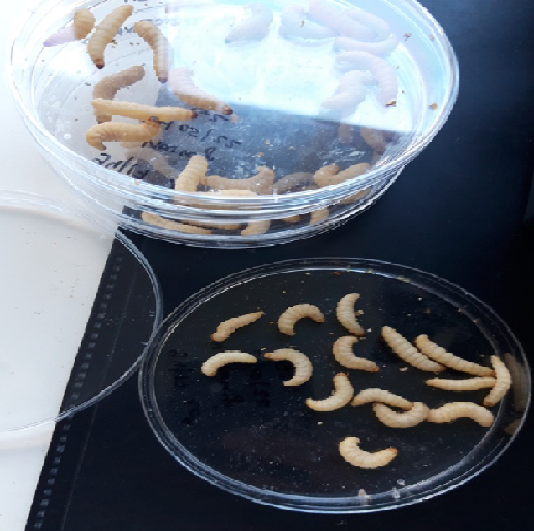
For strain 94/17 of V. harveyi (Figure 1), mortality was observed in one larva inoculated with the supernatant after 120 h, and in a second larva inoculated with a 1 × 10⁹ cfu/mL bacterial cell suspension after 144 h (Figure 2).
Figure 2. Kaplan-Meier curves displaying the estimated survival probability for four strains A) V. harveyi 97/17 B) V. harveyi A2 C) V. harveyi FR-5 D) V. harveyi ESP 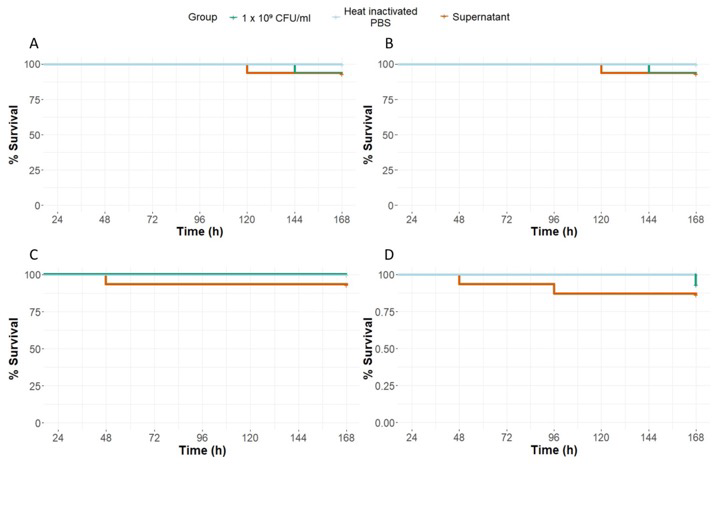
For strain A2, one larva inoculated with supernatant showed mortality after 120 h. One mortality was recorded in the larvae group inoculated with 1 × 10⁹ cfu/mL after 144 h (Figure 2). For strain FR-5, one larva inoculated with supernatant showed mortality after 48 h (Figure 2). No mortalities were recorded in the larval group inoculated with 1 × 10⁹ cfu/mL after 168 h (Figure 2).
For strain ESP, one larva inoculated with supernatant showed mortality after 48 h, followed by a second mortality after 96 h. One mortality was recorded in larvae inoculated with 1 × 10⁹ cfu/mL after 168 h (Figure 2).
Discussion
V. harveyi is one of the most commonly isolated marine Vibrio species, and can be found both as free-living bacteria or associated with the intestinal microbiota of marine animals (Makemson et al., 1999; Rigos and Katharios, 2010). Moreover, V. harveyi is the dominant heterotrophic species in Mediterranean seawater and marine bivalves during the warm season (Pujalte et al., 2003).
In the last two decades, V. harveyi has been recognised as a major cause of vibriosis (Austin and Zhang, 2006; Xu et al., 2017; Pavlinec et al., 2022), a disease that results in severe losses in aquaculture and threatens its long-term sustainability (Sitjà-Bobadilla et al., 2007; Amaro et al., 2020; Zupičić et al., 2024). The disease is characterised with high mortality up to 100%, and vibriosis caused by V. harveyi can affect several species of molluscs, crustaceans and fish (Defoirdt et al., 2007)
Many virulence factors, such as haemolysins, proteases, lipopolysaccharide, the capacity to bind iron, interaction with bacteriophages, biofilm formation, and quorum sensing have been identified. It is likely that pathogenicity reflects the interaction between two or more virulence factors functioning together or in sequence (Won and Park, 2008; Zhang et al., 2020).
To learn more about the pathogenicity of this economically important bacterium, alternative infection models that allow in vivo trials are becoming increasingly important, since experimentation on vertebrates faces stricter regulations. However, there are few alternate hosts available for studying pathogens affecting aquaculture pathogens.
G. mellonella larvae inoculated with the supernatant showed a survival rate of 93.33% for strains 94/17, A2, and FR-5, while larvae inoculated with the strain ESP had a survival rate of 86.67%, indicating the possible presence of virulence factors such as toxins, which merits further study. Meanwhile, larvae inoculated with a bacterial suspension at 1 × 10⁹ cfu/mL exhibited a high survival rate of 93.33% for strains 94/17, A2, and ESP, whilst larvae inoculated with strain FR-5 at the same bacterial concentration displayed no mortality. This finding suggests that V. harveyi may be unable to initiate an infection in the G. mellonella larvae, an interesting observation given that this alternate host is suitable for assessing the virulence of Vibrio anguillarum, a closely related bacterium to V. harveyi (McMillan et al., 2015).
Further research is needed to identify specific virulence factors that could be effectively studied using this model, as well as the reasons behind the observed differences in virulence between V. harveyi and V. anguillarum isolates. It is possible that higher inoculum levels of V. harveyi, freshly prepared bacterial isolates, or alterations to larval incubation conditions could lead to infection. These variables deserve closer attention given the potential of this alternative model. The growing emphasis on minimising vertebrate use, in line with the 3R principles, along with cost reductions, infrastructure requirements, and regulatory challenges associated with native aquaculture hosts, underscore the importance of developing new, ethically preferable alternative infection models (Zak and Oreilly, 1991;
Chamilos et al., 2007; Desbois and Coote, 2012). Many existing alternatives rely on tissue culture or aquaria, yet these models often lack immune complexity or are unsuitable for studying certain virulence factors.
In this study, we evaluated the G. mellonella model for assessing the virulence of V. harveyi. However, our findings suggest that this alternate host is not a reliable model for assessing V. harveyi virulence, in contrast to previous studies on V. anguillarum (McMillan et al., 2015). These results highlight the critical importance of validating alternate hosts for their suitability in studying the virulence of specific pathogenic species.
Acknowledgements
The authors are grateful to Batuhan Coskun from the University of Stirling for assistance.
References [… show]
Larve voštanog moljca (Galleria mellonella) kao alternativni model za proučavanje virulencije bakterije Vibrio harveyi
Dr. sc. Ivana Giovanna ZUPIČIĆ, znanstvena suradnica, Hrvatski veterinarski institut, Zagreb, Hrvatska, dr. sc. Andrew Paul DESBOIS, profesor, dr. sc. Sean MONAGHAN, profesor, Sveučilište Stirling, Velika Britanija; dr. sc. Dražen ORAIĆ, znanstveni savjetnik u trajnom zvanju, dr. sc. Snježana ZRNČIĆ, znanstvena savjetnica u trajnom zvanju, dr. sc. Dorotea GRBIN, stručna suradnica, Matea ALFIER, doktorandica, Hrvatski veterinarski institut, Zagreb, Hrvatska
Ovo istraživanje opisuje prikladnost ličinki voštanog moljca (Galleria mellonella) kao alternativnog modela za istraživanje virulencije bakterije Vibrio harveyi, značajnog uzročnika bolesti u morskoj akvakulturi. Tradicionalni modeli kralježnjaka koji se koriste za proučavanje uzročnika bolesti akvatičnih organizama ograničeni su visokim troškovima, etičkim izazovima i regulatornim zahtjevima. Nasuprot tome, G. mellonella nudi brojne prednosti, uključujući nisku cijenu, minimalne infrastrukturne zahtjeve, brze infekcijske cikluse i etičku prihvatljivost. Ličinkama su inficirane bakterijskim suspenzijama, nadtalogom i toplinski inaktiviranim bakterijama, a praćene su stope preživljavanja. U kontrolnim skupinama, kao i kod ličinki tretiranih toplinski inaktiviranim bakterijama, nije zabilježena smrtnost, što potvrđuje nužnost živih bakterija za razvoj patogenih učinaka. Stope preživljavanja ličinki inokuliranih bakterijskim supernatantima varirale su ovisno o soju, u rasponu od 86,67 % do 93,33 %. Slično, bakterijske suspenzije koncentracije 1 × 10⁹cfu/mL prouzročile su minimalnu smrtnost, dok soj FR-5 nije pokazao patogenost. Ovi rezultati upućuju na to da G. mellonella možda nije pouzdan model za infekcije prouzročene V. harveyi. Potrebna je daljnja validacija i optimizacija da bi se utvrdila njegova korisnost u proučavanju ovog uzročnika bolesti i identifikaciju njegovih čimbenika virulencije.
Ključne riječi: Vibrio harveyi, Galleria mellonella, alternativni modelni organizam, Hrvatska obala Jadranskog mora
