
Control of glyphosate residues in food in the European union in the period 2007-2022

M. Denžić Lugomer*, D. Pavliček and T. Novosel

Abstract
Most agricultural crops are treated several times with different types of pesticides during cultivation and it is therefore very likely that pesticide residues remain on the treated agricultural crops. Pesticides are therefore a very important group of chemical compounds that need to be controlled, mainly because of their high toxicity and widespread use in the production of agricultural products. The most commonly used herbicide is glyphosate. To ensure a high level of consumer protection, legal limits ormaximum residue levels have been set in Regulation (EC) No. 396/2005. The European Food Safety Authority (EFSA) publishes an annual report that provides an overview of the official monitoring of pesticide residues in the European Union Member States, Iceland and Norway. This paper summarises the data from EFSA’s annual reports from 2007 to 2022, referring to data related to the best-selling herbicide glyphosate.
Key words: glyphosate; EFSA; monitoring; food control; Regulation No 396/2005
Introduction
Agrochemicals have allowed food production to more than double in the last century, and the current need to increase food production to feed a rapidly growing population keeps pressure on the intensive use of pesticides and fertilisers (Carvalho, 2017). Research around the world has documented the contamination and effects of agrochemical residues in soil, terrestrial and aquatic ecosystems, as well as their toxic effects on humans. Most agricultural crops are treated several times with different types of pesticides during cultivation, and therefore it is very likely that pesticide residues remain on the treated agricultural crops. Pesticides are therefore a very important group of chemical compounds that need to be controlled, primarily because of their high toxicity and widespread use in the production of agricultural products in food. The widespread use of pesticides on agricultural crops means that pesticides remain in food for several months after application and contaminate the environment (air, surface water, ground water and soil) (Knežević et al., 2010). It is precisely for this reason that a comprehensive legal framework has been created in the European Union (EU) that defines the rules for the approval of active substances used in plant protection products, their use and their residues in food. In order to ensure a high level of consumer protection, Regulation (EC) No. 396/2005 (Regulation EC, 2005) sets legal limits or maximum residue levels.
In the EU, harmonised MRLs have been set for more than 1300 pesticides for 378 food products and food groups. This regulation requires Member States to perform testing to ensure that the food placed on the market complies with the legal restrictions. This regulation establishes both EU and national control programmes:
• A control programme harmonised with the EU: This programme defines foods and pesticides to be controlled by all Member States. The Commission Implementing Regulations on the coordinated multiannual Union control programme to ensure compliance with maximum levels of pesticide residues and the assessment of consumer exposure to pesticide residues in and on food of plant and animal origin have established a monitoring programme that lists all types of food and the number and method of selection of samples to be taken to check for the presence of glyphosate.
• National control programmes: Member States usually define the scope of national control programmes, focusing on specific products where residues are expected to be present in concentrations exceeding legal limits or on products that are more likely to pose a risk to consumer safety.
Article 31 of Regulation No 396/2005 requires Member States to notify the European Commission, the European Food Safety Authority (EFSA) and other Member States of the results of official controls and other relevant information by August 31 of each year. According to Article 32 of the Regulation, EFSA is responsible for preparing an annual report on pesticide residues, which analyses the data on compliance with maximum residue levels of foodstuffs available in the EU and the exposure of European consumers to pesticide residues.
In addition, EFSA derives recommendations for future monitoring programmes based on these results.
The number of pesticides, i.e., active ingredients that can be used in food production, is increasing and it is estimated that more than 1000 types of pesticides are used, which can be divided into 126 different chemical groups. According to their biological effect, they are divided into: algaecides, acaricides, fungicides, herbicides, insecticides, musculicides, nematocides, growth regulators, rodenticides, etc., with the most commonly used herbicide being glyphosate. In animals and plants, glyphosate is very poorly metabolised to the main metabolite aminomethylphosphonic acid (AMPA) (EFSA, 2017b). Other possible metabolites are acetamidomethylphosphonic acid (N-acetyl-AMPA) and N-acetyl-(phosphonomethyl)glycine (N-acetyl-glyphosate). Studies published by EFSA have shown that glyphosate and AMPA residues are stable for at least two to more than three years in different types of samples (EFSA, 2015b). This paper presents the status of residues of the best-selling herbicide and its metabolites in food in the EU from 2009 to 2022. It provides an overview of the number of samples analysed over the years and the proportion of non-objectionable samples and their distribution in relation to the type of food. Statistical data is also presented for Croatia since its accession to the EU in 2013.
Herbicide glyphosate
Glyphosate, i.e., N-(phosphonomethyl)- glycine, is the world’s best-selling herbicide used as an arboricide to control annual and perennial narrowleaf and broadleaf weeds, perennial herbaceous and woody weeds with deep root systems in vineyards, orchards, forest plantations, stubble and non-agricultural areas. According to the data analysis of the Phytosanitary Information System, glyphosate is the best-selling pesticide in Croatia (Ostojić et al., 2018).
In the period 2012–2017, 217–300 tonnes of glyphosate were sold in Croatia, which accounts for 12–15% of all pesticides or 27– 37% of all herbicides.
As of 19 December 2023, 27 plant protection products containing glyphosate as an active ingredient are registered on the list of the Ministry of Agriculture of the Republic of Croatia: Boom effect, Cidokor plus, Roundup rapid, Satelite, Glifokor 360 TF, Herkules, Karda, Gallup super 480, Barbarian Xtra 610, Resolva 24H, Glyfoon 480, Galaxia max, Total up, Glyphogan, Rodeo Plus, Coctel gold, Singlif, Glister ultra, Nasa, Barbarian xtra 610, Gallup super 480, Catamaran 360, Roundup bioactive, Ouragan system 4, Roundup future, Tartan super 360, Clinic xtreme (FIS, 2023).
After the European Commission proposed a 10-year extension of the authorisation for the use of glyphosate on 20 September 2023, 27 EU Member States voted on this proposal on 13 October, but no agreement was reached. Austria, Croatia and Luxembourg voted against, Germany, France, Belgium, the Netherlands, Bulgaria and Malta abstained, while all other member states voted in favour of extending the approval for the use of glyphosate. The Commission referred the Regulation to the Committee of Appeal, which met on 16 November 2023. The Appeal Committee did not issue an opinion (i.e., there was no qualified majority for or against the Commission’s proposal). On 28 November 2023, the European Commission adopted an implementing regulation extending the authorisation of glyphosate for ten years. This is in line with EU legislation, which requires the Commission to adopt an implementing regulation if there is no qualified majority for or against the proposal in the Standing Committee and the Board of Appeal, as in the case of glyphosate. The Implementing Regulation was published in the Official Journal of the EU on 29 November 2023 under the code 2023/2660 (Commission Implementing Regulation, 2023).
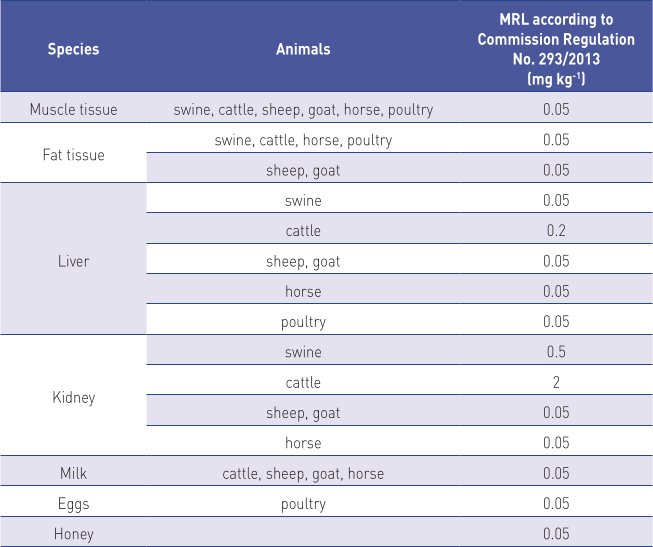
In order to protect human health, continuous monitoring of pesticide concentrations is necessary in various products of plant origin (fruit and vegetables, cereals, fruit, vegetable and cereal products) and in food of animal origin (fatty tissue, milk and milk products, fish and fish products, meat and meat products). Systematic controls must ensure that only foods of plant and animal origin whose pesticide content does not exceed the maximum permissible concentration of pesticides prescribed in the current Commission Regulation No. 396/2005 or its amendment No. 293/2013 on maximum residue levels of glyphosate in foodstuffs (Commission Regulation, 2013) are placed on the market. For food of plant origin, the maximum residue level for glyphosate residues is 0.1 mg kg-1 for most samples, with the exception of 0.5 mg kg-1 for oranges, mandarins, table and wine grapes, potatoes; 1 mg kg-1 for table olives; 2 mg kg-1 for tea; 3 mg kg-1 for sweet corn; 10 mg kg-1 for lentils, peas, rapeseed, mustard, cotton and flax, rye, and wheat; 20 mg kg-1 for sunflower seeds, soy, barley, oats, and sorghum, and 50 mg kg-1 for wild mushrooms. The maximum residue levels for foods of animal origin are listed in Table 1 and the permitted concentrations are significantly lower compared to foods of plant origin.
EFSA annual reports
EFSA publishes an annual report that provides an overview of official pesticide residue monitoring activities in the European Union Member States (EU), Iceland and Norway. It summarises the results of the control programme coordinated by the European Union and the national control programmes.
In 2007, a total of 74,305 samples were tested for pesticides, of which 409 cereal samples and 2302 fruit and vegetable samples were tested for glyphosate (EFSA, 2009).
Glyphosate was found in 39 cereal samples and in one fruit and vegetable sample. The gas chromatography-mass spectrometry method (GC-MS) after derivatisation was used for the analysis. An overview of the methods for the determination of glyphosate and its metabolites was presented previously (Denžić Lugomer et al., 2019). The quantification of glyphosate is a major challenge due to the high polarity and amphoteric nature of the molecule, low molecular weight, high water solubility and lack of a chromophore. For these reasons, glyphosate cannot be determined by several methods used in pesticide analysis, and methods that include a derivatisation step are time-consuming and increase the cost of analysis.
In 2008, more than 70,000 samples of more than 200 different foods were tested for pesticides, including 646 cereal samples for glyphosate and 90 cereal samples for the metabolite AMPA. Glyphosate was found in 38 cereal samples and AMPA in one sample, and the analyses were carried out in six countries for glyphosate and one country for AMPA. In fruit and vegetables, glyphosate was analysed in 2810 samples and detected in one sample. The analyses were carried out in five countries.
The total number of analytical determinations reported by all Member States amounted to more than 14,000,000 in 2009 (EFSA, 2011). However, no data on glyphosate were published.
In 2010, 77,000 samples were tested for pesticides, of which 258 cereal samples were tested for glyphosate: 126 oat samples and 132 rye samples (EFSA, 2013). Of these, 30 oat samples and three rye samples tested positive for glyphosate. Although the number of compounds, i.e., the parameters tested, was increased in 2010, no analyses of glyphosate in cereals were carried out. Efforts were made to introduce a standardised method for the determination of glyphosate, but no satisfactory results were obtained.
As part of the coordinated EU monitoring programme, more than 12,000 samples were tested in 2011. A total of 98.1% of the food samples analysed complied with the legal limits (EFSA, 2014a). In all, 252 samples of rice and 223 samples of wheat flour were tested, of which 11 samples showed glyphosate concentrations below the MRL but above the limit of quantification (LOQ). Glyphosate was analysed by liquid chromatography-tandem mass spectrometry (LC-MS/MS), which represents a significant development in the methodology of glyphosate determination.
In 2012, a total of 78,390 samples were tested for various pesticides, of which 635 were tested for glyphosate: glyphosate was detected in 78 samples, but none of the samples exceeded the maximum residue limit (EFSA, 2014b). Glyphosate was detected in 77 of 393 wheat samples tested and in one cauliflower sample (of 110 tested).
In 2013, 80,967 samples were tested for pesticide residues, of which 458 food samples were tested for glyphosate: 69 oat samples, 230 rye samples and 51 wine samples for glyphosate residues, in which glyphosate was detected in 55, 12 and 4 samples, respectively.
None of the samples contained glyphosate above the MRL (EFSA, 2015a). Although the Republic of Croatia joined the EU during that year, it should be noted that Croatia did not yet participate in the EU monitoring programme in 2013.
In 2014, a total of 82,649 samples were tested for pesticides (EFSA, 2016). Glyphosate, the herbicide that has aroused great public interest, was analysed by 22 countries. A total of 4,721 samples of various products (including processed products) were analysed for glyphosate residues, mainly fruits and nuts (1662 samples), vegetables (1359 samples) and cereals (1348 samples). No information is available on glyphosate residues in animal products. It should be noted that 68.2% of the results relate to samples analysed in Germany. The results show that 4.2% of the samples analysed for glyphosate contained measurable residues of this active ingredient, but were within the legal limits. Among the various foods tested, the highest percentage of residues was found in sunflower seeds (50%), followed by dry lentils (38.3%), mustard seeds (33.3%), dry peas (30.8%), linseed (26.5%) and soy (25%). However, as only a limited number of samples of these products were tested for glyphosate (fewer than 100 samples), the results are not statistically reliable. In cereals, glyphosate was mainly found in barley (23.4% of the samples analysed for glyphosate), followed by wheat (8.3%), oats (7.7%) and rye (6.3%). Only one sample exceeded the legal limit (dry beans with a content of 2.3 mg kg-1, the maximum residue level was set at 2 mg kg-1). For that year, Croatia provided data for the first time under the EU monitoring programme and contributed to the increase in the total number of samples analysed for pesticides with 376 samples reported; however, no data is available on how many samples were tested for glyphosate.
In 2015, 5329 samples of various products (including processed products) were analysed for glyphosate, mainly vegetables (1853 samples), fruits and nuts (1684 samples) and cereals (1407 samples) (EFSA, 2017a).
In addition, foods for infants and young children (260 samples), some foods of animal origin (26 samples) and other plant products (99 samples) were tested for glyphosate residues. Among the individual foods tested, glyphosate was mainly analysed in wheat (1079 samples), table grapes, strawberries, cereal-based foods for infants and young children, peppers, asparagus, tomatoes, herbs, lettuce, cucumbers, barley and pears.
For other foods, results were reported for fewer than 100 samples. It should be noted that the number of soy samples was very limited (11 samples mainly from the EU). As soybeans are an important globally traded commodity where glyphosate is frequently used, more detailed information on the occurrence of glyphosate residues would be desirable. Compared to 2014, the number of samples analysed for glyphosate increased by 13% in 2015 (2014: 4721 samples analysed).
Overall, 76.7% of the samples came from the EU, 14.6% from third countries and 8.7% were unidentified (unknown origin).
Germany analysed the most samples (68.3%), followed by the UK (7.2%) and France (6.4%).
Overall, 3.1% of the samples analysed for glyphosate contained quantified residues of this active ingredient. Among the individual foods tested, the highest percentage of quantifications was found in dry lentils, followed by mustard and sunflower seeds.
In cereals, glyphosate was mainly found in wheat (10.1%; 109/1079 samples), followed by oats (9.1%; 2/22), barley (8.4%; 9/107), rye (2.3%; 2/86) and rice (1.8%; 1/55 samples).
Glyphosate was not quantified in infant and toddler food (260 samples, including 211 samples of processed cereal-based infant and toddler food), maize (33 samples) or soybeans (11 samples).
Although glyphosate metabolites were not included in the residue definitions in 2015 and there was no legal obligation for Member States to analyse these metabolites, some Member States provided some information on the AMPA metabolite, which was analysed in 3370 samples (mainly table grapes, strawberries, wheat, peppers, herbs, tomatoes, green salad and apples; less than 100 samples for other food products).
AMPA was quantified in 0.15% of these samples. Positive results were only reported for cultivated and field-grown mushrooms.
This metabolite was not quantified in fruit (1345 samples), cereals (244 samples), foods for infants and young children (72 samples) or other plant products (48 samples). Data on other metabolites of glyphosate are not available.
In 2016, glyphosate was analysed by 26 reporting countries (EFSA, 2018). A total of 6761 samples of various food products (including processed foods) were analysed for glyphosate residues; of these, 124 samples were baby food, 76 samples were food of animal origin. Among the individual foods analysed, glyphosate residues were mainly found in wheat and rye (813 and 542 samples, respectively), apples, tomatoes, grapes, honey and other bee products, strawberries, table grapes, peppers, lettuce, asparagus, plums, leeks, potatoes, kiwi, carrots, cherries and pineapple. Compared to 2015, the total number of samples analysed for glyphosate increased by 27% in 2016 (5329 samples analysed in 2015). Overall, 77.3% of samples analysed came from the EU, 12.7% from third countries and in 10% the origin of the sample could not be determined (unknown origin).
Germany analysed the most samples (60%), followed by the UK (7.5%) and Croatia (5.3%).
According to the EFSA report, a total of 8672 and 9573 different foods (including processed products) were tested for glyphosate in 2017 and 2018; of these, 306 and 192 food samples, respectively, were of animal origin (including honey) (EFSA, 2019b, 2020). The results from 2018 showed that glyphosate was not quantified in 98% of samples, and in 97.5% in 2017 (EFSA, 2020).
In 1.9% of samples (179 samples) glyphosate was quantified above the LOQ but below the MRL, and in 12 samples (0.1%) the residue level exceeded the MRL. The percentage of exceedances decreased compared to 2017 (0.2%). Glyphosate residues in honey were detected below the LOQ and above the detection limit in 162 and 148 samples in 2017 and 2018, respectively. 16 and four samples were below the MRL, while eight and five samples were above the MRL. Glyphosate was not detected in other types of food of animal origin, and honey proved to be the matrix in which glyphosate was most frequently detected.
In 2019, glyphosate was analysed by 26 reporting countries (EFSA, 2021). A total of 13,336 samples of various foods (including processed products) were analysed for glyphosate residues, including 165 samples of baby food and 1028 samples of animal food (including honey). The results showed that glyphosate was not quantified in 97% of the samples. In 2.7% of the samples (364 samples), glyphosate was quantified at levels above the LOQ but below the MRL, and in 12 samples (0.1%), the residue levels exceeded the MRL. The exceedance rate (0.1%) was the same compared to the 2018 results, although the quantification rate (2.7 %) increased compared to 2018 (1.9%). Glyphosate residues were not quantified in any of the baby food samples. Exceedances of the maximum residue levels were detected in European samples from Poland (6 samples) and in one sample from each of the following countries Germany, France, Croatia, Lithuania, the Netherlands and Spain, although it is not clear from the report which types of samples were involved.
The EFSA report for 2020 mentions for the first time the analysis of the glyphosate metabolite AMPA, which was examined in 4534 food and 242 feed samples as a result of an LC-MS/MS analysis (EFSA, 2022).
In animal feed, AMPA was quantified in 31 samples (12.8%), while in food it was quantified in 0.2% of samples: four legume samples, five cereal samples, one orange sample and one onion sample.
In 2021, glyphosate was reported by 26 countries analysing 15,136 samples of various food products and by 7 countries analysing 459 samples of feed (for which no MRL was set) (EFSA, 2023). The 2021 report mentions for the first time other glyphosate metabolites analysed at different levels in food samples AMPA (3875 samples), N-acetyl-AMPA (954 samples) and N-acetyl-glyphosate (2669 samples), with only AMPA quantified in 44 samples (1.2%), mainly in cultivated mushrooms. Data on analyses of food of animal origin are not available.
In 2022, glyphosate was reported by 25 countries analysing 15,307 samples of different food products, of which 444 were samples from feed (EFSA, 2024). Glyphosate metabolites were analysed in different food samples: AMPA (9322 samples), N-acetyl-AMPA (825 samples) and N-acetyl-glyphosate (7145 samples). AMPA was quantified in nine samples (0.097%), mainly in soybean. No quantified sample was reported for N-acetyl-AMPA nor N-acetyl-glyphosate. In crops or parts of crops exclusively used for animal feed production, where MRLs are not set, the following substances were quantified: glyphosate (40.8%) and AMPA (10%); no results were reported as above LOQ on N-acetyl-glyphosate and no N-acetyl-AMPA result was reported (Figure 1).
Conclusion
The production of healthy and nutritious food is of strategic importance for all EU Member States. The presence of pesticide residues, including glyphosate, in food has become a reality and, given that the environment and animal and human health are at risk as a result, it is necessary to monitor food contamination.
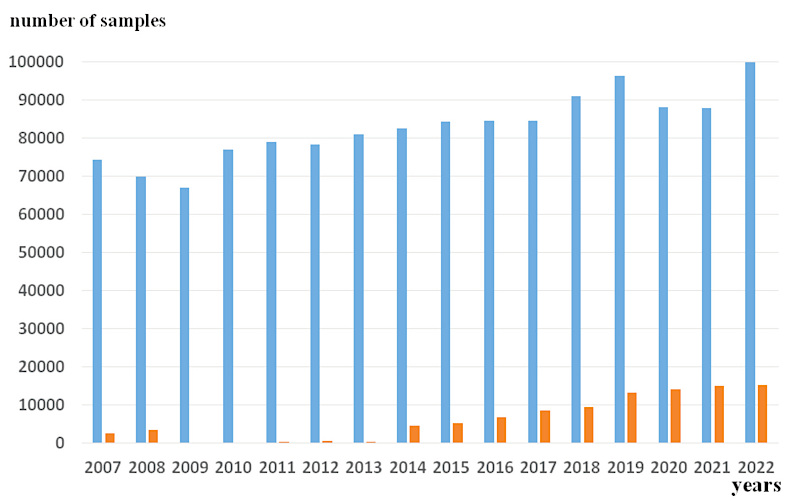
According to the available data from EFSA’s annual reports, the total number of samples analysed for pesticides and those analysed for glyphosate steadily increased from 2007 to 2022. In 2020, there was a 9.3% decrease in the total number of samples submitted for testing by reporting countries compared to 2019, mainly due to the COVID-19 pandemic.
Glyphosate analyses were started in 2007 using gas chromatography methods after derivatisation, but due to the long duration of the method, the development of simpler methods was initiated. In 2011, the first results of the determination of glyphosate in rice and wheat flour using the liquid chromatography-tandem mass spectrometry method were reported. In the following years, the methods for the determination of glyphosate in other types of food were further developed, so that reports were also submitted for other types of food of plant origin. For 2016, the first results of the determination of glyphosate in food of animal origin and the data for glyphosate metabolites were reported: AMPA, N-acetyl-AMPA and N-acetyl-glyphosate are mentioned for the first time in the 2021 report.
With Croatia’s accession to the EU, the results of the national pesticide monitoring plan were also processed by EFSA and included in the annual reports with the results of all other Member States starting in 2014, when Croatia officially joined the monitoring programme.
References [… show]
Kontrola ostataka glifosata u hrani u Europskoj uniji u razdoblju 2007.-2022.
Dr. sc. Marija DENŽIĆ LUGOMER, BSc, dr. sc. Damir PAVLIČEK, BSc., Tiana NOVOSEL, BSc, Hrvatski veterinarski institut- podružnica Križevci, Hrvatska
Većina poljoprivrednih kultura tretira se više puta različitim vrstama pesticida tijekom uzgoja te je vrlo vjerojatno da će ostatci pesticida ostati na tretiranim poljoprivrednim kulturama. Pesticidi stoga predstavljaju vrlo znatnu skupinu kemijskih spojeva koje je potrebno kontrolirati u hrani prrije svega zbog visoke toksičnosti i široke primjene u poljoprivredi u proizvodnji poljoprivrednih kultura, a najkorišteniji herbicid je glifosat. Kako bi se osigurala visoka razina zaštite potrošača, maksimalno dopuštene razine ostataka pesticida propisane su u Uredbi (EZ) br. 396/2005. Svake godine EFSA izdaje izvješće koje daje pregled aktivnosti službene kontrole rezidua pesticida koje se provode u zemljama članicama Europske unije (EU), Islandu i Norveškoj. Ovaj rad sažima podatke godišnjih izvješća EFSA-e od 2007. do 2022. s osvrtom na podatke koji se odnose na najprodavaniji herbicid glifosat.
Ključne riječi: glifosat, EFSA, monitoring, kontrola hrane, Uredba br. 396/2005
