
Impact of Dietary Phenolic Compounds on Lipogenesis, Antimicrobial Activity and Antioxidant Capacity and Caecal Short Chain Fatty Acids in Broiler Chickens
S.Heštera*, I. Sabolek, K. Starčević, T. Mašek
Sunčica HEŠTERA1* (corresponding author), suncicasertic@gmail.com; Ivana SABOLEK2, isabolek@vef.unizg.hr, orcid.org/0000-0002-9405-4629; Kristina STARČEVIĆ3, kstarcevic@vef.unizg.hr, orcid.org/0000-0002-2606-7807; Tomislav MAŠEK1, tmasek@vef.unizg.hr, orcid.org/0000-0002-6103-4728.
1Department of Animal Nutrition and Dietetics, Faculty of Veterinary Medicine University of Zagreb, 10000 Zagreb, Croatia
2Department of Animal Hygiene, Behaviour and Welfare, Faculty of Veterinary Medicine University of Zagreb, 10000 Zagreb, Croatia
3 Department of Chemistry and Biochemistry, Faculty of Veterinary Medicine University of Zagreb, 10000 Zagreb, Croatia

https://doi.org/10.46419/cvj.58.1.3
Received: 13 May 2026
Accepted: 1 September 2026
Online publication: 30 November 2026
Abstract
The effects of a diet supplemented with a phenolic compound mixture on growth performance, antimicrobial and antioxidative properties, caecal short-chain fatty acid (SCFA) concentrations, and fatty acid composition of the liver and breast muscle (m. pectoralis superficialis) were evaluated. Dietary treatments included a control group (no supplementation) and a treatment group receiving a phenolic mixture composed of tannic acid, gallic acid, and thymol (5 g/kg; 25:25:1 ratio). The phenolic mixture exhibited comparable in vitro antimicrobial activity and significantly greater antioxidative capacity (p < 0.05) than the individual phenolic compounds. Furthermore, supplementation significantly increased SCFA concentrations in the caecum, suggesting alterations in microbial metabolism. It also led to significantly higher levels of eicosapentaenoic, docosahexaenoic, and total polyunsaturated fatty acids, while significantly reducing monounsaturated fatty acids in both liver and muscle tissues. In conclusion, the tested phenolic mixture shows potential as an effective antimicrobial and antioxidant dietary supplement. Additionally, it positively influences lipid metabolism and caecal fermentation, which may contribute to improved broiler health and enhanced meat quality and consumer acceptance.
Keywords: antioxidant; oxidative susceptibility; n3 fatty acids; phenolic compounds; chicken broiler.
Introduction
Phenolic compounds are a large and diverse group of plant secondary metabolites characterised by the presence of at least one aromatic ring bearing one or more hydroxyl groups. To date, more than 8,000 individual phenolic compounds have been identified, exhibiting substantial structural diversity. Their biological activity has been widely associated with antioxidative properties, including the scavenging of reactive oxygen species. These are considered to contribute to the reduced incidence of chronic diseases (e.g., cardiovascular diseases, cancer, obesity, and diabetes) observed in populations with a high consumption of plant-based foods (de la Rosa et al., 2019). Although antioxidative capacity represents the most extensively studied property of dietary phenolics, increasing evidence suggests that these compounds exert a broader spectrum of biological effects, highlighting their potential as valuable functional components in both food and feed systems.
In recent years, the use of phenolic compounds, either as whole plants, plant extracts, or isolated bioactive molecules, has gained considerable attention as a natural alternative to conventional feed additives in animal nutrition. This growing interest follows a paradigm shift from viewing these compounds primarily as antinutritional factors to recognising their dose- and structure-dependent health-promoting properties. Reported benefits include improved animal productivity (Cross et al., 2007), enhanced antioxidative status (Rhee et al., 1996), antimicrobial activity (Gill and Holley, 2006; Jesus et al., 2015), immunomodulatory effects (Hashemipour et al., 2013), anti-inflammatory responses (Badr et al., 2011), improved carcass quality (Starčević et al., 2015; Žužul et al., 2026), as well as better reproductive performance and reduced mortality and morbidity (Ezzat Abd El-Hack et al., 2016).
Simultaneously, there is increasing demand for animal-derived products with improved nutritional quality, particularly those enriched with n-3 polyunsaturated fatty acids (PUFA) relative to less desirable n-6 fatty acids and saturated fatty acids (Ponnampalam et al., 2021). However, meat enriched with PUFA is more susceptible to lipid oxidation, a key factor contributing to quality deterioration during storage (Bou et al., 2004). Therefore, strategies to mitigate oxidative degradation in animal tissues are of critical importance. Dietary phenolic compounds represent a promising approach, not only due to their potent antioxidative properties but also because they are generally perceived as more acceptable alternatives to synthetic additives.
Previous investigations from our group demonstrated that individual phenolic compounds may exert different biological effects in broiler chickens. In a study evaluating the effects of different phenolic compounds, supplementation with gallic acid was associated with changes in meat fatty acid composition, including increased PUFA content, tannic acid showed beneficial effects on selected production performance parameters, whereas thymol influenced caecal fermentation characteristics and microbial activity (Mašek et al., 2014; Starčević et al., 2015). These findings indicated that individual phenolic compounds may affect different physiological processes depending on their chemical structure and biological properties.
However, the literature is primarily focused on the effects of single phenolic compounds, while possible interactions resulting from their combined supplementation remain unclear. In natural plant-based feed sources, phenolic compounds are present as complex mixtures rather than isolated molecules, suggesting that interactions between different compounds may influence their overall biological activity. Such interactions may enhance, complement, or reduce the effects observed for individual compounds.
Material and methods
Animal study, experimental design and experimental diets
All experimental procedures were conducted in compliance with the European Union Directive on the protection of animals used for scientific purposes (Directive 2010/63/EU of the European Parliament and of the Council, 22 September 2010). The study protocol was reviewed and approved by the Institutional Ethics Committee of the University of Zagreb, Faculty of Veterinary Medicine (approval date: 22 September 2022; reference number: 640-01/21-02/09; 251-61-01/139-21-66).
Experimental birds were reared on a solid floor covered with wood shavings at a density of 3 kg/m² and had ad libitum access to feed and water. Ambient temperature was maintained at 33°C during the first 7 days and subsequently reduced by 3°C per week until reaching approximately 24°C. Relative humidity was maintained at 60–65% during the first week and then adjusted to 50–60% thereafter. Birds were vaccinated according to a standard immunisation program against Newcastle disease and infectious bronchitis.
A three-phase feeding programme was implemented, with starter, grower, and finisher diets provided during days 1–21, 22–35, and 36–42, respectively. Diets were offered in mash form, and their chemical composition was previously published (Žužul et al., 2026).
The experimental design included two groups, each comprising five replicates of ten birds (n = 50 per group): a control group receiving the basal diet without supplementation and an experimental group supplemented with a phenolic mixture containing tannic acid, gallic acid, and thymol at 5 g/kg of feed (25:25:1 ratio). On day 42, birds were electrically stunned and exsanguinated. Breast muscle (m. pectoralis superficialis) and liver samples were collected immediately post-mortem, snap-frozen in liquid nitrogen for 90 s, individually wrapped in aluminium foil, and transported to the laboratory for subsequent analysis.
Animal growth performance
Body weight (BW) was recorded weekly for all birds. Body weight gain, feed consumption, and feed conversion (g feed/g of gain) were calculated pen-wise for the respective periods.
Minimum inhibitory concentrations and minimum biofilm eradication concentrations
Minimum inhibitory concentrations (MICs) and minimum biofilm eradication concentrations (MBECs) were determined in 11 bacterial cultures: Klebsiella pneumoniae (ATCC 700603), Escherichia coli (ATCC 8735, 8739), Enterococcus faecalis (ATCC 29122), Enterococcus hirae (ATCC 8043), Staphylococcus aureus (ATCC 6539), Bacillus subtilis (ATCC 6603), Bacillus cereus (ATCC 11778) and Pseudomonas aeruginosa (ATCC 9027) as well as in 2 fungal cultures Candida albicans (ATCC 1023) and Candida parapsilosis (ATCC 22019). The investigated compounds and BHT as a control were prepared by weighing 200 mg, dissolved in 500 µL ethanol and resuspended in 5 mL mQ water. A serial microdilution procedure was performed to determine the MIC of acids in the range of 100 to 0.7125 µg/mL, by the EUCAST method. MIC values were determined using the broth microdilution method according to EUCAST recommendations in 96-well microtiter plates. Each well contained 100 µL of the test mixture with the appropriate concentration of the tested compound and a standardised microbial inoculum adjusted to approximately 5 × 10⁵ CFU/mL. Plates inoculated with bacteria were incubated at 35 ± 2°C for 24 h, whereas fungal cultures were incubated for 48 h under the same conditions. Growth control wells containing microbial suspension without the tested compounds and solvent control wells containing the corresponding concentration of ethanol were included in each experiment to verify microbial growth and to confirm that ethanol did not affect microbial viability. Following incubation, aliquots from all dilution wells were inoculated onto appropriate nutrient agar plates and further incubated under suitable conditions. Microbial growth was evaluated after incubation, and the MIC value was defined as the lowest concentration of the tested compound at which no microbial growth was observed after subculturing.
The minimum biofilm eradication concentration (MBEC) was determined by crystal violet (CV) staining of bacterial and fungal biofilms formed in 96-well microtitre plates. Negative controls consisted of microbial cultures without tested compounds, while positive controls contained gentamicin for bacterial cultures and amphotericin B for fungal cultures. A volume of 100 µL bacterial suspension (10⁷ CFU/mL) or fungal suspension (5 × 10⁶ CFU/mL), together with the tested solution at the appropriate concentration, was added to each well. After inoculation, plates were incubated under aerobic conditions at 37°C for 24 h for bacteria and 48 h for fungi to allow biofilm formation. Following incubation, the wells were washed with 250 µL PBS to remove non-adherent cells, dried, and fixed with 20–30 µL methanol. Biofilms were stained with 1% crystal violet solution for 5 min, followed by washing to remove excess stain and drying for 24 h. The bound crystal violet was then solubilised by adding 100 µL methanol, and absorbance was measured at 570 nm using a microplate reader. The MBEC value was defined as the lowest concentration of the tested compound resulting in the absence of detectable biofilm formation compared with the untreated control. All experiments were performed with appropriate controls.
Short-chain fatty acids
After euthanasia, the ceca were excised and opened, and approximately 1 g digesta was carefully expressed into sterile tubes and stored at -80°C until further analysis. For the determination of short-chain fatty acids (SCFA), around 1 g previously thawed digesta was mixed with 1 ml ultrapure water and centrifuged (n = 20 per group). After centrifugation (10 minutes at 5000×g), the supernatant was collected into a new tube, and 0.2 mL 24% metaphosphoric acid was added. The mixture was then kept in an ice bath to ensure complete protein precipitation. Following this step, samples were centrifuged again (10 minutes at 5000×g), and the resulting clear supernatant was used for analysis.
The SCFA concentrations (acetic, propionic, and butyric acid) were quantified from the supernatant using a Shimadzu GC2010Plus gas chromatograph (Shimadzu, Japan), fitted with an AOC-20i autosampler, a flame ionization detector (FID), and a Nukol™ capillary column (30 m × 0.25 mm × 0.25 μm; Supelco, Bellefonte, PA, USA). The chromatographic conditions were as follows: helium as the carrier gas; split ratio of 1:100; injection volume of 1 μL; injector temperature set at 220°C; detector temperature at 230°C; and an oven temperature programme starting at 100°C, increasing at a rate of 20°C/min to 140°C, followed by a further increase of 8°C/min up to 200°C. Crotonic acid served as the internal standard. All analyses were performed in triplicate.
Fatty acid composition
Total lipids from liver and breast muscle (m. pectoralis superficialis) samples were isolated following a previously established procedure (Folch et al., 1957) (n = 20 per group). The extracted lipid fractions were evaporated under a stream of nitrogen in the presence of BHT as an antioxidant and subsequently stored at -80°C. Fatty acid methyl esters were prepared by transmethylation using 2 M KOH for 15 minutes at room temperature. The resulting compounds were extracted with n-hexane and transferred into vials containing anhydrous Na₂SO₄.
Fatty acid analysis was carried out using a GC–MS system (QP2010 Ultra, Shimadzu, Kyoto, Japan) equipped with a BPX70 capillary column (30 m length, 0.25 mm internal diameter, 0.25 μm film thickness; SGE, Austin, TX, USA). The chromatographic parameters followed those previously reported (Starčević et al., 2018). Fatty acid profiles were expressed as percentages of the total identified fatty acids.
Delta desaturase expression
Total RNA was isolated from 30 mg liver tissue and reverse transcribed as previously described (Starčević et al., 2018) (n = 10 per group). The qPCR was performed using a Stratagene MxPro3005 (Agilent Technologies, US and Canada) thermocycler. The oligonucleotides used for quantitative PCR were: Δ5D-F, 5′-ggamcagtgggtggacct-3′, Δ5D-R, 5′- agatgaagccccaggatacc -3′, Δ6D-F, 5′-aattgagcaccacctgttcc-3′, Δ6D-R, 5′-tggcacataacgacttcacc-3′, Δ9D-F, 5′- catgggccattctgtgctt-3′, Δ9D-R, 5′-ggccatggagtttgcaatag-3′, G6PDH-F, 5′-gctaaaggccgcaccagt-3′, G6PDH-R, 5′-ggagctccatggtcagaaac-3′ (Boschetti et al., 2016). The gene expression from each sample was analysed and relatively quantified using the ΔΔCt method (2ΔΔCt) after normalisation to β-actin and cyclophilin (housekeeping genes) (Livak and Schmittgen, 2001). Data are represented as the fold change in gene expression relative to the Control group.
Statistical analyses
For production performance traits, the replication was considered the experimental unit. For fatty acid composition and fermentation parameters, individual birds were considered the experimental unit, with samples collected from representative birds within each pen. Data were analysed using GraphPad Prism 8 v. 8.4.3. software (GraphPad Software Inc., San Diego, CA, USA). All data were expressed as mean ± standard deviation (SD). The normality of the distribution was tested using the Shapiro-Wilks test. Student t-test was used to determine statistical differences between group means. The standard deviations of fold changes for the tested gene expression were determined according to the established procedure (Livak and Schmittgen, 2001). Significant differences were considered at P<0.05.
Results
Broilers Growth Performance
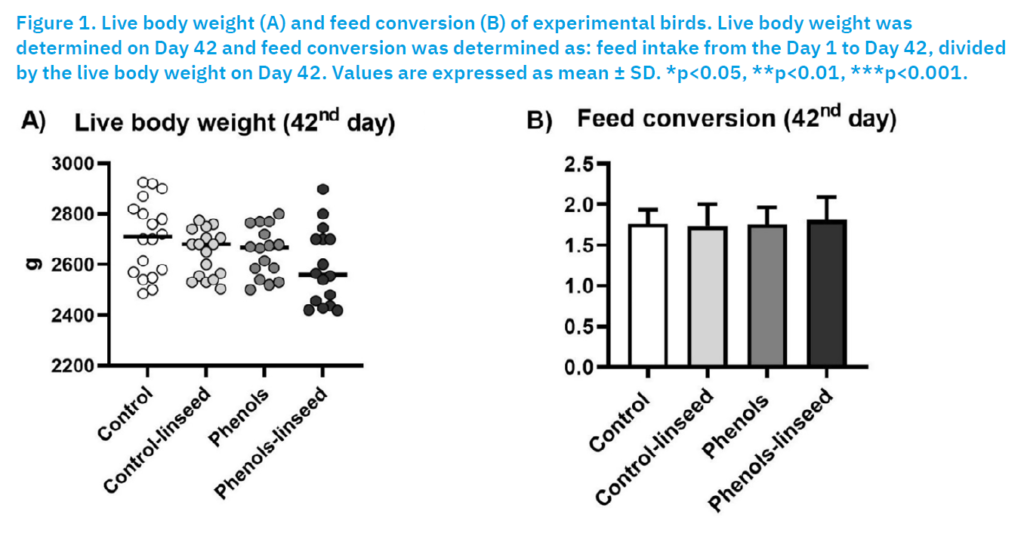
Growth performance data and feed conversion of broilers fed experimental diets are shown in Figures 1A and 1B. Despite a relatively high dosage of phenol supplementation, no significant decrease was observed in live BW. Similarly, feed conversion was not influenced by the treatments.
Minimum inhibitory concentration and minimum biofilm eradication concentration
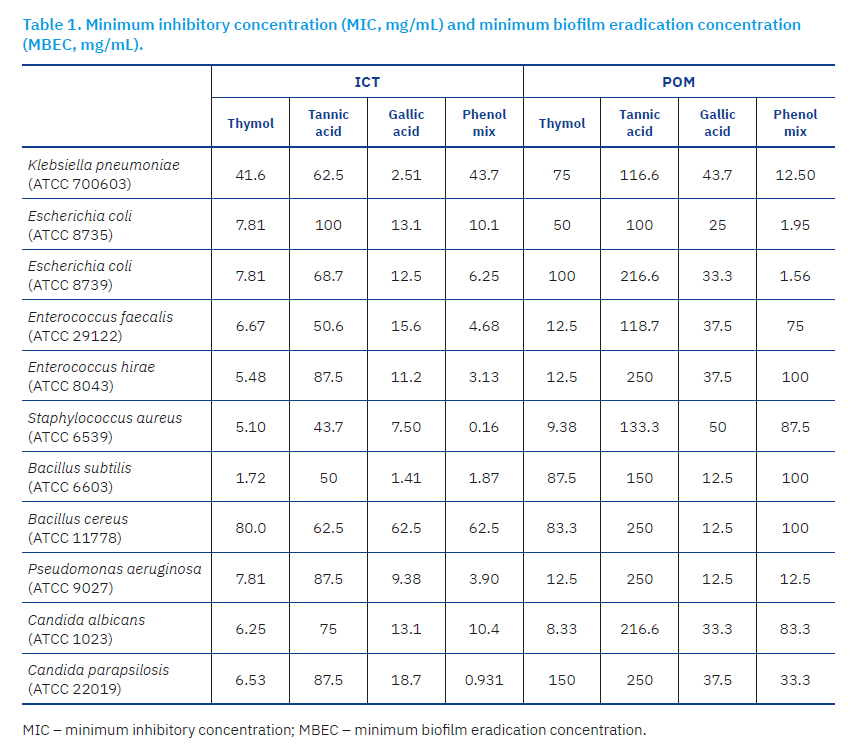
The MIC and MBEC results of individual compounds (thymol, tannic acid and gallic acid) and the phenol mixture are shown in Table 1. The results confirmed that the MIC and MBEC values for the phenol mixture were not lower than those for the individual phenolic compounds. Moreover, for some bacteria, the phenol mixture had improved MIC (Staphylococcus aureus, ATCC 6539; Candida parapsilosis, ATCC 22019) and MBEC values (Escherichia coli ATCC 8735 and Escherichia coli, ATCC 8739).
Antioxidative properties of experimental compounds
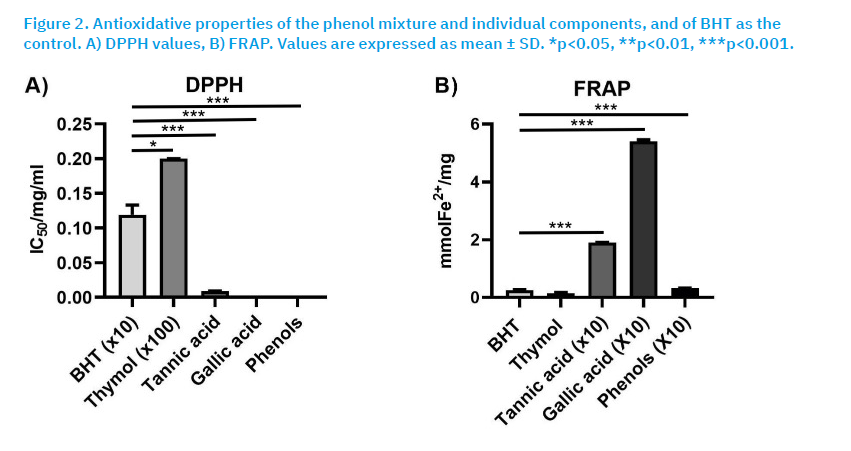
The antioxidant properties of gallic acid, tannic acid, and thymol and their mixture in a 25:25:1 ratio were analysed to evaluate individual antioxidative capacity and potential synergistic effects in the mixture. The DPPH and FRAP assays showed similar or even higher antioxidative capacity in the phenol mixture compared to the values of individual compounds (Figures 2A and 2B).
Caecal short-chain fatty acids
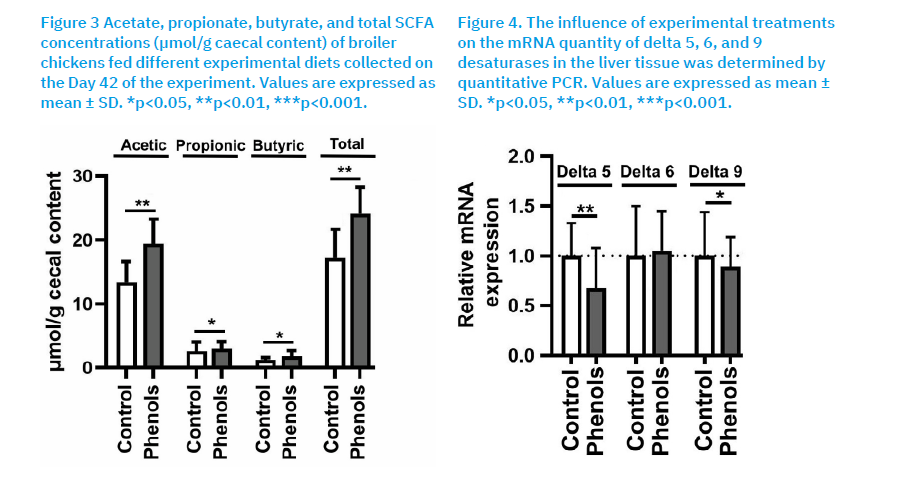
Caecal SCFA data of birds fed experimental diets are presented in Fig. 3. The diet containing phenols increased the caecal concentration of acetate, butyrate, propionate and total SCFA.
Fatty acid profile of tissues
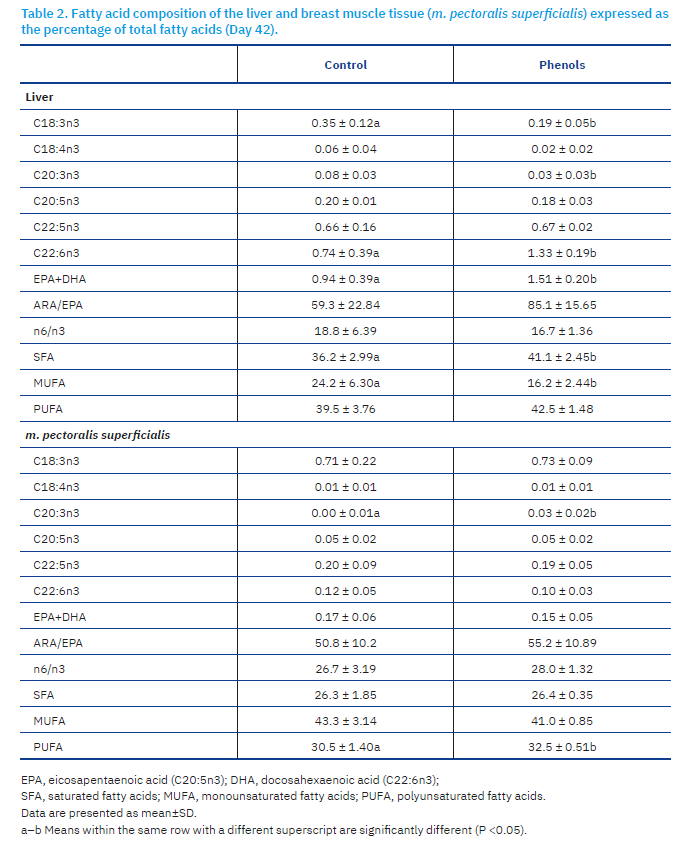
Fatty acid composition of the liver and breast (m. pectoralis superficalis) tissue is shown in Table 2. Phenol supplementation increased EPA + DHA and total PUFA content and decreased MUFA content in liver and muscle tissue. Additionally, in liver tissue, DHA content also increased.
Expression of desaturases
The hepatic expressions of delta 5, 6, and 9 desaturases are shown in Figure 4. Quantitative PCR revealed decreased hepatic expression of Δ5 and 9 in the phenol-treated group compared with the Control group.
Discussion
The effects of plant-derived bioactive compounds on broiler growth performance and feed conversion are highly dose-dependent, as excessive inclusion levels may impair growth performance (Mansoori et al., 2007; Samuel et al., 2017). In addition to dosage, factors such as treatment duration and the form of supplementation (plant extract vs. whole plant material) may also influence biological responses. Conversely, low inclusion levels may result in limited or no measurable effects. Therefore, determining an optimal and biologically effective dosage represents a major challenge in the development of plant-derived growth promoters. The dosage applied in this study was based on previous trials that did not show adverse effects (Mašek et al., 2014; Starčević et al., 2015). Nevertheless, this dosage may represent a limitation of the present study, as it was close to the upper range at which growth inhibition could potentially occur, and additional large-scale studies are required before practical implementation in poultry production.
Phenolic compounds have significant antimicrobial activity (Sarjit et al., 2015; Marchese et al., 2016; Dong et al., 2018). The mechanism of their antimicrobial action is an active area of research and it is evident that it involves many sites of action at the cellular level (Sikkema et al., 1995). Studies suggest that the antibacterial activity of most phenolic substances is related to the interactions between the substance and bacterial cell surface (Bouarab-Chibane et al., 2019). We tested in vitro antimicrobial activity by establishing values for MIC and MBEC for individual compounds and for the phenolic mixture. The results suggested that antimicrobial properties are still present in the phenolic mixture and even enhanced for several bacterial strains (e.g., MIC for: Staphylococcus aureus, ATCC 6539; Candida parapsilosis, ATCC 22019 and MBEC for: Escherichia coli ATCC 8735 and Escherichia coli, ATCC 8739).
We also investigated if a dietary phenolic mixture could change the poultry gut environment by measuring the concentrations of SCFA. Increased SCFA concentrations indicate enhanced microbial fermentation activity and may contribute to improved intestinal health through the maintenance of epithelial integrity, regulation of microbial balance, and provision of energy substrates for intestinal cells (van Der Wielen et al., 2000). These findings suggest that phenolic compounds may exert beneficial effects not only through antioxidant mechanisms but also through the modulation of gut microbial metabolism. The observed increase in caecal SCFA concentrations may have important physiological implications for broiler health. SCFA, including acetate, propionate, and butyrate, are key metabolites produced by microbial fermentation and serve as indicators of active and functional caecal microbiota (Morison and Preston, 2016). In particular, butyrate represents an important energy source for intestinal epithelial cells and contributes to the maintenance of intestinal barrier integrity (Hamer et al., 2008), whereas acetate and propionate participate in host energy metabolism. Therefore, increased SCFA production may indicate enhanced microbial utilisation of dietary substrates and a shift toward a more favourable intestinal environment. Increased caecal SCFA production may also have implications for intestinal immune regulation (Barnes et al., 1979). SCFA, particularly butyrate, have been reported to modulate inflammatory responses, support intestinal barrier function, and contribute to maintaining immune homeostasis in the gut (Corrêa-Oliveira et al., 2016). Therefore, the ability of phenolic compounds to influence microbial fermentation and increase SCFA production may represent an additional mechanism by which they affect host health, beyond their direct antioxidant activity. The observed effects may be related to the ability of phenolic compounds to modulate caecal microbial populations and fermentation processes, thereby contributing to their potential beneficial effects on animal health and performance.
Phenolic compounds are best known for their antioxidative activity (Rice-Evans et al., 1997). In the present study, the phenolic mixture showed better antioxidative potency measured by DPPH and FRAP assays compared to the individual phenolic compounds, indicating synergistic effects. This is in agreement with studies that found synergistic antioxidant activity in plants containing different polyphenolic compounds (Jain et al., 2011; Aslam et al., 2017).
Enrichment of edible animal tissues with beneficial fatty acids (n3 line or CLA) has been an active research area in recent decades (Kartikasari et al., 2012; Mašek et al., 2014a). Nevertheless, significant lipid peroxidation in n3 fatty acids-enriched tissues remains as issue, as it lowers the quality of meat and meat products. Therefore, it is of utmost importance to find products that can attenuate oxidative deterioration in the meat products. Phenolic compounds, with their strong antioxidative properties, could present an effective alternative to synthetic antioxidants because they are considered by consumers to be non-toxic or at least less toxic (Serra et al., 2021).
In the present study, increased phenol content could be associated with the increased content of beneficial n3 fatty acids and total PUFAs, and a simultaneous decrease in monounsaturated fatty acids in both liver and muscle tissues. These results are most likely the combined influence of the antioxidative properties of phenols that preserved n3 fatty acids and decreased the activity of Δ9 desaturase that cause the inhibition of monounsaturated fatty acid synthesis.
Conclusions
The main findings of this study demonstrated that the phenolic mixture exhibited significant in vitro antioxidant and antimicrobial activity. Furthermore, the in vivo trial indicated preservation of beneficial fatty acids, while caecal fermentation was associated with increased production of SCFA, which are known to exert antimicrobial effects. Collectively, these results suggest that the dietary phenolic mixture evaluated in this study may serve as an effective health-promoting feed supplement for poultry. Nevertheless, additional large-scale studies are required to determine optimal and economically feasible inclusion levels, and to further evaluate the safety and consumer acceptance of phenolic compounds used in animal nutrition.
References [… show]
Utjecaj fenolnih spojeva u hrani na lipogenezu, antimikrobnu aktivnost i antioksidativni kapacitet te koncentracije kratkolančanih masnih kiselina u cekumu tovnih pilića
Sunčica HEŠTERA1* (dopisni autor), suncicasertic@gmail.com; Ivana SABOLEK2, isabolek@vef.unizg.hr, orcid.org/0000-0002-9405-4629; Kristina STARČEVIĆ3, kstarcevic@vef.unizg.hr, orcid.org/0000-0002-2606-7807; Tomislav MAŠEK1, tmasek@vef.unizg.hr, orcid.org/0000-0002-6103-4728.
1Zavod za prehranu i dijetetiku životinja, Veterinarski fakultet Sveučilišta u Zagrebu, 10000 Zagreb, Hrvatska
2Zavod za higijenu, ponašanje i dobrobit životinja, Veterinarski fakultet Sveučilišta u Zagrebu, 10000 Zagreb, Hrvatska
3Zavod za kemiju i biokemiju, Veterinarski fakultet Sveučilišta u Zagrebu, 10000 Zagreb, HrvatskaU ovom istraživanju procijenjeni su učinci prehrane obogaćene mješavinom fenolnih spojeva na proizvodne rezultate, antimikrobna i antioksidativna svojstva, koncentracije kratkolančanih masnih kiselina (SCFA) u cekumu te sastav masnih kiselina u jetri i prsnom mišiću (m. pectoralis superficialis). Pokusne skupine uključivale su kontrolnu skupinu (bez dodatka) i tretiranu skupinu koja je primala mješavinu fenolnih spojeva sastavljenu od taninske kiseline, galne kiseline i timola (5 g/kg; omjer 25:25:1). Fenolna mješavina pokazala je usporedivu antimikrobnu aktivnost in vitro te značajno veći antioksidativni kapacitet (p < 0.05) u odnosu na pojedinačne fenolne spojeve. Nadalje, dodatak je značajno povećao koncentracije SCFA u cekumu (p < 0.05), što upućuje na promjene u mikrobnom metabolizmu. Također je doveo do značajno viših razina eikozapentaenske i dokozaheksaenske kiseline (p < 0.05), kao i ukupnih polinezasićenih masnih kiselina, uz istodobno značajno smanjenje mononezasićenih masnih kiselina u jetri i mišićnom tkivu (p < 0.05). Zaključno, ispitivana mješavina fenolnih spojeva pokazuje potencijal kao učinkovit antimikrobni i antioksidativni dodatak prehrani. Osim toga, pozitivno utječe na metabolizam lipida i cekalnu fermentaciju, što može pridonijeti boljem zdravlju brojlera te poboljšanoj kvaliteti mesa i prihvaćenosti od strane potrošača.
Ključne riječi: antioksidans; podložnost oksidaciji; n-3 masne kiseline; fenolni spojevi; tovni pilići.
