
The Importance of Wild Rabbit (Oryctolagus cuniculus Linnaeus, 1758) Populations in Tick Ecology on Croatian Islands in the Adriatic Sea
K.Pintur*, E. Gagović, T. Dumić, V. Slijepčević, N. Fabijanić, D. Jurković Žilić, R. Beck*
Krunoslav PINTUR1* (corresponding author), krunoslav.pintur@vuka.hr, orcid.org/0000-0003-4724-4523; Ema GAGOVIĆ2, gagovic@veinst.hr, orcid.org/0009-0007-6122-5958; Tomislav DUMIĆ1, tomislav.dumic@vuka.hr, orcid.org/0000-0001-5943-4346; Vedran SLIJEPČEVIĆ1, vedran.slijepcevic@vuka.hr, orcid.org/0000-0002-0508-6224; Nera FABIJANIĆ3, nera_az@yahoo.com, orcid.org/0000-0001-7964-7939; Daria JURKOVIĆ ŽILIĆ2, jurkovic@veinst.hr, orcid.org/0000-0002-3504-5271; Relja BECK2* (corresponding author), beck@veinst.hr, orcid.org/0000-0002-5304-2875.
1Department of Wildlife Management and Nature Conservation, Karlovac University of Applied Sciences, 47000 Karlovac, Croatia
2Laboratory for Parasitology, Department of Bacteriology and Parasitology, Croatian Veterinary Institute, 10000 Zagreb, Croatia
3Croatian Hunting Association, 10000 Zagreb, Croatia

https://doi.org/10.46419/cvj.58.1.6
Received: 27 May 2026
Accepted: 12 July 2026
Online publication: 30 November 2026
Abstract
The European wild rabbit (Oryctolagus cuniculus) plays an important ecological and epidemiological role in Mediterranean ecosystems, particularly as a host for ticks and tick-borne pathogens. However, data on tick infestation of wild rabbits in Croatia are lacking. The aim of this study was to investigate tick infestation in 66 wild rabbits on three Croatian Mediterranean islands: Pag, Goli Otok, and Pašman during 2024 and 2025. In total, 517 ticks were collected from 59 infested rabbits, resulting in an overall infestation prevalence of 89.4%. The highest infestation intensity was recorded on Goli Otok (15.33 ± 6.80 ticks per rabbit), while the lowest was observed on Pašman (2.25 ± 1.26). Statistically significant differences in infestation intensity were found among sites (Kruskal-Wallis test, p = 0.0023). Three tick species were identified: Ixodes ventalloi, Ixodes festai, and Rhipicephalus bursa. Ixodes ventalloi was the dominant species, accounting for 88.2% of all collected ticks, and was also the only species recorded on Goli Otok. Ixodes festai accounted for 11.6% of collected ticks and was recorded on the islands of Pag and Pašman, while a single nymph of Rhipicephalus bursa was found on Pag. Adult ticks predominated over nymphs, whereas larvae were not detected. Molecular analysis based on sequencing of the mitochondrial 16S rRNA gene confirmed the morphological identification of all tick species and provided the first molecularly confirmed record of Ixodes festai in Croatia. The results indicate that wild rabbit is an important host for maintaining tick populations in Mediterranean island ecosystems. This study provides an important basis for future research on tick ecology and tick-borne pathogens in Adriatic island ecosystems.
Key words: European wild rabbit; Oryctolagus cuniculus; Croatia; islands; ticks.
Introduction
The European wild rabbit (Oryctolagus cuniculus Linnaeus, 1758) belongs to the order Lagomorpha and the family Leporidae. Originating from the Iberian Peninsula and southern France (Flux and Fullagar, 1992; Fontanesi et al., 2021), today it is considered one of the most widespread mammals in the world (Fontanesi et al., 2021). Its current global distribution is primarily the result of human activities, namely intentional and unintentional introductions to numerous parts of Europe and the world, including South America, Australia, New Zealand, and more than 800 islands (Flux and Fullagar, 1992, Flux, 1994). The spread of this species throughout Europe, particularly in the Mediterranean region, began as early as the Roman period (Flux and Fullagar, 1992; Rogers et al., 1994; Fontanesi et al., 2021).
Within its native range on the Iberian Peninsula, the European wild rabbit plays a key ecological role: more than 40 vertebrate species depend on it as a food source, while its presence influences plant community composition and soil fertility. Despite this, the species is endangered in its native range. In contrast, in most areas where it has been introduced, it exhibits high invasiveness and exerts significant negative impacts on native flora, fauna, and agriculture, and as such is listed among the 100 worst invasive species according to the IUCN (Delibes-Mateos et al., 2008; Kopij, 2024; Kossoff et al., 2024). The ecological plasticity of the species arises from its generalist feeding behaviour and its ability to adapt to different habitat types and vegetation availability (Marín-García and Lobat, 2021).
In Croatia, two species from the family Leporidae are present: the European wild rabbit (Oryctolagus cuniculus Linnaeus, 1758) and the European hare (Lepus europaeus Pallas). Populations of the European wild rabbit have been recorded on several northern Adriatic islands, including Pag, Rab, Ugljan, Pašman, Maun, Goli Otok, Dolin, Trstenik, and Dugi Otok, although data regarding their genetic origin and long-term population trends remain limited (Flux and Fullagar, 1992; Brajković et al., 2017). On some islands, such as Goli Otok, only the European rabbit is present, whereas on islands such as Pag, Rab, Ugljan, and Pašman, the European wild rabbit coexists with the European hare. In Croatia, the European wild rabbit has the status of a game species.
Given its high abundance and close associations with both plant and animal communities, understanding its ecological role in Mediterranean and island ecosystems is particularly important (Calvete et al., 2004; Gálvez-Bravo et al., 2011; Mann-Vollrath et al., 2024). Beyond its ecological relevance, the species also plays a notable epidemiological role, especially through its relationships with ectoparasites—primarily ticks—and its influence on tick population dynamics (Rogers et al., 1994; González et al., 2016; Napoli et al., 2021; Rafael et al., 2025). To date, there are no published data on tick species parasitizing European wild rabbits in Croatia. Studies conducted on the Iberian Peninsula indicate their importance in the ecology of ticks of the genera Hyalomma, Ixodes, Rhipicephalus, and Dermacentor, particularly regarding their developmental stages (larvae and nymphs) (González et al., 2016; Taylor et al., 2020; Napoli et al., 2021; Sánchez et al., 2022; Castro-Scholten et al., 2024). Certain tick species feeding on rabbits have a broad host spectrum and may represent an ecological bridge between wild and domestic animals and humans, thereby contributing to the maintenance and transmission of zoonotic pathogens (Toledo et al., 2009).
Accordingly, the European wild rabbit possesses not only ecological but also significant epidemiological importance. Its role in the maintenance and circulation of various pathogens has been confirmed, as it may act as a reservoir and/or amplifier host for disease agents. Among the most important are Coxiella burnetii (Sánchez et al., 2022; Castro-Scholten et al., 2024), Ehrlichia spp and Rickettsia spp. (Remesar et al., 2022a, 2022b; Rafael et al., 2025), and the zoonotic pathogen Francisella tularensis (Ammam et al., 2024). Considering the lack of data for Croatia, investigating the interaction between the European wild rabbit and ticks represents an important contribution to understanding tick ecology and the epidemiology of tick-borne diseases in Mediterranean island ecosystems.
Materials and methods
Study area
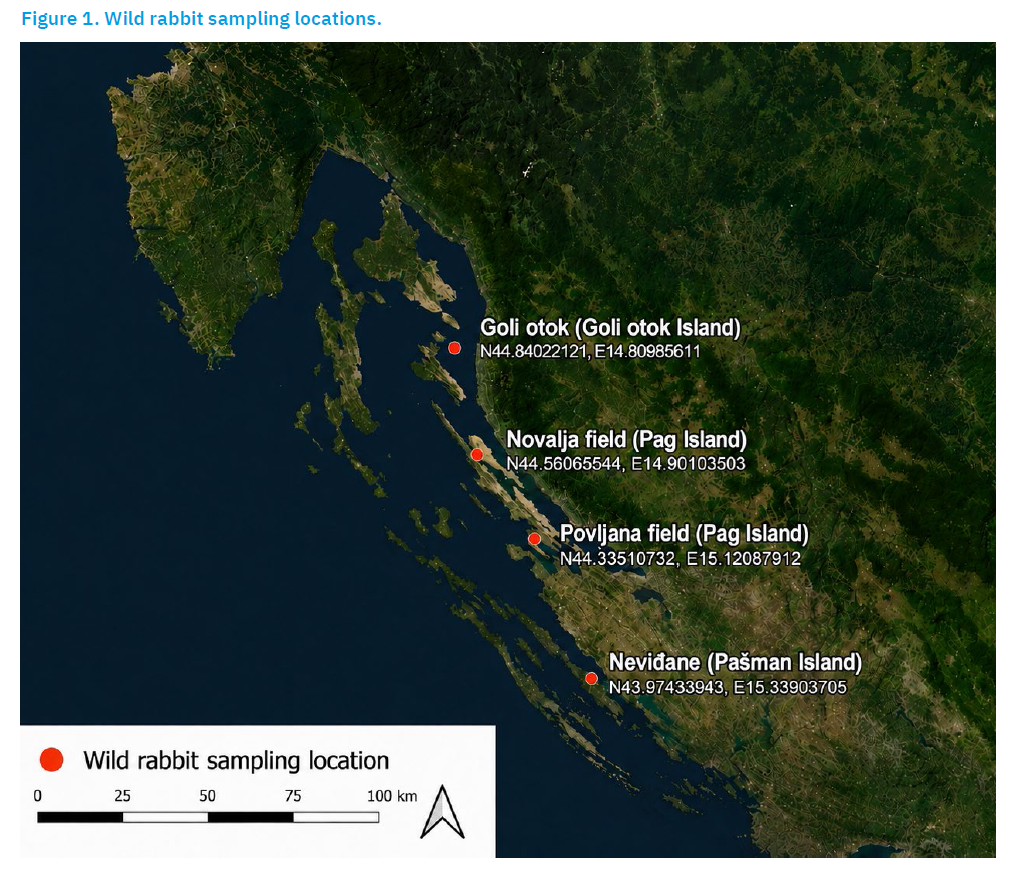
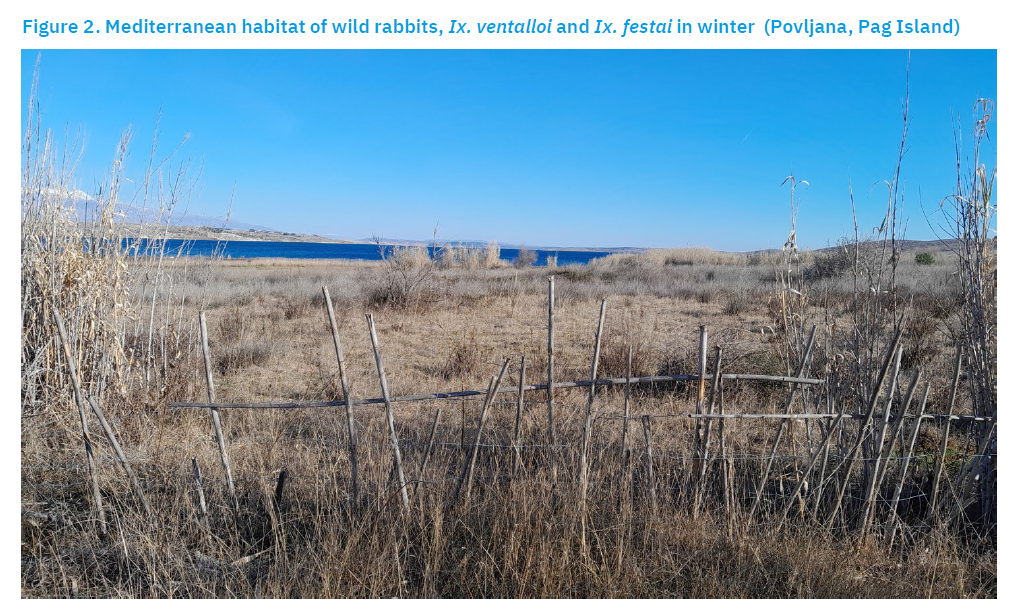
The study was conducted on two islands of the northern Adriatic, Pag and Goli Otok, and one island in the central Adriatic, Pašman. On Pag, rabbits were sampled at two locations inhabited by wild rabbits: the Novalja Field and the Povljana Field. Each field is approximately 250 ha in area. These fields represent typical Mediterranean agrarian depressions within a karst landscape, with vegetation shaped by a combination of natural factors and long-term agricultural activity. Abandoned agricultural land (primarily abandoned vineyards) and meadow-pasture communities dominate these areas. On Goli Otok, vegetation is dominated by eastern Adriatic rocky pastures of the sub-Mediterranean zone (Alliance Chrysopogoni-Koelerion splendentis H-ić. 1975 (= Chrysopogoni-Saturejon Ht. et H-ić. 1934 p.p.)) and stands of prickly juniper (Juniperus oxycedrus), while plantations of Aleppo pine (Pinus halepensis) are located on the southwestern part of the island (Nikolić, 2026). The fields surrounding the settlement of Neviđane on Pašman consist of a mosaic of cultivated plant communities (olive groves and orchards), anthropogenic grasslands, and abandoned agricultural land.
The altitude of the Povljana and Stara Novalja localities on Pag, and the site on Pašman, ranges from 0 to 25 m above sea level, while the altitude of the study site on Goli Otok ranges from 0 to 100 m above sea level.
According to the Köppen climate classification, Pag and Goli Otok are characterised by a humid subtropical climate type with hot summers (Cfa), whereas Pašman belongs to the Mediterranean climate type with hot summers (Csa) (Šegota and Filipčić, 2003). The mean annual precipitation on all three islands ranges from 800 to 1100 mm, relative humidity from 60–70%, with a mean annual temperature from 13–14°C (Zaninović et al., 2008).
Tick sampling
During the study, a total of 66 wild rabbits were examined. On Pag, 55 wild rabbits were examined (11 rabbits from the Novalja Field area and 44 rabbits from the Povljana Field area), on Goli Otok, 6 wild rabbits were examined, while 5 rabbits were examined on Pašman. Sampling was conducted from September to March in 2024 and 2025. Examined rabbits were collected after regular culling carried out in accordance with the hunting management plan. Collected ticks were stored in test tubes containing 96% ethanol and kept refrigerated at -20°C until identification. A total of 416 ticks were collected from rabbits on Pag, 92 ticks from Goli Otok, and 9 ticks from Pašman, giving a total of 517 collected ticks.
Tick identification
Ticks were morphologically identified to species, sex, and developmental stage using standard taxonomic keys based on morphological characteristics (Contini et al., 2011; Estrada-Peña et al., 2017a; Hornok et al., 2026). Documentation was carried out using a SteREO Discovery.V20 microscope (Carl Zeiss AG, Oberkochen, Germany) equipped with AxioVision and ZEN2 Pro software. After identification, each tick was washed in 70% ethanol, rinsed with sterile distilled water, dried on sterile filter paper to remove external contaminants (such as soil particles, host-derived material, fur, and blood residues), and stored individually in sterile 2 mL tubes containing 96% ethanol until molecular analysis.
After morphological identification, 48 individual ticks were selected for molecular species confirmation. Genomic DNA was extracted using the MagMAX™ CORE Nucleic Acid Purification Kit (Thermo Fisher Scientific, Waltham, MA, USA) on the KingFisher™ Flex Purification System (Thermo Scientific), according to the manufacturer’s instructions, with a final elution volume of 100 μL. Species identity was confirmed by amplification and sequencing of a 460 bp fragment of the mitochondrial 16S rRNA gene using the forward primer 16SF (5′-CTGCTCAATGTTTTTTAAATTGCTGTGG-3′) and reverse primer 16SR (5′-CCGGTCTGAACTCAGATCAAGT-3′) (Black and Piesman, 1994).
PCR reactions were performed in a final volume of 20 µL containing 10 µL GoTaq® G2 Master Mix (Promega, Madison, WI, USA), 7.2 µL DNase/RNase-free distilled water (Promega), 0.4 µL of each primer (10 pmol/µL), and 2 µL DNA template. Positive and negative extraction controls were included in all amplification rounds to monitor contamination.
Amplification products were evaluated by capillary electrophoresis using a QIAxcel system (Qiagen, Germany) with the QIAxcel DNA Fast Analysis kit, DNA QX Alignment Marker (15 bp – 3 kb), and QX DNA Size Markers (50 bp – 1.5 kb and 100 bp – 2.5 kb). PCR products were purified using ExoSAP-IT™ PCR Product Clean-up Reagent (Applied Biosystems™, Waltham, MA, USA) according to the manufacturer’s instructions and sequenced bidirectionally at Macrogen Europe using the corresponding primer sets.
Raw sequence chromatograms were assembled and edited using SeqMan Pro 18 and SeqBuilder Pro 18 (DNASTAR, Madison, WI, USA). Consensus sequences were aligned and analysed using SeqMan and EditSeq (Lasergene, DNASTAR) and compared with reference sequences available in GenBank using the BLASTn algorithm (https://blast.ncbi.nlm.nih.gov) to confirm species identity.
Statistical analysis
Statistical analyses were performed using Python 3.x with the pandas, NumPy, and SciPy libraries. Descriptive statistics were expressed as mean ± standard deviation (SD). Differences among localities were assessed using the Kruskal-Wallis test. Differences in infestation prevalence, tick species composition, and developmental stages were analysed using the χ² test. Statistical significance was set at p < 0.05.
Results
A total of 66 rabbits were examined on three islands: Pag, Goli Otok, and Pašman. Tick infestation was recorded in 59 individuals, representing an overall prevalence of 89.4%. A total of 517 ticks were collected from infested rabbits. Significant differences in infestation intensity were observed among the studied localities (H = 12.15; p = 0.0023). The highest infestation intensity was recorded on Goli Otok (15.33 ± 6.80 ticks per rabbit), while the lowest was observed on Pašman (2.25 ± 1.26). The locality on Pag showed intermediate infestation (8.49 ± 5.61) (Table 1). Post hoc analysis demonstrated statistically significant differences between all pairs of localities: Pag–Pašman, Goli Otok–Pag, and Goli Otok–Pašman (p < 0.05).
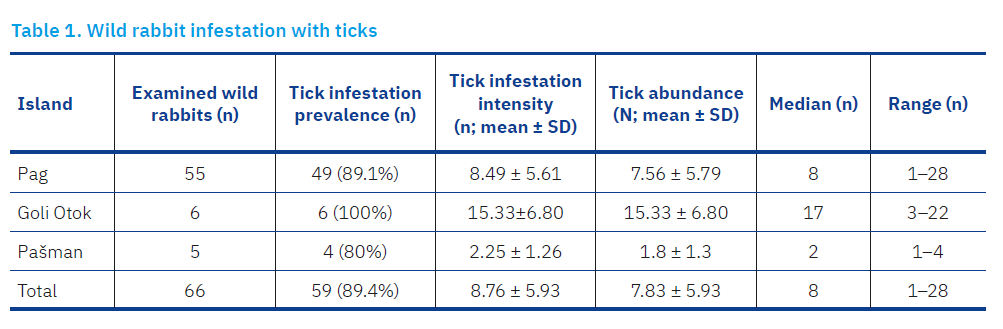
The highest infestation prevalence was recorded on Goli Otok (100%), followed by Pag (89.1%), while the lowest prevalence was observed on Pašman (80%). The mean number of ticks per rabbit was also highest on Goli Otok (15.33), intermediate on Pag (8.49), and lowest on Pašman (2.25) (Table 1). Ticks were attached primarily to the head and neck region. A total of 86.1% of females and 92.2% of nymphs were engorged.
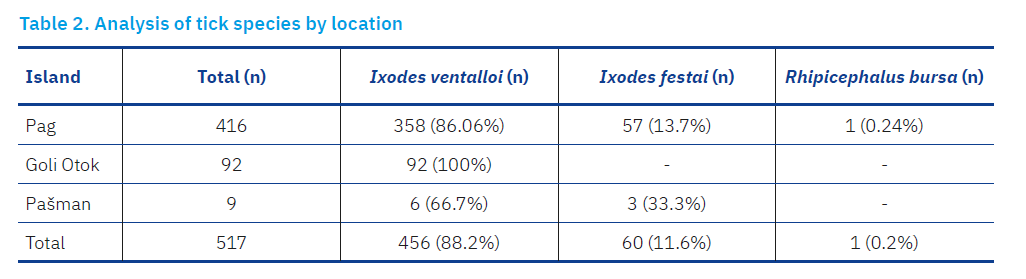
Three tick species were identified: Ixodes ventalloi, Ixodes festai, and Rhipicephalus bursa. I. ventalloi was the dominant species on Pag and Pašman, with all ticks collected on Goli Otok belonged to this species. Ixodes ventalloi was the dominant species, comprising 88.2% of all collected ticks, whereas I. festai accounted for 11.6%. The difference in abundance between the two species was statistically significant (χ² = 693.6; p < 0.001). Ixodes festai was recorded on rabbits from Pag and Pašman. One nymph of R. bursa was also collected from rabbits on Pag (Table 2).
Nymphs and adult ticks were found on rabbits, whereas larvae were not recorded. The distribution of developmental stages showed a clear predominance of adults. Adults predominated in both I. ventalloi (72.1%) and I. festai (76.7%), while nymphs accounted for the remaining proportion. The highest proportion of nymphs was observed on Goli Otok (38%). The only specimen of R. bursa was an unfed nymph. No significant differences in developmental stages were found among species (χ² = 0.34; p = 0.559).
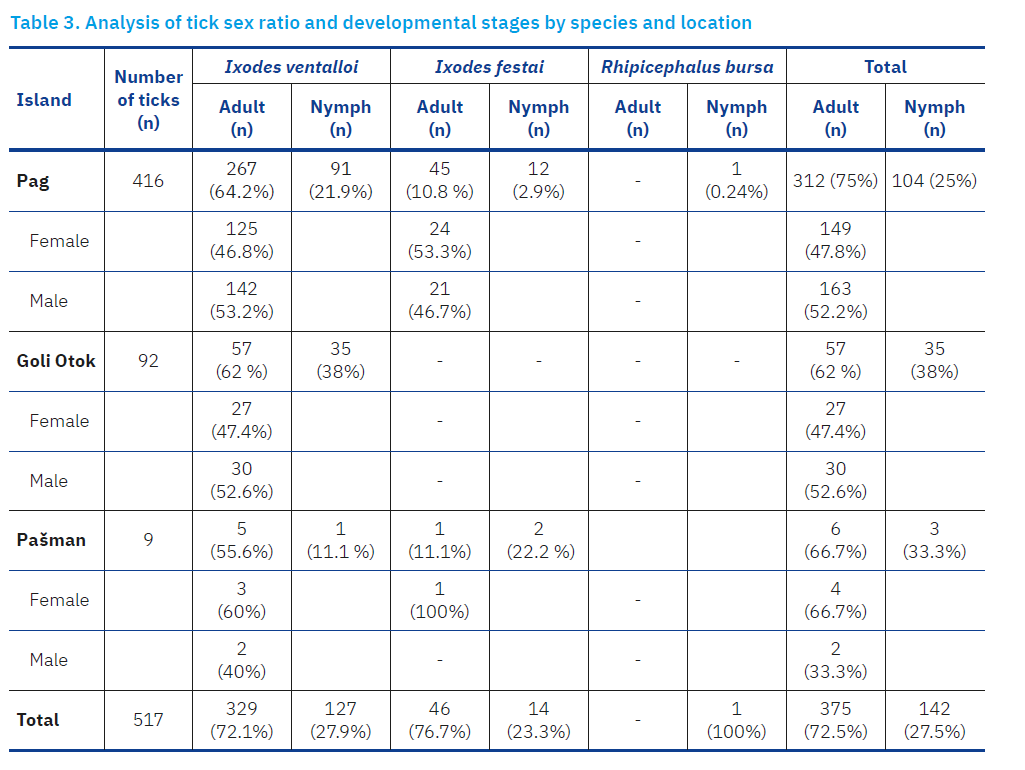
Analysis of the sex structure of adult ticks showed a relatively balanced sex ratio in both dominant species (Table 3). Coinfestation of Ixodes ventalloi with Ixodes festai and Rhipicephalus bursa was recorded in wild rabbits on Pag, as well as coinfestation of nymphal and adult developmental stages at all studied localities.
Sequence analysis confirmed the morphological identification of all tick species. Sequences of Ixodes ventalloi showed 99.54% similarity to reference sequences available in the GenBank database (accession numbers MW173476 and KY231931). Sequences of Ixodes festai showed 100% similarity to the GenBank reference sequence (accession number PV27798). Sequence analysis of Rhipicephalus bursa revealed 99.76% similarity to the reference sequence KR870983 available in GenBank.
Discussion
This study represents the first systematic investigation of tick infestation in wild rabbits in Croatia and one of the few available reports on the role of rabbits in tick ecology on Mediterranean islands in Europe. The results of this study significantly contribute to the knowledge of tick fauna associated with wild rabbits in Croatia, as well as to a better understanding of their distribution, ecology, and potential epidemiological importance in Mediterranean island ecosystems of Europe.
The high infestation prevalence recorded (89.4%) confirms that wild rabbits represent important hosts for maintaining tick populations on the studied islands. Particularly noteworthy is the finding of complete infestation on Goli Otok, as all examined rabbits were infested with ticks. Such results are likely the consequence of a combination of ecological factors, including rabbit density, the limited number of alternative hosts, and favourable microclimatic conditions for the development and maintenance of tick populations. Similar observations have also been described in Mediterranean regions of the Iberian Peninsula, where wild rabbits play a key role in maintaining populations of certain tick species, particularly the nymphal and adult developmental stages (González et al., 2016; Napoli et al., 2021;).
The mean tick abundance per rabbit in the present study (7.83 ticks), was higher than that reported in southern Italy (2.3 ticks; Napoli et al., 2021), but lower than the values recorded in Spain (13.8 ticks; Valcárcel et al., 2015).
The dominant tick species in this study was Ixodes ventalloi, accounting for more than 88% of all collected ticks. This species is a Palearctic, endophilic, monotropic three-host tick species characteristic of lagomorphs and small mammals in Mediterranean regions of Europe and North Africa (Estrada-Peña et al., 2017b). Its dominant presence across all studied localities confirms its strong association with wild rabbits as primary hosts. Notably, all ticks collected on Goli Otok belonged to this species, which may reflect the ecological isolation of the island and its limited host and tick diversity.
This tick species has been recorded on wild rabbits in Spain; however, its abundance was markedly lower than in the present study, accounting for less than 1% of collected ticks, while Rhipicephalus pusillus and Hyalomma lusitanicum were identified as the dominant tick species in Spain (González et al., 2016; Valcárcel et al., 2017; Sánchez et al., 2022). Similarly, Ixodes ventalloi was not recorded on rabbits in southern Italy, where Rhipicephalus pusillus was the dominant species (Napoli et al., 2021). In contrast, studies from central Europe have identified different tick assemblages, with Ixodes ricinus recorded on wild rabbits in Germany (Frank et al., 2013). However, earlier observations from France indicate that Ixodes ventalloi can be highly relevant in Mediterranean and sub-Mediterranean habitats, showing a strong host association and specific attachment sites on the head and neck (Gilot et al., 1985), which is consistent with the findings of the present study.
The second most abundant species was Ixodes festai, recorded on the islands of Pag and Pašman. This species, most commonly associated with birds and small mammals, is considered relatively rare and remains poorly studied in Europe (Hornok et al., 2026). Its occurrence on wild rabbits further supports the role of this host in maintaining diverse tick assemblages, particularly in insular ecosystems.
Of particular importance is that the identification of all species was confirmed using sequencing of a fragment of the 16S rRNA gene. This approach minimised the risk of misidentification of morphologically similar species, and provided the first genetically confirmed data on tick species associated with wild rabbits in Croatia.
On the island of Pag, a single nymph of Rhipicephalus bursa was also found. This species has previously been recorded on wild rabbits in central Spain (Gonzalez et al. 2016) and its presence is particularly interesting from an epidemiological perspective. Although only a single specimen was found, R. bursa is of considerable veterinary importance, as it is involved in the transmission of various bacterial and protozoan pathogens affecting domestic animals (Kapo et al., 2025). Its presence on a wild rabbit may indicate that rabbits can serve as occasional hosts for tick species typically associated with domestic ruminants and larger mammals. In this context, wild rabbits may act as an ecological bridge between wild and domestic animals, particularly on Mediterranean island environments where ecological niches overlap.
An interesting finding was the dominance of adult tick stages compared to nymphs, while larvae were not recorded. This pattern is likely influenced by the sampling period, as collections were conducted during autumn and winter, when adult stages are typically more active in these habitats. These observations are consistent with studies from France and Spain, which highlight the endophilic behaviour of Ixodes species and the peak activity of adults and nymphs from autumn to spring (Gilot et al., 1985; González et al., 2016). Furthermore, the high proportion of engorged females and nymphs confirms that wild rabbits represent highly suitable hosts for tick feeding.
The results also suggest possible differences in tick ecology among the studied islands. The islands of Pag and Pašman are characterised by heterogeneous landscapes, including anthropogenic habitats, abandoned agricultural land, olive groves, and pastures, whereas Goli Otok is a highly isolated and vegetation-simplified ecosystem. Such variation in habitat structure, together with differences in the availability of alternative hosts, likely influence the composition and abundance of tick populations.
Wild rabbits have been widely recognised in numerous European studies as important reservoirs and amplifying hosts for a range of tick-borne pathogens, including Coxiella burnetii, Ehrlichia spp., and Francisella tularensis (Toledo et al., 2009; Astobioza et al., 2011; Sánchez et al., 2022). Although pathogen analysis was not performed in this study, the findings provide a valuable baseline for future investigations of tick-borne pathogens in Mediterranean island ecosystems of Croatia. In this context, island environments, due to their isolation, may serve as natural models for studying host–tick–pathogen interactions.
In Croatia, ten tick species of the genus Ixodes have been described to date (Krčmar, 2012; Jurković, 2021; Kapo et al., 2024). Ixodes ventalloi was first molecularly confirmed in Croatia from five ticks feeding on European brown hare (Lepus europaeus) on the island of Vir (Jurković, 2021). The present study significantly expands current knowledge of this species, both in terms of the number of analysed specimens and the geographic range of confirmed occurrences. Furthermore, this study represents the first molecularly confirmed record of I. festai in Croatia.
This study presents certain limitations. The number of examined rabbits at each site was relatively small, particularly on Goli Otok and Pašman, and sampling was conducted during a limited part of the year. Therefore, the seasonal dynamics of infestation and the activity patterns of different developmental stages could not be fully assessed. In addition, pathogen screening in ticks was not performed, which would have further increased the epidemiological value of the results.
Despite these limitations, the results of this study represent an important contribution to the understanding of tick fauna in Croatia and highlight the ecological role of wild rabbits in maintaining tick populations in Mediterranean island ecosystems. Moreover, the study provides a solid foundation for future research focusing on pathogen detection in ticks and on evaluating the epidemiological role of wild rabbits in the maintenance and transmission of zoonotic disease agents in Croatia and the wider Mediterranean region of Europe.
Conclusions
The results of this study suggest that wild rabbits in Mediterranean ecosystems play an important role in tick ecology, particularly in relation to I. ventalloi. Despite the study limitations, primarily related to the number of examined animals at some localities and the seasonally limited sampling period, the findings represent an important contribution to the knowledge of tick fauna in Croatia. The study also provides a valuable basis for future research focused on the seasonal dynamics of infestation and the ecology of tick populations in island environments. Given the epidemiological and vector potential of wild rabbits and I. ventalloi, these findings also represent a foundation for further investigations aimed at clarifying their role in the maintenance and transmission of tick-borne pathogens on Croatian islands.
Acknowledgements
This study was carried out within the framework of the scientific research project “Investigation of the Role of Small Game in the Ecology of Ticks and Tick-Borne Zoonotic Pathogens (TRISGAME)”, funded by the NextGenerationEU programme.
References [… show]
Značaj populacije divljeg kunića (Oryctolagus cuniculus Linnaeus, 1758) u ekologiji krpelja na nekim hrvatskim otocima u Jadranskom moru
Krunoslav PINTUR1* (dopisni autor), krunoslav.pintur@vuka.hr, orcid.org/0000-0003-4724-4523; Ema GAGOVIĆ2, gagovic@veinst.hr, orcid.org/0009-0007-6122-5958; Tomislav DUMIĆ1, tomislav.dumic@vuka.hr, orcid.org/0000-0001-5943-4346; Vedran SLIJEPČEVIĆ1, vedran.slijepcevic@vuka.hr, orcid.org/0000-0002-0508-6224; Nera FABIJANIĆ3, nera_az@yahoo.com, orcid.org/0000-0001-7964-7939; Daria JURKOVIĆ ŽILIĆ2, jurkovic@veinst.hr, orcid.org/0000-0002-3504-5271; Relja BECK2* (dopisni autor), beck@veinst.hr, orcid.org/0000-0002-5304-2875.
1Odjel lovstva i zaštite prirode, Veleučilište u Karlovcu, 47000 Karlovac, Hrvatska
2Laboratorij za parazitologiju, Odjel za bakteriologiju i parazitologiju, Hrvatski veterinarski institut, 10000 Zagreb, Hrvatska
3Hrvatski lovački savez, 10000 Zagreb, HrvatskaDivlji kunić (Oryctolagus cuniculus) ima važnu ekološku i epidemiološku ulogu u mediteranskim ekosustavima, osobito kao domaćin krpeljima i patogenima koje krpelji prenose. Međutim, podaci o infestaciji krpeljima divljih kunića u Hrvatskoj do sada nisu bili dostupni. Cilj ovog istraživanja bio je ispitati infestaciju krpeljima divljih kunića na odabranim hrvatskim mediteranskim otocima. Tijekom 2024. i 2025. godine ukupno je pregledano 66 divljih kunića na tri jadranska otoka: Pag, Goli otok i Pašman. Ukupno je prikupljeno 517 krpelja s 59 infestiranih kunića, što je rezultiralo ukupnom prevalencijom infestacije od 89,4%. Najveći intenzitet infestacije zabilježen je na Golom otoku (15,33 ± 6,80 krpelja po kuniću), dok je najniži utvrđen na otoku Pašmanu (2,25 ± 1,26). Između istraživanih lokaliteta utvrđene su statistički značajne razlike (Kruskal–Wallisov test, p = 0,0023). Identificirane su tri vrste krpelja: Ixodes ventalloi, Ixodes festai i Rhipicephalus bursa. Ixodes ventalloi je bila dominantna vrsta, čineći 88,2% svih prikupljenih krpelja te je bila jedina vrsta zabilježena na Golom otoku. Ixodes festai činila je 11,6% prikupljenih krpelja i zabilježena je na otocima Pag i Pašman. Jedna nimfa vrste Rhipicephalus bursa utvrđena je na otoku Pagu. Odrasli stadiji krpelja prevladavali su nad nimfama, dok ličinke nisu utvrđene. Molekularna analiza temeljena na sekvenciranju mitohondrijskog 16S rRNA gena potvrdila je morfološku identifikaciju svih vrsta krpelja te pružila prvi molekularno potvrđeni nalaz vrste Ixodes festai u Hrvatskoj. Dobiveni rezultati ukazuju na činjenicu da divlji kunići predstavljaju važne domaćine u održavanju populacija krpelja u mediteranskim otočnim ekosustavima. Ovo istraživanje pruža važnu osnovu za buduća istraživanja ekologije krpelja i patogena koje prenose krpelji u jadranskim otočnim ekosustavima.
Ključne riječi: divlji kunić; Oryctolagus cuniculus; Hrvatska; otoci; krpelji.
