
Recombinant Protein and mRNA Technologies in Toxoplasma gondii Vaccination: Current Advances and Future Perspectives
A.G.Oryasin*
Asude Gulce ORYASIN* (corresponding author), asude.guler@adu.edu.tr, orcid.org/0000-0002-7219-2879.
Aydin Adnan Menderes University, Faculty of Veterinary Medicine, Department of Parasitology, Experimental Animal Production and Research Center, 09000 Aydin, Turkey

https://doi.org/10.46419/cvj.58.1.8
Received: 15 June 2026
Accepted: 4 September 2026
Online publication: 30 November 2026
Abstract
Toxoplasma gondii is an obligate intracellular protozoan parasite of major medical and veterinary importance, highlighting the need for safe and effective vaccination strategies. This review evaluates recent advances in recombinant protein and mRNA-based vaccine platforms against T. gondii, with emphasis on antigen selection, immunological responses, protective efficacy, and translational limitations. Recombinant protein vaccines targeting surface antigens, dense granule proteins, rhoptry proteins, and multi-antigen constructs have induced antigen-specific humoral and cellular responses and reduced parasite burden or prolonged survival in experimental models. mRNA-based platforms, particularly lipid nanoparticle (LNP)-formulated vaccines, enable endogenous antigen expression and can induce Th1-biased cellular immunity together with antigen-specific antibody responses. For example, TGGT1_316290 (TG290) mRNA-LNP vaccination induced humoral and cellular immune responses and prolonged survival in experimentally infected mice. Despite these advances, recombinant protein and mRNA vaccines against T. gondii are typically evaluated as separate platforms. Direct experimental evidence demonstrating synergistic protection from combined recombinant protein-mRNA vaccination is currently lacking. Evidence from heterologous prime-boost strategies involving other vaccine formats provides a rationale for investigating whether complementary platform combinations could improve protective immunity. Future studies should prioritise standardised comparative challenge experiments, validation in natural hosts, optimisation of antigen selection and delivery, and evaluation of clinically relevant veterinary endpoints, including prevention of reproductive losses, reduction of tissue cyst burden, and interruption of oocyst shedding. Such studies are required to determine whether the immunological complementarity of recombinant protein and mRNA technologies can translate into improved protection against toxoplasmosis.
Key words: Toxoplasma gondii; mRNA vaccines; One Health; recombinant proteins; vaccine efficacy; zoonotic pathogen.
Introduction
Toxoplasma gondii, a protozoan parasite belonging to the Apicomplexa phylum, is a zoonotic pathogen of global concern (Innes et al., 2019). It is estimated that approximately one-third of the world’s human population is infected, with seroprevalence varying significantly by geographic region and dietary habits. While infection is typically asymptomatic in immunocompetent individuals, it can cause severe opportunistic diseases such as encephalitis, pneumonitis, and disseminated infection in immunocompromised patients (e.g., those with AIDS, organ transplant recipients, or undergoing chemotherapy). In pregnant women, primary infection during gestation may lead to congenital toxoplasmosis, resulting in miscarriage, stillbirth, chorioretinitis, hydrocephalus, and long-term neurological sequelae in the offspring (Tenter et al., 2000).
In veterinary medicine, T. gondii is particularly important in small ruminants, in which infection during pregnancy can cause embryonic death, abortion, stillbirth, and neonatal mortality, resulting in substantial reproductive and economic losses. Sheep and goats are therefore important target species for vaccination strategies aimed at preventing congenital toxoplasmosis and reproductive failure. In food-producing animals, particularly pigs and small ruminants, vaccination may also contribute to food safety by reducing the formation and persistence of tissue cysts in edible tissues. Cats, as the definitive hosts of T. gondii, represent a distinct vaccination target because reducing or preventing oocyst shedding could decrease environmental contamination and interrupt parasite transmission. These host-specific objectives highlight the need to evaluate vaccine efficacy using clinically and epidemiologically relevant endpoints rather than relying predominantly on survival outcomes in murine models.
The only commercially available vaccine against toxoplasmosis is based on the live attenuated S48 strain of T. gondii used in sheep to reduce reproductive losses associated with infection. Experimental studies in pregnant ewes have demonstrated that S48 vaccination can substantially improve pregnancy outcomes following T. gondii challenge, and protective immunity has been shown to persist for at least 18 months (Buxton et al., 1991, 1993). Nevertheless, the live nature of the vaccine imposes important practical and safety limitations. It should not be administered during pregnancy, requires careful handling, and has a relatively short shelf life. These limitations, together with the need for vaccines applicable to a broader range of hosts and epidemiological objectives, have encouraged the development of safer non-living approaches, including recombinant protein and nucleic acid-based vaccine platforms.
Although recombinant protein and mRNA vaccine platforms have each shown promising results in experimental models, their respective strengths and limitations have largely been investigated separately. Direct experimental evidence demonstrating synergistic protection from combined recombinant protein-mRNA vaccination against T. gondii is currently lacking. Therefore, the potential complementarity of these platforms should be regarded as an immunological and vaccine-design rationale rather than an experimentally established synergistic effect. This review synthesises current evidence on recombinant protein and mRNA-based vaccination strategies, distinguishes evidence obtained from individual, multivalent, and heterologous vaccine approaches, identifies major translational barriers, and discusses priorities for future development, particularly in natural hosts and within the One Health framework.
Literature search strategy
A targeted literature search was conducted to identify relevant studies on recombinant protein and mRNA-based vaccination against T. gondii, with additional emphasis on experimental vaccine efficacy, immune responses, delivery technologies, and evidence from natural animal hosts. PubMed/MEDLINE, Web of Science, and Scopus were searched using combinations of the terms “Toxoplasma gondii,” “toxoplasmosis,” “vaccine,” “vaccination,” “recombinant protein,” “recombinant antigen,” “mRNA vaccine,” “mRNA-LNP,” “lipid nanoparticle,” “prime–boost,” “heterologous vaccination,” “sheep,” “goat,” “pig,” and “cat.” The literature assessment focused primarily on studies published from 2000 to 2026, while earlier studies were included when they provided foundational evidence on live vaccination, natural-host protection, or key immunological mechanisms. Reference lists of relevant articles and reviews were also examined to identify additional primary studies. Particular attention was given to original experimental studies when evaluating specific vaccine constructs, antigen combinations, protective efficacy, and outcomes in natural hosts. The final literature search was updated on 4 September 2026. This review was conducted as a narrative synthesis and was not designed as a systematic review or meta-analysis.
Immune response to Toxoplasma gondii infection and vaccine targets
Effective immunity against T. gondii requires a coordinated response involving both cellular and humoral mechanisms. The immune requirements differ depending on the stage of infection.
Acute phase response
Protective immunity during acute T. gondii infection is predominantly associated with a type 1 cellular immune response. Early production of interleukin-12 (IL-12) by innate immune cells promotes interferon-γ (IFN-γ) production by natural killer cells and T lymphocytes, thereby contributing to the control of rapidly replicating tachyzoites. CD4+ T cells support the development and maintenance of this response, whereas CD8+ T cells contribute through IFN-γ production and cytotoxic mechanisms directed against infected cells. IFN-γ is particularly important for restricting intracellular parasite replication and is therefore considered a central mediator of protective immunity against T. gondii (Yap and Sher, 1999; Gazzinelli and Denkers, 2006).
Chronic phase response
During chronic infection, immune control is required to limit parasite persistence and reactivation rather than to achieve complete elimination of tissue cysts. IFN-γ-producing CD4+ and CD8+ T cells remain important for maintaining control of persistent infection, while parasite-specific antibodies contribute to host defence against extracellular stages released during parasite dissemination or cyst reactivation. Long-lived cellular and humoral immune responses are therefore relevant considerations for vaccine development. However, because most experimental vaccine studies evaluate acute survival or brain cyst burden in murine models, the extent to which individual immune correlates predict durable protection in natural hosts remains incompletely defined (Yap and Sher, 1999).
Ideal vaccine profile and veterinary endpoints
An effective vaccine against T. gondii should induce durable cellular and humoral immunity capable of limiting acute parasite replication, dissemination, and establishment or reactivation of persistent infection. However, the definition of protective efficacy should also reflect the biology and epidemiological role of the target host. In sheep and goats, clinically meaningful endpoints include prevention or reduction of abortion, stillbirth, neonatal mortality, and congenital infection. In food-producing animals, particularly pigs and small ruminants, reduction of viable tissue cysts in edible tissues is an important endpoint because it may decrease the risk of foodborne transmission. In cats, which are the definitive hosts of T. gondii, prevention or substantial reduction of oocyst shedding represents a distinct vaccination objective with the potential to reduce environmental contamination. Accordingly, survival after lethal challenge in mice, although useful for initial screening, should not be regarded as sufficient evidence of translational vaccine efficacy. Evaluation in natural hosts using species-specific clinical and epidemiological outcomes is essential for determining the veterinary and One Health relevance of candidate vaccines (Freyre et al., 1993; Innes et al., 2009; Burrells et al., 2015).
Key features of recombinant protein and mRNA technologies
Recombinant protein-based vaccines
Recombinant protein-based vaccines against T. gondii have primarily focused on immunogenic antigens derived from surface antigens (SAG), dense granule proteins (GRA), rhoptry proteins (ROP), microneme proteins (MIC), and combinations or chimeric constructs incorporating antigens from different parasite compartments. These candidates are intended to present defined parasite antigens without the safety concerns associated with live organisms. Experimental studies have shown that recombinant protein immunisation can induce antigen-specific antibody and cellular immune responses and, depending on the antigen, formulation, adjuvant, and challenge model, may prolong survival or reduce tissue cyst burden in mice.
Nevertheless, the protective efficacy reported for recombinant protein vaccines is heterogeneous and is predominantly based on murine models. Outcomes obtained with single-antigen formulations should therefore be distinguished from those obtained with multivalent cocktails or chimeric proteins. In addition, recombinant proteins generally require appropriate adjuvants and vaccination regimens to achieve sufficient immunogenicity. Consequently, evidence of improved protection with a particular multivalent formulation should not be interpreted as evidence that multivalent recombinant protein vaccination is universally superior to single-antigen vaccination. Representative experimentally evaluated recombinant protein candidates are summarised in Table 1.
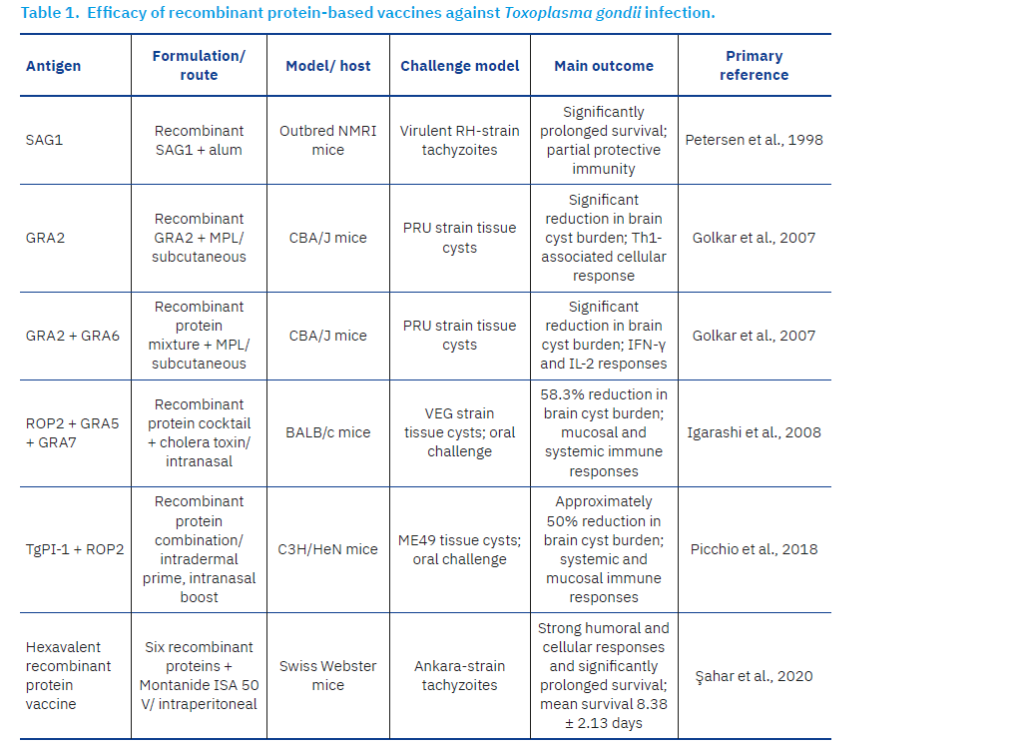
As summarised in Table 1, recombinant protein vaccination has produced varying degrees of protection depending on antigen selection, formulation, route of administration, and challenge model. Multivalent formulations can enhance antigenic coverage, but the available evidence does not demonstrate that increasing the number of antigens consistently improves protection. Direct comparisons using standardised challenge models are therefore required to determine the relative contribution of individual antigens and antigen combinations.
mRNA-based vaccines
mRNA-based vaccines represent an emerging approach for toxoplasmosis vaccination because they enable intracellular antigen expression without the use of live parasites (Pardi et al., 2018). Following delivery into host cells, translated antigen can be processed through endogenous antigen-presentation pathways, thereby supporting both cellular and humoral immune responses. Lipid nanoparticles (LNP) are commonly used to protect mRNA from degradation and facilitate cellular uptake. However, evidence for mRNA vaccination against T. gondii remains predominantly preclinical and is currently based on murine models.
Early evidence was provided by a self-amplifying RNA vaccine encoding T. gondii nucleoside triphosphate hydrolase-II (NTPase-II). In mice, the LNP-formulated construct induced antigen-specific humoral and cellular responses and provided protection against both acute and chronic infection, including a 62.1% reduction in brain cyst burden following PRU strain challenge (Luo et al., 2017). More recently, conventional mRNA-LNP candidates have been evaluated using newly selected T. gondii antigens. TGGT1_316290 (TG290) mRNA-LNP induced antigen-specific antibody and cellular responses and significantly prolonged survival following lethal RH strain challenge in BALB/c mice, with a mean survival time of 18.7 ± 3 days (Li et al., 2023). TGGT1_278620 mRNA-LNP similarly induced humoral and cellular immune responses and significantly prolonged survival after RH strain challenge in mice (Zhang et al., 2024; Table 2). These findings demonstrate the feasibility of mRNA-LNP vaccination against T. gondii, while also emphasising that current evidence remains limited to experimental models.
Multivalent mRNA approaches have further expanded this concept. A quadrivalent self-amplifying mRNA-LNP vaccine encoding selected regions of ROP18, TGME49_237490, TGME49_268230, and MIC13 induced humoral and cellular immune responses and provided protection against both acute and chronic toxoplasmosis in mice (Wu et al., 2025). Such findings support continued investigation of multivalent mRNA vaccines. However, they should be interpreted as evidence for multivalent vaccination within the mRNA platform, rather than as evidence for synergistic protection between mRNA and recombinant protein vaccines.
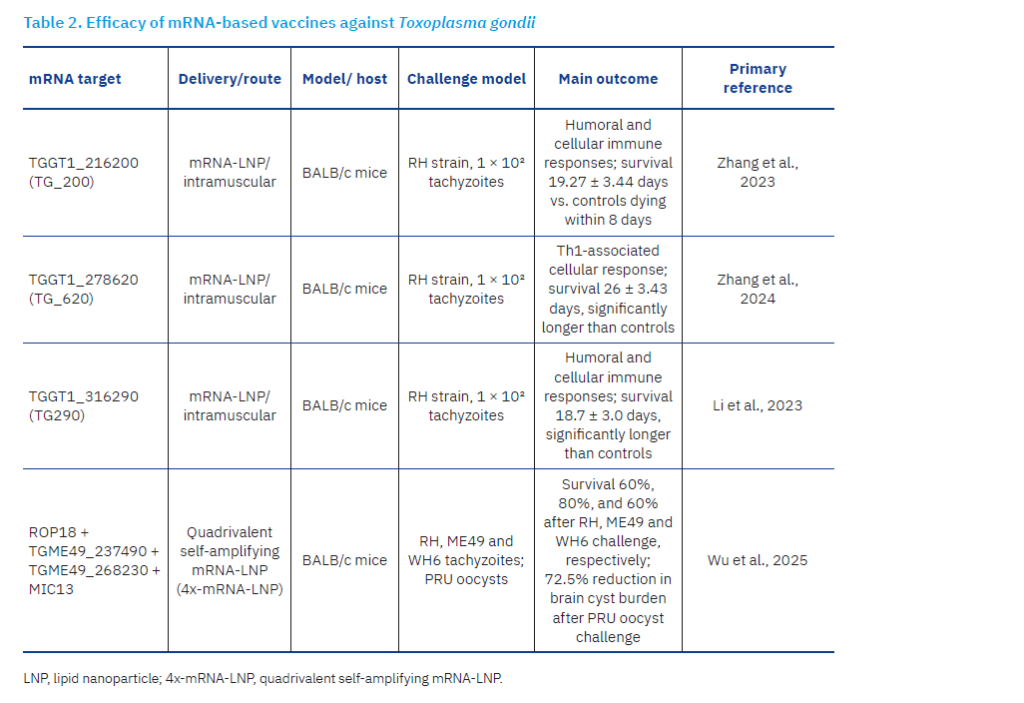
Beyond antigen selection, mRNA delivery chemistry is a major determinant of vaccine performance. Lipid nanoparticle composition can influence mRNA protection, cellular uptake, endosomal release, and downstream immune responses, while the design of ionisable lipids can substantially affect cytotoxic T-cell induction (Hou et al., 2021; Oyama et al., 2023).
Immunological complementarity and rationale for heterologous vaccination
Recombinant protein and mRNA vaccine platforms differ in the way antigens are delivered and presented to the immune system, providing a theoretical basis for complementary or heterologous vaccination strategies. Recombinant proteins can efficiently induce antigen-specific antibody responses and cellular immune responses, depending on the antigen, adjuvant, and formulation. In contrast, mRNA vaccines enable endogenous antigen expression and facilitate antigen presentation through intracellular pathways, including MHC class I presentation. These mechanistic differences suggest that sequential or complementary use of the two platforms could potentially broaden vaccine-induced immunity.
For T. gondii, however, direct experimental evidence demonstrating synergistic protection from the combined administration of recombinant protein and mRNA vaccines is currently lacking. Therefore, complementarity between these platforms should be regarded as an immunological and vaccine-design rationale rather than an experimentally established synergistic effect. Evidence from heterologous prime-boost approaches using other vaccine platforms indicates that sequential delivery of parasite antigens in different formats can enhance immune responses and protective efficacy. For example, a GRA14 DNA-prime/recombinant-protein-boost strategy enhanced antigen-specific humoral and cellular responses and improved protection in mice, supporting the feasibility of heterologous vaccination against T. gondii (Pagheh et al., 2019).
More recently, heterologous DNA-mRNA prime-boost vaccination targeting GRA35 has also been investigated in mice, further demonstrating that different nucleic-acid vaccine platforms can be used sequentially against T. gondii (Chen et al., 2026). Nevertheless, neither DNA-protein nor DNA-mRNA prime-boost studies provide direct evidence that recombinant protein-mRNA vaccination produce additive or synergistic protection. Such a hypothesis requires direct experimental testing using appropriately controlled groups receiving each individual platform and the combined or sequential regimen.
An additional distinction is provided by recent multi-epitope vaccine studies. The T-SGR construct, incorporating epitopes derived from SAG1, GRA7, and ROP16, has been evaluated independently as both an mRNA-LNP vaccine and a recombinant protein vaccine in mice. Both formulations induced humoral and cellular immune responses, while the mRNA-LNP formulation showed stronger immune responses and greater protective efficacy under experimental conditions (Cui et al., 2026). Importantly, the two formulations were compared rather than co-administered; therefore, this study provides direct comparative evidence between the platforms but does not demonstrate recombinant protein-mRNA synergy.
Collectively, current evidence supports further investigation of heterologous and complementary vaccination strategies, but does not yet establish recombinant protein-mRNA combination vaccination as superior to either platform alone. Future studies should directly compare homologous and heterologous prime-boost regimens, simultaneous versus sequential administration, antigen-matched formulations, dose and timing, and protection against both acute and chronic infection before claims of synergy can be substantiated.
Translational evidence from multivalent, heterologous, and natural-host vaccination strategies
Evidence from experimental T. gondii vaccination studies supports the potential value of targeting multiple antigens and delivering antigens through different vaccine formats. However, these approaches should be distinguished according to their experimental design. Multivalent vaccines combine several antigens within the same platform, whereas heterologous prime-boost strategies deliver antigenic targets sequentially using different vaccine platforms. Neither approach should be considered equivalent to combined recombinant protein-mRNA vaccination unless both platforms are directly evaluated within the same vaccination regimen.
Multivalent vaccination has been investigated using several platforms. DNA vaccine cocktails targeting multiple T. gondii antigens have reduced parasite burden and improved protective immune responses in mice, while recombinant protein cocktails have also demonstrated substantial reductions in brain parasite burden. For example, trivalent recombinant protein formulations containing ROP2+ROP4, and either GRA4 or SAG1 reduced parasite burden by 84% and 77%, respectively, in BALB/c mice (Dziadek et al., 2012). These findings support multi-antigen targeting within recombinant protein vaccination but do not provide evidence for recombinant protein-mRNA synergy.
Heterologous prime-boost vaccination represents a conceptually distinct strategy. As discussed above, DNA-prime/recombinant-protein-boost vaccination with GRA14 improved antigen-specific immune responses and protection in mice (Pagheh et al., 2019). Such studies demonstrate that sequential antigen delivery through different formats is experimentally feasible in toxoplasmosis vaccination. Nevertheless, extrapolation to recombinant protein-mRNA regimens requires direct experimental validation.
Translation beyond murine models remains a major priority. In sheep, vaccination with the live attenuated S48 strain has provided protection against reproductive toxoplasmosis, including improved pregnancy outcomes following challenge (Buxton et al., 1991), with protective immunity persisting for at least 18 months (Buxton et al., 1993). In pigs, S48 vaccination reduced the presence of viable T. gondii in tissues following experimental challenge, demonstrating the relevance of tissue cyst reduction as a food-safety endpoint (Burrells et al., 2015). In cats, vaccination studies using the T-263 strain have demonstrated that prevention or reduction of oocyst shedding is an experimentally achievable endpoint (Freyre et al., 1993). Although these live-vaccine studies do not directly validate recombinant protein or mRNA technologies, they establish biologically and epidemiologically relevant benchmarks against which next-generation vaccine platforms should be evaluated.
Delivery technologies may further influence the performance of non-living vaccines by improving antigen stability, cellular uptake, and antigen presentation. Lipid nanoparticles are central to current mRNA vaccine development, while particulate and polymer-based delivery systems have also been investigated for recombinant antigens and other T. gondii vaccine formats. However, improvements attributed to a delivery system should be interpreted within the specific antigen, formulation, route, and challenge model in which they were demonstrated. Direct comparative studies will be required to determine whether such delivery innovations improve protection in natural hosts.
Challenges and future perspectives
The development of effective vaccines against Toxoplasma gondii remains challenging because of the parasite’s complex life cycle, intracellular localisation, antigenic diversity, persistence as tissue cysts, and the different protective requirements of individual host species. Although recombinant protein and mRNA-based vaccines have generated encouraging immune responses and partial protection in experimental studies, most evidence remains derived from murine models. Translation of these findings therefore requires cautious interpretation and validation in natural hosts.
For recombinant protein vaccines, major challenges include antigen selection, the need for appropriate adjuvants and delivery systems, and variability in protective efficacy among antigens, formulations, and challenge models. Multivalent and chimeric constructs may broaden antigenic coverage, but their apparent advantages should be established through direct comparisons with the corresponding individual antigens. Future studies should also determine whether vaccine-induced reductions in murine brain cyst burden translate into clinically meaningful outcomes in livestock and other natural hosts.
For mRNA vaccines, the available evidence against T. gondii is comparatively recent and remains preclinical. Important questions include optimisation of antigen selection, mRNA sequence and dose, delivery systems, vaccination schedules, durability of immunity, and safety across different target species. Lipid nanoparticle formulations have enabled effective delivery in experimental models, but formulation requirements, stability, storage conditions, manufacturing feasibility, and species-specific tolerability will need to be evaluated for veterinary application. Claims regarding the superiority of mRNA vaccines over established vaccine platforms therefore require direct comparative studies.
A further priority is the evaluation of vaccine candidates using host-specific endpoints. In sheep and goats, studies should assess prevention of abortion, foetal infection, stillbirth, and neonatal mortality following challenge during pregnancy. In pigs and other food-producing animals, reduction of viable tissue cysts in edible tissues is particularly relevant to food safety. In cats, prevention or substantial reduction of oocyst shedding should represent a primary endpoint because of the definitive host’s central role in environmental contamination. These outcomes are more informative for veterinary translation and One Health impact than survival after lethal challenge in mice alone.
The potential use of recombinant protein and mRNA vaccines in heterologous or complementary regimens represents an interesting area for future investigation, but direct evidence for synergistic protection between these two platforms is not yet available. Appropriately controlled studies should therefore compare recombinant protein alone, mRNA alone, homologous prime-boost regimens, and heterologous protein-mRNA regimens using antigen-matched formulations. Such studies should evaluate dose, sequence of administration, route, safety, durability of immune responses, protection against both acute and chronic infection, and clinically relevant outcomes.
Before consideration of human clinical development, priority should be given to reproducible efficacy in preclinical models, standardised correlates of protection, comparative challenge studies, dose and formulation optimisation, safety assessment, and validation in relevant natural hosts. Human vaccine development will ultimately require additional toxicology, manufacturing, regulatory, and clinical evidence that is currently unavailable for T. gondii recombinant protein-mRNA combination strategies. Accordingly, current evidence supports continued preclinical development rather than immediate progression to phase I human trials.
Future progress will depend on linking antigen discovery and vaccine-platform innovation with biologically relevant models and clearly defined target-product profiles. Rather than assuming that a single vaccine formulation will meet all requirements, development strategies should distinguish among prevention of reproductive disease in small ruminants, reduction of tissue cysts in food animals, interruption of oocyst shedding in cats, and eventual prevention of human disease. This host-specific, evidence-based approach provides a more realistic framework for advancing T. gondii vaccination within a One Health context.
Discussion
The development of an effective vaccine against Toxoplasma gondii remains an important objective for both veterinary and human health. Current evidence indicates a progressive shift from live-attenuated vaccines toward more defined non-living platforms, particularly recombinant protein and nucleic acid-based vaccines. Recombinant protein and mRNA technologies offer distinct immunological and practical advantages, but the available evidence does not currently support the conclusion that their combined use provides synergistic protection against T. gondii. Rather, the existing literature supports their consideration as potentially complementary platforms whose combined value remains to be established experimentally.
Recombinant protein vaccines have been extensively investigated using surface, dense granule, rhoptry, and microneme antigens, either individually or in multivalent and chimeric formulations. These vaccines can induce antigen-specific antibody responses and, depending on the antigen, adjuvant, and immunisation regimen, cellular immune responses and partial protection. However, protective efficacy varies substantially among experimental studies. In particular, reductions in parasite burden or prolonged survival observed with selected recombinant antigens cannot be generalised across formulations. Their dependence on appropriate adjuvants also remains an important consideration.
mRNA-based vaccination offers a mechanistically distinct approach because intracellular antigen expression enables antigen presentation through both MHC class I and class II pathways. Recent murine studies have demonstrated that mRNA-LNP vaccines targeting individual or multiple T. gondii antigens can induce Th1-associated cellular responses, antigen-specific antibodies, prolonged survival, and reductions in parasite burden. Multivalent and multi-epitope constructs are particularly relevant because protective immunity against T. gondii is unlikely to depend on a single antigen or parasite stage. Nevertheless, these findings remain predominantly preclinical, and differences in vaccine constructs, delivery systems, challenge strains, infection routes, and experimental endpoints limit direct comparisons among studies.
An important issue in interpreting the current literature is the distinction between multivalent vaccination, heterologous prime-boost vaccination, and true recombinant protein-mRNA combination vaccination. Multivalent vaccines deliver several antigenic targets within the same platform, whereas heterologous strategies use different vaccine technologies sequentially. Studies using DNA-protein or DNA-mRNA prime-boost regimens demonstrate that heterologous vaccination is feasible in experimental toxoplasmosis, but they do not establish that recombinant protein and mRNA vaccines will interact additively or synergistically. Similarly, the independent evaluation of the same multi-epitope construct as recombinant protein and mRNA-LNP formulations provides useful comparative information but does not constitute evidence for combined vaccination. Direct studies including recombinant protein alone, mRNA alone, and matched combined or sequential regimens are therefore necessary before synergy can be claimed.
The translational relevance of the available evidence also requires careful consideration. Most recombinant protein and essentially all current mRNA vaccine studies have been performed in mice, whereas the objectives of toxoplasmosis vaccination differ substantially among natural hosts. In sheep and goats, prevention of abortion, stillbirth, neonatal mortality, and congenital infection represents a major veterinary objective. In food-producing animals, reduction of viable tissue cysts is particularly important for limiting foodborne transmission, whereas in cats, reduction or prevention of oocyst shedding could directly decrease environmental contamination. Consequently, survival after lethal challenge in mice should be regarded primarily as an early screening endpoint rather than sufficient evidence of practical vaccine efficacy. Evaluation in natural hosts using host-specific clinical, parasitological, and epidemiological endpoints will therefore be essential for translation.
Natural-host vaccination studies with non-mRNA platforms provide an important framework for this transition. Evidence from several natural hosts, including sheep, pigs, and cats, demonstrates that vaccine efficacy can be assessed using outcomes that are directly relevant to transmission and disease, including reproductive protection, tissue-cyst burden, and oocyst shedding. These studies should not be interpreted as direct evidence for recombinant protein-mRNA vaccination; instead, they identify the biological endpoints and experimental designs that future molecular vaccine studies should adopt when progressing beyond murine models.
From a One Health perspective, the optimal vaccination strategy may therefore depend on the target host and intended epidemiological outcome rather than on a single universally applicable formulation. Vaccination of small ruminants could primarily target reproductive losses, vaccination of food animals could aim to reduce tissue cysts entering the food chain, and vaccination of felids could reduce environmental dissemination of oocysts. Human vaccination, if ultimately pursued, would require substantially higher standards of safety, durability, and clinical validation. This host-specific approach provides a more realistic translational framework than extrapolating directly from protection observed in murine challenge models. This interpretation is also consistent with the host-specific target-product approach already developed in the preceding section of this review.
Future research should therefore focus on several related priorities: standardised head-to-head evaluation of promising antigens and vaccine platforms; direct testing of antigen-matched recombinant protein-mRNA combinations; optimisation of dose, route, timing, and delivery systems; identification of reliable correlates of protection; and validation in natural hosts. For mRNA vaccines in particular, improvements in formulation stability, manufacturing cost, and storage requirements will be important for veterinary deployment. Multi-antigen and multi-stage vaccine designs remain attractive, but their increasing complexity should be accompanied by rigorous assessment of safety, immunogenicity, and biologically meaningful protection.
Overall, recombinant protein and mRNA technologies should currently be viewed as complementary but independently supported vaccine platforms rather than as an experimentally validated synergistic combination. Their distinct mechanisms provide a strong rationale for future combined or heterologous evaluation, but the strength of future claims should depend on direct comparative evidence. Progress toward an effective T. gondii vaccine will ultimately require integration of rational antigen selection, appropriate delivery technology, natural-host validation, and clearly defined host-specific endpoints within a One Health framework.
Conclusions
Recombinant protein and mRNA-based vaccines are two promising but still predominantly experimental approaches to vaccination against Toxoplasma gondii. Recombinant protein vaccines offer defined antigen composition and have demonstrated antigen-specific immune responses and partial protection in numerous experimental models, whereas mRNA-based platforms enable intracellular antigen expression and have shown encouraging cellular and humoral immunogenicity in recent murine studies. Nevertheless, the evidence supporting both approaches remains heterogeneous, and direct comparison across studies is complicated by differences in antigens, formulations, adjuvants, vaccination schedules, challenge strains, and efficacy endpoints.
Current evidence does not demonstrate synergistic protection from combined recombinant protein-mRNA vaccination against T. gondii. Multivalent vaccination within individual platforms, heterologous prime-boost strategies involving other vaccine technologies, and direct comparisons between recombinant protein and mRNA formulations provide useful conceptual and experimental foundations, but should not be interpreted as evidence that a recombinant protein-mRNA combination is superior to either platform alone. Direct, appropriately controlled studies are required to test this hypothesis.
A major priority for future vaccine development is translation from murine models to natural hosts. Vaccine efficacy should be assessed using species-specific outcomes, including prevention of reproductive losses and congenital infection in sheep and goats, reduction of viable tissue cysts in food-producing animals, and prevention or reduction of oocyst shedding in cats. Such endpoints are essential for determining whether next-generation vaccines can provide meaningful veterinary, food-safety, and One Health benefits.
Accordingly, future research should prioritise antigen selection, formulation and dose optimisation, comparative challenge studies, standardised correlates of protection, safety assessment, durability of immunity, and validation in relevant natural hosts. Recombinant protein and mRNA platforms provide complementary opportunities for further vaccine development, but their potential use in combined or heterologous regimens should remain a testable research hypothesis until direct experimental evidence becomes available.
References [… show]
Tehnologije rekombinantnih proteina i mRNA u cijepljenju protiv Toxoplasma gondii: trenutačni napredak i buduće perspektive
Asude Gulce ORYASIN* (corresponding author), asude.guler@adu.edu.tr, orcid.org/0000-0002-7219-2879
Aydin Adnan Menderes University, Faculty of Veterinary Medicine, Department of Parasitology, Experimental Animal Production and Research Center, 09000 Aydin, TurkeyToxoplasma gondii je obligatni intracelularni protozoarni parazit velikog značaja u humanoj i veterinarskoj medicini, što naglašava potrebu za sigurnim i učinkovitim cijepljenjem. Ovaj pregledni rad procjenjuje najnovija dostignuća u razvoju cjepiva temeljenih na rekombinantnim proteinima i mRNA platformama protiv T. gondii, s naglaskom na odabir antigena, imunološke odgovore, zaštitnu učinkovitost i translacijska ograničenja. Cjepiva temeljena na rekombinantnim proteinima koja ciljaju površinske antigene, proteine gustih granula, proteine roptrija i multiantigenske konstrukte potaknula su antigen-specifične humoralne i stanične imunološke odgovore te smanjila parazitsko opterećenje ili produljila preživljenje u eksperimentalnim modelima. mRNA platforme, osobito cjepiva formulirana u lipidnim nanočesticama (LNP), omogućuju endogenu ekspresiju antigena te mogu potaknuti Th1-usmjereni stanični imunitet zajedno s antigen-specifičnim odgovorom protutijela. Primjerice, cijepljenje TGGT1_316290 (TG290) mRNA-LNP potaknulo je humoralne i stanične imunološke odgovore te produljilo preživljenje eksperimentalno inficiranih miševa. Unatoč navedenom napretku, cjepiva protiv T. gondii temeljena na rekombinantnim proteinima i mRNA platformama uglavnom su ispitivana kao odvojene tehnologije. Trenutačno ne postoje izravni eksperimentalni dokazi koji bi potvrdili sinergističku zaštitu kombiniranim cijepljenjem rekombinantnim proteinima i mRNA cjepivima. Ipak, dokazi iz heterolognih prime-boost strategija koje uključuju druge cjepivne platforme pružaju osnovu za istraživanje može li kombinacija komplementarnih platformi poboljšati zaštitni imunitet. Buduća istraživanja trebala bi dati prednost standardiziranim usporednim pokusima izazovne infekcije, validaciji u prirodnim domaćinima, optimizaciji odabira antigena i načina dostave te procjeni klinički relevantnih veterinarskih ishoda, uključujući sprječavanje reproduktivnih gubitaka, smanjenje opterećenja tkivnim cistama i prekid izlučivanja oocista. Takva su istraživanja potrebna kako bi se utvrdilo može li se imunološka komplementarnost tehnologija rekombinantnih proteina i mRNA prevesti u poboljšanu zaštitu protiv toksoplazmoze.
Ključne riječi: Toxoplasma gondii; mRNA cjepiva; jedno zdravlje; rekombinantni proteini; učinkovitost cjepiva; zoonotski patogen.
