
Epidemiology of Foodborne Pathogens in Europe with Special Emphasis on the Republic of Croatia: A Five-Year Analysis
L.Peinović , L. Hlebić, D. Tomašković, I. Reil , S. Duvnjak , M. Dopuđ , A. Bagarić , E. Postružin , A. Humski.
Lovran PEINOVIĆ1, peinovic@veinst.hr, orcid.org/0009-0005-9845-491X; Lucija HLEBIĆ1 hlebic@veinst.hr, orcid.org/0009-0003-9496-4192; Dora TOMAŠKOVIĆ1, stojevic@veinst.hr, orcid.org/0000-0002-2009-5997; Irena REIL2, reil@veinst.hr, orcid.org/0000-0002-2198-557X; Sanja DUVNJAK2, marjanovic@veinst.hr, orcid.org/0000-0002-1308-267X, Maja DOPUĐ2, dopud@veinst.hr, orcid.org/0009-0009-0495-9861; Antonela BAGARIĆ3, marijan@veinst.hr, orcid.org/0009-0002-5567-681X; Eva POSTRUŽIN3, postruzin@veinst.hr, orcid.org/0009-0004-8930-2845; Andrea HUMSKI1* (corresponding author), humski@veinst.hr, orcid.org/0000-0003-3027-1306.
1 Laboratory for Food Microbiology, Department for Veterinary Public Health, Croatian Veterinary Institute, 10000 Zagreb, Croatia
2Laboratory for Bacterial Zoonoses and Molecular Diagnostics of Bacterial Diseases, Department for Bacteriology and Parasitology, Croatian Veterinary Institute, 10000 Zagreb, Croatia
3 Laboratory for General Bacteriology and Mycology, Department for Bacteriology and Parasitology, Croatian Veterinary Institute, 10000 Zagreb, Croatia

https://doi.org/10.46419/cvj.57.6.5
Abstract
This review evaluates the occurrence and epidemiological trends of major foodborne zoonotic pathogens in the European Union, with particular emphasis on the Republic of Croatia, over the period 2020-2024. Using the One Health framework, data were synthesised from annual zoonosis reports of the European Food Safety Authority (EFSA) and the European Centre for Disease Prevention and Control (ECDC), complemented by targeted national and regional studies. Following a temporary, pandemic-related decline in 2020, largely attributable to COVID-19 related disruptions in surveillance and behavioral changes, notification rates for most foodborne pathogens rebounded and stabilised at pre-pandemic or higher levels. Campylobacteriosis remained the most frequently reported zoonosis, while salmonellosis persisted at consistently high levels, with notable shifts in serovar distribution, including the emergence of Salmonella Infantis. Listeriosis, although less frequent, demonstrated the highest hospitalisation and case fatality rates, with a continued upward trend. Shiga toxin-producing Escherichia coli (STEC) infections increased substantially, partly due to improved molecular diagnostics and enhanced surveillance sensitivity. Unlike existing consolidated EFSA/ECDC reports, this review highlights the importance of regional data for identifying localised hotspots and more precisely understanding transmission dynamics. This more detailed perspective emphasises the need for continuous, integrated surveillance across the human, veterinary, and environmental sectors to effectively address evolving, region-specific risks related to pathogen adaptation, antimicrobial resistance, and climate-related pressures within the food supply chain.
Key words: foodborne pathogens; zoonoses; epidemiological trends; One Health; Republic of Croatia.
Introduction
Foodborne diseases remain a significant public health and veterinary challenge in the European Union (EU) and the Republic of Croatia, with substantial impacts on food production, healthcare system, and trade. Within the EU surveillance framework, the most frequently reported foodborne zoonotic pathogens include: Campylobacter, Salmonella, Listeria monocytogenes, and Shiga toxin-producing Escherichia coli (STEC), which are systematically monitored through integrated human, animal, and food safety surveillance systems under the One Health approach.
During the 2020–2024 period, the epidemiology of foodborne infections in Europe was strongly influenced by several interconnected drivers. These include the globalisation of food supply chains, intensification of livestock production (particularly in the poultry sector), the emergence and spread of antimicrobial resistance (Mandal and Kumari, 2024; Gyimah et al., 2025), climate variability affecting environmental pathogen persistence (Ray and Singh, 2022; Cunningham et al., 2024), and demographic shifts such as population ageing, which increase susceptibility to severe outcomes, especially in the case of listeriosis (Pniewski et al., 2024). In addition, the COVID-19 pandemic temporarily disrupted routine surveillance systems, healthcare-seeking behavior, and food consumption patterns, leading to an artificial decline in reported cases in 2020, followed by a rebound in subsequent years as surveillance activities normalised (Schirone and Visciano, 2021).
Given the dynamic nature of foodborne hazards and the evolving distribution of key pathogens across the EU food chain, continuous and analytically robust surveillance is essential for evidence-based risk assessment and policy development (Davydova et al., 2025).
The objective of this review was to critically assess epidemiological trends, pathogen distribution patterns, and emerging risk factors associated with major foodborne zoonoses in the European Union, with a focus on the Republic of Croatia, during the 2020–2024 surveillance period.
Materials and Methods
Study Design and Data Sources
To evaluate the occurrence of foodborne pathogens in the Republic of Croatia and the European Union for 2020–2024, we conducted a structured review using EFSA and ECDC annual One Health zoonoses reports (published 2021–2025) as primary data sources, supplemented by peer-reviewed studies. Epidemiological metrics were directly extracted from these institutional reports, capturing structured data on outbreak locations, etiological agents, and the most likely food matrices associated with the events (Schirone and Visciano, 2021). This continuous monitoring of infectious agents is fundamentally based on the One Health framework. Over the past five years, the landscape of food-related illnesses has changed significantly; contributing factors include the COVID-19 crisis, evolving dietary patterns, international livestock trade, and the emergence of antimicrobial-resistant strains.
Epidemiological Surveillance Framework
Establishing an ecologically viable and safe food network requires a holistic surveillance methodology aligned with the “farm to fork” initiative (European Commission, 2020). Concurrently, veterinary professionals play a crucial role in managing zoonotic threats through livestock health management, on-farm biosecurity protocols, and laboratory testing of animal-derived foods. In addition, National Control Programmes (NCPs) define the sampling protocols used at the national level to assess the distribution of specific pathogens throughout the food supply chain (EFSA and ECDC, 2025). To effectively monitor these targets at the species and serovar levels across borders, data collection relies on integrated European platforms (Tast Lahti et al., 2023). Specifically, human epidemiological data is captured via the ECDC’s European Surveillance System (TESSy), whereas non-human data, including environmental samples and food matrices, are routed through the EFSA’s Data Collection Framework (DCF). Together with the Rapid Alert System for Food and Feed (RASFF), these databases form the operational backbone of EU outbreak investigation and risk mitigation.
Pathogen Detection and Characterisation Methods
Data included in this review originate from surveillance systems that rely on standardised microbiological and molecular diagnostic methods (Jurinović et al., 2022). To monitor the microbial composition in complex matrices such as raw milk, advanced diagnostic methods including flow cytometry and matrix-assisted laser desorption/ionisation time-of-flight mass spectrometry (MALDI-TOF MS) are used to capture precise pathogen profiles (Mikulec et al., 2025). The use of standardised cultivation techniques and whole-genome sequencing (WGS) has shown that single portions of commercial meat often contain several different bacterial strains with genetic differences. Analysing multiple isolates from a single sample enables investigators to observe significant internal genetic diversity, thereby identifying points of microbial transfer from agricultural settings to consumer markets (Dziegiel et al., 2024; García-Fernández et al., 2025).
Advanced Data Analysis and Modelling
Beyond conventional diagnostic testing, the integration of innovative digital tools provides new opportunities for monitoring and improving hygiene standards (Abdurrahman & Ferrari, 2025). Specifically, implementing Digital Twin frameworks (virtual, data-driven replicas of physical production environments) in food manufacturing enables simulated tracking of the supply chain, facilitating predictive safety optimisations throughout the entire production lifecycle (Defraeye et al., 2021; Abdurrahman & Ferrari, 2025).
Latest Foodborne Outbreak Impact
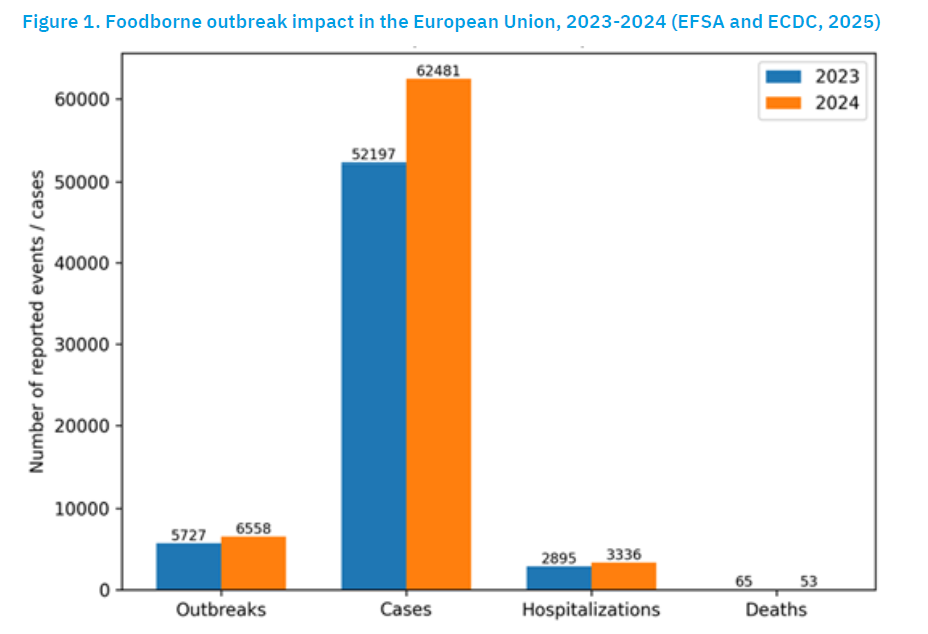
In 2024, the European Union reported 6,558 foodborne outbreaks, a 14.5% increase from 2023. These events highlight the ongoing challenge of food safety within the ‘farm to fork’ continuum. The total impact of these outbreaks in 2024 resulted in 62,481 human cases, a 19.7% increase compared to 2023. There were also 3,336 hospitalisations, representing a 15.2% increase in severe morbidity. In contrast, the absolute number of deaths decreased by 18.5% to 53 (Figure 1). Statistics show that while the case-fatality rate (CFR) and the absolute number of deaths have declined, the overall number of incidents and affected individuals continues to rise. This dynamic underscore the need for enhanced biosecurity and more robust diagnostic surveillance across the veterinary and medical sectors (EFSA and ECDC, 2025).
Consideration of External Influencing Factors
The analysis explicitly accounts for major external factors that may have influenced reported epidemiological trends during the study period (Mandal and Kumari, 2024). These include the COVID-19 pandemic and its impact on surveillance intensity, changes in consumer behavior (Schirone & Visciano, 2021; EFSA and ECDC, 2025), globalisation of food trade, intensification of poultry production systems, antimicrobial resistance development (EFSA and ECDC, 2025; Gyimah et al., 2025), and climatic variability affecting environmental pathogen persistence and transmission (Ray and Singh, 2022; Cunningham et al., 2024).
Limitations
Several limitations should be acknowledged. First, surveillance data across EU Member States may differ in sensitivity, reporting completeness, and diagnostic capacity, which can affect cross-country comparability (EFSA and ECDC, 2025). Second, the temporary reduction in reported cases in 2020 likely reflects underreporting and reduced healthcare access rather than a true decline in disease incidence (EFSA and ECDC, 2021; Pijnacker et al., 2024). Third, the increased use of advanced molecular diagnostics in recent years, particularly for STEC, may have contributed to the observed rise in notification rates (EFSA and ECDC, 2025; Jung-Sendzik et al., 2025). Finally, as a structured narrative review, the study relies on secondary data sources and descriptive synthesis rather than quantitative meta-analysis, which may limit causal inference (EFSA and ECDC, 2025).
Foodborne pathogens
Salmonella
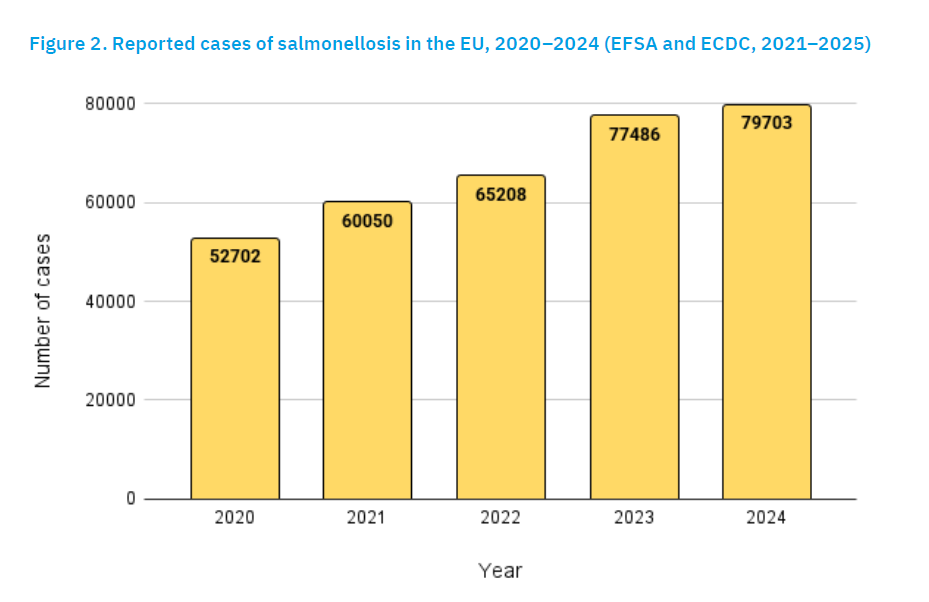
Salmonellosis has consistently ranked among the most frequently reported gastrointestinal infections in humans in the European Union (EU) since 2007, remaining the second most frequently reported foodborne gastrointestinal infection throughout the 2020–2024 period (EFSA and ECDC, 2021–2025). The data regarding these notification rates and their increasing trend are visible in Figure 2. A significant shift in the epidemiological landscape occurred in 2024, when Salmonella in “eggs and egg products” became the most frequent agent/food pair causing outbreaks and hospitalisations across the EU (EFSA and ECDC, 2025).
Although fresh broiler meat and its derived products are recognised as major sources of human foodborne infections (particularly those caused by Salmonella), the range of infection vehicles within the food chain is considerably broader. Pathogens, including various Salmonella serotypes, are frequently transmitted through different food categories, such as processed meats and sausages available on the market. Consequently, ensuring both the high quality and microbiological safety of these products remains a major public health and societal concern. (Lianou et al., 2017; Peinović et al., 2018). A comprehensive approach to food safety monitoring, in accordance with the “farm to fork” strategy, is essential for creating a healthy and environmentally sustainable food system (European Commission, 2020). In this context, the implementation of new technologies, such as Digital Twin applications in the food industry, offers advanced opportunities for monitoring and optimising safety across all stages of food production (Abdurrahman and Ferrari, 2025).
Compliance with National Control Programmes (NCPs) has shown a concerning decline; while 19 Member States achieved all Salmonella reduction targets in poultry populations in 2022, this fell to only 14 Member States in 2024 (EFSA and ECDC, 2023, 2025). Although NCPs have significantly reduced the prevalence of targeted serovars (Salmonella Enteritidis and Salmonella Typhimurium), the overall prevalence of Salmonella spp. in broiler flocks remains a challenge (EFSA and ECDC, 2025).
The historically dominant Salmonella Enteritidis remains the most frequently reported serovar in humans in the EU and the Republic of Croatia (Jaki Tkalec et al., 2021; EFSA and ECDC, 2025). Recent data further indicate that Croatia’s average salmonellosis morbidity rate (29.2 cases per 100,000) is 1.6 times higher than the overall EU average (18.2 cases per 100,000) for the 2014–2023 period (EFSA and ECDC, 2025; Peić and Marušić, 2025). In parallel, S. Infantis has emerged as an important challenge for the food safety system, becoming the dominant serovar in poultry meat (Jaki Tkalec et al., 2021) and the fourth most frequently isolated serovar from human infections in the EU (Jaki Tkalec et al., 2021; EFSA and ECDC, 2025). Epidemiological data from the Republic of Croatia and neighbouring EU countries show that S. Infantis is widely distributed across multiple sample types (Jaki Tkalec et al., 2021). In Croatia, it is the predominant serovar in chicken meat, accounting for 63.2% of all isolates (Jaki Tkalec et al., 2021), which is consistent with recent regional monitoring in eastern Croatia identifying S. Infantis as the leading serovar in contaminated fresh chicken meat (Perković et al., 2026). A similar replacement of previously circulating strains by S. Infantis has also been reported in Slovenia, where its clonal spread has been documented in both broilers and human infections (Papić et al., 2022). In Romania, a concerning increase among pathogenic Salmonella strains isolated from poultry meat products has been reported, with Salmonella Infantis displacing Salmonella Virchow (Forgaciu et al., 2022). Conversely, studies in Serbia indicate that Salmonella Enteritidis remains the dominant serotype among poultry isolates (Spalević et al., 2023). The spread of S. Infantis through cross-border trade and food distribution has also been documented in Switzerland, where clones closely associated with poultry were isolated from various food samples and directly from human infections (Hindermann et al., 2017). However, control measures such as vaccination, strict on-farm biosecurity, feed and water control, and regular sampling are gradually altering this pattern (Vandeplas et al., 2010; Peić and Marušić, 2025).
The epidemiology of Salmonella in Europe shows clear regional differences and changes in dominant serovars, highlighting weaknesses in current control strategies. The difference between Croatia’s morbidity rates and the EU average, together with the increasing dominance of S. Infantis, suggests uneven implementation of food safety measures among Member States. Although vaccination and biosecurity remain essential, the decline in NCP compliance indicates reduced effectiveness. Recent evaluations suggest this decline is heavily driven by farm level economic pressures, such as the rising costs of biosecurity infrastructure and labour, as well as widespread implementation fatigue among producers facing continuous and overlapping disease control mandates (EFSA and ECDC, 2025; Mahmood et al., 2025).
New approaches, such as Digital Twin technology, represent a promising move towards data-driven prevention. However, there is still limited evidence on the practical application of these systems within the economic conditions of Central and Eastern European food chains. Future research and policy should therefore focus not only on surveillance of emerging serovars, but also on implementing real-time, predictive food safety models across cross-border trade systems.
Campylobacter
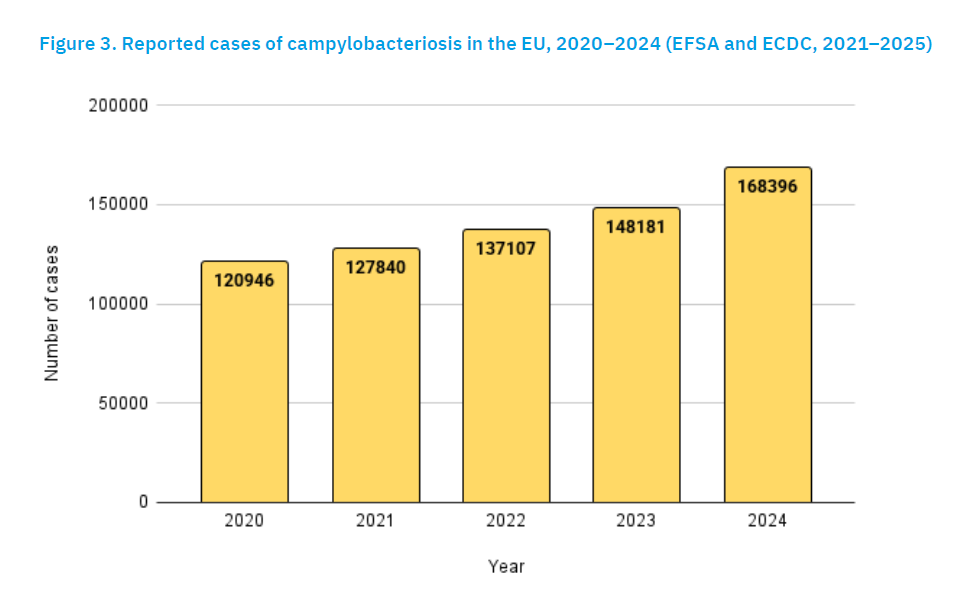
Campylobacteriosis remained the most frequently reported foodborne gastrointestinal infection in the European Union (EU) throughout the 2020-2024 period, accounting for 63.7% of all reported zoonotic cases in 2024 (EFSA and ECDC, 2025). Despite a temporary decrease in reported campylobacteriosis cases during 2020, likely associated with the impact of the COVID-19 pandemic (EFSA and ECDC, 2021), notification rates subsequently rebounded and have since remained stable, with a gradual upward trend observed in the following years (EFSA and ECDC, 2022, 2023, 2024). By 2024, the total reached 168,396 cases, with the EU notification rate rising to 55.3 cases per 100,000—an 11.9% increase compared to the 2023 rate of 49.4 per 100,000 (EFSA and ECDC, 2025). These trends are shown in Figure 3.
Handling, preparation, and consumption of contaminated broiler meat remain the primary transmission routes. Process hygiene limits exceeding 1,000 CFU/g are still frequently breached at slaughterhouses across Member States, with official control samples often showing higher non-compliance rates than food business operator self-checks (EFSA and ECDC, 2025). Persistent circulation of Campylobacter spp. throughout the poultry production chain therefore represents a major epidemiological challenge. A recent study found that 27.7% of sampled poultry meat was positive for Campylobacter spp., with prevalence rates reaching 32.5% at the slaughterhouse level and remaining at 25.5% at retail (Popa et al., 2025). In the Republic of Croatia and the surrounding region, the epidemiological situation mirrors broader European trends, with poultry meat identified as the primary transmission vehicle. Historical data highlighted an exceptionally high retail risk in Croatia, where thermotolerant Campylobacter spp. were detected in 73.86% of fresh chicken meat samples (Mikulić et al., 2016). Surveillance data from 2024 showed that 11.5% of chilled broiler carcasses in Croatia exceeded the European safety threshold for Campylobacter (>1,000 CFU/g), corresponding to a human notification rate of 47.5 cases per 100,000 (EFSA and ECDC, 2025). Among isolates from Croatian retail chicken meat, Campylobacter jejuni accounted for 53.53% and Campylobacter coli for 15.35% (Mikulić et al., 2016). Similar findings have been reported regionally, where recent monitoring in neighboring Serbia identified an overall retail poultry contamination rate of 75%, with quantified samples ranging from 20 to 7,600 CFU/g (Milojević et al., 2025). WGS combined with optimised culture methods has further shown that individual retail chicken samples often contain multiple Campylobacter sequence types (STs), with up to eight different STs isolated from a single positive sample. This high intra-sample diversity, likely reflecting cross-contamination between farm and retail environments, complicates outbreak detection, source attribution, and hazard assessment, highlighting the need for continuous multi-isolate surveillance (Dziegiel et al., 2024). In addition to meat products, other marine foods, such as bivalve molluscs, have recently been recognised in Croatia as important reservoirs of zoonotic pathogens, including Campylobacter. This highlights the need for systematic monitoring across all food sectors (Jurinović et al., 2022).
Current epidemiological data indicate that standard control measures for Campylobacter are insufficient, mainly because of its high prevalence and ability to survive in different environments. The persistence of campylobacteriosis in the EU is linked to problems such as inadequate slaughterhouse hygiene, inconsistent self-monitoring, and frequent cross-contamination, which is also reflected in the high genetic diversity found within single retail samples. In Croatia, the detection of marine reservoirs such as bivalve mollusks highlight gaps in surveillance programs that focus mainly on poultry.
To reduce human infections, food safety systems need a broader and more modern approach. This should include the routine use of multi-isolate whole-genome sequencing to track contamination routes and stricter, independent hygiene controls across all possible food sources.
Listeria monocytogenes
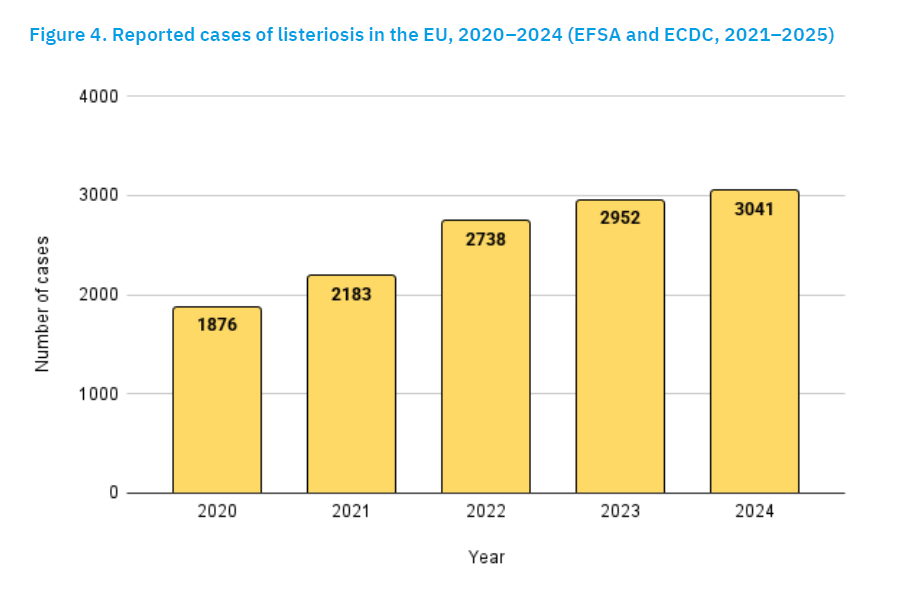
Listeriosis remains the fourth most frequently reported, yet by far the most severe, zoonotic disease in the EU throughout the 2020–2024 period. Cases have shown a consistent upward trend across the EU, rebounding from a temporary dip in 2020 and rising by 2024 to the highest number recorded since EU-level surveillance began (EFSA and ECDC, 2021–2025). The data are shown in Figure 4. Although the total number of L. monocytogenes cases is lower than that of Salmonella, listeriosis has a much more severe clinical outcome. In 2024, listeriosis showed exceptionally high hospitalisation and case fatality rates, reaching 97.3% and 15.6%, respectively, and resulting in 301 deaths across the European Union. It should be noted that this 97.3% hospitalisation rate primarily reflects invasive cases identified through surveillance; therefore, it captures the most severe forms of the disease rather than the overall incidence of milder or subclinical infections. Despite the relatively small number of foodborne outbreaks attributed to L. monocytogenes, the health impact remains disproportionately high (EFSA and ECDC, 2025).
This continues the pattern observed in 2022, the year with the highest record of deaths from food-borne outbreaks in the past decade, predominantly associated with L. monocytogenes (EFSA and ECDC, 2023). These findings highlight L. monocytogenes as a leading cause of fatal food-borne outbreaks across Member States, underscoring the need for a comprehensive and continuous approach to food safety monitoring (EFSA and ECDC, 2025). Like other food-borne pathogens, L. monocytogenes can enter the food chain from various sources, but it is particularly associated with certain ready-to-eat (RTE) food categories, where ensuring microbiological safety is especially important for public health (Yangchen et al., 2025). Contaminated RTE foods, particularly fish and fish products, continue to represent the most significant sources of concern for this pathogen (EFSA and ECDC, 2021). RTE foods may become contaminated during handling and preparation, emphasising the importance of strict monitoring of processing environments and continuous verification of hygiene criteria to mitigate the severe risks posed by L. monocytogenes and to protect vulnerable populations throughout the food chain (Pniewski et al., 2024).
At the primary production level, domestic ruminants such as cattle, sheep, and goats serve as important natural reservoirs, facilitating the bacterium’s entry into the human food chain while herd-level infections cause considerable agricultural losses (Končurat and Sukalić, 2024). Once introduced into processing facilities, L. monocytogenes often evades routine sanitation procedures. Historically, this risk has spanned a wide variety of sectors. For instance, an earlier Croatian study highlighted the pathogen’s ability to reach high bacterial loads (10⁶–10⁷ CFU/g) in complex, multi-ingredient RTE foods like cakes within the hospitality and pastry sectors (Uhitil et al., 2004). Today, this persistent environmental colonisation continues to be demonstrated in more recent national surveillance studies. Recent evaluations of Croatian slaughterhouses have revealed its capacity to survive standard cleaning protocols, particularly in poorly designed or inadequately maintained equipment, leading to persistent cross-contamination of meat products along the processing line (Dulikravić et al., 2025). Furthermore, the pathogen has been detected in raw milk vending machines, where molecular typing identified L. monocytogenes in 4.38% of samples. The recurrence of identical pulsotypes over time suggests that the pathogen can persistently colonise specific farms and dairy dispensing systems, posing a continuous risk to consumers of unpasteurised milk (Zdolec et al., 2019).
Recent epidemiological data on L. monocytogenes reveal significant weaknesses in current sanitation practices in food processing. Although its incidence is lower than that of other major foodborne pathogens, it accounts for a high proportion of hospitalisations and deaths, particularly in ready-to-eat (RTE) and raw food products.
In Croatia, the repeated detection of identical strains in raw-milk vending machines and slaughterhouses indicates that the bacterium can persist in processing environments by forming biofilms that are not eliminated by standard cleaning. This issue requires changes in both regulation and industry practice. Testing only the final product is insufficient. Food producers should implement continuous molecular surveillance and enhanced sanitation measures as part of routine hygiene programmes to better protect consumers, especially vulnerable groups.
Shiga toxin-producing Escherichia coli
Shiga toxin-producing Escherichia coli (STEC) has been among the most frequently reported gastrointestinal infections in humans in the European Union (EU) as the fourth most reported foodborne gastrointestinal infection from 2020 to 2022 and rising to the third most reported zoonotic agent in 2023 (EFSA and ECDC, 2024). Despite a temporary decrease in reported STEC cases in 2020 due to the COVID-19 pandemic (EFSA and ECDC, 2021), notification rates rebounded and progressively increased in the subsequent years, as seen in Figure 5. By 2024, confirmed cases had surged, representing a notification rate of 3.5 per 100,000 (EFSA and ECDC, 2025). This significant rise is partly attributed to the adoption of more sensitive laboratory diagnostic methods across Member States, which improved the detection of human-pathogenic virulence genes such as stx1, stx2, and eae (Sokolović et al., 2022: EFSA and ECDC, 2025).
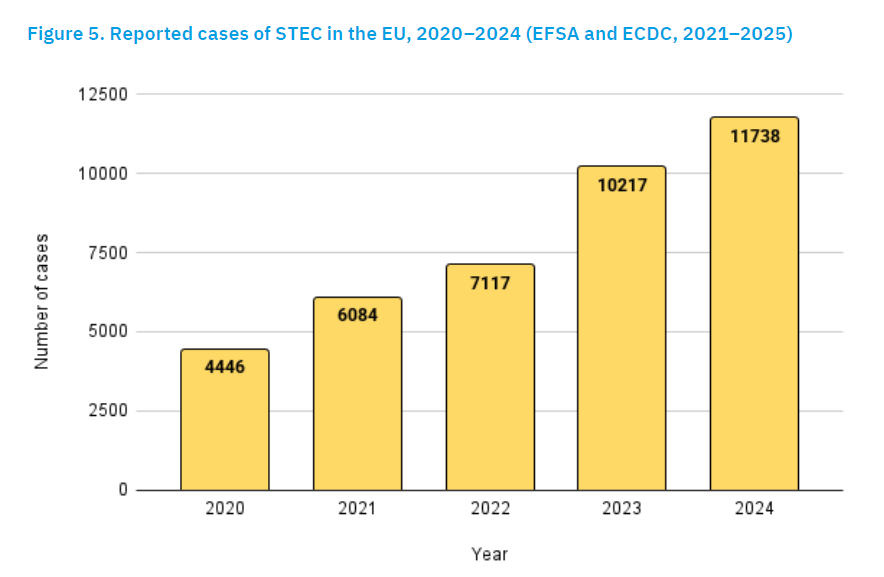
STEC is a critical foodborne pathogen responsible for severe human gastrointestinal illnesses worldwide, including haemorrhagic colitis and the potentially fatal haemolytic uremic syndrome (HUS), which usually affects young children (Ray and Singh, 2022). In the EU, STEC infections are a major public health concern with an increasing notification trend, and a separate analysis recorded 8,565 confirmed human cases in 2022 alone (Cunningham et al., 2024). Ruminants, particularly cattle and sheep, are the main reservoirs of STEC, and human infections in the EU are mostly associated with foods of ruminant origin, such as bovine meat and raw milk, as well as fresh produce. Infection sources within the food chain are considerably broader and include various food categories, such as RTE foods, raw milk cheeses, and bovine meat and milk products, whose quality and microbiological safety are of great importance for public health (EFSA and ECDC, 2022, 2024; Bonardi et al., 2024). Direct animal contact and environmental exposures, amplified by climatic events such as heavy rainfall and flooding, contribute significantly to transmission (Ray and Singh, 2022; Cunningham et al., 2024). Environmental reservoirs beyond domestic ruminants are also relevant. In the Liguria province of northwest Italy, a multi-year surveillance study identified wild ruminants, such as roe deer and fallow deer, as significant environmental reservoirs. STEC isolates recovered from these animals frequently carried the highly virulent stx2 gene, posing a significant risk to humans through direct contact or cross-contamination (Listorti et al., 2024). While Northern and Western European countries generally report the highest notification rates for human STEC cases, the epidemiological situation in the Republic of Croatia shows lower, more sporadic clinical incidences but highlights persistent risks from agricultural and environmental sources. A comprehensive nine-year epidemiological surveillance study analysing animal feed in Croatia found that 1.6% of feed samples tested positive for STEC, indicating a persistent environmental risk within the agricultural chain. Importantly, all positive isolates originated from poultry farms and carried critical human-pathogenic virulence genes, including stx1, stx2, and eae (Sokolović et al., 2022).
Given this complex epidemiological landscape, a comprehensive “farm to fork” approach to food safety monitoring is essential to ensure both human health and environmental sustainability (European Commission, 2020). Innovative technologies, such as Digital Twin applications in the food industry, offer promising opportunities for advanced monitoring of foodborne pathogens and optimisation of safety across all stages of production and distribution (Defraeye et al., 2021). The changing epidemiology of STEC in the EU highlights the need to modernise current monitoring systems. The continued increase in human cases, partly due to improved genomic diagnostics and partly to wider environmental reservoirs, shows that STEC transmission is no longer limited to domestic ruminants. This shift is clearly supported by Listorti et al. (2024) and Sokolović et al. (2022), who documented the pathogen’s persistent presence in wild ruminant populations and poultry environments, respectively. The detection of virulent STEC strains in wildlife and poultry feed indicates complex cross-species contamination pathways that are difficult to track with traditional surveillance methods. To reduce this public health risk, monitoring systems must become more advanced and integrated.
Epidemiological Trends of Major Foodborne Zoonoses in the EU with a focus on Croatia
The epidemiological monitoring of major foodborne zoonoses between 2020 and 2024 revealed a clear pattern of temporary decline followed by a sustained increase across the European Union (EFSA and ECDC, 2025). The initial reduction in reported human cases during 2020 was largely a consequence of the COVID-19 pandemic, which temporarily altered consumer behaviour and disrupted routine public health surveillance (Schirone and Visciano, 2021). In the years that followed, infection rates rebounded sharply, indicating that the underlying drivers of these illnesses, such as globalised food distribution and changing dietary patterns, remained highly active (Gyimah et al., 2025). Over this five-year period, campylobacteriosis consistently remained the most widespread gastrointestinal illness in Europe, with over 168,000 cases by the end of the reporting period (EFSA and ECDC, 2025). Salmonellosis rates stabilised at high levels, approaching 80,000 cases by 2024 (EFSA and ECDC, 2025). In the Republic of Croatia, the epidemiological burden is particularly severe, especially regarding specific serovars and food matrices. For example, the national morbidity rate for salmonellosis significantly exceeds the overall European average (Peić and Marušić, 2025). Furthermore, retail assessments in the region have recorded high contamination rates in raw poultry; historical baselines and recent studies in neighboring countries indicate that up to three-quarters of fresh chicken samples are contaminated with Campylobacter (Mikulić et al., 2016; Milojević et al., 2025). Quantitative analyses of these contaminated samples often reveal alarming bacterial concentrations, exposing consumers to substantial infectious doses during domestic food preparation (Milojević et al., 2025).
In addition to overall prevalence, the distribution of circulating pathogens is evolving, making standard mitigation strategies more challenging (EFSA and ECDC, 2025). Salmonella Infantis has rapidly emerged as the predominant serovar in Croatian chicken meat, surpassing previously common strains (Jaki Tkalec et al., 2021). STEC has shown a continuous upward trend in notification rates, becoming the third most frequent zoonotic agent in the EU by 2023 (EFSA and ECDC, 2024). Clinical manifestations of STEC remain relatively sporadic in Croatia compared to Northern Europe. However, the presence of critical virulence genes in isolates from regional agricultural environments indicates a continuing risk of transmission from animal reservoirs into the human food chain (Sokolović et al., 2022).
Listeria monocytogenes was recorded in fewer overall cases than Campylobacter or Salmonella, but its epidemiological trend poses the most acute threat to public health due to the severe clinical outcomes (Končurat and Sukalić, 2024). Its ability to survive standard sanitation procedures in food processing environments remains a major challenge (Dulikravić et al., 2025). By 2024, European surveillance recorded the highest number of listeriosis cases since monitoring began, with notably high hospitalisation and case fatality rates (EFSA and ECDC, 2025). The persistent presence of this pathogen in domestic supply chains is demonstrated by targeted Croatian surveillance, which isolated the bacteria from RTE products and raw milk distribution systems (Uhitil et al., 2004; Zdolec et al., 2019). The detection of extensive bacterial loads in these complex matrices highlights a critical vulnerability, as these items are typically consumed without prior thermal processing (Uhitil et al., 2004).
Addressing these evolving risks requires coordinated surveillance across human, animal, and environmental sectors within the One Health framework, combined with advanced genomic analyses to characterise pathogen virulence and epidemiological risk, thereby informing evidence-based food safety policies and regulatory strategies (de Oliveira et al., 2024). Maintaining proactive surveillance is crucial for reducing the cascading risks associated with climate change and the evolving pathogen virulence (Cunningham et al., 2024).
The renewed increase of major foodborne zoonoses after 2020 highlights clear weaknesses in current, fragmented food safety systems. Existing control measures are often static and cannot fully respond to the rapid spread of strains such as S. Infantis or the environmental persistence of L. monocytogenes. At the same time, climate change and global trade are further influencing patterns of transmission across Europe.
The One Health concept therefore needs to move from theory to consistent and binding practice. This requires harmonised implementation of real-time genomic surveillance and predictive environmental monitoring across all EU Member States. Without such coordinated action, the continued rise in human infections, especially in countries with high prevalence of foodborne cases, will remain a significant public health challenge
Conclusion
The epidemiological trends of major foodborne pathogens from 2020 to 2024 showed a significant shift in both the European Union and the Republic of Croatia. Although pandemic-related disruptions temporarily affected reported incidence rates, the subsequent resurgence of most zoonotic agents resulted in a 14.5% increase in foodborne outbreaks in the European Union and a 19.7% rise in human cases by 2024, thus underscoring the ongoing need for robust food safety surveillance. Persistent challenges further demonstrate the growing complexity of foodborne risk management. These include the high prevalence of thermotolerant Campylobacter, which reached 25.5% in recent European Union retail studies and has historically exceeded 73% in poultry in Croatia, the steady increase in STEC notifications, and the continued public health significance of Listeria monocytogenes, which remains associated with severe morbidity despite its relatively low incidence. Strengthening integrated One Health surveillance, expanding genomic monitoring, and improving real-time data exchange between veterinary and public health sectors are essential for mitigating these evolving threats. Particular attention should also be given to pathogen persistence in processing environments and to climate-related environmental pressures that may further influence the epidemiology of foodborne diseases in the coming decade.
References [… show]
Epidemiologija patogena koji se prenose hranom u Europi s posebnim naglaskom na Republiku Hrvatsku: petogodišnja analiza
Lovran PEINOVIĆ1, peinovic@veinst.hr, orcid.org/0009-0005-9845-491X; Lucija HLEBIĆ1 hlebic@veinst.hr, orcid.org/0009-0003-9496-4192; Dora TOMAŠKOVIĆ1, stojevic@veinst.hr, orcid.org/0000-0002-2009-5997; Irena REIL2, reil@veinst.hr, orcid.org/0000-0002-2198-557X; Sanja DUVNJAK2, marjanovic@veinst.hr, orcid.org/0000-0002-1308-267X, Maja DOPUĐ2, dopud@veinst.hr, orcid.org/0009-0009-0495-9861; Antonela BAGARIĆ3, marijan@veinst.hr, orcid.org/0009-0002-5567-681X; Eva POSTRUŽIN3, postruzin@veinst.hr, orcid.org/0009-0004-8930-2845; Andrea HUMSKI1* (dopisni autor), humski@veinst.hr, orcid.org/0000-0003-3027-1306.
1Laboratorij za mikrobiologiju hrane, Odjel za veterinarsko javno zdravstvo, Hrvatski veterinarski institut, 10000vZagreb, Hrvatska
2Laboratorij za bakterijske zoonoze i molekularnu dijagnostiku bakterijskih bolesti, Odjel za bakteriologiju i parazitologiju, Hrvatski veterinarski institut, 10000 Zagreb, Hrvatska
3Laboratorij za opću bakteriologiju i mikologiju, Odjel za bakteriologiju i parazitologiju, Hrvatski veterinarski institut, 10000 Zagreb, Hrvatska
Sažetak
Ovaj pregledni rad procjenjuje pojavnost i epidemiološke trendove glavnih zoonotskih uzročnika bolesti prenosivih hranom u Europskoj uniji, s posebnim naglaskom na Republiku Hrvatsku, u razdoblju 2020.–2024. Primjenom koncepta „One Health“ obrađeni su podaci iz godišnjih izvješća o zoonozama Europske agencije za sigurnost hrane (EFSA) i Europskog centra za prevenciju i kontrolu bolesti (ECDC), uz nadopunu ciljanim nacionalnim i regionalnim istraživanjima. Nakon privremenog pada u 2020. godini, povezanog s pandemijom bolesti COVID-19 i poremećajima u nadzoru te promjenama u ponašanju stanovništva, stope prijava za većinu uzročnika ponovno su porasle i stabilizirale se na pretpandemijskim ili višim razinama. Kampilobakterioza je ostala najčešće prijavljivana zoonoza, dok je salmoneloza zadržala visoku učestalost uz zamjetne promjene u raspodjeli serovara, uključujući pojavu serovara Salmonella Infantis. Listerioza je, iako rjeđa, pokazala najviše stope hospitalizacije i smrtnosti te kontinuirani porast. Infekcije bakterijom Escherichia coli koja proizvodi Shiga toksine (STEC) značajno su porasle, djelomično zbog unaprijeđene molekularne dijagnostike i povećane osjetljivosti sustava nadzora.
Rezultati naglašavaju potrebu za trajnim i integriranim nadzorom u humanom, veterinarskom i okolišnom sektoru, u svrhu kontrole rastućih rizika povezanih s prilagodbom patogena, antimikrobnom rezistencijom i klimatskim pritiscima unutar lanca opskrbe hranom.
Ključne riječi: patogeni koji se prenose hranom; zoonoze; epidemiološki trendovi; One Health; Republika Hrv
