
The Effect of Feeding Honeybee Colonies (Apis mellifera L.) with Protein Patties on the Level of Nosema spp. Spore Invasion
A.Mužić, M. I. Smodiš Škerl , A. Majoroš , I. Tlak Gajger*
Antonia MUŽIĆ1, muzictonka@gmail.com; Maja Ivana SMODIŠ ŠKERL2, Maja.Smodis.Skerl@kis.si, orcid.org/0000-0003-1635-1414; Arnold MAJOROŠ3, marnold.vet@gmail.com; Ivana TLAK GAJGER4* (corresponding author), itlak@vef.unizg.hr, orcid.org/0000-0002-4480-3599.
1Veterinary ambulance Rijeka, 51000 Rijeka, Croatia
2Agricultural Institute of Slovenia, 1000 Ljubljana, Slovenia
3Luna Vet veterinary ambulance, 21235 Temerin, Serbia
4Department of Biology and Pathology of Fish and Bees, Faculty of Veterinary Medicine, University of Zagreb, 10000 Zagreb, Croatia

https://doi.org/10.46419/cvj.57.6.3
Abstract
The honeybee colony needs sufficient nectar, honey and pollen supplies to meet its energy and nutritional needs, which in turn requires the constant availability of natural food. However, during early spring and periods of adverse weather conditions, the most reliable source of additional food is supplementary feeding of honeybee colonies with patties or sugar syrup in sufficient quantity and quality, as part of good beekeeping practice. This study aimed to determine the impact of protein patties on honeybee colonies after application during supplementary feeding, and possible effects on the level of invasion by Nosema spp. spores. Samples of adult bees collected in the apiary in experimental and control groups were examined under the hypothesis that honeybee colonies would take up protein patties better than sugar patties, and that the number of spores of Nosema spp. microsporidia would be reduced. Laboratory examination using a light microscope determined the presence and quantification of Nosema spp. spores. Although the analysis of the results did not reveal statistically significant differences in the number of spores between the control and experimental groups of honeybee colonies, a significant reduction in the number of Nosema spp. spores were observed during the experiment in colonies fed with protein patties over the course of the study.
Key words: honeybee; Nosema spp. spores; protein patties.
Introduction
Beekeeping, as a commercial activity, contributes to environmental protection and biodiversity. Bees are essential for the pollination of plants and the production of food for humans and animals (Faux and Kane, 2021). The health and productivity of honeybee colonies (Apis mellifera L.) are profoundly influenced by their nutritional status, particularly protein intake. Protein-rich diets, such as pollen or its substitutes, are essential for brood development, immune function, and overall colony vitality. However, the relationship between protein supplementation and susceptibility to pathogens, particularly microsporidian parasites affecting adult bees such as Nosema spp., is complex and not fully understood.
Depending on the season, food availability can be scarce, especially in winter and early spring, compromising the health of bees and the strength of honeybee colonies. To ensure sufficient nutrition, beekeepers often need supplemental feed for bees, especially after honey extraction and during periods when natural food sources are not available. Sugar-honey dough or patties are mostly used in winter and spring. Patties are available in different forms and compositions, with or without additives (Katušić, 2020; Majoroš et al., 2022). Long grazing periods, climate change that leads to sudden changes in the environment, and large agricultural areas under monoculture crops are just some of the factors that can lead to colony starvation. In such conditions, the honeybee colony becomes more susceptible to infections caused by pathogenic microorganisms and invasions/infestations by parasites and pests. The most common pathogens are microsporidia Nosema spp., Varroa destructor, economically significant bee viruses, bacteria and fungi (Tlak Gajger et al., 2024). Recent studies have yielded mixed results regarding the impact of protein supplementation on Nosema spp. invasions. Some research indicates that while protein-rich diets can enhance adult bee physiology and immune responses, they may also inadvertently promote Nosema spp. spore proliferation. For instance, Di Pasquale et al. (2013) found that honeybees consuming natural pollen had higher haemolymph protein levels and better survival rates, despite increased Nosema ceranae spore loads. This suggests that improved nutritional status may bolster the bees’ tolerance to invasion, even if it does not reduce the pathogen load. Conversely, other studies have shown that certain protein supplements have no significant effect on Nosema spp. spore counts or colony strength. DeGrandi-Hoffman et al. (2010) reported no statistically significant differences in Nosema spp. invasion intensity or colony strength among colonies fed various protein supplements compared to controls. These findings highlight the need for further research to determine the efficacy of different protein sources and formulations in managing Nosema spp. invasions. Moreover, the type and digestibility of protein supplements play a crucial role in the effectiveness of good beekeeping practice regarding supplemental feeding. Some protein patties may not be as readily assimilated as natural pollen, potentially affecting their utility in disease management. Additionally, the interaction between protein nutrition and other pathogens, such as viruses, adds another layer of complexity. Research by Dussaubat et al. (2012) suggests that protein-rich diets can influence the dynamics between Nosema spp. spore level and viral infections, potentially altering disease outcomes (Tritschler et al., 2017).
Given these contrary findings, this study aims to elucidate the effects of feeding honeybee colonies with protein patties on colony vitality and level of Nosema spp. spore infestation. By systematically evaluating different protein supplements and their impacts on N. ceranae infection levels, we seek to provide clearer guidance for beekeepers on nutritional strategies to enhance honeybee colony health and resilience against pathogens.
Materials and methods
Location of the experimental apiary
The research was conducted in a stationary apiary on the eastern side of the island of Cres, situated about two kilometres from the village of Hrast. The apiary includes 40 honeybee colonies in Langstroth-Root hives, a vertical type of hive with standardized parts both in form and size. The study was conducted on 24 of these colonies: 12 colonies formed the control group (c) fed with commercial sugar patties, and 12 colonies formed the experimental group fed with commercial protein patties containing protein substitutes (without honeybee pollen).
Supplemental feeding of honeybee colonies
Feeding of honeybee colonies was carried out after the initial sampling of adult bees in early April 2025. After the first loaf of patties, colonies were clinically inspected every two weeks. After 60 days from the initial sampling and inspection of colonies, sampling of adult bees was performed again. In mid-August, all honeybee colonies were again fed with the additional patties, and the third sampling of adult bees was done 30 days after the second feeding term, i.e., 90 days after initial feeding.
Sampling
Adult bees were taken from the peripheral frames directly from the honeycombs and placed in a clean, 120 mL plastic container. Each container was tightly closed, labelled, and stored on ice in a portable refrigerator. Each sample contained approximately 60 adult bees, which is a standard sample for the laboratory quantitative examination on nosemosis.
Laboratory Examinations
After collecting samples of adult bees in the field, the samples were stored in plastic bags and frozen at -20°C until analysis. In preparation for laboratory examination, 10 bees were randomly selected from each bag and placed in a plastic cup with 10 mL distilled water. The bees were thoroughly crushed with a plastic swab to release the intestinal contents. This mixture was filtered and stirred to create a homogeneous sample for examination under a light microscope.
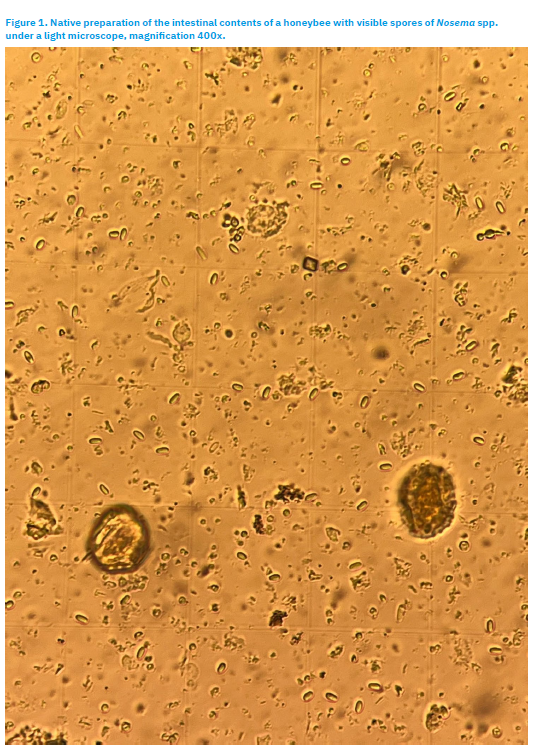
A disposable pipette was used to transfer the prepared suspension of the intestinal contents. Two drops of this suspension were placed on a Malassez haemocytometer and covered with a microscopy cover slide. The haemocytometer contains 25 squares, and samples were examined under a light microscope at a magnification of 400x. Spores of Nosema spp. were counted in five squares, and the arithmetic mean of the number of spores counted in five squares (multiplied by 5) represents the number of spores per bee. Each sample of the prepared native suspension of intestinal contents was counted in triplicate. Spores of Nosema spp. have a regular oval shape with a darker border (Figure 1).
Statistical analysis
The data were processed using the GraphPad Prism 8 program, and the nonparametric Kruskal-Wallis test was used to determine differences between the experimental and control groups of honeybee colonies, i.e., the determined average number of Nosema spp. spores.
Results
In this study, a total of 72 samples were collected; a total of 24 samples from each of three sampling periods, in which 12 samples were from the control group fed with sugar patty, and 12 samples were from the experimental group fed with protein patties.
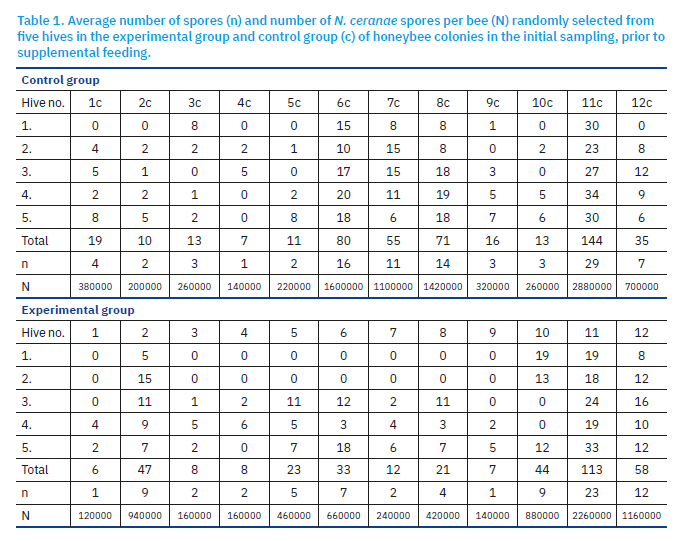
In the initial sampling session, prior to any treatment, the average number of N. ceranae spores found was 1,503 per bee in the experimental group and 790,000 per bee in the control group (Table 1).
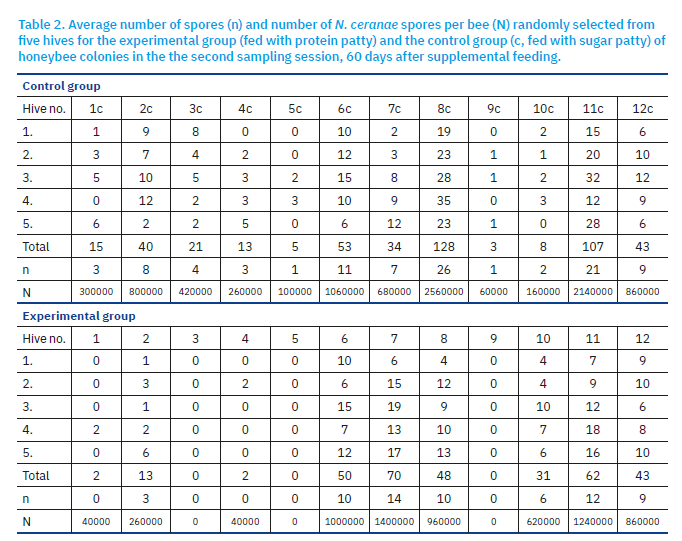
After the initial sampling, honeybee colonies were fed with protein patties (experimental group) or sugar patties (control group). After 60 days, the second sampling was performed, and the average number of N. ceranae spores in the experimental group was 460,000 per bee, and the control group was 783,333 spores per bee (Table 2).
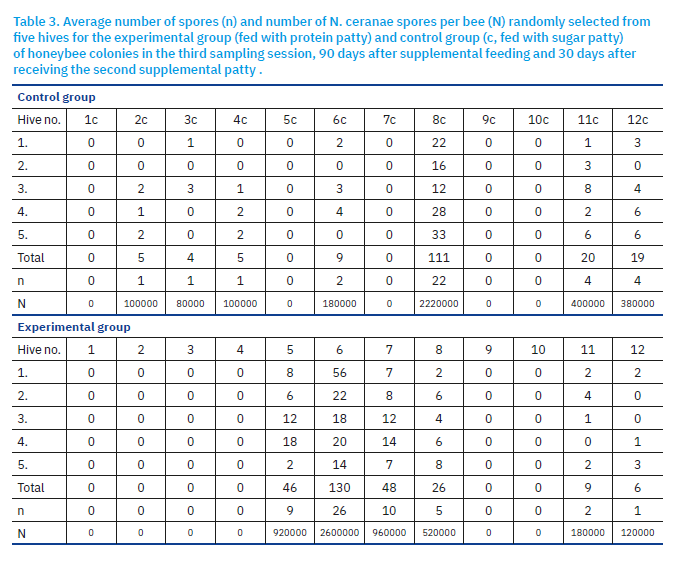
In the third and final sampling, the average number of N. ceranae spores in the experimental group was 441,666 per bee, and in the control group 288,333 spores per bee (Table 3).
Discussion
The present study evaluated the impact of protein supplementation on N. ceranae spore loads in honeybee colonies. While no significant differences were observed between control and experimental groups in any of the sampling periods, a notable decrease in spore counts was detected in the experimental group following the initial protein feeding. This finding aligns with previous research suggesting that protein-rich diets can enhance honeybee immunity and reduce pathogen loads. For instance, Dussaubat et al. (2016) demonstrated that protein supplementation improved honey bee survival rates despite increased N. ceranae spore loads, indicating a complex relationship between nutrition and pathogen dynamics.
Recent studies have highlighted the role of diet in modulating N. ceranae infections. Sbaghdi et al. (2024) found that the gut microbiota response to N. ceranae is influenced by dietary components, including probiotics and neonicotinoids, suggesting that nutritional interventions can alter infection outcomes. Additionally, Oliveira et al. (2023) emphasised the protective function of the peritrophic matrix in the honey bee midgut against N. ceranae infection, and that its integrity was influenced by dietary factors.
Despite the observed trends, the lack of consistent significant differences across all sampling periods in the present study may be attributed to various factors, including environmental conditions, colony health status, and the specific composition of the protein patties used. Moreover, the complex interplay between nutrition, immunity, and pathogen dynamics necessitates further study to elucidate the mechanisms underlying these observations.
Supplemental feeding of honeybee colonies is a common api-technical procedure. It can be performed at several times of year, depending primarily on the availability of natural food that varies during the beekeeping season. It is especially important to regularly inspect honeybee colonies and monitor the amount of stored food reserves in the hive when preparing the colonies for wintering. Also, a balanced diet of honeybee colonies is achieved by occasional supplemental feeding. The most common practice of feeding honeybee colonies, apart from sugar syrup, is patties (Katušić, 2020; Majoroš et al., 2022). Patties available on the market, as well as those prepared at home, vary in their basic compositions, and may or may not contain additives. In the literature, there are reports on the influence of fertilising with different concentrations of pollen or food additives made of protein substitutes on the degree of invasion by Nosema spp. spores, mitigating the negative effects of protein supplementation by adding honeybee pollen, and on a number of physiological indicators. It was found that groups of honeybee colonies fed only with pollen took more food, and microscopic examination determined a decreased number of Nosema spp. spores, compared to groups of honeybee colonies fed with a pure protein supplement or a mixture of pollen and protein supplements (Watkins De Jong et al., 2019).
In the present study, the effect of the application of protein and sugar patties before and after feeding honeybee colonies in an apiary in coastal Croatia was compared to determine the effect of feeding with patties on the reduction of the number of spores of Nosema spp. Although there was an overall reduction in the degree of infestation with the pathogen causing nosemosis in the experimental colonies, it is necessary to point out the limitations of the study, in which a small number of honeybee colonies were included and which, at the beginning of the experiment, were uniformly naturally infested with Nosema spp. spores.
These results follow several previous studies on the effect of honeybee feed additives on the degree of infestation with Nosema spp., namely N. ceranae, which is the only species widespread in apiaries in Croatia (Tlak Gajger et al., 2010). Namely, many studies have been conducted on Croatian apiaries and in laboratory-controlled conditions with the application of various feed additives for honeybees (Krznar et al., 2015; Tlak Gajger, 2011; Tlak Gajger et al., 2009, 2009a, 2011, 2015, 2018, 2020, 2021, 2023).
It was previously established that the use of EM® probiotics for bees is a good beekeeping practice applied worldwide. The use of EM® probiotics for bees in the form of a dietary supplement has so far been positively evaluated by beekeepers and confirmed by research in the field and laboratory-controlled conditions (Tlak Gajger et al., 2020, 2023). By monitoring the probiotic effect on the strength and health status of honeybee colonies, and the trends in the degree of invasion with Nosema spp. spores in treated colonies, its positive effect has been proven in terms of preventing invasions of manifested nosemosis type C, and as a support in strengthening colonies to preserve a healthy microbiome of the digestive system of adult bees. The results obtained in previous studies have shown the desired effects of applied probiotics originating from the intestinal system of bees on the general condition and productivity of the fed honeybee colonies (Mudrunova et al., 2011, Audisio et al., 2015, Alberoni et al., 2016, Corby-Harris et al., 2016, Tlak Gajger et al., 2023, Smriti et al., 2024). Also, applying sugar feedings enriched with pentadecapeptide BPC 157, which was found to have an effective impact on on physiological and immunological indicators, the general health of honeybee colonies, and the number of spores of microsporidium Nosema spp. in treated honeybee colonies (Tlak Gajger et al., 2018, 2020).
In beekeeping practice, it has been shown that registered food supplements approved for use in beekeeping can prevent strong invasions of the causative agent of nosemosis type C, and serve as an aid in strengthening colonies to preserve the beneficial microbiome of the digestive system of adult bees. A study in Florida conducted in the field conditions of apiaries on a total of 75 colonies examined the effects of feeding commercial protein patties on the strength of the colonies and the degree of invasion with Nosema spp. spores. The authors concluded that honeybee colonies took up patties from BeePro, UltraBee, MegaBee, and significantly weaker colonies fed with Brood Builder patty well. During the experiment, the number of spores of Nosema spp. decreased in all observed honeybee colonies during April, both the control and experimental groups (Mortensen et al., 2018).
A similar result was interpreted by Štavalj (2021) after conducting research on 19 apiary locations located in continental Croatia on a total of 1119 honeybee colonies fed with two types of commercial patties, while colonies that were not fed served as the control group.
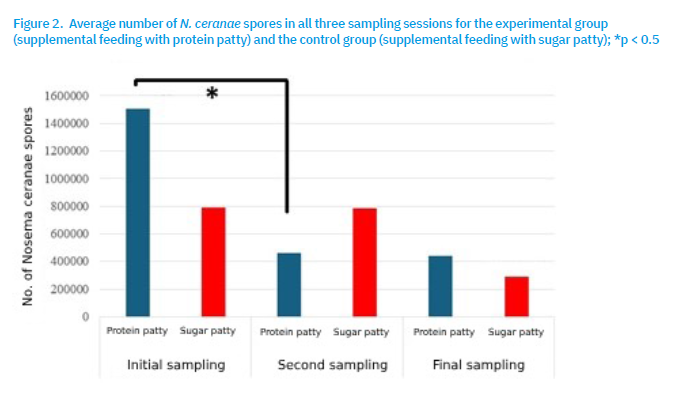
Figure 2 shows that despite the results that did not show a statistically significant difference between the control and experimental groups, there was a significant reduction in the number of Nosema spp. spores in the group of honeybee colonies fed with protein patty between the initial and second sampling sessions.
Conclusion
This study underscores the potential benefits of protein supplementation in managing N. ceranae infections in honeybee colonies. While the results indicate a trend towards reduced spore loads following protein feeding, the variability observed across sampling periods highlights the need for further research to optimise dietary interventions. Future studies should focus on identifying the most effective protein sources and formulations, and on exploring the synergistic effects of combining protein supplementation with other management strategies, such as the administration of probiotics. Implementing such integrated approaches could enhance honeybee colony health and resilience against N. ceranae and other pathogens.
Acknowledgments
This research was supported by the European Union – NextGenerationEU through the National Recovery and Resilience Plan 2021-2026 of the Republic of Croatia, project BeeNutriGen (NPOO-3): Increasing the resistance of honey bee colonies (Apis mellifera carnica) through the integration of nutrition and immunogenetics.
References [… show]
Učinak prihranjivanja pčelinjih zajednica (Apis mellifera L.) proteinskim pogačama na stupanj invadiranosti sporama Nosema spp.
Antonia MUŽIĆ1, muzictonka@gmail.com; Maja Ivana SMODIŠ ŠKERL2, Maja.Smodis.Skerl@kis.si, orcid.org/0000-0003-1635-1414; Arnold MAJOROŠ3, marnold.vet@gmail.com; Ivana TLAK GAJGER4* (dopisni autor), itlak@vef.unizg.hr, orcid.org/0000-0002-4480-3599.
1Veterinarska stanica Rijeka, 51000 Rijeka, Hrvatska
2Kmetijski inštitut Slovenije, 1000 Ljubljana, Slovenija
3Luna Vet veterinarska stanica, 21235 Temerin, Srbija
4Zavod za biologiju i patologiju riba i pčela, Veterinarski fakultet Sveučilišta u Zagrebu, 10000 Zagreb, Hrvatska
Pčelinja zajednica treba dostatne zalihe nektara, meda i peluda da bi zadovoljila energetske i prehrambene potrebe. Pri tome potrebna je stalna dostupnost prirodne hrane, no u rano proljeće i tijekom bespašnih razdoblja zbog nepovoljnih vremenskih prilika, najpouzdaniji izvor dodatne hrane je kvantitativno i kvalitativno zadovoljavajuće prihranjivanje pčelinjih zajednica pogačama i / ili šećernim sirupom koje pčelar provodi u okviru dobre pčelarske prakse. Cilj ovog rada bio utvrditi učinkovitost primjene proteinskih pogača tijekom prihrane pčelinjih zajednica te utvrditi mogući utjecaj na stupanj invadiranosti sporama Nosema spp. Pretraženi su uzorci odraslih pčela sakupljeni na pčelinjaku u pokusnim i kontrolnim skupinama (24) pod hipotezom da će pčelinje zajednice bolje uzimati proteinske nego šećerne pogače, te da će se smanjiti broj spora mikrosporidija Nosema spp. Laboratorijskim pretraživanjem uporabom svjetlosnog mikroskopa utvrđena je prisutnost i kvantifikacija spora Nosema spp. Iako analiziranjem rezultata nisu utvrđene statistički značajne razlike u broju spora između kontrolne i pokusne skupine pčelinjih zajednica, tijekom trajanja pokusa uočeno je značajno smanjenje broja spora u pokusnoj skupini prihranjivanoj proteinskom pogačom uspoređujući početak i tijek istraživanja (p < 0.5).
Ključne riječi: medonosna pčela; spore Nosema spp.; proteinske pogače.
