
Influences of Sorghum-based Diets on Poultry Production Systems: A review
W.A. Abd El-Ghany
Wafaa A. ABD EL-GHANY, wafaa.soliman@cu.edu.eg, orcid.org/0000-0003-1686-3831.
Poultry Diseases Department, Faculty of Veterinary Medicine, Cairo University, 12211 Giza, Egypt

https://doi.org/10.46419/cvj.57.6.4
Abstract
This review article outlines the different impacts of sorghum supplementation as an effective corn alternative in poultry nutrition, focusing on production performance, carcass traits, gut health, and blood parameters. The cereal grain sorghum, can substitute corn as a growth promotor by enhancing body weight gain and the feed conversion ratio of poultry. It can improve carcass characteristics, including dressing percentages and the relative weights of muscles and organs. Regarding gut health modulation, sorghum supplementation to poultry diets increases the count of the beneficial microflora while reducing pathogenic bacteria. Sorghum shows no adverse effects on the different blood indices. In conclusion, the dietary inoculation of sorghum in poultry diets can be considered as a good source of carbohydrates, which maintaining the health and productivity of birds. Before incorporating sorghum into poultry feed, further studies are required to evaluate its starch digestibility and tannin levels.
Keywords: sorghum; poultry production; gut health; blood parameters; carcass traits.
Introduction
Sorghum (Sorghum bicolor L. Moench) is a cereal crop widely grown in sub-Saharan Africa due to its tolerance of harsh, arid conditions (Abreha et al., 2022). It is the fifth leading cereal crop or animal feed grain in many countries after wheat, maize, rice, and barley (Xu et al., 2017; Wilk et al., 2022). Although sorghum possesses a nutritional profile fundamentally similar to corn, particularly regarding its high energy and starch content (Gualtieri and Rapaccini, 1990; Garcia et al., 2013; Hadebe et al., 2017), several critical differences influence its application in poultry nutrition. Notably, sorghum often contains higher but more variable protein levels and is frequently deficient in essential amino acids like lysine (Zhang et al., 2025). Furthermore, the presence of anti-nutritional factors such as tannins and kafirins in certain sorghum varieties can negatively impact starch digestibility and overall nutrient absorption (Zhang et al., 2025). Unlike the pigment-rich profile of corn, sorghum lacks the xanthophylls necessary for tissue and yolk pigmentation, requiring the use of dietary supplements to meet specific market preferences (Chaves et al., 2022).
The nutritional composition of sorghum, expressed on a dry matter basis, consists of 5.9–16.8% crude protein, 3.3–4.1% ether extract, 1.9–5.5% ash, and 3.6% crude fibre, with dry matter content ranging from 31.6–90.9% (Mnisi et al., 2023). In poultry feed formulations, low-tannin (Type I) non-bird-resistant sorghum varieties are typically used as a standard replacement for corn. If the goal is maximizing energy efficiency, waxy, low-tannin varieties are the gold standard for poultry rations because they combine the best starch structure with the lowest level of anti-nutritional interference (Moritz et al., 2022). While sorghum cereal grains possess a high gross energy content, ranging from 3,633 to 3,944 kcal/kg on a dry matter basis (Saleh et al., 2019), their metabolizable energy for poultry typically represents 95–98% of that found in yellow corn. Agronomically, sorghum is distinguished by its superior drought resilience; it can tolerate prolonged moisture stress with minimal physiological damage, making it a more stable crop in arid and semi-arid regions compared to corn. While sorghum exhibits a comparable amino acid profile to other common feed grains and is a notable source of cysteine and tryptophan, it is deficient in certain essential amino acids, particularly lysine and threonine (Hulan and Proudfoot, 1982; Okpala and Okoli, 2011). Recent genetic advancements have led to the development of sorghum hybrids with significantly reduced concentrations of anti-nutritional factors, most notably condensed tannins (Osman et al., 2022). These substances, along with kafirins and phytates, are known to form complexes with dietary nutrients and endogenous enzymes, thereby limiting the bioavailability of proteins, minerals, and energy in poultry rations. Modern sorghum hybrids enhance poultry health and productivity through their rich profile of bioactive compounds, including phytosterols, anthocyanins, and phenolic acids that exert potent antioxidant and immunomodulatory effects (Awika et al., 2005; Manyelo et al., 2019; Puntigam et al., 2020). Sorghum varieties have been developed globally, ranging from their evolutionary centre of origin in North-Eastern Africa to modern breeding programmes in the United States, India, and Brazil, to overcome marginal environmental conditions, specifically demonstrating high tolerance to prolonged drought and acidic soil profiles (Batista et al., 2019; Reddy, 2019; Abreha et al., 2021). Sorghum provides significant nutritional and economic benefits, characterised by its high energy content, accessibility, and competitive pricing on the global feed market (Manwar and Mandal, 2009).
While sorghum is often broadly categorised by grain colour, its classification is complex and based on a diverse range of genotypes. Beyond the red and brown types, which typically contain higher concentrations of phenolic acids and flavonoids compared to white varieties (Al-Mashhadani and Al-Rubaie, 2021), sorghum exists in white, yellow, and even black varieties. These are further classified by their nutritional and functional properties into grain, forage, sweet, and biomass types, each suited for specific applications in human nutrition and animal feed. Consequently, sorghum grain is increasingly recognised as a functional feed ingredient due to its abundance of secondary metabolites with bioactive properties. Sorghum contains a diverse array of bioactive phytochemicals, including phenolic acids, flavonoids (specifically 3-deoxyanthocyanidins), and phytosterols, which have the potential to enhance poultry health and productivity by mitigating oxidative stress and modulating gut microbiota (Gu et al., 2007; Cardoso et al., 2017; Shen et al., 2018; Xiong et al., 2019). Furthermore, the nutritional value of the grain is influenced by its specific protein and secondary metabolite profile, notably kafirins, hydrophobic storage proteins that form a dense matrix around starch granules, as well as phytates and proanthocyanidins (condensed tannins), which can influence the bioavailability of essential nutrients (Ashley et al., 2019). While traditionally viewed as anti-nutritional, the low concentrations of tannins found in modern sorghum hybrids, typically less than 0.5% (5 g/kg dry matter), can actually enhance gut health (Moritz et al., 2023) and optimise the digestive performance of broilers (Huang et al., 2018). Conversely, high-tannin varieties, often exceeding 1.5–3.0% (15–30 g/kg dry matter), are associated with a significant reduction in protein and starch digestibility due to the formation of insoluble nutrient complexes. The health-promoting potential of sorghum is derived from its unique profile of bioactive metabolites, specifically 3-deoxyanthocyanidins and condensed tannins. These compounds act as potent chemo-preventive agents by inducing Phase II detoxification enzymes via the nuclear factor erythroid 2´related factor 2 pathway and upregulating p53 expression, facilitating apoptosis in damaged cells (Hargrove et al., 2011; Jiang et al., 2020; Xu et al., 2021; Rezaee et al., 2024). While anti-cancer research has focused primarily on human cell lines and murine models, these molecular pathways are increasingly recognised in avian species for their role in enhancing systemic antioxidant (Herald et al., 2012), anti-inflammatory (Burdette et al., 2010), and immunomodulation (Abdel-Moneim et al., 2020) defences. Beyond its primary nutritional value, sorghum has been shown to modulate lipid metabolism, effectively lowering serum cholesterol and reducing markers associated with cardiovascular disease. These hypocholesterolemic effects, attributed to the presence of phytosterols and policosanols, have been extensively documented in human and murine models (Burdette et al., 2010). In poultry, these same mechanisms contribute to a reduction in abdominal fat deposition and a lower cholesterol concentration in egg yolks, highlighting sorghum’s role as a functional ingredient for producing leaner meat and heart-healthy eggs. The dietary inclusion of sorghum in poultry rations, ranging from partial substitution (15–50%) to complete corn replacement (100%) on a weight-for-weight basis, has been shown to enhance production performance, carcass yield, and gut integrity (Manyelo et al., 2019; Moses et al., 2022, 2024; Ahmad et al., 2024). Specifically, inclusion levels up to 60% in broiler diets have been reported to improve production performance and stabilise intestinal microbiota without compromising growth parameters (Ciurescu et al., 2023; Moritz et al., 2023).
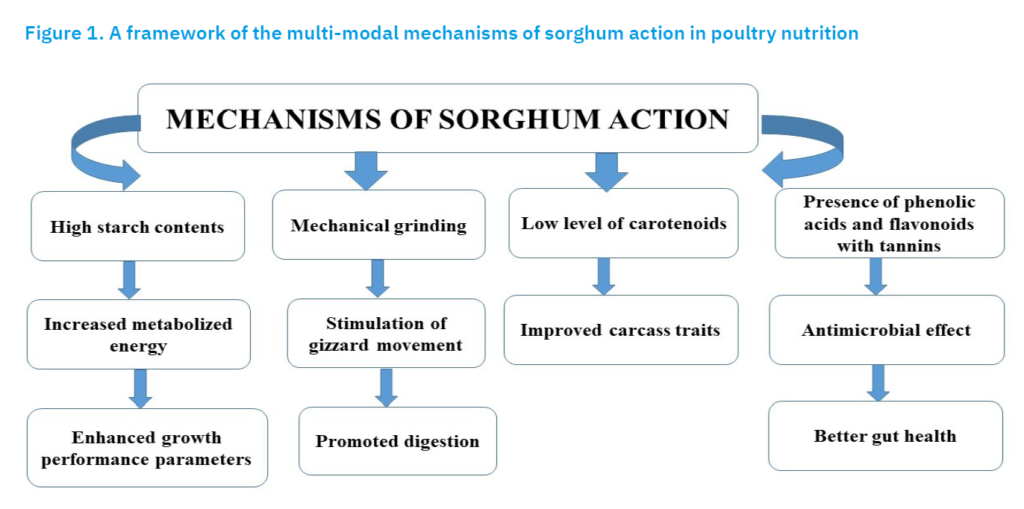
The multifaceted nutritional and physiological pathways through which sorghum influences poultry productivity are summarised in Figure 1. These pathways are categorised into four primary axes: nutritional density, physical processing, pigmentation profile, and bioactive composition. High starch content directly contributes to elevated metabolisable energy, thereby driving growth performance. Physically, the requirement for mechanical grinding stimulates gizzard motility to optimise nutrient digestion. The characteristic low carotenoid levels in sorghum lead to distinct carcass traits, such as whiter skin and fat, which are preferred on specific global markets. Finally, the presence of secondary metabolites, including phenolic acids, flavonoids, and low-level tannins, exerts antimicrobial effects that stabilise the intestinal microbiota and enhance overall gastrointestinal health.
This review article evaluates the nutritional efficacy of sorghum as a strategic dietary replacement for corn in poultry rations. It specifically examines the dose-dependent impacts of varying inclusion levels, ranging from partial substitution to complete replacement, on production performance, carcass characteristics, gut integrity, and clinical and biochemical profiles.
Effects of sorghum-based diets on production systems of poultry
Production performance
The impact of substituting maize with low-tannin sorghum is highly dependent on the replacement level and the specific growth phase of the bird. Torres et al. (2013) demonstrated that the partial or total (100%) replacement of maize with low-tannin sorghum in Cobb 500 broilers from 1 to 42 days of age did not induce deleterious effects on performance parameters (body weight, average daily gain, and feed conversion ratio). Similarly, Puntigam et al. (2020) confirmed that total replacement levels maintained performance parity in commercial flocks, provided the diets were balanced for limiting amino acids. Quantifying these improvements, Manyelo et al. (2019) observed that replacing maize with sorghum at levels of 25%, 50%, 75%, or 100% in Ross 308 broilers (age 1–42 days) led to a significant linear increase in body weight gain; specifically, birds at the 100% replacement level reached a final body weight approximately 5.4% higher than the maize-based control group, while the feed conversion ratio (FCR) improved from 1.56 in the control group to 1.48 in the 100% sorghum group. Notably, these gains occurred without a significant alteration in total feed intake, which averaged 3480 g over the 42-day period, suggesting higher nutrient density or better metabolizable energy use of the specific sorghum cultivars tested. Further performance enhancements have been recorded through the use of malted grains, as broilers fed malted red and white sorghum showed marked improvements in growth and carcass traits, including a 3–5% increase in breast meat yield (Feyera, 2021; Moses et al., 2022). These positive outcomes are fundamentally linked to the nutritional shifts occurring during the malting process, which triggers endogenous phytase and protease activity that can reduce phytate levels by up to 40%. This biological processing degrades the hydrophobic kafirin matrix, increasing the availability of α-amylase for starch breakdown, and shifting the protein profile toward more soluble fractions, thereby enhancing overall amino acid digestibility compared to raw, untreated grain.
The performance of broilers on sorghum-based diets is highly sensitive to the grain’s phenolic profile and the inclusion level within the formulation. Broiler chickens fed white grain sorghum typically exhibit superior growth performance compared to those fed red varieties. This disparity is attributed to lower concentrations of both phytic acid and non-tannin phenolic compounds in white cultivars, resulting in reduced chelation of essential minerals and less interference with protein-digesting enzymes (Selle et al., 2010a). Strategic inclusion levels further dictate metabolic success. Saleh et al. (2019) demonstrated that a 50:50 blend of yellow corn and low-tannin sorghum significantly enhanced body weight gain over traditional corn-based control diets, suggesting a synergistic energy effect when these grains are combined. This threshold was supported by Torres et al. (2013), who observed superior feed conversion ratios in 42-day-old broilers at 50% sorghum inclusion compared to 100% replacement levels. At total replacement, the cumulative effect of kafirin-starch encapsulation likely limits nutrient density. Recent data from Kiptui et al. (2024) confirmed that the 50% inclusion of low-tannin sorghum remained the “optimum physiological ceiling” for maximising growth rates and FCR in commercial broilers. However, performance can be maintained or even enhanced at various levels if the variety is optimised. Ahmad et al. (2024) reported increased body weights at substitution levels of 20%, 40%, and even 100%, with significantly higher feed intake noted at the 20% level. This suggests that modern, low-tannin sorghum varieties possess a metabolizable energy value that can match or exceed maize, provided that the anti-nutritional barrier (tannins and phytates) is sufficiently minimised through genetic selection or processing.
Malting sorghum has been reported to reduce certain anti-nutritional factors, such as phenolic contents, tannins, and flavonoids (Makokha et al., 2002; Ogbonna et al., 2012; Khoddami et al., 2017), and fibre content (Moses et al., 2024). In poultry nutrition, the transition from maize to sorghum is often limited by the latter’s bitter profile; however, the use of malted sorghum avoids this deterrent. Research by Bohoua and Yelakan (2007) and Mohammed et al. (2019) demonstrated that replacing maize with malted sorghum did not adversely affect voluntary feed intake. This stability in intake indicates that the malting process successfully mitigates the astringency of tannins, thereby maintaining the organoleptic palatability of the diet at levels comparable to maize-based formulations.
While sorghum is a viable energy substitute for corn, poultry farmers, particularly during the starter phase (the first 21 days), often exhibit indecision due to three primary factors including nutrient bioavailability, product aesthetics, and batch consistency (Ciurescu et al., 2023). Specifically, the presence of kafirin proteins and tannins in certain sorghum varieties can inhibit protein digestibility and enzyme activity in the immature guts of young chicks, leading to poor early-growth performance. Furthermore, because sorghum lacks the carotenoid pigments found in corn, it produces pale skin and yolks, which often necessitates the added cost of synthetic pigments to meet consumer expectations (Moses et al., 2022). Ultimately, the risk of high quality-variance between batches often outweighs the potential cost savings during the bird’s most sensitive stage of development. The reported reductions in body weight and feed efficiency in sorghum-fed broilers (Robertson and Perez-Maldonado, 2006; Emami et al., 2012; Osman and Gassem, 2013; Mohammed et al., 2019) were not merely a result of lower nutrient density, but were specifically attributed to the structural complexity of the sorghum grain. The primary limiting factor is the kafirin-protein matrix, a hydrophobic layer that encapsulates starch granules. This matrix acts as a physical barrier, significantly reducing starch bioavailability in the immature gastrointestinal tracts of young chicks. Furthermore, even in low-tannin varieties, the presence of phytates and kafirins increases the secretion of endogenous nitrogen (such as mucin), diverting dietary amino acids away from muscle accretion and toward gut maintenance. This metabolic ‘nutrient drain’ explains the significantly lower feed conversion ratio observed when compared to wheat or corn-based diets, where starch and protein are more readily accessible to endogenous enzymes (Hodges et al., 2021). A lack of significant effects on feed intake was reported in broilers following feeding on malted high tannin sorghum (Torki and Pour, 2007; Al-Mashhadani and Al-Rubaie, 2021). Similarly, no positive effects on feed intake, body weight gain, or FCR of broilers fed low-tannin sorghum-based diets (Garcia et al., 2013; Tandiang et al., 2014) or fed diets containing corn with hybrid of sorghum grain instead of corn (Ciurescu et al., 2023). However, Demeke (2007) and Onyimba (2020) reported lower weekly feed intake in broilers fed industrial brewers’ grain or fermented spent sorghum grains, respectively. Certain anti-nutritional compounds including kafirin, phenols, and phytate are present in sorghum and contribute to the relative slow and incomplete digestion of starch in poultry (Selle et al., 2017). Tannin binds proteins and carbohydrates, while kafirin is hydrophobic, and all these characters hamper the proper sorghum utilization in diets of monogastric animals (Taylor et al., 2007).
The performance disparity between sorghum-based and wheat or maize-based diets is primarily rooted in the unique structural and chemical architecture of the sorghum endosperm (Selle et al., 2010b). Research has indicated that broiler chickens exhibit significant growth depression during the starter phase (1–24 days) when red sorghum replaced maize grain (Manyelo et al., 2019; Al-Mashhadani and Al-Rubaie, 2021). This phenomenon is specifically attributed to the synergistic inhibitory effects of condensed tannins, phytates, and kafirin proteins, all of which adversely impact nutrient utilisation (Hariprasanna et al., 2015) and metabolic efficiency (Hamid et al., 2017). Unlike the more soluble proteins found in wheat or maize, sorghum contains kafirin, a hydrophobic prolamin protein that forms a dense, cross-linked matrix physically encapsulating starch granules (Moss et al., 2020). This encapsulation creates a mechanical barrier that limits enzymatic access, making the starch largely inaccessible to the bird’s digestive system. Furthermore, condensed tannins exacerbate this nutrient restriction by forming stable, indigestible complexes with dietary proteins and endogenous enzymes within the digestive tract (Selle et al., 2010a). This biochemical interaction significantly decreases the digestion and absorption of both dietary and naturally occurring amino acids, limiting the efficacy of sorghum in monogastric feeding (Myer et al., 2007). Consequently, the presence of these anti-nutritional factors may decrease feed consumption, hinder growth, and increase the incidence of abnormal leg bone development due to disrupted mineral absorption (del Puerto et al., 2016; Avila et al., 2021). The reported discrepancies between studies are largely dictated by the specific tannin-type and vitreousness (kernel hardness) of the sorghum cultivars used, alongside the specific processing methods employed to disrupt the grain’s protective protein matrix.
Carcass traits
Positive influences of malted red and white sorghum on broiler carcass traits have been reported (Feyera, 2021; Moses et al., 2022). Carcasses with lower fat content are in increasing demand by health-conscious consumers, and replacing dietary corn with sorghum has been shown to reduce abdominal fat deposition in broiler carcasses (Cherian et al., 2002; Ciurescu et al., 2023).
The literature indicates that the total or partial replacement of corn with grain sorghum significantly influences broiler carcass parameters (Robertson and Perez-Maldonado, 2006; Garcia et al., 2013; Torres et al., 2013; Ibe and Makinde, 2014; Tandiang et al., 2014) through two primary mechanisms: mechanical stimulation and nutrient partitioning. Specifically, feeding whole or coarsely ground sorghum leads to a marked increase in gizzard weight and intestinal muscularity, a physiological adaptation required to grind the harder sorghum kernels (Puntigam et al., 2020). Conversely, while most studies report that carcass and breast yields remain statistically comparable to corn-fed birds (Gheorghe et al., 2017), high-inclusion levels of sorghum can occasionally result in a reduction in abdominal fat pad weight. This is attributed to the lower lipid content and different fatty acid profile of sorghum compared to corn (Silva et al., 2015), resulting in a leaner carcass without compromising the weight of lymphoid organs or vital viscera (Saleh et al., 2019). While the majority of studies indicate that low-tannin sorghum and corn provide equivalent nutritive value for carcass development, specific instances of reduced dressing and breast meat yields have been reported (El-Afifi et al., 2013; Pasquali et al., 2016; George et al., 2017; Cordova-Noboa et al., 2018; da Silva et al., 2018; Manyelo et al., 2019). These adverse effects are primarily attributed to the high affinity of condensed tannins for dietary proteins, forming indigestible tannin-protein complexes via hydrogen bonding and hydrophobic interactions. Specifically, tannins significantly reduce the ileal digestibility of essential amino acids, particularly methionine, lysine, and threonine, which are the primary limiting factors for muscle protein synthesis and breast meat deposition. Furthermore, tannins can inhibit the activity of endogenous proteases like trypsin and chymotrypsin, further impairing the bird’s ability to utilise the protein required for optimal carcass yield (Thomas and Ravindran, 2008; Ahmad et al., 2024). These results indicated the similarity in the nutritive value of diets based on corn or low-tannin sorghum to broilers.
Regarding the carcass physicochemical composition or quality, breast or thigh meat colour were lightened following replacement of corn with sorghum in the diets of broilers, though meat redness and yellowness of breast and thigh muscles did not differ significantly (Ciurescu et al., 2023). The impact of sorghum on broiler meat quality is most evident in the alteration of visual pigments and textural profiles. While corn-based diets provide high levels of carotenoids (lutein and zeaxanthin) that are deposited in the fat and muscle, sorghum is naturally deficient in these pigments. Consequently, birds fed sorghum-based diets typically exhibit significantly lower yellowness and higher lightness in breast and thigh meat (Ciurescu et al., 2023). The lack of significant differences in redness in some studies suggests that while sorghum lacks yellow xanthophylls, it does not interfere with myoglobin concentrations. Furthermore, textural shifts, specifically increased hardness and gumminess, are attributed to the influence of sorghum’s unique amino acid profile on the density of collagen cross-links within the perimysium of the muscle. However, the stability of pH, moisture, and crude protein levels indicates that sorghum maintains the fundamental physicochemical integrity of the muscle tissue (Garcia et al., 2013; Cordova-Noboa et al., 2018).
Gut health
The impact of sorghum on the broiler intestinal landscape is characterised by a selective modulation of microbial populations, driven primarily by the grain’s specific phenolic profile and inclusion level. Fagundes et al. (2017) demonstrated that total or partial replacement of corn with tannin-rich sorghum significantly reduced Clostridium levels while promoting Lactobacillus proliferation, likely due to the prebiotic potential of hydrolysable tannins. In contrast, studies utilising white, low-tannin sorghum, such as those by Gheorghe et al. (2017) and Ciurescu et al. (2023), reported a significant reduction in pathogenic Enterobacteriaceae and Escherichia coli populations. However, these low-tannin varieties often result in negligible changes to the Lactobacillus count, suggesting that while sorghum-derived phenolic acids and flavan-3-ols exert strong bacteriostatic pressure on Gram-negative pathogens, their influence on beneficial commensal bacteria is highly dependent on the tannin-to-phenolic ratio of the specific sorghum genotype (Daglia, 2012; Shields et al., 2020).
Regarding intestinal architecture, replacing dietary corn with varying levels of sorghum did not significantly alter the ileal dimensions of broiler chickens (Manyelo et al., 2019). Similarly, there were no differences in villi heights or crypt depths in broiler chickens fed sorghum (Silva et al., 2015). Nyamambi et al. (2007) observed a decrease in villi height and crypt depth in broiler chickens fed sorghum meal in diets varying in condensed tannin levels instead of maize meal. The recent study of Ahmad et al. (2024) revealed that the villus crypt depth and the ratio of villus height to crypt depth exhibited no significant changes among broiler chickens fed sorghum based diets with 20%, 40%, and 100% maize replacement. The decline in villi height and crypt depth was attributed to the presence of condensed tannins, which may have induced damages in the intestinal villi. The observed reduction in villus height and the concomitant increase in crypt depth are primarily attributed to the presence of high concentrations of condensed tannins, typically exceeding 1.5% (15 g/kg dry matter). These secondary metabolites can cause localised mucosal irritation and increase enterocyte turnover, diverting energy away from growth toward intestinal repair (Huang et al., 2018). However, it is essential to note that at lower inclusion levels (less than 0.5% dry matter), these morphological alterations are generally absent, and the presence of phenolic compounds may even support gut health by reducing the colonisation of pathogenic bacteria.
Sorghum syrup is a natural, nutrient-dense concentrate produced by expressing and boiling the juice from the stalks of sweet sorghum (Sorghum bicolor). Beyond the raw grain, sorghum syrup exhibits significant antimicrobial potential against a broad spectrum of Gram-negative and Gram-positive bacteria (Kumar et al., 2012). This inhibitory effect is primarily driven by the high concentration of 3-deoxyanthocyanidins and phenolic acids, which disrupt bacterial cell membrane integrity and interfere with intracellular metabolic pathways. Additionally, the synergistic effect of low water activity and the chelation of essential metal ions by sorghum polyphenols creates a hostile environment for microbial proliferation, further establishing sorghum-derived products as functional agents in both food and animal nutrition. The microbiological analysis of the digesta revealed that a 20% inclusion level of sorghum optimised the enteric environment for beneficial microbiota. Specifically, Lactobacillus counts, quantified via selective plate culture on De Man, Rogosa, and Sharpe agar, were significantly higher at this level compared to higher replacement rates (Ahmad et al., 2024), suggesting a dose-dependent prebiotic effect of sorghum phytochemicals.
The antibacterial activity of phenolics in sorghum may vary based on the metabolic pathways and the oxygen requirements of the bacteria. The antibacterial efficacy of sorghum is not uniform, as the phenolic profile varies significantly across genotypes, with pigmented and tannin-rich varieties possessing higher bioactive concentrations than white hybrids. These specific phenolics, such as 3-deoxyanthocyanidins, interact differently with bacteria based on their cell wall structure and metabolic pathways. For instance, anaerobic bacteria and Gram-positive species often show higher sensitivity to sorghum polyphenols due to the absence of an outer lipopolysaccharide membrane, enabling easier intercalation of phenolic acids into the cytoplasmic membrane.
Sorghum phenolic extracts, specifically those isolated using acidified 80% methanol or 70% acetone, exhibit potent antibacterial activity against major avian pathogens. In vitro studies utilising broth microdilution assays have identified significant inhibitory effects, with Minimum Inhibitory Concentrations (MIC) as low as 1.5 to 2.0 mg/mL for Salmonella enterica and Staphylococcus aureus (Shields et al., 2020), and even higher sensitivity for Campylobacter jejuni, where phenolic extracts reached MIC values of 0.06 to 0.5 mg/mL (Schnur et al., 2021). These antibacterial properties are directly correlated with the concentration of 3-deoxyanthocyanidins and condensed tannins, which facilitate the disruption of bacterial cell membrane integrity and the inhibition of essential metabolic enzymes. The antimicrobial potential of sorghum is derived from both its phenolic profile and its specific protein fractions. Condensed tannin extracts, isolated via acidified aqueous acetone, have demonstrated broad-spectrum efficacy against Staphylococcus aureus, Escherichia coli, and Salmonella Enteritidis (Sulieman et al., 2007; Kil et al., 2009). Complementing these phytochemicals, sorghum-derived glycine and proline-rich proteins, often isolated through salt-gradient chromatography, exhibit targeted inhibitory activity against Escherichia coli, Bacillus subtilis, and Rhodococcus fascians by disrupting bacterial membrane stability (Halder et al., 2019).
Sorghum-specific secondary metabolites, particularly the 3-deoxyanthocyanidins (e.g., apigeninidin) and condensed tannins, protect the host from microbial challenges by modulating intracellular signalling and dampening the inflammatory response (Al Zoreky, 2009). These compounds effectively downregulate the expression of toll-like receptor genes, thereby preventing the excessive release of pro-inflammatory cytokines that contribute to mucosal damage (Sobhani et al., 2021). Furthermore, dietary inclusion of red sorghum has been shown to upregulate differentially expressed genes associated with innate defence, which significantly reduces the severity of intestinal lesions during necrotic enteritis challenges caused by Clostridium perfringens (Moritz et al., 2023).
Blood parameters
The metabolic safety of malted sorghum is evidenced by the maintenance of baseline biochemical parameters in broilers, including total protein, albumin, and urea (Moses et al., 2024). Beyond safety, the enhanced energy density of malted grains supports the transport of proteins essential for steroid and thyroid hormone synthesis (Kim and Kang, 2016). The observed increase in creatinine levels (Ileke et al., 2014) serves as a physiological marker for heightened muscle contraction and protein turnover, consistent with the superior weight gain and muscle accretion reported in birds utilising these bioavailable energy sources.
While the polyphenolic compounds in sorghum may induce a hypoglycaemic effect by modulating glucose absorption (Krueger et al., 2003), the overall mineral stability of the birds is maintained through malting. Although white malted sorghum shows variations in magnesium and chlorine compared to red varieties (Moses et al., 2024), likely due to differential concentrations of phytates and oxalates (Samtiya et al., 2020), the preservation of critical electrolytes such as calcium, potassium, and sodium indicates that the bioavailable mineral pool remains adequate for the physiological demands of the broiler.
Hepatic biomarker stability, as evidenced by consistent levels of alkaline phosphatase, alanine transaminase, aspartate aminotransferase, and gamma-glutamyl transferase in broilers fed 100% sorghum diets, confirms that sorghum does not impair liver health (Ciurescu et al., 2023). Furthermore, the unique physiological profile of birds fed malted red sorghum, characterised by specific elevations in transaminase activity (Moses et al., 2024), highlights the hepato-protective and antioxidant properties of malted grains. These processed cultivars enhance the bird’s ability to sequester free radicals, thereby protecting liver tissue from oxidative insult and maintaining systemic metabolic health (Hernandez et al., 2006).
Low-tannin sorghum functions as an effective hypolipidemic agent in broilers, reducing plasma triglycerides and cholesterol without inducing hepatic stress or altering protein metabolism (Saleh et al., 2019). This effect is mediated by proanthocyanidins and phytosterols, which competitively inhibit cholesterol absorption (Santos-Buelga et al., 2019). Additionally, the use of malted sorghum enhances key haematological parameters, including basophil counts and mean corpuscular haemoglobin (Moses et al., 2024), indicating a heightened state of immunological readiness and improved respiratory efficiency in the blood of growing broilers.
Conclusion and limitations
In summary, while sorghum stands as one of the most resilient and drought-tolerant cereals for arid and semi-arid tropical regions, its full potential in sustainable poultry production remains partially underutilised. Although the presence of specific phytochemicals, namely kafirins, phytates, and condensed tannins, has historically limited its inclusion, modern genetic improvements and advanced feed processing technologies have largely mitigated these anti-nutritional barriers. By adopting low-tannin hybrids and utilising exogenous enzymes such as proteases and phytases, the poultry industry can effectively transition to sorghum as a 100% replacement for corn. Ultimately, integrating sorghum into global feed formulations not only stabilises production costs against corn market volatility but also enhances the environmental sustainability of the poultry sector in the face of escalating climate challenges.
References [… show]
Prikaz različitih utjecaja hranidbe peradi na bazi sirka na proizvodna svojstva
Wafaa A. ABD EL-GHANY, wafaa.soliman@cu.edu.eg, orcid.org/0000-0003-1686-3831.
Poultry Diseases Department, Faculty of Veterinary Medicine, Cairo University, 12211 Giza, Egypt
Ovaj pregledni rad prikazuje različite utjecaje dodavanja sirka kao učinkovite alternative kukuruzu u hranidbi peradi, s naglaskom na proizvodna svojstva, karakteristike trupova, zdravlje crijeva i krvnih parametara. Sirak je žitarica s niskim udjelom tanina i može zamijeniti kukuruz u hranidbi peradi. Ima svojstva promotora rasta, djeluje na povećanje prirasta i konverziju hrane u peradi. Osim toga, može poboljšati klaonička svojstva trupova, posebice randman poboljšavajući relativnu masu mišičja i organa. U modulaciji zdravlja crijeva, dodavanje sirka u hranidbi peradi povećava udio korisne mikroflore i smanjuje udio patogenih bakterija. Sirak ne pokazuje štetne učinke na različite krvne parametre. Zaključno, dodavanje sirka u hranidbu peradi dobiva se dobar izvor ugljikohidrata koji pogoduje održavanju zdravlja i prirasta ptica. Prije uključivanja sirka u hranidbu peradi, potrebna su daljnja istraživanja kako bi se procijenila probavljivost škroba u sirku i količina tanina.
Ključne riječi: sirak; proizvodnja peradi; zdravlje crijeva; krvni parametri; karakteristike trupova.
