
Tick Species Infesting Rock Partridges (Alectoris graeca Meisner, 1804) in Croatia: Ecological Significance and Host Associations
K. Pintur*, V. Slijepčević, E. Gagović , T. Dumić, N. Fabijanić , J. Gulin, R. Beck*
Krunoslav PINTUR1* (corresponding author), krunoslav.pintur@vuka.hr, orcid.org/0000-0003-4724-4523; Vedran SLIJEPČEVIĆ1, vedran.slijepcevic@vuka.hr, orcid.org/0000-0002-0508-6224; Ema GAGOVIĆ2, gagovic@veinst.hr, orcid.org/0009-0007-6122-5958; Tomislav DUMIĆ1, tomislav.dumic@vuka.hr, orcid.org/0000-0001-5943-4346; Nera FABIJANIĆ3, nera_az@yahoo.com, orcid.org/0000-0001-7964-7939; Josip GULIN4; Relja BECK2* (corresponding author), beck@veinst.hr, orcid.org/0000-0002-5304-2875.
1Department of Wildlife Management and Nature Conservation, 47000 Karlovac University of Applied Sciences, Karlovac, Croatia
2Laboratory for Parasitology, Department of Bacteriology and Parasitology, Croatian Veterinary Institute, 10000 Zagreb, Croatia
3Croatian Hunting Association, 10000 Zagreb, Croatia
4Gulini Dolačani 55, 22000 Šibenik, Croatia

https://doi.org/10.46419/cvj.57.6.7
Abstract
Ticks (Acari: Ixodidae) are important ectoparasites and vectors of numerous pathogens affecting wildlife, domestic animals, and humans. Although birds play a significant role in tick ecology, information on tick infestations in wild galliform birds remains limited. The aim of this study was to identify tick species associated with rock partridge (Alectoris graeca) populations in Mediterranean and sub-Mediterranean habitats of Croatia, and to evaluate their potential importance in tick ecology. A total of 39 rock partridges were examined from four localities in Croatia (Pag, Lozovac, Primorski Dolac and Svilaja). A total of 47 ticks were collected from 27 birds (69.2%). Molecular analysis based on sequencing of the mitochondrial 16S rRNA gene confirmed the morphological identification of all tick species. Four tick species belonging to the genus Ixodes were identified: Ixodes festai, Ixodes gibbosus, Ixodes ventalloi and Ixodes hexagonus. Ixodes festai was the dominant species (72.3%) and was recorded at all four localities. The remaining ticks belonged to I. gibbosus (10.6%), I. ventalloi (8.5%), and I. hexagonus (8.5%) and were found exclusively on Pag Island. Among the collected ticks, adult stages (55.3%) and nymphs (42.6%) predominated. The results indicate that rock partridges represent important hosts for several Mediterranean tick species of the genus Ixodes and may contribute to the maintenance of their local populations. The dominance and widespread occurrence of I. festai suggest a strong ecological association between this ornithophilic tick species and rock partridge populations. Furthermore, the exclusive occurrence of I. ventalloi, I. gibbosus and I. hexagonus on Pag Island indicates the influence of local ecological conditions and host community composition on tick population structure. The results of this study contribute to a better understanding of tick ecology and provide an important basis for future research on tick-borne pathogens in Mediterranean ecosystems.
Keywords: rock partridge; Alectoris graeca; ticks; Ixodes festai; Croatia.
Introduction
Birds play a key role in tick ecology (Keve et al., 2022). Due to their high mobility and ability to occupy a wide range of habitats, they contribute to the maintenance and dispersal of tick populations and associated pathogens (Papadopoulos et al., 2002; Keve et al., 2022). Numerous studies have demonstrated that birds can transport ticks over considerable distances, thereby facilitating the spread of both native and non-native tick species and influencing the epidemiology of tick-borne diseases (Hornok et al., 2022; Keve et al., 2024). Most studies investigating bird-associated ticks and the long-distance dispersal of ticks and pathogens have focused on migratory passerines (Keve et al., 2022; Pitó et al., 2024). Consequently, birds are increasingly recognised as important components of host–tick–pathogen systems throughout Europe.
The rock partridge (Alectoris graeca Meisner, 1804) is a characteristic galliform species inhabiting mountainous, rocky, and karst landscapes of southern Europe, particularly across the Balkan Peninsula, the Apennines, and numerous Mediterranean islands (BirdLife International, 2024). In Croatia, the species is widely distributed throughout the Dinaric region and on several Adriatic islands, where it is an important small game species (Grubešić et al., 2011). Besides its ecological importance, the rock partridge also possesses considerable economic and cultural value owing to its role in hunting and game management.
Rock partridges are generally regarded as sedentary birds with relatively small home ranges and limited dispersal abilities compared with migratory bird species. Although local seasonal movements and altitudinal migrations have occasionally been reported, particularly in mountainous areas where snow cover and food availability influence habitat use (Bernard-Laurent, 1991; Randi et al., 2003), the species is considered predominantly resident throughout its distribution range (Randi et al., 2003; Bontzorlos et al., 2012; Brustenga et al., 2022). Therefore, its role in tick ecology is likely related primarily to the maintenance of local host–tick cycles rather than to the long-distance dispersal of ticks and tick-borne pathogens.
To date, little attention has been paid to the role of galliform birds in tick dispersal, despite their potential importance as hosts for several Mediterranean tick species. Among these, species of the genus Alectoris appear to be particularly relevant. There is lack of literature on tick species associated with rock partridges in Croatia or elsewhere in Europe. In Spain, Calvete et al. (2003) investigated tick infestations in the red-legged partridge (Alectoris rufa) and identified Haemaphysalis punctata, Hyalomma lusitanicum, and Ixodes frontalis, confirming their roles as host for ectoparasite species in Mediterranean ecosystems. Reports from the Middle East and western Asia have documented infestations of the chukar partridge (Alectoris chukar) with tick species such as Hyalomma marginatum and Alveonasus canestrinii (Hosseini-Chegeni et al., 2019). Keve et al. (2022) reviewed the occurrence of I. frontalis, I. hexagonus, I. acuminatus, I. ventalloi, Haemaphysalis punctata, and Hyalomma lusitanicum on red-legged partridge and chukar partridges (A. rufa and A. chukar). Collectively, these findings indicate that species of the genus Alectoris may serve as hosts for a diverse assemblage of both hard and soft ticks throughout their distribution ranges. Several of these tick species parasitise a broad spectrum of vertebrate hosts and may act as ecological bridges between wildlife, domestic animals, and humans, thereby contributing to the maintenance and transmission of zoonotic pathogens such as Borrelia spp. and Rickettsia spp. (Hornok et al., 2014; Lommano et al., 2014; Keve et al., 2022). Given the lack of data on tick species associated with populations of Alectoris graeca in Croatia, the aim of the present study was to identify tick species associated with rock partridges at selected localities in Croatia and to evaluate the potential role of this species in the ecology of ticks inhabiting Mediterranean and sub-Mediterranean habitats of the country.
Materials and methods
Study area
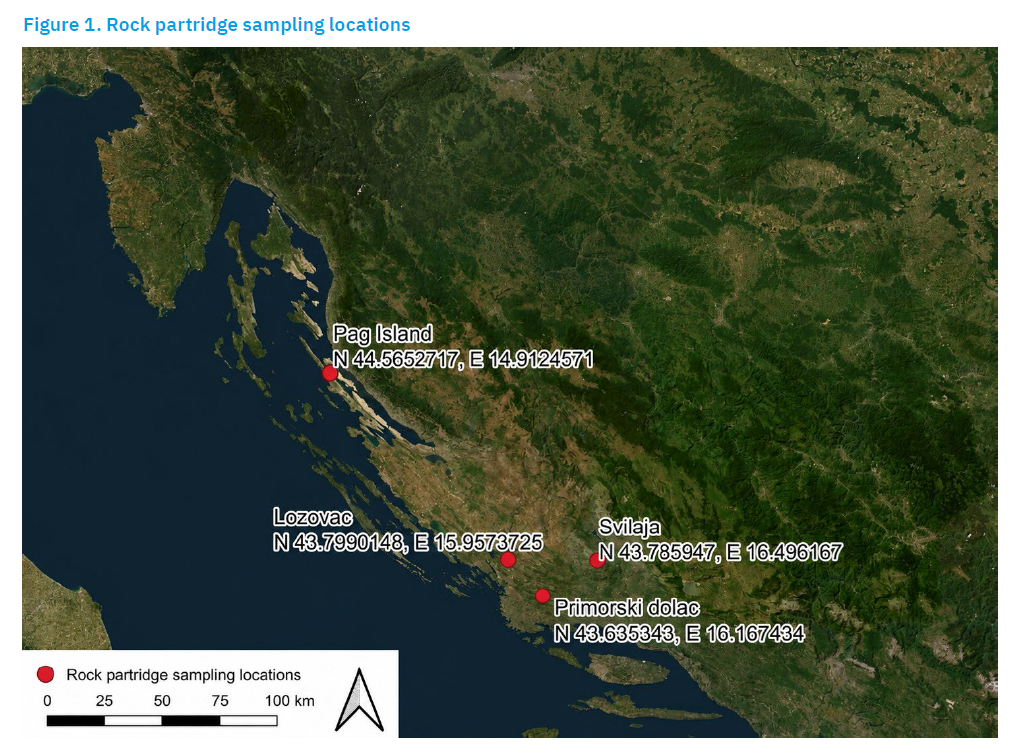
The study was conducted at four localities in Croatia inhabited by rock partridges (Alectoris graeca): Pag Island, Lozovac, Primorski Dolac, and Mt. Svilaja (Figure 1). These localities represent typical Mediterranean and sub-Mediterranean habitats characterised by rocky terrain, karst landscapes, sparse shrub vegetation, dry grasslands, and open habitats suitable for rock partridge populations.
Pag Island is situated in the northern Adriatic Sea and is characterised by extensive rocky pastures, Mediterranean shrublands, and highly fragmented vegetation communities influenced by strong bora winds and prolonged summer droughts. The locality of Lozovac is located in the hinterland of central Dalmatia, within the Krka River catchment, and consists of a mosaic of rocky grasslands, Mediterranean scrub vegetation, and agricultural habitats. Primorski Dolac is situated in the Dalmatian hinterland and is characterised by karst plateaus, rocky pastures, and open habitats with sparse woody vegetation. Similar habitat characteristics occur in the Mt. Svilaja area, where rock partridges inhabit dry mountain grasslands, rocky slopes, and sub-Mediterranean shrub communities.
According to the Köppen climate classification, the investigated localities belong predominantly to Mediterranean (Csa) and transitional sub-Mediterranean climatic zones, characterised by hot and dry summers, mild winters, and pronounced seasonal variation in precipitation. These environmental conditions provide suitable habitats for both rock partridges and several Mediterranean tick species.
Tick sampling
Rock partridges (Alectoris graeca) included in the study were obtained during regular hunting activities conducted in accordance with Croatian hunting legislation and approved game management plans. Immediately after collection, each bird was carefully examined for the presence of ticks.
Particular attention was paid to body regions commonly infested by ticks, including the head, neck, periocular region, ear openings, and surrounding featherless skin areas. All detected ticks were manually removed using fine forceps, taking care to preserve the integrity of the specimens for subsequent morphological and molecular analyses. Collected ticks were individually stored in sterile tubes containing 96% ethanol. Samples were subsequently stored at -20°C until further processing.
A total of 47 tick specimens were collected from 39 rock partridges (22 ticks from Pag Island, 17 ticks from Lozovac, 2 ticks from Primorski dolac, 6 ticks from Mt. Svilaja) and subjected to further morphological and molecular analyses. When multiple ticks were present on a single host individual, each specimen was processed separately.
Tick identification
Ticks were morphologically identified to species, sex, and developmental stage using standard taxonomic keys based on morphological traits (Contini et al., 2011; Estrada-Peña et al., 2017; Hornok et al., 2026). Documentation was carried out using a SteREO Discovery.V20 microscope (Carl Zeiss AG, Oberkochen, Germany) equipped with AxioVision and ZEN2 Pro software. After identification, each tick was washed in 70% ethanol, rinsed with sterile distilled water, dried on sterile filter paper to remove external contaminants (such as soil particles, host-derived material, fur, and blood residues), and stored individually in sterile 2 mL tubes containing 96% ethanol until molecular analysis.
Following morphological identification, 18 representative specimens were selected for molecular confirmation. The selection included representatives of all morphologically identified species, with particular emphasis on taxa that are difficult to distinguish morphologically, such as Ixodes festai and I. ventalloi, to validate species identification. Genomic DNA was extracted using the MagMAX™ CORE Nucleic Acid Purification Kit (Thermo Fisher Scientific, Waltham, MA, USA) on the KingFisher™ Flex Purification System (Thermo Scientific), according to the manufacturer’s instructions, with a final elution volume of 100 μL. Species identity was confirmed by amplification and sequencing of a 460 bp fragment of the mitochondrial 16S rRNA gene using the forward primer 16SF (5′-CTGCTCAATGTTTTTTAAATTGCTGTGG-3′) and reverse primer 16SR (5′-CCGGTCTGAACTCAGATCAAGT-3′) (Black and Piesman, 1994).
PCR reactions were performed in a final volume of 20 µL containing 10 µL GoTaq® G2 Master Mix (Promega, Madison, WI, USA), 7.2 µL DNase/RNase-free distilled water (Promega), 0.4 µL of each primer (10 pmol/µL), and 2 µL DNA template. Positive and negative extraction controls were included in all amplification rounds to monitor contamination.
Amplification products were evaluated by capillary electrophoresis using a QIAxcel system (Qiagen, Germany) with the QIAxcel DNA Fast Analysis kit, DNA QX Alignment Marker (15 bp – 3 kb), and QX DNA Size Markers (50 bp – 1.5 kb and 100 bp – 2.5 kb). PCR products were purified using ExoSAP-IT™ PCR Product Clean-up Reagent (Applied Biosystems™, Waltham, MA, USA) according to the manufacturer’s instructions and sequenced bidirectionally at Macrogen Europe using the corresponding primer sets.
Raw sequence chromatograms were assembled and edited using SeqMan Pro 18 and SeqBuilder Pro 18 (DNASTAR, Madison, WI, USA). Consensus sequences were aligned and analysed using SeqMan and EditSeq (Lasergene, DNASTAR) and compared with reference sequences available in GenBank using the BLASTn algorithm (https://blast.ncbi.nlm.nih.gov) to confirm species identity.
Statistical analysis
Statistical analysis was performed using descriptive and inferential methods. Tick prevalence was calculated as the proportion of infested rock partridges relative to the total number of examined birds and expressed as percentages. Differences in infestation prevalence among localities were assessed using the chi-square (χ²) test of independence. The association between locality and tick species composition was also evaluated using the chi-square test at the host level. The strength of association was estimated using Cramér’s V coefficient. Statistical significance was set at p < 0.05. Analyses were performed using R software (R Core Team, Vienna, Austria).
Results
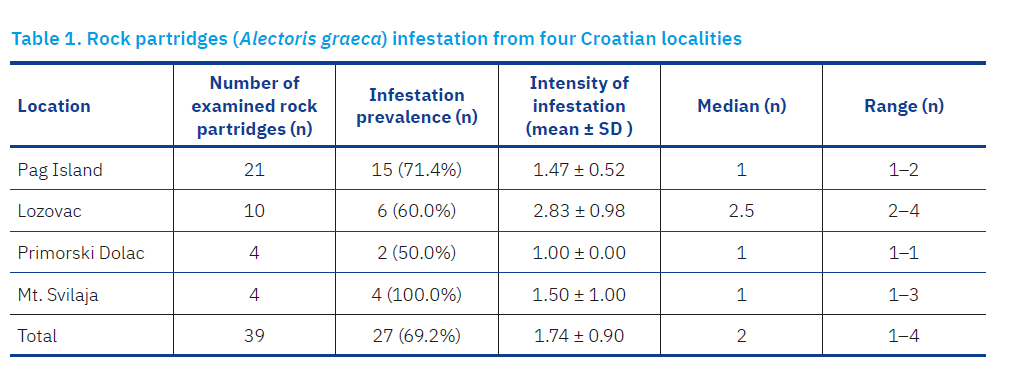
A total of 39 rock partridges (Alectoris graeca) originating from four Croatian localities (Pag Island, Lozovac, Primorski Dolac, and Mt. Svilaja) were examined. Ticks were recorded on 27 birds, while 12 individuals (30.8%) were free of ticks at the time of examination, giving an overall prevalence of tick infestation of 69.2%. The highest prevalence was recorded on Mt. Svilaja, where all four birds were infested. On Pag Island, ticks were found on 15 of 21 examined birds (71.4%), while six of ten birds (60.0%) from Lozovac were infested. The lowest prevalence was observed at Primorski Dolac, where two of four examined birds (50.0%) carried ticks.
Tick prevalence did not differ significantly among localities (χ² = 2.92, df = 3, p = 0.404). Likewise, no significant association was found between locality and tick species composition at the host level (χ² = 12.32, df = 12, p = 0.420), although I. gibbosus, I. ventalloi and I. hexagonus were recorded exclusively on Pag Island. However, due to the relatively small sample size and low expected frequencies in some categories, the results of the chi-square tests should be interpreted with caution.
The distribution of examined birds, and the infestation prevalence of collected tick specimens by locality is presented in Table 1.
Molecular analyses confirmed the presence of four tick species belonging to the genus Ixodes: I. festai, I. gibbosus, I. ventalloi, and I. hexagonus. Species composition and relative abundance are shown in Table 2. I. festai was the dominant species, accounting for 34 of the 47 collected specimens (72.3%). The remaining identified specimens were I. gibbosus (n = 5; 10.6%), I. ventalloi (n = 4; 8.5%), and I. hexagonus (n = 4; 8.5%).
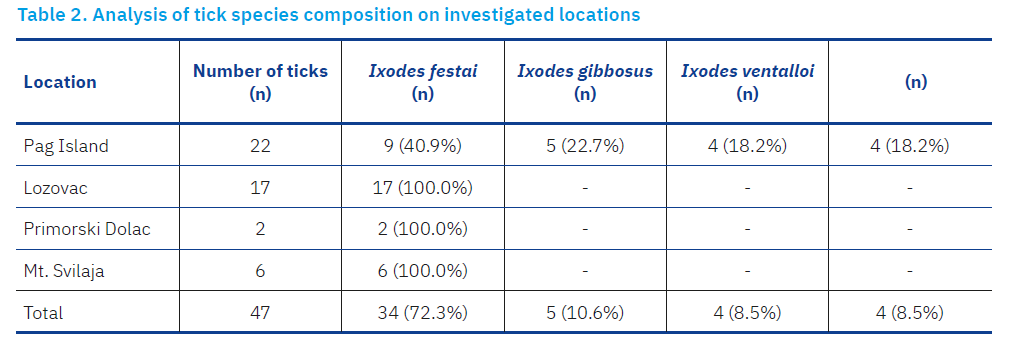
The distribution of identified tick species differed by locality (Table 2). I. festai was recorded at all four sites and was the only identified tick species at Lozovac, Primorski Dolac, and Mt. Svilaja. Of the 34 identified I. festai specimens, 17 originated from Lozovac, nine from Pag Island, six from Mt. Svilaja, and two from Primorski Dolac. All specimens of I. gibbosus, I. ventalloi, and I. hexagonus were collected exclusively on Pag Island. Five specimens of I. gibbosus, four specimens of I. ventalloi, and four specimens of I. hexagonus were identified at this locality.
The development stages of the collected ticks are presented in Figure 2. Adult ticks predominated among collected specimens and accounted for 26 of 47 ticks (55.3%), whereas 20 specimens (42.6%) were identified as nymphs. Only a single larval specimen (2.1%) was recorded and belonged to I. gibbosus.
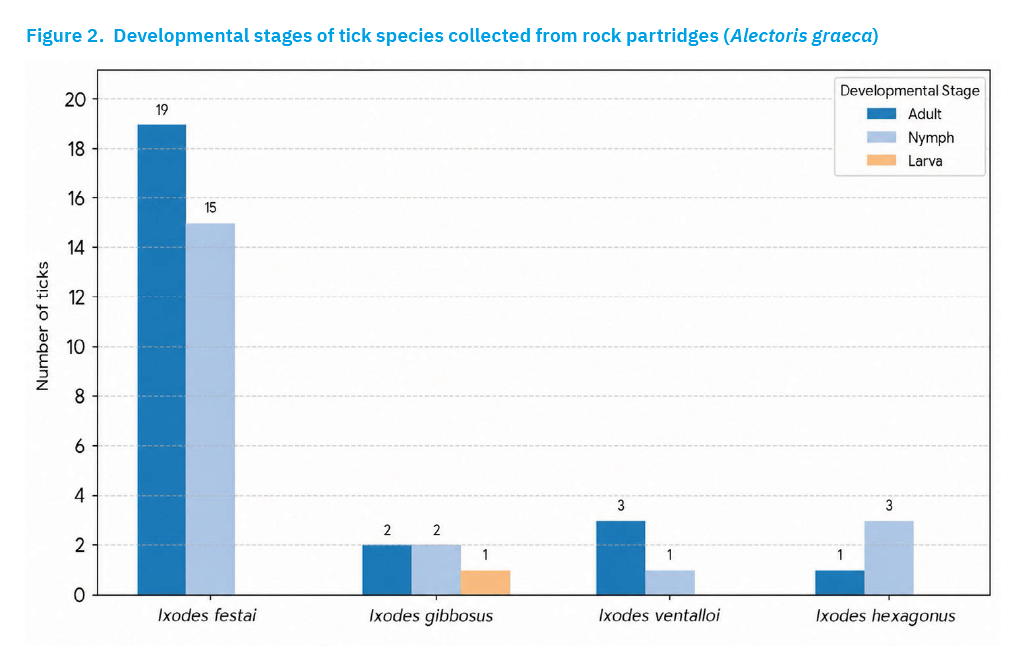
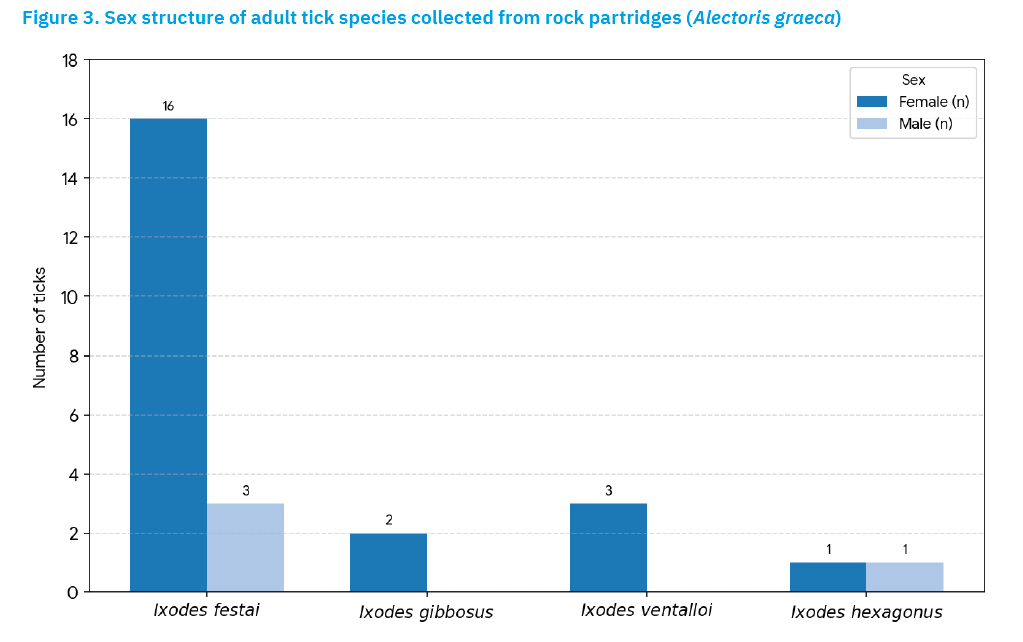
Adult specimens were recorded in all four identified tick species. The majority of adult ticks were female (22/26; 84.6%), while only four adult males (15.4%) were collected. Male ticks were recorded exclusively in I. festai (n = 3) and I. hexagonus (n = 1) (Figure 3).
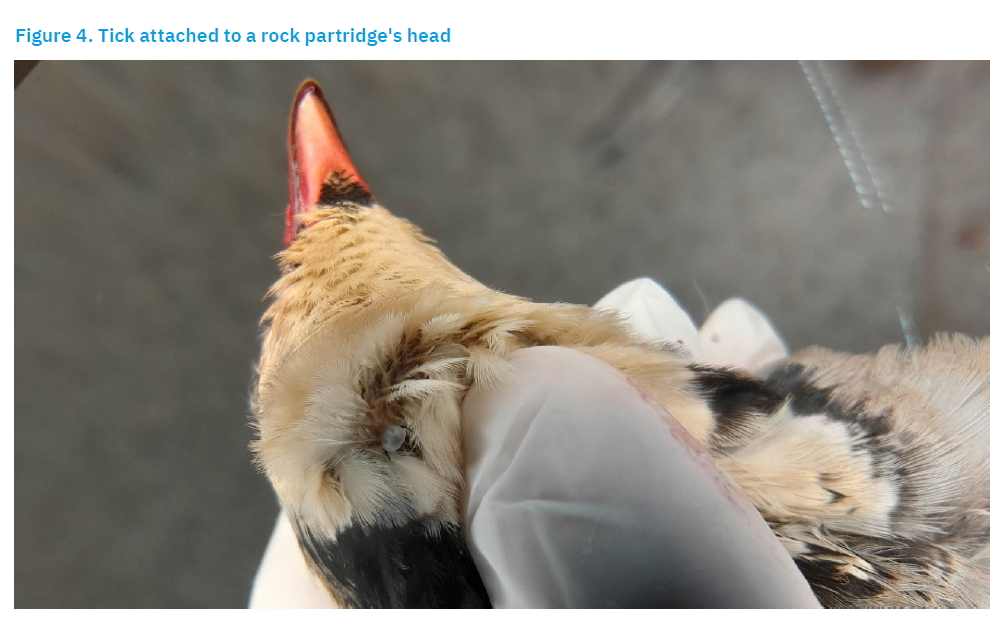
All ticks fed on the head and neck of the rock partridges (Figure 4).
Sequence analysis confirmed the morphological identification of all tick species. Sequences of I. ventalloi showed 99.54% similarity to reference sequences available in the GenBank database (accession numbers MW173476 and KY231931). Sequences of I. festai showed 100% similarity to the GenBank reference sequence (accession number PV27798) and 98.36%, 98.86%, and 99.09% similarity to the sequence deposited under accession number PZ177815.
Sequences of I. gibbosus showed 99.3% similarity to the GenBank reference sequence (accession number OQ981354). Sequences of I. hexagonus showed 100% similarity to the GenBank reference sequence (accession number MT658768).
Discussion
The present study provides the first comprehensive data on tick species associated with rock partridges (Alectoris graeca) in Croatia and contributes to the limited body of knowledge regarding tick infestations of wild galliform birds in Europe. Four tick species belonging to the genus Ixodes were identified using molecular methods, namely I. festai, I. gibbosus, I. ventalloi, and I. hexagonus. Among these, I. festai was the most abundant species, accounting for more than 70% of all successfully genotyped specimens and occurring at all investigated localities. To date, the occurrence of the tick species I. gibbosus, I. ventalloi, and I. hexagonus has been documented in Croatia; however, none of these species have previously been reported from avian hosts (Krčmar, 2012; Jurković, 2021; Kapo et al., 2024)
Birds are recognised as important hosts for numerous tick species and play a key role in the ecology and dispersal of ticks and tick-borne pathogens (Papadopoulos et al., 2002; Keve et al., 2022). However, most available studies have focused on migratory passerines because of their ability to transport ticks over long distances (Hornok et al., 2022; Keve et al., 2024; Pitó et al., 2024). In contrast, information concerning galliform birds remains scarce despite their ecological importance in Mediterranean habitats. The present findings indicate that rock partridges may be important hosts for several Ixodes species, contributing to the maintenance of local tick populations in Mediterranean and sub-Mediterranean ecosystems (Calvete et al., 2003; Keve et al., 2022).
Adult ticks slightly predominated over immature stages in the present study. This pattern may reflect the ecology of resident galliform hosts, which can support repeated feeding opportunities for adult ticks within relatively stable habitats. In contrast, studies on migratory passerines often report a predominance of immature stages, particularly larvae and nymphs (Keve et al., 2022; Pitó et al., 2024).
The predominance of I. festai represents the most important finding of this study. This species was originally described from a Barbary partridge (Alectoris barbara) in Libya (Rondelli, 1926) and has traditionally been regarded as an ornithophilic tick associated with birds inhabiting Mediterranean environments. Although reports of I. festai remain relatively uncommon, the species has been recorded from numerous avian hosts throughout southern Europe and North Africa (Papadopoulos et al., 2002; Contini et al., 2011). Recent taxonomic studies have further confirmed the validity of the species and highlighted the limited knowledge regarding its ecology, host associations, and geographical distribution (Hornok et al., 2025).
The dominance of I. festai observed in the present study suggests a close ecological relationship between this tick species and the rock partridge. Considering that I. festai was originally described from a member of the genus Alectoris, the present findings provide additional evidence supporting a long-standing host association between partridges and this poorly studied tick species. Furthermore, the occurrence of I. festai at all investigated localities suggests that this association is widespread across Mediterranean and sub-Mediterranean habitats of Croatia rather than being restricted to a specific geographical area.
Another noteworthy finding was the detection of I. ventalloi on rock partridges on Pag Island. Traditionally, this species has been regarded as a tick associated with lagomorphs, particularly wild rabbits (Oryctolagus cuniculus) (Latrofa et al., 2016; Santos and Santos-Silva, 2018). Previous studies on Croatian wild rabbits have similarly identified I. ventalloi as one of the characteristic tick species associated with Mediterranean lagomorph populations (Pintur et al., 2026). However, recent studies have demonstrated that I. ventalloi may occasionally infest birds, indicating a broader host spectrum than previously assumed (Loziaková Peňazziová et al., 2024). The occurrence of I. ventalloi on rock partridges in the present study further supports this hypothesis, suggesting that multiple vertebrate hosts may contribute to the maintenance of local populations of this tick species. However, the exclusive occurrence of I. ventalloi on Pag Island may also be associated with the local abundance of wild rabbits (Oryctolagus cuniculus), which are considered among the principal hosts of this Mediterranean tick species (Latrofa et al., 2016; Santos and Santos-Silva, 2018). In contrast to the other study sites, Pag Island supports relatively dense rabbit populations, potentially providing favourable ecological conditions for the maintenance of local I. ventalloi populations. Under such circumstances, incidental infestations of alternative hosts, including rock partridges, may occur more frequently. Although the present study was not designed to evaluate host–tick relationships quantitatively, the absence of I. ventalloi at localities where rabbits were not recorded and its exclusive detection on Pag Island suggest that rabbit abundance may influence the local distribution of this tick species. The identification of I. gibbosus is also noteworthy. This species is widely distributed throughout the Mediterranean Basin and has been reported from a broad range of vertebrate hosts, including reptiles, mammals, and occasionally birds (Estrada-Peña et al., 2017). The presence of both adult and immature developmental stages on rock partridges suggests that these birds may serve as suitable hosts for different life stages of the species. Such findings support the ecological flexibility commonly observed among Mediterranean Ixodes ticks.
Similarly, I. hexagonus was detected exclusively on Pag Island. This species is generally considered a nidicolous tick associated primarily with hedgehogs, carnivores, and small mammals (Estrada-Peña et al., 2017). Reports of this tick species on birds are relatively uncommon, although Estrada-Peña et al. (1984) reported infestations of the red-legged partridge (Alectoris rufa) with I. ventalloi and I. hexagonus. Its occurrence on rock partridges most likely reflects opportunistic host utilisation. Nevertheless, the finding illustrates the complexity of host–tick interactions within Mediterranean ecosystems, where several vertebrate species often share overlapping habitats and ecological niches.
An interesting aspect of the present study is the observed geographical variation in tick species composition. While all four identified species were recorded on Pag Island, only I. festai was detected at Lozovac, Primorski Dolac, and Mt. Svilaja. Several factors may contribute to this pattern, including differences in habitat structure, climatic conditions, host diversity, and local abundance of alternative vertebrate hosts. Pag Island represents a unique Mediterranean ecosystem characterised by extensive rocky grasslands, sparse shrub vegetation, and relatively isolated wildlife communities. Such environmental conditions may facilitate interactions among different host species and support a greater diversity of tick species.
Unlike migratory passerines, rock partridges are resident birds with relatively small home ranges. Consequently, their epidemiological significance is likely related primarily to the maintenance of local tick populations rather than long-distance dispersal. This distinction may be particularly important for ornithophilic species such as I. festai, whose ecology remains insufficiently understood. The widespread occurrence of I. festai observed in the present study suggests that resident galliform birds may play a more important role in the life cycle of certain Mediterranean tick species than previously recognised.
To the extent of our knowledge, this is the only study specifically investigating tick infestations of Alectoris graeca and among the first molecularly confirmed records of multiple Ixodes species associated with rock partridges in the eastern Adriatic region. Consequently, the present findings significantly improve current knowledge regarding host–tick associations in Mediterranean game birds.
Several limitations of this study should be acknowledged. The number of study sites, as well as the number of birds examined, was relatively limited. The study focused exclusively on tick species identification and did not investigate the presence of tick-borne pathogens. Future research incorporating larger sample sizes, broader geographic coverage, and pathogen screening would provide valuable insights into the epidemiological significance of rock partridges in Mediterranean ecosystems.
Despite these limitations, the present results clearly demonstrate that rock partridges host a diverse assemblage of Ixodes ticks and may play an important role in maintaining local tick populations. In particular, the strong association observed between Alectoris graeca and I. festai highlights the ecological importance of resident galliform birds in the life cycle of one of the least studied ornithophilic tick species of the Mediterranean region.
Conclusions
This study represents the first systematic investigation of ticks associated with rock partridges (Alectoris graeca) in Croatia. Molecular analyses confirmed the presence of four tick species belonging to the genus Ixodes: I. festai, I. gibbosus, I. ventalloi, and I. hexagonus. Among them, I. festai was by far the most abundant and geographically widespread species, occurring at all investigated localities.
The findings suggest that rock partridges may be important hosts for several Mediterranean tick species, and may contribute to the maintenance of local tick populations in Mediterranean and sub-Mediterranean habitats. The strong association observed between A. graeca and I. festai highlights the ecological importance of resident galliform birds in the life cycle of this poorly studied ornithophilic tick species. The exclusive occurrence of I. ventalloi on Pag Island further suggests that local wild rabbit populations may influence the distribution and host associations of this Mediterranean tick species.
Further investigations involving larger sample sizes, broader geographic coverage, and screening for tick-borne pathogens are needed to better understand the epidemiological significance of rock partridge populations in Mediterranean ecosystems.
Acknowledgements
This study was carried out within the framework of the scientific research project “Investigation of the Role of Small Game in the Ecology of Ticks and Tick-Borne Zoonotic Pathogens (TRISGAME)”, funded by the NextGenerationEU programme.
References [… show]
Krpelji kamenjarke grivne (Alectoris graeca Meisner, 1804) u Hrvatskoj: ekološki značaj i povezanost s domaćinom
Krunoslav PINTUR1* (dopisni autor), krunoslav.pintur@vuka.hr, orcid.org/0000-0003-4724-4523; Vedran SLIJEPČEVIĆ1, vedran.slijepcevic@vuka.hr, orcid.org/0000-0002-0508-6224; Ema GAGOVIĆ2, gagovic@veinst.hr, orcid.org/0009-0007-6122-5958; Tomislav DUMIĆ1, tomislav.dumic@vuka.hr, orcid.org/0000-0001-5943-4346; Nera FABIJANIĆ3, nera_az@yahoo.com, orcid.org/0000-0001-7964-7939; Josip GULIN4; Relja BECK2* (dopisni autor), beck@veinst.hr, orcid.org/0000-0002-5304-2875.
1Odjel lovstva i zaštite prirode, Veleučilište u Karlovcu, 47000 Karlovac, Hrvatska
2Laboratorij za parazitologiju, Odjel za bakteriologiju i parazitologiju, Hrvatski veterinarski institut, 10000 Zagreb, Hrvatska
3Hrvatski lovački savez, 10000 Zagreb, Hrvatska
4Gulini Dolačani 55, 22000 Šibenik, Hrvatska
Sažetak
Krpelji (Acari: Ixodidae) su važni ektoparaziti i prijenosnici brojnih uzročnika bolesti divljih i domaćih životinja te ljudi. Iako ptice imaju značajnu ulogu u ekologiji krpelja, podaci o infestacijama divljih kokošarki krpeljima i dalje su ograničeni. Cilj ovog istraživanja bio je utvrditi vrste krpelja povezane s populacijama jarebice kamenjarke (Alectoris graeca) u mediteranskim i submediteranskim staništima Hrvatske te procijeniti njihovu potencijalnu važnost u ekologiji krpelja. Ukupno je pregledano 39 jedinki jarebice kamenjarke s četiri lokaliteta u Hrvatskoj (Pag, Lozovac, Primorski Dolac i Svilaja). Krpelji su utvrđeni na 27 jedinki (69,2 %), dok 12 pregledanih ptica nije bilo infestirano. Ukupno je prikupljeno 47 krpelja. Molekularna analiza temeljena na sekvenciranju mitohondrijskog 16S rRNA gena potvrdila je morfološku identifikaciju svih vrsta krpelja. Utvrđene su četiri vrste krpelja iz roda Ixodes: Ixodes festai, Ixodes gibbosus, Ixodes ventalloi i Ixodes hexagonus. I. festai je bila dominantna vrsta (72,3 %) i zabilježena je na svim istraživanim lokalitetima. Preostali krpelji pripadali su vrstama I. gibbosus (10,6 %), I. ventalloi (8,5 %) i I. hexagonus (8,5 %) i utvrđeni su isključivo na otoku Pagu. Među prikupljenim krpeljima prevladavali su odrasli razvojni stadiji (55,3 %) i nimfe (42,6 %). Rezultati pokazuju da jarebice kamenjarke predstavljaju važne domaćine za više mediteranskih vrsta krpelja roda Ixodes te mogu pridonositi održavanju njihovih lokalnih populacija. Dominacija i široka rasprostranjenost vrste I. festai upućuju na snažnu ekološku povezanost ove ornitofilne vrste krpelja s populacijama jarebice kamenjarke. Prisutnost vrsta I. ventalloi, I. gibbosus i I. hexagonus na otoku Pagu upućuje na utjecaj lokalnih ekoloških uvjeta i sastava zajednice domaćina na strukturu populacija krpelja. Rezultati istraživanja pridonose boljem razumijevanju ekologije krpelja te predstavljaju važnu osnovu za buduća istraživanja patogena koje prenose krpelji u mediteranskim ekosustavima.
Ključne riječi: jarebica kamenjarka; Alectoris graeca; krpelji; Ixodes festai; Hrvatska.
