
Temporal and Spatial Dynamics of Canine Leptospirosis in Croatia: A Long-Term Epidemiological Study (2013–2023)
M.Zdelar-Tuk, I. Reil*, S. Duvnjak, M. Dopuđ, G. Kompes, J. Habuš, S. Špičić
Maja ZDELAR-TUK1, zdelar-tuk@veinst.hr, orcid.org/0000-0002-9349-6177; Irena REIL1*(corresponding author), reil@veinst.hr, orcid.org/0000-0002-2198-557X; Sanja DUVNJAK1, marjanovic@veinst.hr, orcid.org/0000-0002-1308-267X; Maja DOPUĐ1, dopud@veinst.hr, orcid.org/0009-0009-0495-9861; Gordan KOMPES2, kompes@veinst.hr, orcid.org/0009-0000-4934-1357; Josipa HABUŠ3, jhabus@vef.hr, orcid.org/0000-0002-9663-0466; Silvio ŠPIČIĆ1, spicic@veinst.hr, orcid.org/0000-0001-8317-5831.
1 Laboratory for Bacterial Zoonoses and Molecular Diagnostics of Bacterial Diseases, Department for Bacteriology and Parasitology, Croatian Veterinary Institute, 10000 Zagreb, Croatia,
2 Laboratory for General Bacteriology and Mycology, Department for Bacteriology and Parasitology, Croatian Veterinary Institute, 10000 Zagreb, Croatia,
3 Department for Microbiology and Infectious Diseases, Faculty of Veterinary Medicine, University of Zagreb, 10000 Zagreb, Croatia

https://doi.org/10.46419/cvj.57.6.9
Abstract
Leptospirosis is a re-emerging zoonotic disease of increasing importance in both veterinary and public health, with its epidemiology strongly influenced by environmental and climatic factors. The aim of this study was to investigate the temporal and spatial distribution of canine leptospirosis in Croatia over an 11-year period (2013–2023), with particular emphasis on prevalence trends and serovar distribution. A total of 2,444 canine blood samples submitted for diagnostic testing were analysed using the microscopic agglutination test (MAT) for antibodies against 12 Leptospira serovars. Overall, 983 samples (40.22%) were seropositive. Annual prevalence showed marked fluctuations, with the highest numbers of positive samples recorded in 2018, 2020, and 2021. Geographical analysis revealed higher prevalence in central and northwestern Croatia, particularly in the City of Zagreb and surrounding counties. The most frequently detected serovars were Pomona (26.12%), Grippotyphosa (22.20%), Australis (16.96%), and Sejroe (14.95%), while other serovars occurred only sporadically. Temporal changes in serovar distribution were also observed, indicating dynamic epidemiological patterns. The identified fluctuations in prevalence are likely associated with environmental conditions favorable for Leptospira survival and transmission, including periods of increased precipitation and flooding documented in Croatia during the study period. These findings highlight considerable temporal, geographical, and serovar-related variability in canine leptospirosis, and emphasise the importance of continuous surveillance, regionally relevant vaccination strategies, and a One Health approach to disease prevention and control.
Keywords: canine leptospirosis; epidemiology; seroprevalence; Leptospira serovars; climate change; flooding; zoonosis; One Health; Croatia; MAT.
Introduction
Leptospirosis is a globally distributed re-emerging zoonotic disease caused by pathogenic spirochetes of the genus Leptospira, comprising more than 300 serovars grouped into at least 29 serogroups (Kmety and Dikken, 1993). The disease is widely present in both developed and developing countries, with a higher incidence typically reported in tropical and subtropical regions characterised by high levels of precipitation, while it is rarely detected in polar areas (Beauté et al., 2024). Due to ongoing environmental and climatic changes, particularly increasing temperatures and altered rainfall patterns, leptospirosis has gained renewed attention as a climate-sensitive infectious disease, prompting the World Organisation for Animal Health (WOAH) to recommend enhanced surveillance and control measures (Dufour et al., 2008). The epidemiology of leptospirosis is closely linked to environmental conditions, as Leptospira spp. are able to survive for prolonged periods in moist environments such as stagnant or slow-moving water. Consequently, outbreaks are frequently associated with periods of heavy rainfall and flooding, which facilitate environmental contamination and transmission (Semenza, 2020). In Europe, particularly in regions with river basins and temperate climates, leptospirosis persists as an endemic disease with localised enzootic areas. A wide range of domestic and wild animals are involved in the epidemiology of leptospirosis, though rodents are considered the principal reservoir hosts for most pathogenic serovars (Adler and Moctezuma, 2010). Other mammalian species, including cattle, pigs, sheep, and dogs, may function as maintenance or incidental hosts depending on the serovar and ecological context. Transmission occurs through direct contact with infected urine or tissues, and indirectly via contaminated water, soil, or food (McCallum, 2019).
Dogs play a particularly important role in the epidemiology of leptospirosis due to their close contact with humans and their high susceptibility to infection. In addition to being clinically affected, dogs can act as carriers and shed leptospires in urine, thereby contributing to environmental contamination and representing a potential source of infection for humans (Sant’Anna et al., 2017; Lemos et al., 2020). For this reason, dogs are often considered sentinel species, reflecting the level of environmental exposure to pathogenic Leptospira spp. (Bertasio et al., 2020). Seroprevalence of leptospirosis in dogs varies considerably worldwide, ranging from approximately 1.8% in Australia to over 17% in the United States, depending on geographic location, environmental conditions, and study design (Davis et al., 2008; Zwijnenberg et al., 2008; Bier et al., 2012; Shi et al., 2012; Khalili et al., 2020). In Europe, prevalence is generally lower but remains highly variable, reflecting regional ecological differences and changing epidemiological patterns (Scahill et al., 2022). Historically, the serovars Canicola and Icterohaemorrhagiae were considered the primary causative agents of canine leptospirosis; however, more recent studies have demonstrated the increasing importance of other serovars, including Grippotyphosa, Australis, Pomona and Bratislava (Piredda et al., 2022). These shifts are thought to be influenced by environmental changes, host dynamics, and vaccination practices. In Croatia, leptospirosis is most commonly reported in central and northwestern regions, particularly in river basin areas such as the Sava and Drava valleys, where environmental conditions favor the persistence of leptospires. Flooding events and increased precipitation have been identified as important drivers of disease occurrence, further emphasising the impact of climate variability on leptospirosis epidemiology (Dufour et al., 2008). However, despite the recognised importance of the disease, comprehensive long-term data on canine leptospirosis in Croatia remain limited. In particular, there is a lack of detailed information on temporal trends, regional distribution, and changes in serovar prevalence over extended periods. Such data are essential for understanding the epidemiological dynamics of the disease and for guiding effective prevention and control strategies, including vaccination programmes. Therefore, the aim of this study was to investigate the temporal and spatial distribution of canine leptospirosis in Croatia over an 11-year period (2013–2023), with particular emphasis on annual prevalence, regional differences, and the distribution of Leptospira serovars detected using the microscopic agglutination test (MAT).
Material and methods
Between 2013 and 2023, a total of 2444 canine blood samples were submitted for leptospirosis testing to the Laboratory for Bacterial Zoonoses and Molecular Diagnostics of Bacterial Diseases at the Croatian Veterinary Institute, Zagreb, Croatia. The samples were submitted by small animal veterinary practitioners based on clinical suspicion of leptospirosis and originated from dogs of both sexes, different age groups, and various breeds from all regions of Croatia. All serum samples were tested for the presence of antibodies against Leptospira spp. using the microscopic agglutination test (MAT), performed according to standard procedures (Dikken and Kmety, 1978; Hartskeerl et al., 2006). A panel of 12 Leptospira serovars was used as antigens: Icterohaemorrhagiae (RGA), Ballum (Mus 127), Australis (Ballico), Pomona (Pomona), Grippotyphosa (Moskow V), Sejroe (M84), Saxkoebing (M24), Tarassovi (Perepelicin), Canicola (Hond Utrecht IV), Bataviae (Van Tienen), Hardjo (Hardjoprajitno), and Hardjo-bovis. An initial serum dilution of 1:100 was used as the cut-off value for a positive reaction, and samples showing agglutination at this dilution or higher were considered seropositive. Since a single serum sample could react with more than one serovar, multiple serovar reactions were recorded when present. Data on the number of tested and positive samples were collected and analysed according to year and geographical origin at the county level. Seroprevalence was calculated as the proportion of positive samples among the total number of tested samples and expressed as percentages. For each year and county, 95% confidence intervals were calculated. Differences in prevalence between years and counties were assessed using the chi-square (χ²) test, while temporal trends over the study period were evaluated using the chi-square test for trend. The distribution of Leptospira serovars was analysed descriptively, and differences between time periods were assessed using the χ² test. A p-value of <0.05 was considered statistically significant. Due to the retrospective design of the study and the use of samples submitted for routine diagnostic purposes, ethical approval was not required.
Results
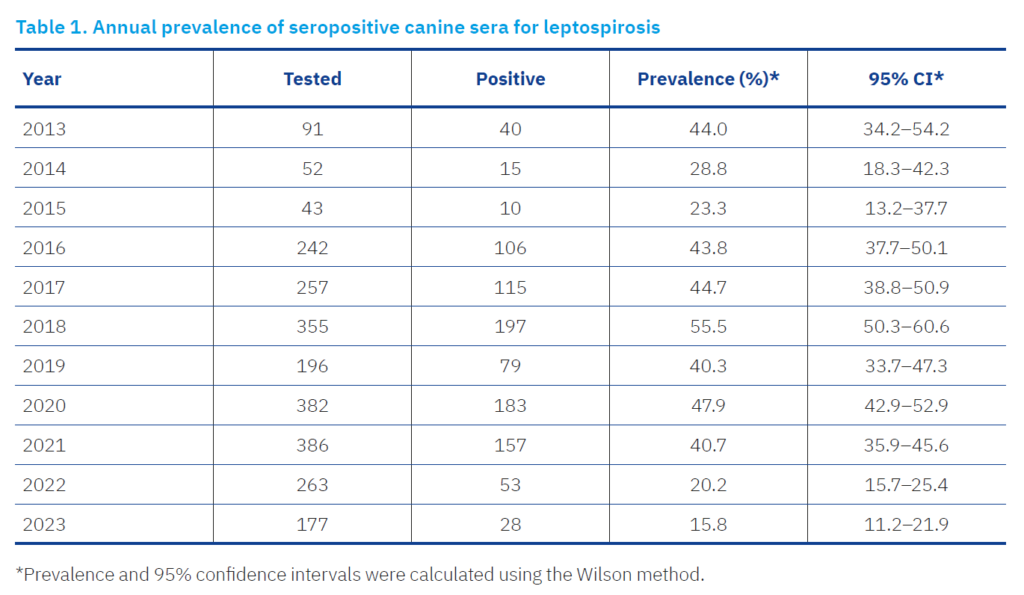
During the study period, a total of 2444 canine serum samples were tested, of which 983 (40.22%; 95% CI 38.3–42.2) were positive for antibodies against one or more Leptospira serovars and were therefore considered seropositive (Table 1).
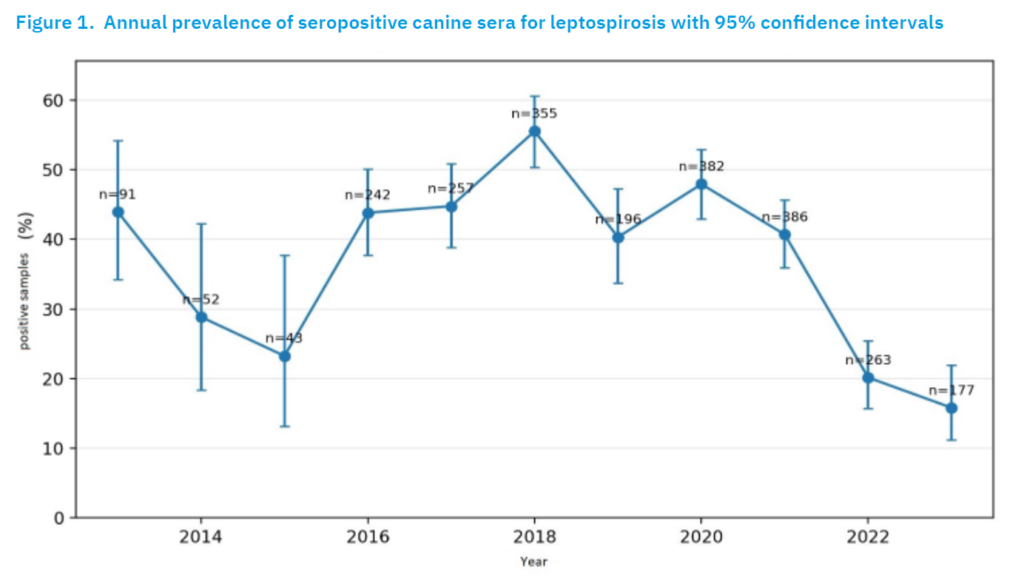
Annual prevalence varied significantly throughout the study period (χ²(10) = 143.70; p < 0.001), with the highest prevalence recorded in 2018 (197/355; 55.5%), followed by 2020 (183/382; 47.9%), 2017 (115/257; 44.7%), and 2021 (157/386; 40.7%) (Table 1, Figure 1). A significant overall temporal trend was detected (Z = -5.87; p < 0.001), although marked year-to-year fluctuations were observed. The highest number of samples was tested in 2021 (386 samples), followed by 2020 (382), 2018 (355), and 2022 (263), whereas the lowest number was recorded in 2015, when only 43 samples were submitted (Table 1).
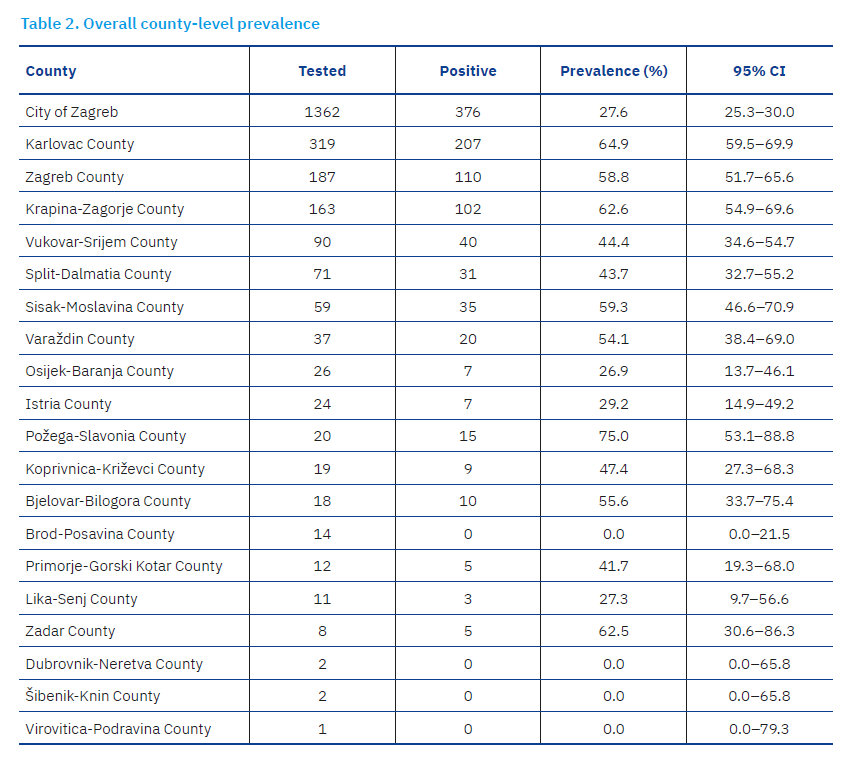
The largest number of tested samples originated from the City of Zagreb (1,362), of which 376 samples (27.6%) were positive, followed by Karlovac County (207/319 were positive), Zagreb County (110/187), Krapina-Zagorje County (102/163), and Vukovar-Srijem County (39/90) (Table 2). Only one county, Međimurje County, submitted no samples during the study period, while only one sample was received from Virovitica-Podravina County and two samples each from Šibenik-Knin and Dubrovnik-Neretva counties (Table 2). Seroprevalence differed significantly among counties (χ²(19) = 275.29; p < 0.001), indicating pronounced spatial heterogeneity in the occurrence of canine leptospirosis in Croatia (Table 2, Figure 2). County-level estimates based on very small sample numbers should, however, be interpreted with caution.

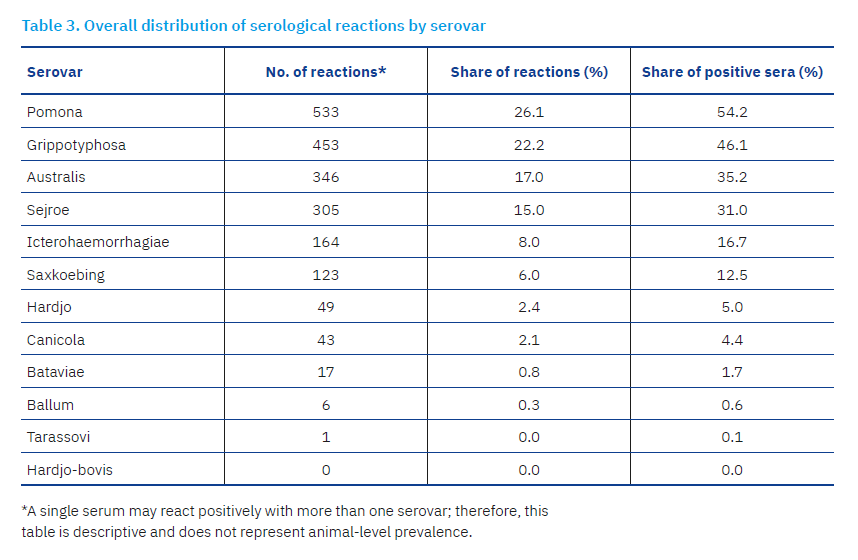
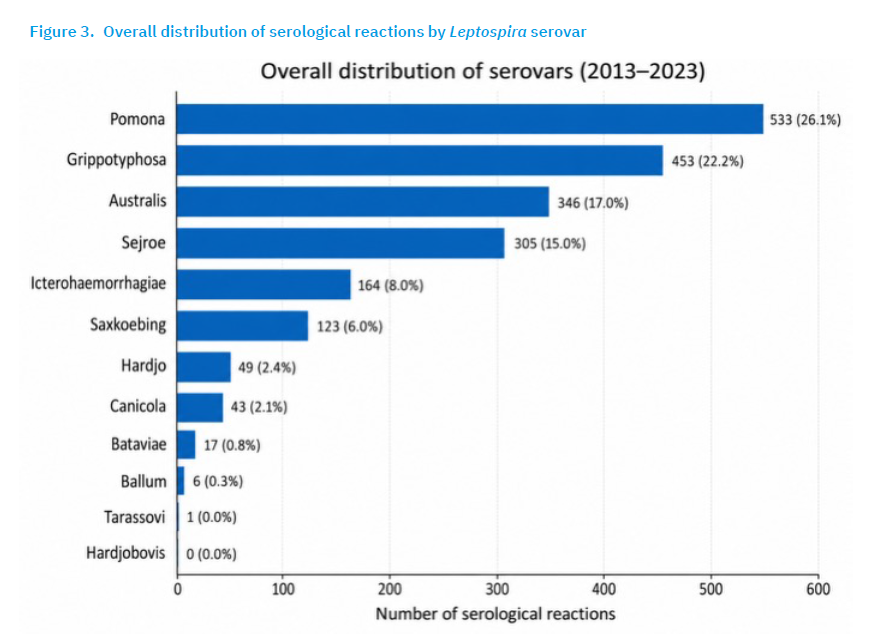
A total of 2040 serological reactions were recorded, corresponding to an average of 2.08 reactions per positive serum (Table 3). Among these reactions, the most frequently detected serovar was Pomona (533; 26.1%), followed by Grippotyphosa (453; 22.2%), Australis (346; 17.0%), and Sejroe (305; 15.0%) (Table 3, Figure 3). The least frequently detected serovars were Hardjo-bovis, which was not detected in any sample, Tarassovi, which was recorded in only one sample (0.05%), and Ballum, detected in six samples (0.30%) (Table 3). Serovar Pomona, Grippotyphosa, Australis and Sejroe predominated during most of the study period.
Discussion
Leptospirosis remains a globally important re-emerging zoonosis with complex epidemiology influenced by environmental, climatic, and host-related factors. The present study provides a comprehensive long-term overview of canine leptospirosis in Croatia, demonstrating pronounced temporal and spatial variability, as well as dynamic shifts in serovar distribution.
The overall seroprevalence of 40.22% observed in this study is considerably higher than reports from most European countries, where prevalence in dogs typically ranges between 5% and 20%, depending on geographic region and study design (Scahill et al., 2022; Beauté et al., 2024). This difference is most likely explained by the study design, as samples were submitted based on clinical suspicion of leptospirosis. Consequently, the results reflect the burden of disease among suspected cases rather than true population-level prevalence. Nevertheless, such data are epidemiologically valuable, as they provide insight into disease dynamics in clinically relevant settings and may serve as an early indicator of environmental exposure risk.
Our findings can also be interpreted in the context of previous studies from Croatia and neighbouring countries. A Croatian serological survey conducted between 2006 and 2010 reported a seropositivity of 37.7% in dogs, identifying Pomona, Grippotyphosa, Icterohaemorrhagiae, Australis, Saxkoebing, and Hardjo among the predominant presumptive infecting serovars (Štritof Majetić et al., 2012). In the present study, the overall seropositivity was similarly high (40.22%), while Pomona, Grippotyphosa, Australis, and Sejroe predominated, supporting the persistence of some previously recognised serological patterns, but also suggesting continuing epidemiological shifts in the relative importance of individual serogroups in canine leptospirosis in Croatia. Comparable findings have also been reported in neighbouring Bosnia and Herzegovina, where serological reactions to several serovars, including Pomona and Grippotyphosa, were detected in dogs, further indicating that the epidemiology of canine leptospirosis in this part of Europe is dynamic and regionally heterogeneous (Lindtner Knific et al., 2019).
Marked annual fluctuations in prevalence were observed, with peaks in 2018, 2020, and 2021. These variations are likely associated with environmental and climatic conditions, particularly increased precipitation and flooding events, which are known to enhance survival and dissemination of Leptospira spp. in the environment (Semenza, 2020). Several documented flooding events in Croatia during the study period, including major floods in 2014, extreme rainfall in 2017, urban flooding in Zagreb in 2020, and widespread flooding in 2023, likely contributed to increased environmental contamination and exposure risk. Similar associations between rainfall patterns and leptospirosis incidence have been reported globally, supporting the classification of leptospirosis as a climate-sensitive disease (Semenza, 2020; Suk et al., 2020).
The spatial distribution of cases revealed significantly higher prevalence in central and northwestern regions of Croatia, particularly in the City of Zagreb and surrounding counties. These areas are characterised by river basins and favourable ecological conditions, including high humidity, surface water accumulation, and dense rodent populations, all of which facilitate the persistence of Leptospira spp. (Nova et al., 2022). Urban environments may further amplify transmission dynamics due to increased contact between dogs, humans, and contaminated environments, reinforcing the role of dogs as sentinel species for environmental exposure (Bertasio et al., 2020).
The serovar distribution observed in this study indicates a clear shift from historically dominant serovars such as Icterohaemorrhagiae and Canicola toward Pomona, Grippotyphosa, Australis and Sejroe. Similar trends have been reported in several European countries, where non-classical serovars are increasingly being reported (Schuller et al., 2015; Piredda et al., 2022). This shift may reflect changes in reservoir host populations, environmental conditions, and vaccination practices. In particular, the widespread use of vaccines targeting traditional serovars may have altered selection pressures, allowing other serovars to emerge more prominently (Ellis, 2022). These findings have important practical implications, suggesting that current vaccination strategies may require periodic reassessment to ensure adequate coverage of circulating serovars.
The high proportion of multiple serological reactions observed in this study is consistent with the well-recognised limitations of the microscopic agglutination test (MAT), including cross-reactivity between serovars and the difficulty of identifying the infecting serovar with certainty (Hartskeerl et al., 2011). Therefore, MAT results should be interpreted primarily as indicating presumptive infecting serogroups or serological reactions to reference serovars, rather than definitive serovar identification. This limitation is particularly relevant in epidemiological studies, where the predominance of a given serovar in MAT reflects serological reactivity patterns and possible exposure history rather than confirmed circulation of that serovar alone. Nevertheless, despite these constraints, MAT remains the reference serological method for leptospirosis and is useful for identifying broad epidemiological patterns when interpreted cautiously and in combination with clinical and epidemiological data. The integration of molecular methods in future studies would further enhance resolution and enable more precise characterisation of circulating strains.
From a One Health perspective, the findings highlight the interconnectedness of environmental, animal, and human health. Dogs, due to their close contact with humans and shared environments, represent an important bridge between environmental reservoirs and human exposure. The high seroprevalence observed in clinically suspected dogs suggests substantial environmental contamination and potential risk for human infection, particularly in regions with favorable ecological conditions. This underscores the importance of integrated surveillance systems that combine veterinary, environmental, and public health data.
Several limitations of this study should be acknowledged. In addition to the selection bias inherent to clinically suspected cases, the retrospective design limited the availability of detailed epidemiological data, such as vaccination status, lifestyle, and exposure history. Furthermore, the reliance on MAT alone restricts interpretation due to its limited specificity and inability to distinguish between current and past infections (Hartskeerl et al., 2011). Despite these limitations, the large sample size and long study period provide robust insights into temporal and spatial trends.
Overall, this study demonstrates that canine leptospirosis in Croatia is characterised by significant temporal variability, marked regional differences, and evolving serovar patterns, strongly influenced by environmental and climatic factors. These findings support the growing recognition of leptospirosis as a climate-sensitive zoonosis and emphasise the need for continuous surveillance, adaptive vaccination strategies, and integrated One Health approaches to disease control and prevention.
Conclusion
This long-term study demonstrates that canine leptospirosis in Croatia is characterised by pronounced temporal and spatial variability, with marked annual fluctuations in seroprevalence and clear regional differences in disease occurrence. Higher seropositivity was observed particularly in central and northwestern Croatia, while the predominance of serovars Pomona, Grippotyphosa, Australis and Sejroe indicates dynamic changes in the epidemiological profile of the disease over time. These findings suggest that environmental and climatic conditions, especially periods of increased precipitation and flooding, play an important role in shaping the persistence and transmission of Leptospira spp. in Croatia. The results also support the role of dogs as valuable sentinel animals for monitoring environmental exposure to leptospires and highlight the public health relevance of canine leptospirosis within a One Health framework. Continuous surveillance, regular reassessment of circulating serovars, and regionally adapted vaccination strategies are essential for improving prevention and control of leptospirosis in both animal and human populations.
References [… show]
Vremenska i prostorna dinamika pseće leptospiroze u Hrvatskoj: dugoročno epidemiološko istraživanje (2013.–2023.)
Maja ZDELAR-TUK1, zdelar-tuk@veinst.hr, orcid.org/0000-0002-9349-6177; Irena REIL1*(dopisni autor), reil@veinst.hr, orcid.org/0000-0002-2198-557X; Sanja DUVNJAK1, marjanovic@veinst.hr, orcid.org/0000-0002-1308-267X; Maja DOPUĐ1, dopud@veinst.hr, orcid.org/0009-0009-0495-9861; Gordan KOMPES2, kompes@veinst.hr, orcid.org/0009-0000-4934-1357; Josipa HABUŠ3, jhabus@vef.hr, orcid.org/0000-0002-9663-0466; Silvio ŠPIČIĆ1, spicic@veinst.hr, orcid.org/0000-0001-8317-5831.
1Laboratorij za bakterijske zoonoze i molekularnu dijagnostiku bakterijskih bolesti, Odjel za bakteriologiju i parazitologiju, Hrvatski veterinarski institut, 10000 Zagreb, Hrvatska
2Laboratorij za opću bakteriologiju i mikologiju, Odjel za bakteriologiju i parazitologiju, Hrvatski veterinarski institut, 10000 Zagreb, Hrvatska
3Zavod za mikrobiologiju i zarazne bolesti, Veterinarski fakultet Sveučilišta u Zagrebu, 10000 Zagreb, Hrvatska
Sažetak
Leptospiroza je ponovno emergentna zoonoza od sve većeg značaja u veterinarskom i javnom zdravstvu, čija je epidemiologija snažno pod utjecajem okolišnih i klimatskih čimbenika. Cilj ovoga istraživanja bio je analizirati vremensku i prostornu raspodjelu pseće leptospiroze u Hrvatskoj tijekom jedanaestogodišnjeg razdoblja (2013.–2023.), s posebnim naglaskom na trendove prevalencije i raspodjelu serovara. Ukupno su analizirana 2444 uzorka krvi pasa dostavljena na dijagnostičko pretraživanje, a prisutnost protutijela na 12 serovara roda Leptospira određivana je mikroskopskim aglutinacijskim testom (MAT). Ukupno je 983 uzoraka (40,22%) bilo seropozitivno. Godišnja prevalencija pokazivala je izražene oscilacije, pri čemu je najveći broj pozitivnih uzoraka zabilježen 2018., 2020. i 2021. godine. Geografska analiza pokazala je veću prevalenciju u središnjoj i sjeverozapadnoj Hrvatskoj, osobito u Gradu Zagrebu i okolnim županijama. Najčešće utvrđeni serovari bili su Pomona (26,12%), Grippotyphosa (22,20%), Australis (16,96%) i Sejroe (14,95%), dok su ostali serovari zabilježeni samo sporadično. Uočene su i vremenske promjene u raspodjeli serovara, što upućuje na dinamične epidemiološke obrasce. Utvrđene oscilacije u prevalenciji vjerojatno su povezane s okolišnim uvjetima pogodnima za preživljavanje i prijenos leptospira, uključujući razdoblja pojačanih oborina i poplava zabilježenih u Hrvatskoj tijekom promatranog razdoblja. Ovi nalazi ukazuju na izraženu vremensku, geografsku i serovarski uvjetovanu varijabilnost pseće leptospiroze te naglašavaju važnost kontinuiranog nadzora, regionalno prilagođenih strategija cijepljenja i primjene pristupa Jedno zdravlje u sprječavanju i suzbijanju bolesti.
Ključne riječi: leptospiroza; psi; Hrvatska; seroprevalencija; serovarovi; mikroskopski aglutinacijski test; prostorna raspodjela; vremenski trendovi; zoonoza; jedno zdravlje.
