
Pelvimetry of the creole goat of Santa Elena: reference parameters and values
D.Chávez-Garcia*, B. Duque-Chávez, N. Acosta-Lozano, R. Lima-Orozco, C. Iglesias-Pastrana and O. Quintero-Pozo
Debbie Shirley CHÁVEZ-GARCÍA1* (corresponding author), dchavez@upse.edu.ec, orcid.org/0000-0001-8157-2761; Belén Estefania DUQUE-CHÁVEZ2, belen.duquechavez@upse.edu.ec, orcid.org/0009-0009-9815-4406; Néstor Vicente ACOSTA-LOZANO2 nacosta@upse.edu.ec, orcid.org/0000-0003-4848-1360; Raciel LIMA-OROZCO3, raciello@uclv.edu.cu, orcid.org/0000-0002-9278-6076; Carlos IGLESIAS-PASTRANA4, ciglesiaspastrana@gmail.com, orcid.org/0000-0003-3765-1627; Orlando Roberto QUINTEROS-POZO5, oquinteros@upse.edu.ec, orcid.org/0000-0002-3808-257X.
1Peninsula State University of Santa Elena, La Libertad, Ecuador, Red CONBIAND Ecuador, Chimborazo, Riobamba, Ecuador, Center for Research on Small Ruminants and South American Camelids (CIRMCAS), Cevallos, Tungurahua, Ecuador, Ecuadorian Network of Women Scientists (REMCI) Ecuador.
2Peninsula State University of Santa Elena, La Libertad, Ecuador
3Central University Marta Abreus de las Villas- Cuba
4Andalusian Institute of Agricultural and Fisheries Research and Training: Córdoba, Andalusia, España
5Peninsula State University of Santa Elena, La Libertad, Ecuador, Center for Research on Small Ruminants and South American Camelids (CIRMCAS), Cevallos, Tungurahua, Ecuador

https://doi.org/10.46419/cvj.57.3.7
Abstract
This study evaluated the pelvic indices and diameters, pelvic area and circumference of the Santa Elena Creole goat in Ecuador. A total of 340 Creole goats between one and three years of age, with one to three parturitions, the last of which was eutocic. The indices and dimensions of the pelvis were determined and compared by means of a simple analysis of variance. Reference values for the screening range were calculated as ± 1.65 SD. The pelvic indices classify the investigated goats as concavilinear. Pelvic diameters, area, and pelvic circumference in first and second kidding oats were smaller (P<0.05) than in third kidding goats. The lower limit of the reference values for each parameter is its appropriate value before kidding. Prior to first kidding, this is 8.97, 5.77, 6.07 and 7.37 cm, for the true conjugate and the upper, middle, and lower transverse diameters, respectively. For the pelvic area and circumference, the appropriate values are 47.3 cm2 and 15.44 cm, respectively. Prior to the second and third kidding, the ideal values of each parameter were higher than for the first kidding. It is concluded that, according to their pelvic indices, the goats investigated are concavilinear and their pelvic dimensions in the first and second parturition were smaller (P<0.05) than in those of the third parturition.
Key words: zoometric measurements; pelvimetry; height; pelvic area; pelvic circumference; pelvic indices
Introduction
The total goat population in Ecuador is 21,745 head, of which 5.1% are located in the Santa Elena peninsula, which is home to 65.4% of all goats in the coastal region. Goat production systems with the local Creole genotype predominate, constituting one of the main sources of income for families in the territory (Solís et al., 2020).
The Creole goats of Santa Elena are small animals, the oldest genotype in the region and are well adapted to the environment, given their morphological and structural zoometric traits. Therefore, their conservation is recommended, with plans to introduce them into genetic improvement programmes of the goat species of the territory (Solís-Lucas et al., 2020).
However, to date, there has been no scientific research on the pelvic indices and diameters, or the pelvic area and circumference of the Santa Elena Creole goat, which together determine the size of the pelvic canal and ease of calving. These aspects are important for selecting females that may have greater prolificacy and more kids per year, especially when they are crossed with breeds introduced as a paternal line.
In many countries, goat populations have been phenotypically and morphologically characterised, and the differences between them are known (Bedotti et al., 2004; Chacón, 2009; Gómez et al., 2013). However, pelvic indexes, diameters, and dimensions are the least studied anatomical features, although there are techniques and procedures to perform pelvimetry (Alnahrawy et al., 2021).
For pelvic studies, the most used diagnostic method is radiography (X-rays) (Monteiro et al., 2013), although computed tomography (CT) has also been used in cattle (Hiew and Constable, 2015), dogs (Dobak et al., 2018), gazelle (Demircioglu et al., 2021), and in humans (Salk et al., 2016).
X-rays and CT have many limitations to use them in farm animals, in addition to the danger posed by radiation, especially for pregnant females. They present certain difficulties in determining some measurements, such as the sacropubic diameter or true conjugate diameter in large goats (De Amicis et al., 2019).
External pelvimetry does not have the above limitations; it is based on the withers height (AC), measured from the ground to the dorsal margin of the scapula, and the width of the rump (GCA), the distance between the ends of the iliac tuberosities. Both are multiplied by pelvic coefficients, according to the Saint-Cyr and Violet procedures. Therefore, it is a simple, practical, economical method that provides reliable measurements of pelvic diameters, given their small errors, between 5 and 15 mm (Martín and García, 1985).
In Cuba, the external pelvimetry method described by Martín and García (1985) was used to determine the pelvic area (PA) of heifers at the time of incorporation into reproduction and at first calving, which had ideal values of 250 and 285 cm2, respectively. With this practice, more developed females were incorporated and the incidence of dystotic births was reduced (Blanco and Leyva, 1984).
In Belgian blue cattle, the height of the withers and the external width of the hip, from one iliac tuberosity to another, were used to estimate the internal pelvic diameters, with an R2 ranging from 35 to 77%. Estimated internal pelvic sizes can be used to genetically evaluate pelvic traits in this breed and decrease the high rate of caesarean sections (Coopman et al., 2003). However, external pelvimetry has limited use in goat species, limiting the selection of females for breeding, prevention of dystotic births, and neonatal and maternal deaths.
The morphometric and blood characterisation of each animal is of utmost importance since it provides knowledge of its current state, allowing for planning strategies aimed at strengthening production plans and systems (Chicaiza et al., 2023). Goat production is currently important for the economy of owners of the different production systems in the area.
Using the average values of the pelvic area (PA) and pelvic circumference (CP) published in the international literature, obtained in other racial groups as a reference for selecting the Creole goats of the Santa Elena Peninsula for incorporate into the reproduction can lead to errors in selection, and consequently a higher incidence of dystotic births of caesarean sections and stillbirths.
The objective of this study was to evaluate the pelvic indices and diameters, PA and CP of the Creole goat of Santa Elena, and to determine the ideal values of each pelvic dimension.
Materials and Methods
This study was conducted between March and November 2023, in the four rural parishes (Chanduy, Simón Bolívar, Colonche and Manglaralto) on the Santa Elena Peninsula, Ecuador, lying on the southwest Pacific coast, 106 km east of the city of Guayaquil (2°11′45″S, 80°59′02″W). The study area is characterised by low rainfall and large salt panes. The average annual temperature ranges between 18 and 24ºC, with a minimum of 15ºC between the months of July and August and a maximum of 39.5ºC in the months of February and March. The average annual rainfall is between 125 and 150 mm, relative humidity of 86% and an altitude between 5 and 20 meters (INAMI, 2022). There are two seasons, the rainy season from May to December, where 90% of the annual rainfall is recorded and temperatures range between 21 and 40°C, and the dry season from January to April. Santa Elena has three climatic zones: semi-arid tropical mega-thermal zone, dry tropical mega-thermal zone, and semi-humid tropical mega-thermal zone. The first two are most representative of the province (INAMI, 2022). A total of 340 clinically healthy Creole goats between one and three years of age and the same number of parturitions (the last of which was eutocic) were selected, based on a clinical diagnosis performed according to the procedures described by Cuesta et al. (2003).
All goats were of the Creole genotype of the Santa Elena Peninsula, which originated from the Asian and European lineages. The peninsular goat includes small and medium-sized animals of lower weight, with a red coat, straight frontal nasal profile, and small ears positioned horizontally forward (Solís-Lucas et al., 2020).
Zoometric Measurements
According to the procedures described by Chávez et al. (2023), the measurements of the withers height (AC), rump height (ALG), rump width (ACG) and rump length (LG) were determined using a tape measure, a 1 m zoometric cane and a compass of drill bits.
Pelvic Indices
With the CA, ALG, ACG and LG, the pelvic index (PI), transverse pelvic index (IPT) and pelvic longitudinal index (LPI) were calculated, according to the procedures described by Barragán (2017) and Vaz et al. (2022), which are summarized in the following equations:
Pelvic Index = (ACG/LG) x100;
Transverse Pelvic Index (IPET)= (ACG/CA) x100;
Longitudinal pelvic index = (LG/AC) x100.
Pelvimetry Based on the CA and GCA, the pelvic diameters [True Conjugate diameter or sacropubic diameter (TCD), Upper Transverse Diameter (DTS), Mean Transverse Diameter (DTM), Lower Transverse Diameter (DTI), Pelvic Area (PA), and Pelvic Circumference CP)] were calculated, according to the procedures of Sayn Cir and Violet, as cited by Martín and García (1985).
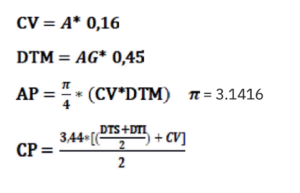
Statistical processing
The descriptive statistics of each of the variables [ , standard deviation (SD), median (M), and coefficient of variation (CV)]. AC, ALG, ACG, LG, TCD, DTS, DTM, DTI, AP and CP were compared by a simple analysis of variance (ANOVA) and Bonferroni’s test (1936) to compare the means, after checking their assumptions.
By processing uncensored data, the procedures for fitting these to a normal distribution were conducted in cases where possible, applying the normality test (Shapiro-Wilks W), Kolmogorov–Smirnov goodness-of-fit test, and the assessment of the asymmetry and Kurtosis coefficients.
For variables with normal distribution or with satisfactory adjustments to it, reference values were calculated for the screening range, determined by normal tolerance limits for ± 1.65 SD, which comprises 90% of the population. When the adjustment to the normal distribution was not satisfactory, tolerance limits for free distribution were calculated for 90% of the population (Álvarez, 2001).
Ethical Management of Animals
Data from animals were collected in their natural environment, in a non-invasive manner as described by Chávez et al. (2023). Animals were handled minimally such that stress was minimised. As production animals, they are taken into the handling chute once a month for both health and reproductive control, at which time data collection took place. Resolution XX of the Ecuadorian Agency for Phyto and Zoosanitary Regulation and Control (2021) establishes the regulations for the formation, approval, and monitoring of Ethics Committees for research involving animals in Ecuador (Article 1), while in Article 3, Application Scope, it does not establish that it is mandatory. The collection of morphometric data, detection, regulation, or modification of anatomical conditions in humans or animals were done.
Results
The zoometric measurements and indices of Creole goats from the Santa Elena Peninsula show moderate heterogeneity in their morphological structure, as reflected in the coefficients of variation (CV), especially in the pelvic indices IP, IPL, IPT, ACG, LG, indicating greater variability in the configuration of the pelvic region. The ALG maintains proportions close to the AC, allowing us to infer a desirable levelled dorsolumbar line based on its functionality. The average values of the AC and the ALG (Table 1) classify the Creole goat from the Santa Elena Peninsula as a small-sized animal.
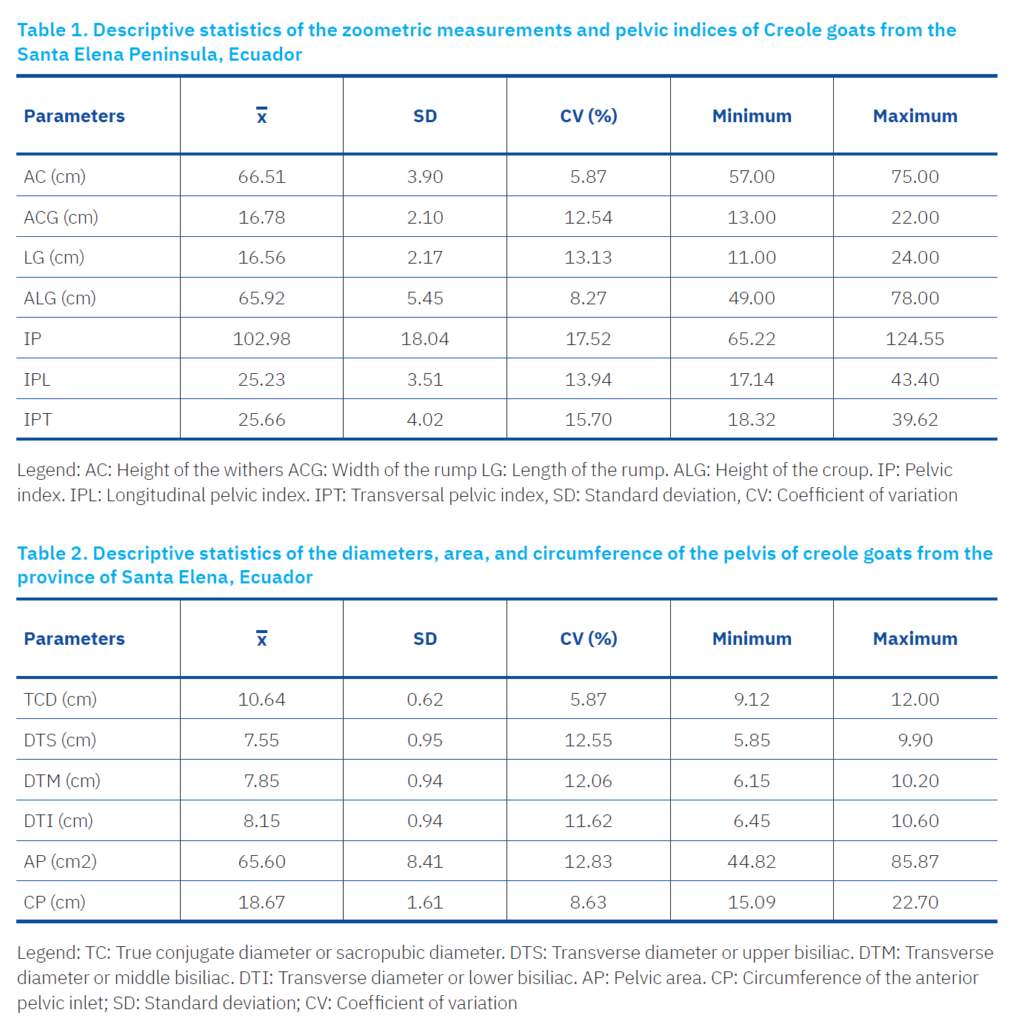
The IP was 102.98 (Table 1), classifying the Creole goat of Santa Elena as concave-linear (>100). In these goats, the width of the rump predominates to a greater extent over its length (Abarca-Vargas et al., 2020). This relates to the body width, the amplitude of the transverse diameters of the pelvis, and the pelvic canal, which together determine greater ease of parturition (Sánchez et al., 2009). However, the standard deviation of ±18.04 (Table 1) indicates that in the sample, there are animals whose IP ranges from 84.94 to 100, classifying them as convex-linear (<100), where the length of the croup is greater than its width. The IPT (Table 1) reached a mean value of 25.66, and the magnitude of the IPT in this research indicates that the Creole goat of Santa Elena has greater ease of parturition, according to the criteria of Bedotti et al. (2004) and Sánchez et al. (2009).
The IPL (Table 1) had an average value of 25.23, in the Creole goats of Santa Elena, animals with a concave body shape predominate, which is why they have a wider hindquarter than those in the literature. The values of IP, IPT, and IPL (Table 1) indicate that, although the Creole goat of Santa Elena has a concave shape, the width predominates over the length of the hindquarters; it is an animal with narrow hips and an intermediate tendency in meat aptitude. However, these animals, due to their hardiness and adaptability to the environment, should be incorporated into genetic improvement programmes through the introduction of exotic breeds to enhance carcass characteristics (Chacón et al., 2009), but their selection should initially be directed towards obtaining females with greater width of the hindquarters, as the kids from those crossings have greater weight and size at birth (Sánchez et al., 2009).
The TCD, DTS, DTM, and DTI have values of 10.64 ± 0.62, 7.55 ± 0.95, 7.85 ± 0.94, 8.14 ± 0.94 cm (Table 2), classifying the sample as dolichopelvic, approaching that of the cow but more elongated and with a less excavated floor than that of the sheep. These results allow us to have reference parameters applicable in selection processes aimed at improving reproductive efficiency in a semi-arid productive environment where hardiness and functional performance are priorities.
The TCD (Table 2) had a mean of 10.64 cm, indicating a notable uniformity in the anteroposterior dimension of the pelvic inlet with a CV% of 5.87; this measurement is fundamental for foetal passage during childbirth. In contrast, the measurements DTS, DTM, and DTI show greater relative dispersion with a CV% between 11.62–12.55%, where considerable variability is observed in the lateral disposition of the pelvic canal. These results could influence reproductive efficiency in conditions of assisted births or primiparous females. AP (Table 2) in the amplitude of its range (44.82 to 85.87 cm²) is an indicator of the volume available for passage of the foetus. Meanwhile, CP, with a CV% of 8.63 and a mean of 18.67 cm, reinforces the knowledge of a moderately variable pelvic conformation. Table 3 shows that the height of the withers, the measurements of the rump and all pelvic diameters, the AP and CP in first and second parity goats were lower (P<0.05) than in third parity goats, with no significant differences (P>0.05) between the first two.
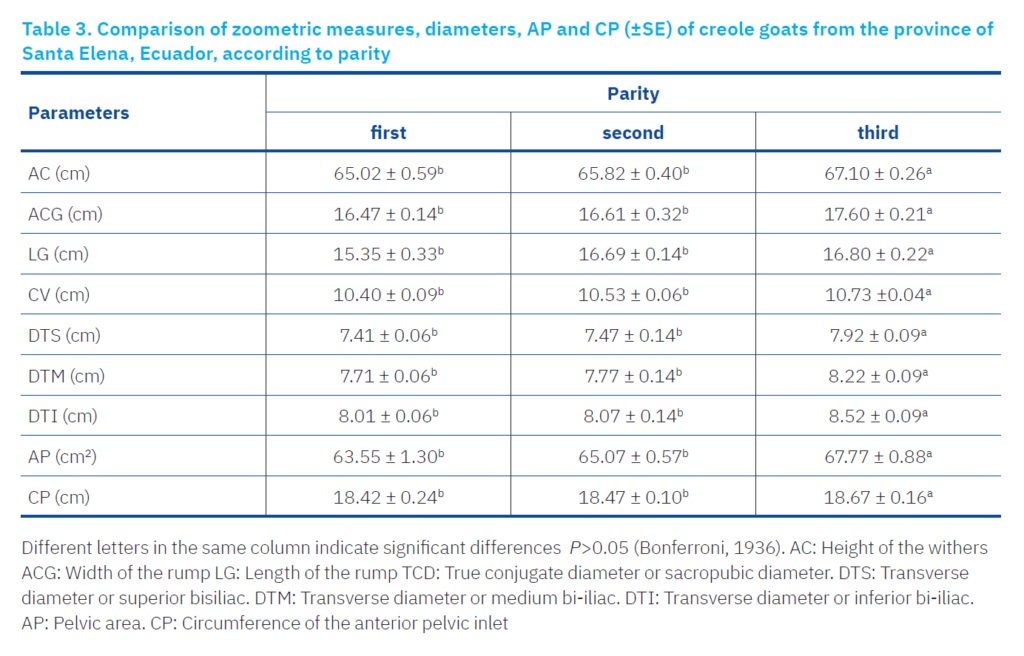
In this research, parity corresponded roughly to the age of the goats, since the first birth occurs at around 12 to 13 months, the second between 24 and 25 months, and the third between 34 and 36 months as the interval between births in Creole goats is approximately 12 months. The measurements AC, ACG, LG (Table 2) showed gradual and significant increases in females with higher parity. This increase was replicated in the internal dimensions of the pelvis, particularly in the TCD, DTS, DTM, and DTI, significantly increasing in females with three births. Similarly, the widening of the AP and the CP in third-parity goats is a potential biomechanical advantage, making foetal transit during birth easier. The above explains the cause of the difference in pelvic parameters since first and second-parity goats are one or two years old and are still growing, and their pelvis is not fully developed; on the other hand, those in their third parity have completed their growth and bodily development.
Therefore, it is necessary to establish reference parameters, which are more objective than point values for comparing or selecting females. In this sense, the lower limit of each parameter will be the ideal value, especially when incorporating females into reproduction and at the time of the first birth. Females with diameters, CP, and especially AP below this quota will be considered a high obstetric risk, and the necessary zootechnical and management measures will be adopted to ensure they reach the desired values or they will be eliminated from reproduction. In Table 4, the height, measurements of the rump, pelvic diameters, AP, and CP of the Creole goats from Santa Elena prior to their first kidding had a normal distribution (P>0.05), so the reference parameters for each indicator are valid. Furthermore, data obtained under production conditions representative of the Creole goat herds in that region were adequately established and used.
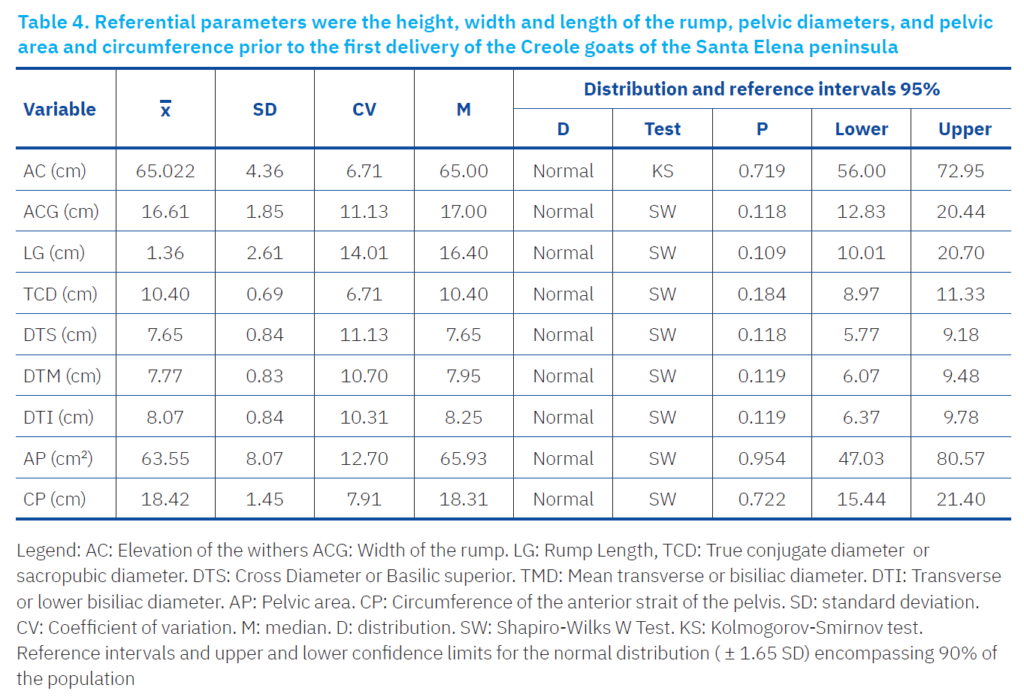
These results are of great importance because the lower limit of each parameter will be its ideal value. According to the previous considerations, prior to the first calving, the ideal values for AC, ACG, and LG were 56.00; 20.44, and 20.70 cm, respectively; the TCD, DTS, DTM, and DTI were be 8.97, 5.77, 6.07, and 7.37, respectively; while the AP was 47.3 cm² and the CP was 15.44 cm. In Table 5, the body, and pelvic measurements of the Santa Elena Creole goats in their second and third calving had a normal distribution (P>0.05), so the reference parameters for each indicator are valid. Furthermore, these were correctly established based on data obtained under production conditions representative of those herds.
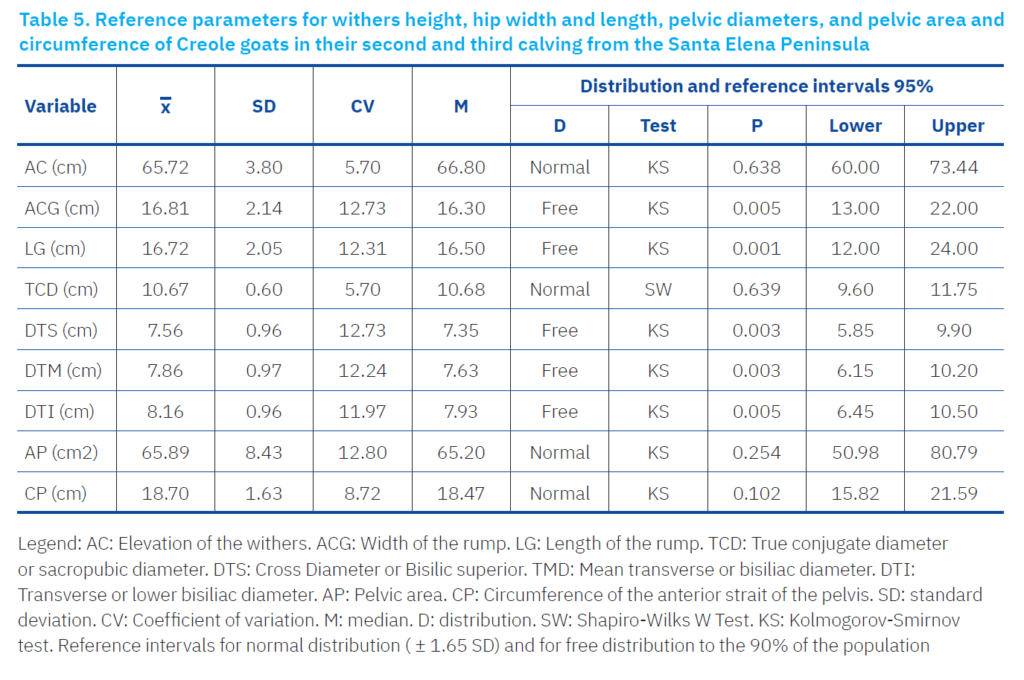
The ideal value is the lower limit of each parameter. Prior to the second and third calving, the ideal AC, ACG, and LG were 73.44; 22.00 and 224.00 cm, respectively; the TCD, DTS, DTM, and DTI were 11.75, 9.90, 10.20, and 10.50, respectively; the AP was 80.79 cm² and the CP was 21.59 cm. When they are below the ideal values in the first calving, it indicates that the female did not have adequate growth during the development stage, and in the second and third calving, it suggests that the female did not continue with optimal development after the first calving. Regardless of parity, values below the ideal in many animals within the herd indicate that nutrition should be improved, and if it is an isolated case, they will be discarded from reproduction. When detected prior to calving, they can be classified as a high obstetric risk, which will serve as a scientific basis to prevent dystocic births, caesareans, and stillbirths (Coopman et al., 2003).
Conclusions
According to its pelvic indices, the Creole goat of the Santa Elena Peninsula is a concavilinear animal, and statistically significant differences (P<0.05) were found in pelvic area and pelvic circumference between goats in their third parturition and those in their first and second , whith greater values observed in the former, so the lower limit of the reference intervals for each parity constitutes the ideal value of the parameters, especially AC and PC prior to the first delivery, which were 47.3 cm2 and 15.44 cm, respectively.
References [… show]
Pelvimetrija kreolskih koza Santa Elene – referentni parametri i vrijednosti
Debbie Shirley CHÁVEZ-GARCÍA1* (dopisni autor), dchavez@upse.edu.ec, orcid.org/0000-0001-8157-2761; Belén Estefania DUQUE-CHÁVEZ2, belen.duquechavez@upse.edu.ec, orcid.org/0009-0009-9815-4406; Néstor Vicente ACOSTA-LOZANO2 nacosta@upse.edu.ec, orcid.org/0000-0003-4848-1360; Raciel LIMA-OROZCO3, raciello@uclv.edu.cu, orcid.org/0000-0002-9278-6076; Carlos IGLESIAS-PASTRANA4, ciglesiaspastrana@gmail.com, orcid.org/0000-0003-3765-1627; Orlando Roberto QUINTEROS-POZO5, oquinteros@upse.edu.ec, orcid.org/0000-0002-3808-257X.
1Peninsula State University of Santa Elena, La Libertad, Ecuador, Red CONBIAND Ecuador, Chimborazo, Riobamba, Ecuador, Center for Research on Small Ruminants and South American Camelids (CIRMCAS), Cevallos, Tungurahua, Ecuador, Ecuadorian Network of Women Scientists (REMCI) Ecuador
2Peninsula State University of Santa Elena, La Libertad, Ecuador
3Central University Marta Abreus de las Villas- Cuba
4Andalusian Institute of Agricultural and Fisheries Research and Training: Córdoba, Andalusia, España
5Peninsula State University of Santa Elena, La Libertad, Ecuador, Center for Research on Small Ruminants and South American Camelids (CIRMCAS), Cevallos, Tungurahua, Ecuador
Ovim se istraživanjem obavljala procjena mjera i promjena, prostora i obujma zdjelice kreolskih koza Santa Elena u Ekvadoru. Odabrano je ukupno 340 kreolskih koza između jedne i tri godina starosti i jednak broj jarenja, zadnje eutokično. Mjere i dimenzije uspoređene su jednostavnom analizom varijance. Referentne vrijednosti za opseg pregleda izračunate su formulom ± 1.65 SD. Mjere pelvisa kategoriziraju koze iz istraživanja kao konkavno-linearne. Promjer, područje i obujam zdjelica u prvih i drugih koza u jarenju bili su manji (P<0.05) od trećih koza u jarenju. Donja granica referentnih vrijednosti za svaki je parametar njegova odgovarajuća vrijednost prije jarenja. Prije prvog jarenja, to je 8,97, 5,77, 6,07 i 7,37 cm, odnosno za sagitalni, gornji, srednji i donji transverzalni promjer. Za područje i obujam zdjelice odgovarajuće su vrijednosti 47,3 cm2, odnosno 15,44 cm. Prije drugog i trećeg jarenja, idealne vrijednosti za svaki parameter bile su više nego za prvo jarenje. Zaključuje se da su, prema mjerama zdjelice, koze u istraživanju konkavno-linearne a njihove dimenzije pelvisa u prvom i drugom jarenju bile manje (P<0,05) od onih u trećem jarenju.
Ključne riječi: zoometrijska mjerenja, pelvimetrija, visina, područje zdjelice, obujam zdjelice; mjere zdjelice
