
Preliminary analysis of cattle deaths suspected to be an adverse reaction of vaccination against lumpy skin disease in Croatia
H. Pavasović*, I. Gruden Zdunić, I. Bazina, E. Oster, N. Čudina, A. Prevendar Crnić and F. Božić
Hrvoje PAVASOVIĆ 1* (corresponding author), hpavasovic@vef.unizg.hr, orcid.org/0000-0002-3261-5187; Iva GRUDEN ZDUNIĆ 2, iva.g-zdunic@mps.hr; Ivana BAZINA 2, ivana.bazina@mps.hr, orcid.org/0009-0001-6512-7470; Ena OSTER 1, eoster@vef.unizg.hr, orcid.org/0000-0001-5746-8497; Nikola ČUDINA 1, ncudina@vef.unizg.hr, orcid.org/0000-0002-0208-1815; Andreja PREVENDAR CRNIĆ 1, apcrnic@vef.unizg.hr, orcid.org/0000-0001-9540-8831; Frane BOŽIĆ 1, bozic@vef.unizg.hr.
1Department of Pharmacology and Toxicology, Faculty of Veterinary Medicine, University of Zagreb, 10000 Zagreb, Croatia
2Veterinary and Food Safety Directorate, Ministry of Agriculture, Forestry and Fisheries, 10000 Zagreb, Croatia
 https://doi.org/10.46419/cvj.57.3.1
Abstract
Vaccination against lumpy skin disease was carried out in Croatia during 2016 and 2017 to prevent this emerging viral disease from causing significant damage to the cattle population. Two unauthorised live vaccines were used for immunoprophylaxis, and adverse reactions in cattle were expected. Adverse events were monitored and 14 selected reported cases of deaths were analysed using the available necropsy results. The cases analysed were classified as probable, possible, inconclusive, or unlikely to be caused by vaccination, primarily based on results of post-mortem examination, taking into consideration factors that contributed to or resulted in death or euthanasia. Most cases were classified as possibly caused by vaccination due to subcutaneous oedema of varying consistency (at the injection site) and intramuscular haemorrhage, in some cases leading to purulent and necrotic processes. These processes eventually led to fatal purulent bronchopneumonia, pulmonary emphysema, septic conditions, or euthanasia. In the remaining cases, necropsy results were unable to be linked to vaccination or the findings were inconclusive due to the presence of other factors, such as Klebsiella infection. It can be assumed that neither vaccine had a direct connection with animal deaths, but they may have contributed to the fatal outcomes due to the complications of severe local reactions and general impact on the immune system.
Key words: lumpy skin disease; vaccination; adverse event; death
Introduction
Lumpy skin disease (LSD) is an infectious, vector-borne, emerging viral disease of cattle and other wild ruminants, mainly characterised by nodules on the skin (Fenin et al., 2022). The LSD virus belongs to the Poxviridae family, genus Capripoxvirus, and is transmitted by vectors, i.e., blood-sucking arthropods, particularly mosquitoes, biting flies and male ticks (ANSES, 2017). LSD causes high economic losses, such as damage to animal leather, decreased milk production, abortions, and death in infected ruminants (Eom et al., 2023). The first cases and outbreaks of this disease in Europe were reported in 2016 in Georgia, Kazakhstan, Albania, Bulgaria, Montenegro, North Macedonia and Serbia. No further LSD cases have been reported from other countries since 2017 (Bianchini et al., 2023).
As this disease approached the borders, the Croatian authorities decided to take defensive measures and conduct prophylactic vaccination of the entire cattle population (Acinger-Rogić et al., 2017). This decision was supported by the European Commission with its implementing act for animal health control measures in relation to lumpy skin disease (European Commission, 2016). After the completion of mass vaccination in 2018, clinical, virological and serological surveillance was carried out, and revealed no signs of LSD on the Croatian territory. Therefore, Croatia regained its disease-free status and the restrictions in relation to LSD vaccination were lifted by an implementing act of the European Commission (European Commission, 2019).
Two live vaccines containing an attenuated strain of the LSD virus were used for the immunoprophylaxis of cattle. These vaccines were not authorised in the EU and their safety profile was unknown, and therefore, vaccination reactions were expected. Suspected adverse events due to vaccination were monitored and reports from the field were collected and analysed. In this paper, 14 reported cases of suspected deaths in cattle following vaccination against LSD were selected on the basis of available necropsy reports and discussed in relation to a possible connection with vaccination.
Material and Methods
Live attenuated vaccines against the LSD virus were used for immunoprophylaxis – vaccine A (104.0 TCID50/mL, SIS Neethling strain) and vaccine B (103.5 TCID50/mL, Neethling strain).
The entire cattle population was vaccinated subcutaneously with 1 mL of one of the two vaccines, once a year for two consecutive years.
Suspected adverse events in cattle after LSD vaccination were monitored and collected by the Department of Pharmacology and Toxicology, Faculty of Veterinary Medicine, University of Zagreb. Reports were submitted by veterinarians by e-mail, fax or telephone on the official standard reporting form of the Faculty of Veterinary Medicine, University of Zagreb (Faculty of Veterinary Medicine, 2017) or via the Ministry of Agriculture, Forestry and Fisheries, the national competent authority for veterinary medicines. Data were entered onto a Microsoft Excel spreadsheet and analysed case by case for causality association between the administered vaccine and the adverse event(s). The collection, recording and analysis were based on good pharmacovigilance practice (European Medicines Agency, 2021).
Depending on the outcome of the causality assessment, cases were classified as either probable, possible, inconclusive or unlikely (caused by the vaccination) or unclassified (European Commission, 2011; European Medicines Agency, 2024):
- Probable (reasonable association in time between application of the product and onset and duration of the adverse event, described clinical signs should be consistent with the known pharmacological and toxicological properties of the product and there is no other equally plausible explanation);
- Possible (the product is one of the possible and plausible causes of the adverse event, but does not fulfil the criteria of the “probable” category);
- Unclassifiable (insufficient information was available to draw any conclusion);
- Inconclusive (other factors prevented a conclusion being drawn, but a product association could not be discounted);
Unlikely (sufficient information exists to establish that the adverse event is not related to a product).
Results
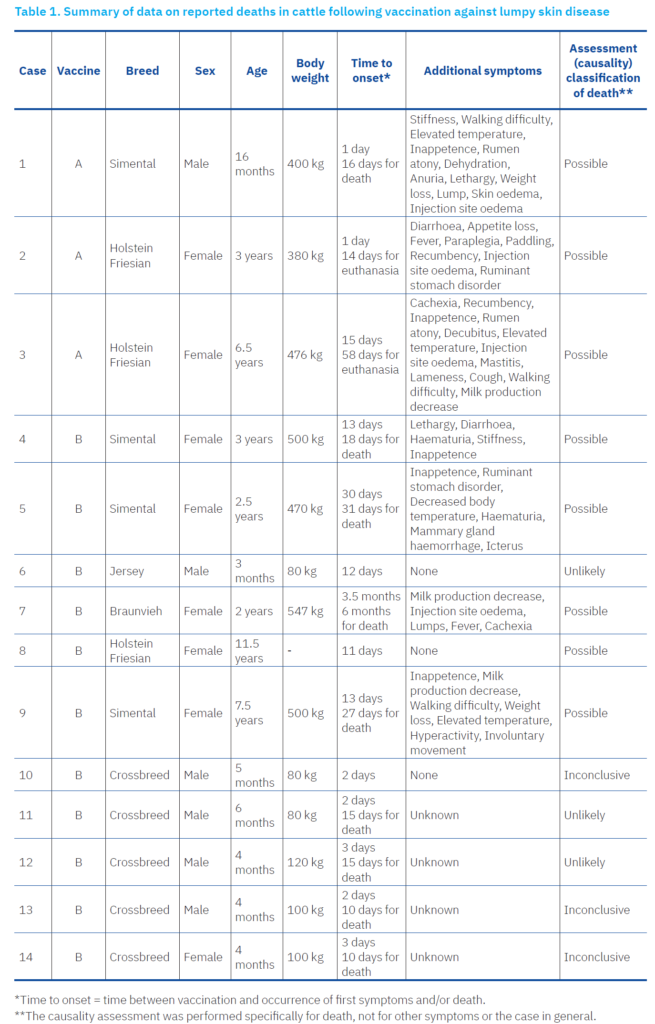
A summary of reported deaths (vaccine administered, species, breed, sex, age, body weight, time to onset and additional symptoms) is provided in Table 1.
Summary of necropsy findings in bovine cadavers from reported death cases after vaccination against lumpy skin disease
In case 1, the necropsy results indicate that death was most likely caused by purulent bronchopneumonia and pulmonary emphysema, most likely related to extensive purulent and necrotic processes in the animal’s subcutis (pain, recumbency, inappetence). The location of the purulent and necrotic processes in the subcutis and muscle tissue suggests that these are most likely a consequence of the vaccination. In cases 2 and 3, the animals were probably sick for a prolonged period and consumed less food and water, as evidenced by visible cachexia, dehydration and an empty gastrointestinal tract. Extensive subcutaneous gelatinous oedema, tissue necrosis and haemorrhage may have been the result of lumpy skin disease vaccination. Necropsy findings in cases 4 and 5 were tissue necrosis, reddish-yellow oedema, intramuscular haemorrhage, and subcutaneous haematoma, possibly due to lumpy skin disease vaccination. There were no pathologic findings in other organ classes. The death in case 6 was most likely caused by severe purulent bronchopneumonia. The necropsy findings in case 7 indicate that death was probably caused by cardiac failure secondary to an acute septic condition. It is possible that the subcutaneous formations were due to connective tissue impregnation of the vaccine causing subcutaneous gelatinous oedema and haemorrhage. It is very likely that the animal was immunocompromised and that hidden bacterial areas were activated after significant stress, followed by acute sepsis. In case 8, the animal probably died as a result of sepsis following severe necrotic hepatitis. Severe pathologic findings such as extensive haemorrhage and gelatinous oedema may be the result of vaccination against lumpy skin disease. In case 9, death was most likely caused by severe purulent bronchopneumonia with lung abscesses. Severe pathology findings, such as extensive haemorrhage and gelatinous oedema, may be the result of vaccination against lumpy skin disease. The findings in case 10 indicate that death was probably caused by severe purulent bronchopneumonia with lung abscesses. The stress caused by the vaccination could have had an immunosuppressive effect and contributed to a more rapid onset of purulent bronchopneumonia with lung abscesses. In cases 11 and 12, death was most likely due to severe purulent bronchopneumonia with lung abscesses. There were no macroscopic changes at the vaccine injection site or other associated findings such as oedema, haemorrhage, or haematoma. In cases 13 and 14, death was most likely the result of severe purulent bronchopneumonia with lung abscesses caused by Klebsiella pneumoniae. Vaccination against lumpy skin disease could have had an immunosuppressive effect and contributed to a more rapid onset of the disease.
Discussion
In the first case, the adverse reactions to LSD vaccination occurred within one day. Although this may imply a certain hypersensitivity reaction, death occurred 15 days later due to purulent bronchopneumonia and pulmonary emphysema. The reported clinical signs of skin oedema and oedema at the injection site were consistent with the necropsy findings, which showed purulent and necrotic processes in the subcutaneous and muscle tissue. It was suspected that these processes were a consequence of vaccination. Therefore, this death was classified as possibly caused by the vaccination.
In cases 2 and 3, death, i.e., euthanasia, occurred 14 and 58 days after vaccination, respectively, preceded by different symptoms indicating a longer period of illness. However, some of the clinical signs observed suggest vaccine involvement, e.g., oedema at the injection site, which was supported by the necropsy results. Examination of animal carcasses revealed subcutaneous gelatinous oedema that may have been due to vaccination. Despite the prolonged period of time in which the fatal outcome occurred, the necropsy findings suggest that the vaccination had a prolonged effect, necessitating euthanasia. Both cases were therefore classified as possibly related to the vaccination.
In cases 4 and 5, there were no clear symptoms suggesting a vaccine reaction, given the late time of onset of clinical symptoms (13 and 30 days after vaccination). On the other hand, certain symptoms such as skin oedema, which would correspond to the necropsy findings, may not have been reported. These include tissue necrosis, intramuscular haemorrhages, and subcutaneous haematomas, which, according to the necropsy report, are indicative of vaccine involvement. Despite some discrepancies, primarily due to the necropsy findings, these cases were assessed as possibly related to vaccination.
In case 7, the onset of symptoms and death was unusually long, i.e., 3.5 months and 6 months, respectively. The recorded symptoms such as injection site oedema may persist for a long time, which is consistent with the necropsy findings of subcutaneous gelatinous oedema and haemorrhage. It was hypothesised that bacterial areas may have developed due to these lesions, which were later activated by significant stress in the immunocompromised animal, leading to an acute septic condition and heart failure. Based on all this information, this death was classified as possibly caused by the vaccination.
In case 8, no symptoms were noted before the animal died 11 days after vaccination. However, the necropsy results showed extensive (presumably skin) gelatinous oedema and haemorrhages possibly due to the vaccination. Potentially bacterial foci may have led to sepsis and severe necrotic hepatitis. Although no previous clinical signs were noted, the death in this case was classified as possibly related to vaccination based on the necropsy findings.
In case 9, clinical signs appeared relatively long after vaccination (13 days), followed by death 14 days later, so no clear link to vaccination can be established. However, the necropsy findings confirmed the presence of extensive haemorrhage and gelatinous oedema (presumably in the subcutis), which would correspond to the symptom described as skin oedema. The cause of death was purulent bronchopneumonia with lung abscesses associated with subcutaneous lesions caused by the vaccination. Therefore, the death of this animal was assessed as possibly related to vaccination.
In cases 6, 11 and 12, no symptoms were noted prior to death, and the time to onset of death was 12, 2 and 3 days, respectively, while the necropsy revealed no association with vaccination. The cause of death in all three cases was severe purulent bronchopneumonia, which was not related to vaccination. Therefore, the death of the animals in these three cases was assessed as unlikely to be related to vaccination.
In cases 10, 13 and 14, death occurred 2, 10 and 10 days after vaccination, respectively, and no other symptoms were observed between vaccination and death. The cause of death in all three cases was purulent bronchopneumonia with lung abscesses, and Klebsiella pneumoniae was also isolated in cases 13 and 14. In all cases, the findings included gelatinous oedema and extensive haemorrhages in the subcutaneous area of the neck (5–10 cm in diameter). However, no link was established between bronchopneumonia and these lesions, except that the immunosuppressive effect of vaccination may have contributed to a more rapid onset of the disease. Therefore, despite some evidence of vaccination reactions, no conclusions could be drawn and these cases were considered inconclusive.
Conclusions
The evaluation of the 14 reported cases was primarily based on necropsy results, though observed symptoms were also taken into account. Most cases were classified as possibly related to vaccination, as pathologic processes in the subcutis were found at necropsy (e.g., oedema, haemorrhage, necrosis), which in half of the cases were consistent with the reported oedema at the injection site. The cause of death in most cases was purulent bronchopneumonia with or without lung abscesses, followed by pulmonary emphysema, acute sepsis with heart failure or necrotic hepatitis. In two cases, the animals were euthanised due to their severely deteriorated condition. In three cases without clinical signs and with undetermined necropsy results, the link between vaccination and death of the animals was assessed as inconclusive. In three cases, an association with vaccination was considered unlikely because there were either no or unknown clinical signs or necropsy results. On the basis of all the assessments presented, it can be concluded that there is no clear link between cattle deaths and vaccination against lumpy skin disease, but that in most cases the vaccine could have been a contributing factor, primarily due to local reactions and immunological stress.
References [… show]
Preliminarna analiza uginuća goveda kao sumnja na nuspojavu cijepljenja protiv bolesti kvrgave kože u Hrvatskoj
Hrvoje PAVASOVIĆ 1* (dopisni autor), hpavasovic@vef.unizg.hr, orcid.org/0000-0002-3261-5187; Iva GRUDEN ZDUNIĆ 2, iva.g-zdunic@mps.hr; Ivana BAZINA 2, ivana.bazina@mps.hr, orcid.org/0009-0001-6512-7470; Ena OSTER 1, eoster@vef.unizg.hr, orcid.org/0000-0001-5746-8497; Nikola ČUDINA 1, ncudina@vef.unizg.hr, orcid.org/0000-0002-0208-1815; Andreja PREVENDAR CRNIĆ 1, apcrnic@vef.unizg.hr, orcid.org/0000-0001-9540-8831; Frane BOŽIĆ1, bozic@vef.unizg.hr.
1Zavod za farmakologiju i toksikologiju, Veterinarski fakultet Sveučilišta u Zagrebu, 10000 Zagreb, Hrvatska
2Uprava za veterinarstvo i sigurnost hrane, Ministarstvo poljoprivrede, šumarstva i ribarstva, 10000 Zagreb, Hrvatska
Cijepljenje protiv bolesti kvrgave kože (BKK) provedeno je u Hrvatskoj tijekom 2016. i 2017. godine kako bi se spriječile znatne štete u populaciji goveda uzrokovane ovom emergentnom virusnom bolesti. Za imunoprofilaksu korištena su dva neodobrena živa cjepiva i nuspojave u goveda su bile očekivane. Veterinarski fakultet Sveučilšta u Zagrebu pratio je štetne događaje i u ovom radu od prijavljenih slučajeva izdvojeno je i analizirano 14 uginuća s dostupnim rezultatima razudbe. Obrađeni slučajevi klasificirani su kao vjerojatno, moguće, ne-zaključivo ili teško vjerojatno prouzročen cijepljenjem, prije svega temeljem rezultata postmortalne pretrage, uzevši u obzir čimbenike koji su doprinijeli ili prouzročili uginuće ili doveli do eutanazije. Većina slučajeva klasificirana je kao moguće prouzročena cijepljenjem, prije svega zbog nastanka supkutanog edema različite konzistencije (na mjestu injekcije) i intramuskularnih krvarenja, koji su se ponekad razvili u gnojne i nekrotične procese. Ovi procesi vremenom su doveli do gnojne bronhopneumonije, plućnog emfizema ili septičnih stanja s posljedičnim uginućem ili eutanazijom. U preostalim slučajevima, temeljem rezultata razudbe, povezanost s cijepljenjem ili nije mogla biti utvrđena ili je bila nejasna (drugi prisutni čimbenici, pr. infekcija s Klebsiella spp.). Može se pretpostaviti da cijepljenje nije izravno prouzročilo uginuća goveda, no cjepiva su mogla doprinijeti smrtnom ishodu zbog komplikacija opsežnih lokalnih reakcija i utjecaja na imunološki sustav.
Ključne riječi: bolest kvrgave kože, cijepljenje, štetan događaj, uginuće
