
Variance components for weight and type traits in a multiracial population of meat sheep in eastern Antioquia
E.Zapata-Gómez, M. A. García-Saldarriaga, E. A. Pelaez-Pelaez, L. C. Caballero-Mendez, S. E. Idarraga-Bedoya*, S. Arias-Montoya and S. J. Calvo-Cardona
Estefanía ZAPATA GÓMEZ1, estefazapata666@gmail.com, Maria Antonieta GARCIA SALDARRIAGA1, mariagasa@hotmail.com; Edgar Antonio PELAEZ PELAEZ2,3, edgarpelaez@utp.edu.co, orcid.org/0000-0002-6501-1937; Lyda Cenobia CABALLERO MÉNDEZ2,3, lydaccm_27@utp.edu.co, orcid.org/0000-0001-6504-3149; Samuel Eduardo IDÁRRAGA BEDOYA2,3* (corresponding author), samuelidarraga@utp.edu.co, orcid.org/0000-0001-7290-8729; Santiago ARIAS MONTOYA 2,3. santiago.arias12@utp.edu.co, orcid.org/0000-0003-2332-0384; Samir Julián CALVO CARDONA2,4 , samir.calvo@utp.edu.co, orcid.org/0000-0003-3400-5208.
1Catholic University of the East, Animal Science Program, 054040 Rionegro, Colombia
2Faculty of Health Sciences, Veterinary Medicine and Animal Science Program, Technological University of Pereira, 660003 Pereira, Colombia
3BIOECOS research group
4BIOPEC research group

https://doi.org/10.46419/cvj.57.3.9
Abstract
The objective of genetic evaluation is to provide a tool to identify and select genetically superior animals that transmit desirable traits to their offspring, improving flock productivity over generations. This study aimed to evaluate genetic and phenotypic parameters for weight and type traits in a multiracial meat sheep population in eastern Antioquia, using Bayesian inference analysis. The study was conducted at two farms: “Ovinos de la Sierra” in La Ceja del Tambo, and “El Charrascal” in Copacabana, Antioquia, Colombia. Animals from various racial groups were evaluated, focusing on productive traits, namely birth weight (BW) and adjusted weaning weight at 90 days (AW90), together with twelve phenotypic traits. A single-trait animal model was applied, incorporating the fixed effects of breed type, calving type, sex, and live weight. Variance components and genetic parameters and expected breeding values were estimated. The mean (± standard deviation) for BW and AW90 were 3.655 ± 0.806 kg and 19.610 ± 5.181 kg, respectively. Direct and maternal heritability estimates for BW were 0.6734 and 0.2963, and for AW90 were 0.9323 and 0.0670. Among phenotypic traits, thoracic perimeter showed the highest heritability, followed by rump length, while the lowest heritability estimates were for withers width and rump width. All estimates were convergent, except maternal and phenotypic estimates for BW. Proper data recording is essential for evaluating genetic and phenotypic parameters, and Bayesian analysis provides reliable variability through posterior distributions, supporting the grouping of animals by age and production group for uniform data.
Key words: heritability; Bayesian inference; weaning weight; birth weight; genetic potential
Introduction
In animal production, genetic selection requires both effectiveness and efficiency. In addition to considering phenotypic aspects, it must also include the genetic component to determine the true breeding value of the animal, and from there, identify appropriate production goals. Sheep farming in Colombia is a growing sector; therefore, the effective use of available genetic material and the implementation of appropriate selection strategies in breeding farms are key approaches to improving meat production and the morphological traits of animals across different production systems (Muñoz, 2015).
Type traits such as withers height, rump height, chest width, and thoracic perimeter, among others, are influenced by management practices and the environmental conditions in which the animal develops. These traits play an important role in the relationship between morphology and the animal’s productive aptitude. This relationship must be considered when selecting breeding animals; otherwise, selection may lead to animal models that are inefficient within production systems and poorly adapted to their environment (Hernández-Montiel et al., 2020).
Heritability (h²) is considered the primary parameter for selection, as it determines the proportion of total variation in a trait that can be attributed to the direct effect of genes. Various methods can be applied to estimate variance components and genetic parameters in a population. However, all of them generally share the goal of studying and quantifying the degree of similarity among related individuals and the proportion and pattern in which quantitative traits related to animal production are inherited. Among the more recent approaches, Bayesian methods offer the advantage of estimating variance components through an emphasis on the precision of the distribution of different parameters, and consequently, in predicting breeding values (Zaabza et al., 2017).
Genetic evaluations in sheep using the animal model and Bayesian inference methods have been conducted, such as in the study by Neiva Rodrigues et al. (2021) in Santa Inês sheep. They suggested evaluating the Famacha Score as a genetic selection criterion for resistance to endoparasites, as it showed higher heritability, repeatability, and a strong genetic correlation with parasite resistance traits.
Other studies estimated genetic parameters for various reproductive traits using univariate and bivariate models. Based on Deviance Information Criterion (DIC) and other criteria, the most appropriate model for each trait was identified. Genetic parameters were estimated for four reproductive and four growth traits using Bayesian inference with Gibbs sampling. Growth traits showed higher heritability than reproductive traits, likely due to non-normal distributions of reproductive traits and low genetic variability in these traits (Junqueira-Oliveira et al., 2021; Habtegiorgis et al., 2022; Tesema et al., 2022).
Additionally, the phenotypic and genetic characterisation study of the Colombian Creole sheep, conducted by Martínez and Malagón (2005) using a Bayesian inference model, compared significant traits with high heritability related to productive and reproductive performance in the Criolla and Mora Colombiana breeds. This allowed for the implementation of selection processes based on estimated breeding values, aiming to modify the genetic and phenotypic trends of the population. The objective of the present study was to evaluate genetic and phenotypic parameters for weight and type traits in a multiracial population of meat sheep in the Eastern region of Antioquia.
Materials and Methods
Ethical statement
This study was approved by the Ethics Committee for Scientific Research of the Universidad Católica de Oriente, Rionegro, Antioquia its session on 27 August 2020.
Farm Description
The Altos de la Sierra farm is in the municipality of La Ceja del Tambo, Antioquia, Colombia, at an altitude of 2200 meters, with an average temperature of 15°C, relative humidity of 60%, and an annual rainfall of 2171 mm. The El Charrascal farm is in the municipality of Copacabana, Antioquia, Colombia, at an altitude of 1454 meters, with an average temperature of 23°C, relative humidity of 80%, and an annual rainfall of 1604 mm. Both farms operate under an intensive management system and are dedicated to the multiplication of maternal, paternal, and dual-purpose lines, using the following breeds: Santa Inês, Colombian Hair Sheep, Dorper, Katahdin, and their crossbreeds.
Animals and records
Records from 174 animals were collected, 142 from Altos de la Sierra farm and 32 from El Charrascal farm. The data comprised sire birth date, dam birth date, individual birth date, sex, breed type, number of parturitions, birth weight (BW), weaning weight adjusted to 90 days (AW90), and weaning date, covering the period from 2014 to 2019. The data were obtained from the OVINCA software, version 9.1807.3.
To adjust the weaning weight data at 90 days, the following equation was used:

Additionally, a total of 2262 data points were included for the following traits: Withers Height (WH), Rump Height (RH), Rump Length (RL), Withers Width (WW), Rump Width (RW), Chest Width (CW), Thoracic Perimeter (TP), Longitudinal Diameter (LD), Loin Length (LL), Face Width (FW), Face Length (FL), and Cannon Bone Perimeter (CBP); corresponding to a total of 166 animals. For simplifying the presentation and interpretation of type and weight traits, the variables were grouped as follows:
Weight traits: Birth Weight (BW) and Weaning Weight at 90 days (AW90)
Forequarter traits: WH, WW, CW, TP, FW, FL, CBP, LD.
Hindquarter traits: RH, RL, RW, LL.
These measurements were taken using a measuring tape by two individuals on each animal.
Statistical analysis
A generalised linear model was used, including all fixed effects (breed type, type of birth, sex, and live weight), to preselect statistically significant estimates and subsequently include them in the Bayesian analysis to improve the estimation of variance components.
The animal model used to estimate the variance components and genetic parameters for weight and type traits was as follows (Henderson 1988):
𝑌 = 𝑋𝛽 + 𝑍𝑎 + 𝑊𝑚 + 𝑒 (For BW and AW90),
𝑌 = 𝑋𝛽 + 𝑍𝑎 + 𝑒 (For type characteristics),
where Y is the response variable (BW, AW90, WH, RH, RL, RW, CW, TP, LD, LL, FW, FL, and CBP), and X represents the fixed effects: breed type, type of birth, sex, and live weight, β denotes the solutions for the fixed effects, Z is the incidence matrix relating to the animals, α the solutions for the direct genetic effect, W the matrix relating the dams, m the solutions for the maternal effect, and e the random residual error.
The additive, maternal, and residual genetic random effects were defined with a normal a priori distribution. The following formulas were used for the prior distribution of genetic variance, maternal variance, and residual variance, respectively:
a ~ N (0, A σ2a), N (0, A σ2m), e ~ N (0, I σ2e).
For variance components σ2a, σ2m y σ2e, independent scaled-inverted Chi-square distributions were used (Wang, 1994).
For the Bayesian inference analysis, a total of 1,000,000 iterations were used, with a burn-in period of the first 200,000 iterations and a sampling interval of every 50 iterations. Credibility intervals were set at 5%. Two distribution families were evaluated: Gaussian and Poisson, for each productive and type trait, and the analysis with the lowest DIC was selected.
The estimation of variance components and genetic parameters was carried out using the MCMCglmm package. The convergence of the posterior distributions was assessed using the Geweke diagnostic (Geweke, 1992), as implemented in the BOA package in R-project software, version 4.5.0 (R core team, 2025). This method compares the estimated mean of the characteristics, generating a Z-score and its corresponding p-value, allowing the identification of convergence in the data (Geweke, 1992).
Results
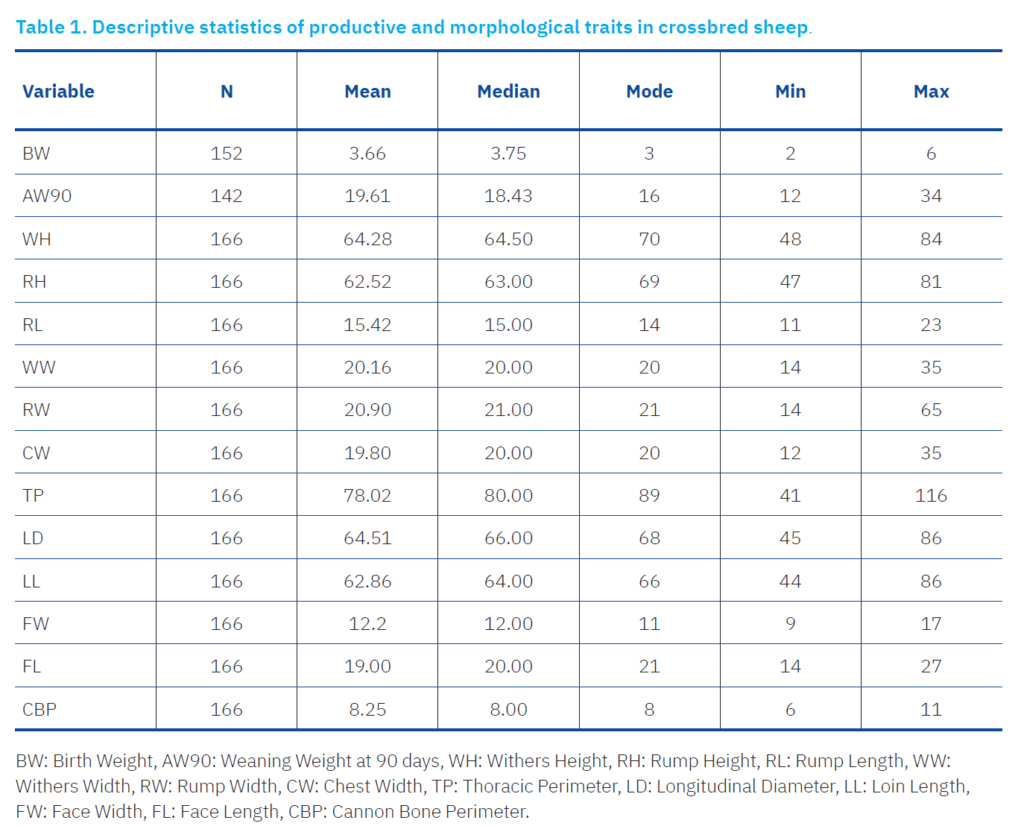
When evaluating Gaussian and Poisson distribution types for each productive and type trait, the model with the lowest DIC was the Poisson distribution. Descriptive statistics for birth weight, weaning weight adjusted to 90 days, and 13 type traits are presented in Table 1. From the descriptive results, it is worth noting that the mean, median, and mode were very similar across all variables. The traits Loin Length (LL), Longitudinal Diameter (LD), Thoracic Perimeter (TP), Withers Width (WW), and Rear Rump Width (RW) showed a high degree of variability in minimum and maximum values within the evaluated sample
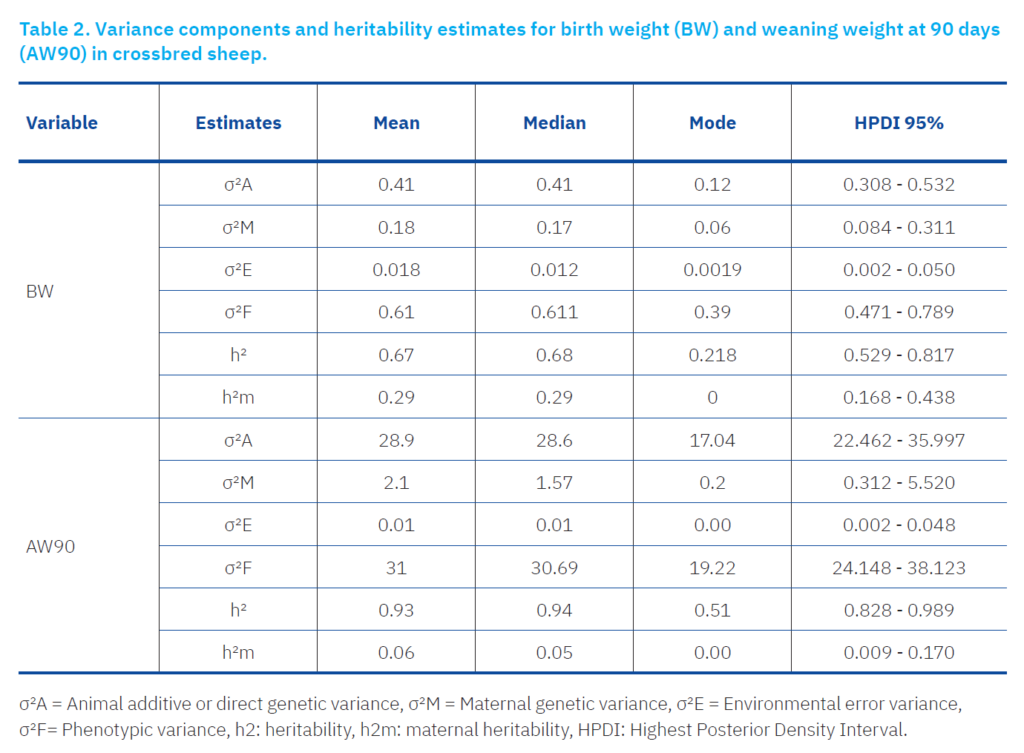
Regarding the variance components and heritability for the traits BW and AW90, a direct heritability of BW = 0.67 was obtained (confidence interval (CI) 0.52908–0.81708). This value was lower than the direct heritability of AW90 = 0.93 (CI 0.82888–0.98948). Maternal heritability was higher for BW, with a value of 0.29 (CI 0.16826–0.43804), whereas for AW90 it was very low, at 0.06 (CI 0.00995–0.17010).
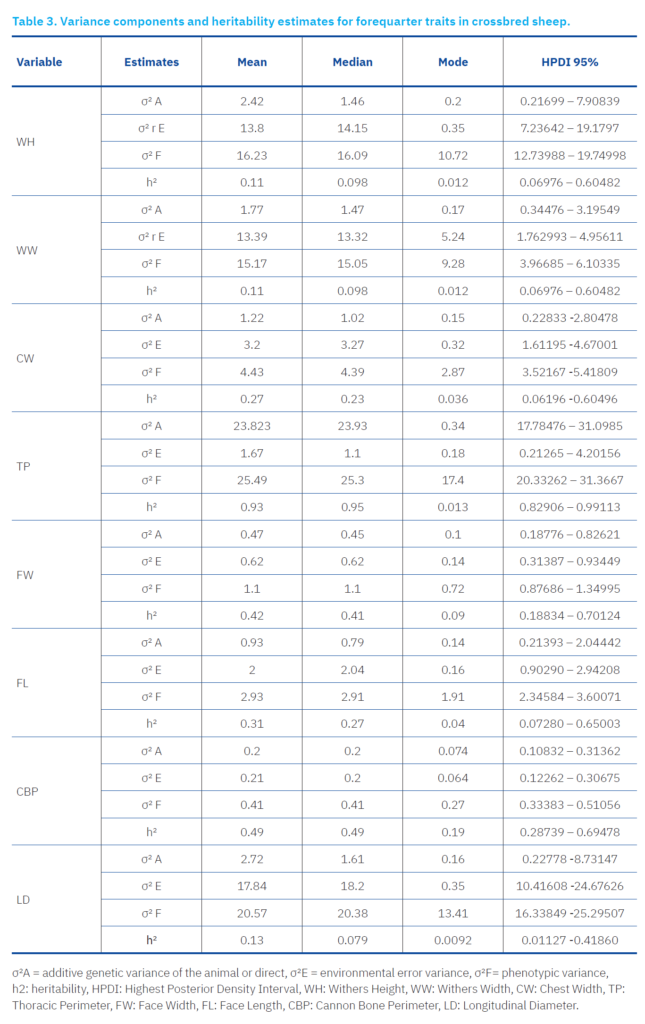
The forequarter trait with the highest heritability was Thoracic Perimeter (TP), with a value of 0.93 (CI 0.82906–0.99113), while the lowest heritability in this group was observed for Withers Width (WW), at 0.11 (CI 0.01127–0.41860).
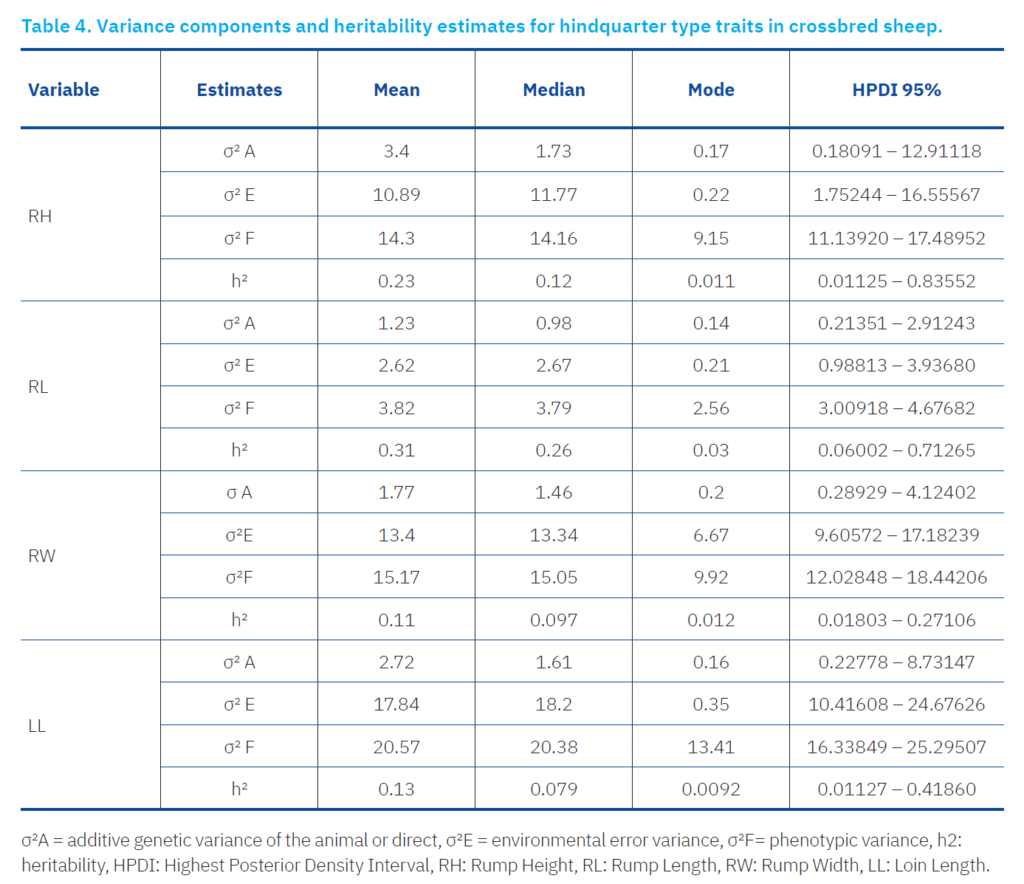
In the hindquarter, the trait with the highest heritability was Rump Length (RL), with a value of 0.31 (CI 0.06002–0.71265). Conversely, the trait with the lowest heritability in this group was Rump Width (RW), with a value of 0.11 (CI 0.01803–0.27106), as shown in Tables 3 and 4.
The posterior distributions for the direct and maternal heritabilities of birth weight (BW) and weaning weight adjusted to 90 days (AW90) are shown in Figure 1
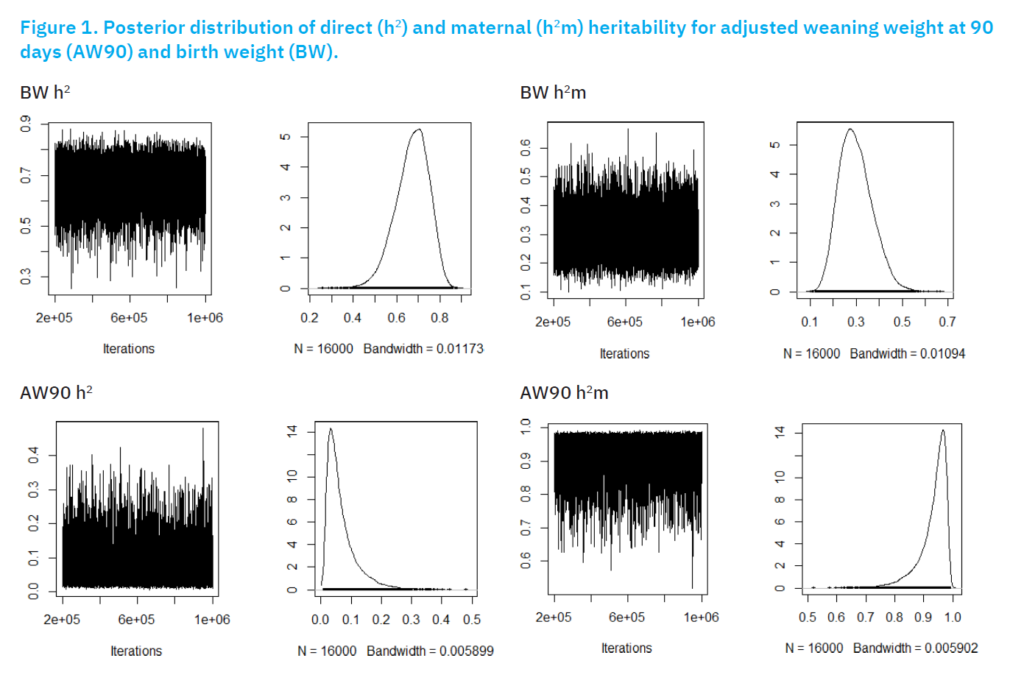
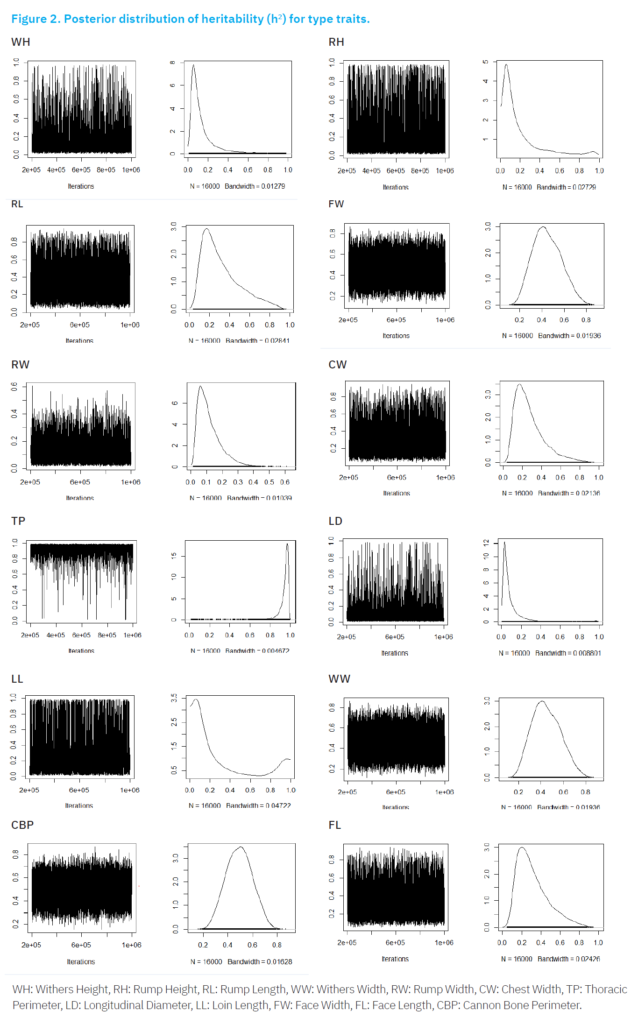
The posterior distributions were symmetric leptokurtic for maternal heritability of BW, three type traits (RW, WW, and CBP), and for maternal heritability of BW, with a slight rightward skew. However, the remaining traits exhibited asymmetric distributions (Figure 2). The TP trait and maternal heritability of AW90 showed negative skewness, while the direct heritability of AW90 and the type traits WH, RH, RL, RW, CW, LD, and FL presented positive skewness, with a slight leftward truncation. Finally, the LL trait showed a predominantly platykurtic distribution; therefore, the mode was taken as the reference value instead of the mean or median, this is because mode is a better estimator of the most probable value of the posterior distribution.
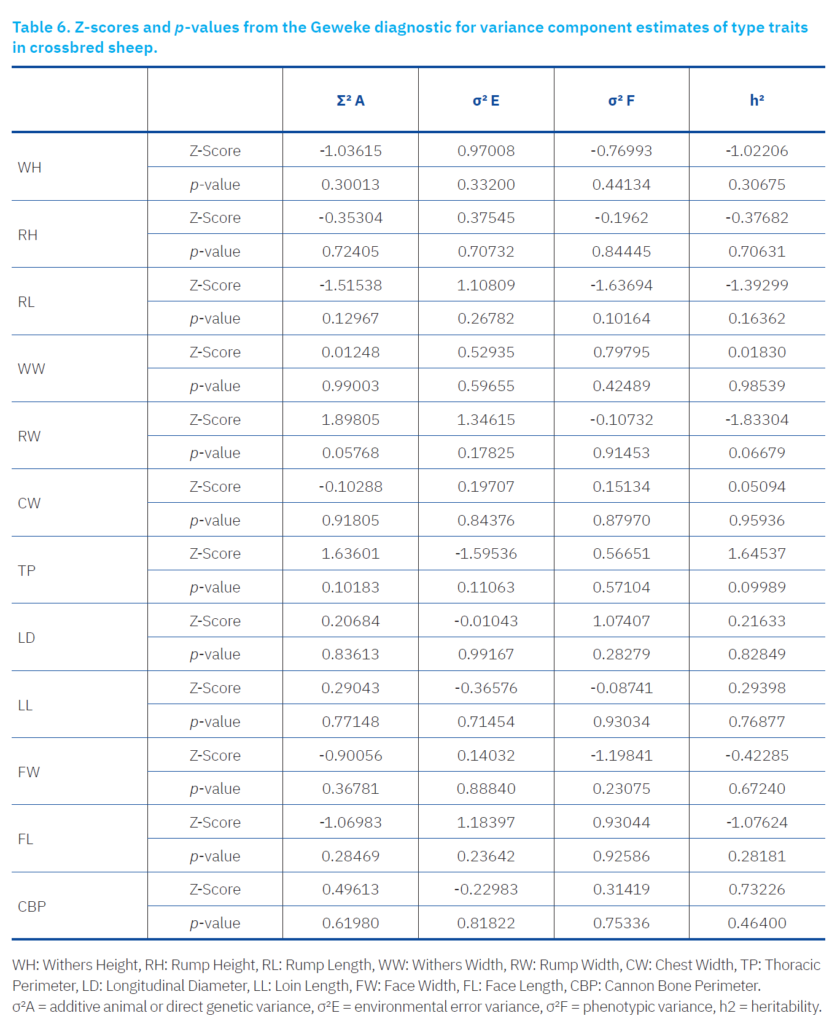
Tables 5 and 6 present the results of the Geweke diagnostic test (Z-score and p-value). All variance components for the evaluated traits showed convergence, except for BW, where the variances σ²M (maternal) and σ²F (residual) had p-values < 0.05.
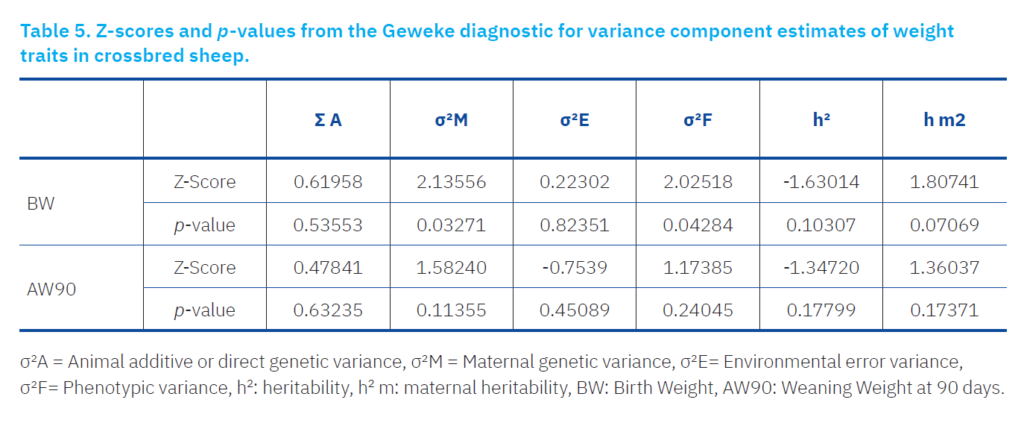
The Z-statistic results from the Geweke diagnostic test for birth weight (BW) and weaning weight (AW90) indicated convergence during the chain construction process (p > 0.05) for all parameters, except for BW, where the variances σ²M and σ²F showed p-values of 0.03 and 0.04, respectively. Similarly, the RW trait presented a p-value of 0.05 for σ²A. It is inferred that the remaining traits did not yield adequate estimates, as shown in the corresponding distribution plots.
Discussion
Regarding the descriptive statistics, Junqueira-Oliveira et al. (2021) reported minimum and maximum values similar to the means obtained for some of the type traits in the present study, namely FW = 12.2, FL = 19, CBP = 8.25, WH = 64.28, TP = 78.02, LL = 62.86, RL = 15.42, and RW = 20.90. This similarity is likely due to the use of the same breeds, including Santa Inês, Colombian Hair Sheep (CHS), and their various crossbreeds. For the BW trait, high values of direct heritability were found (0.67, CI 0.52–0.81), along with a moderate maternal heritability of 0.29 (CI 0.16–0.43). The mean direct heritability for the AW90 trait was also high (0.93, CI 0.82–0.98), whereas maternal heritability was low (0.06, CI 0.0099–0.170). These values do not agree with the results reported by Tesema et al. (2022) in Dorper x indigenous sheep. In that study, low to moderate heritability values for BW were observed, ranging from 0.18 to 0.38, and a high direct heritability for WW120 of 0.55 in the Hampshire breed, with moderate values of 0.29 and 0.26 for the Romney Marsh and Corriedale breeds, respectively. In the same study, maternal heritability values for WW120 ranged from low to moderate (0.08–0.20). Although these results differ from the present study, they are consistent in showing higher direct heritability estimates for traits that would be expected to have a strong maternal influence. These similarities may be explained by the genetic lines used in both studies, which were selected more for paternal (meat) traits than for maternal ability. The variance component and heritability estimates reported by Taborda et al. (2015) in dual-purpose buffaloes in Córdoba, Colombia, showed no difference between the mean and the median, indicating that the posterior marginal distributions were symmetric. In contrast, in the present study, most posterior statistics exhibited asymmetric distributions, and therefore, the mode was used as a reference instead of the mean and median, providing a more reliable estimate. These differences could be attributed to the species evaluated and the level of genetic variability in the productive herds.
On the other hand, when compared to the studies by Habtegiorgis (2022) and Junquira Oliveira (2021), the present results are consistent in that none of the highest posterior density intervals for variance components or heritabilities included zero across all three studies. This indicates that none of the parameter estimates were equal to zero, which is expected when using a 95% confidence interval, as the estimation tends to provide a true value for the parameter.
Conclusions
It was possible to estimate variance components and heritabilities for complex type and weight traits in the evaluated sheep populations, due to the implementation of Bayesian approaches that enhance the reliability of estimates and predictions in genetic evaluations conducted with limited records. Morphological traits require selection criteria that can be easily assessed using a Bayesian framework; therefore, it is important to group animals by production batches to ensure greater data uniformity.
The lack of complete records in production systems, limited awareness of the importance of estimating heritability, and the overall absence of genetic improvement programs for sheep in Colombia have resulted in very limited information on the estimation of genetic and productive parameters. Implementing this type of methodological approach could facilitate the selection of animals with greater genetic and productive potential in Colombian sheep farms.
References
References [… show]
Komponente varijanci za masu i tipske značajke u višepasminske populacije ovaca za meso u istočnoj Antioquiji
Estefanía ZAPATA GÓMEZ1, estefazapata666@gmail.com, Maria Antonieta GARCIA SALDARRIAGA1, mariagasa@hotmail.com; Edgar Antonio PELEZ PELEZ2,3, edgarpelaez@utp.edu.co, orcid.org/0000-0002-6501-1937; Lyda Cenobia CABALLERO MÉNDEZ2,3, lydaccm_27@utp.edu.co, orcid.org/0000-0001-6504-3149; Samuel Eduardo IDÁRRAGA BEDOYA2,3* (dopisni autor), samuelidarraga@utp.edu.co, orcid.org/0000-0001-7290-8729; Santiago ARIAS MONTOYA2,3. santiago.arias12@utp.edu.co, orcid.org/0000-0003-2332-0384; Samir Julián CALVO CARDONA 2,4 , samir.calvo@utp.edu.co, orcid.org/0000-0003-3400-5208.
1Catholic University of the East, Animal Science Program, 054040 Rionegro, Colombia
2Faculty of Health Sciences, Veterinary Medicine and Animal Science Program, Technological University of Pereira, 660003 Pereira, Colombia
3BIOECOS research group
4BIOPEC research group
Cilj je genetičke procjene stvaranje alata za utvrđivanje i odabir genetski boljih životinja koje prenose poželjna svojstva svojem potomstvu, tako generacijama poboljšavajući produktivnost stada. Cilj je ovoga istraživanja bio korištenjem Bayesove analize, procijeniti genetske i fenotipske parametre za masu i tipske značajke kod populacije višerasnih ovaca za meso u istočnoj Anitoquiji. Istraživanje je provedeno na dvije farme: “Ovinos de la Sierra” u mjestu La Ceja del Tambo i “El Charrascal” u mjestu Copacabana u departmanu Antioquia u Kolumbiji. Procjenjivane su životinje različitih pasminskih skupina, usredotočujući se na svojstva produktivnosti, porođajnu masa (BW) i prilagođenu masu pri odbiću 90 dana (AW90), zajedno s dvanaest fenotipskih značajki. Primjenjivao se model životinje s jednim značajkom, koji je obuhvaćao stabilne efekte vrste rase, janjenja, spola i mase. Procjenjivale su se komponente varijanci, genetički parametri i očekivanje vrijednosti rasploda. Prosječna (± standardna devijacija) BW i AW90 bile su 3,655 ± 0,806 kg, odnosno 19,610 ± 5,181 kg. Izravni heritabilitet i majčinski heritabilitet se za BW procijenio na 0,6734 i 0,2963, a za AW90 vrijednosti su bile 0,9323 i 0,0670. Kod fenotispkih svojstava, najveći heritabilitet iskazivao je torakalni opseg, a nakon njega duljina buta (rump length – RL), dok je najniža procjena heritabiliteta bila za širinu u grebenu i butu. Sve procjene bile su konvergentne, osim majčinskih i fenotipskih procjena za BW. Za procjenu genetskih i fenotipskih parametara nužan je točan unos podataka i Bayesova je analiza dala pouzdan varijabilitet putem naknadne distribucije, podržavajući grupiranje životinja po dobi i proizvodnoj skupini prema ujednačenim podatcima.
Ključne riječi: heritabilitet, Bayesova analiza, masa pri odbiću, porođajna masa, genetski potencijal
